Salve,
a little sketch of ancient - Achaemenid - Iranian horseman ''asabāri,'' -
one of them is wearing a kantuš or a Median robe, known by it's Greek name as kandys (candys)
( Ormond Dalton: ''which had the peculiarity that the long narrow sleeves were not used but hung loose on either side like the sleeve of a hussar's jacket'') , over his scales armor.
Some time ago a Hungarian researcher (V. Gerves-Molnar in her study of szür- ancient Hungarian coat) from Canada put forth a claim that kantuš was a ancestor to Hungarian and Polish ''kontusz'', and this hypothesis has not found fertile ground yet amongst the Polish historians of the Polish national costume (yet other picked it up (eg Tullia Linders '' The Kandys in Greece and Persia'' - 1984),
But professor Nick Sekunda embraced it in his book The Persian Army 560-330 BC when talking about the kantuš.
Another Hungarian researcher A. Gaborjan, when studying other Hungarian coats - ''daroc'' and ''guba,'' pointed to their relationship with the ancient East, and probable Persian influences via Turkish borrowings of Persian fashions etc.
Equestrian Polish, Eurasian and the Americas history and horsemanship - from Bronze Age to circa1939AD. Historical equestrian art, my own artwork; reconstructions, and some traditional art media and digital artwork-related topics. All rights reserved unless permitted by 'Dariusz caballeros' aka DarioTW, copyleft or fair use.
Sunday, July 10, 2011
The golden eagle and its feathers versus Plains warriors via Catlin etc
Salve,
eagle feathers are forever the symbols of American Indian warriors, especially the feather bonnets of the Plains warriors. I finished reading an essay, published as bilingual book English-German, by Colin F. Taylor "Wapa'ha. The Plains Feathered Head-dress, Die Plains-Federhaube'' (1994), a short but succinct analysis of the history, type and ceremonialism of the feathered bonnets of the Northern Plains warriors during the per-reservation period. Inspired by the book I decided to cite here some XIX century information on the golden eagle , then called a calumet eagle, the principal source of the feathers for the warriors.
I will start with George Catlin, who is the most prolific of all the observers, for he drew and wrote down his observations...
George Catlin (circa 1832) on eagle feathers (when visiting the Mandan Indians on the Upper Missouri)
[...]''and a part of our labours were vainly spent in the pursuit of a war-eagle. This noble bird is the one which the Indians in these regions, value so highly for their tail feathers, which are used as the most valued plumes for decorating the heads and dresses of the warriors. It is a beautiful bird, and, the Indians tell me, conquers all other varieties of eagles in the country; from which circumstance, the Indians respect the bird, and hold it in the highest esteem, and value its quills. I am unable to say to what variety it belongs; but I am sure it is not to be seen in any of our museums ; nor is it to be found in America (I think), until one gets near to the base of the Rocky Mountains. This bird has often been called the calumet eagle and war-eagle; the last of which appellations I have already accounted for; and the other has arisen from the fact, that the Indians almost invariably ornament their calumets or pipes of peace with its quills.
Some 30 years earlier US Government official explorers Lewis and Clark noted: The Calumet eagle sometimes inhabits this side of the Rocky Mountains. . [.. . ] descends to the plains only in the fall and winter seasons. The natives are at this season on the watch, and so highly is this plumage prized by the Mandans, the Minnetarees [Hidatsa], and the Ricaras [Arikara], that the tail feathers of two of these eagles will be purchased by the exchange of a good horse or gun, and such accoutrements. Amongst the great and little Osages, and those nations inhabiting the countries where the bird is more rarely seen, the price is even double of that above mentioned. With these feathers the natives decorate the stems of their sacred pipes or calumets, from whence the name of the calumet eagle is derived. The Ricaras have domesticated this bird in many instances, for the purpose of obtaining its plumage. The natives on every part of the continent, who can procure the feathers, attach them to their own hair, and the manes and tails of their favorite horses, by way of ornament. They also decorate their war caps' or bonnets with these feathers.
Circa 1831 nature encyclopedia on British America (''Zoology of the northern parts of British America'' by Sir John Richardson, William Swainson, William Kirby) described this bird in relation to the native inhabitants of the Great Plains and provides an anecdote too : ..it is held by the aborigines of America, as it is by almost every other people, to be an emblem of might and courage; and the young Indian warrior glories in his eagle plume as the most honourable ornament with which he can adorn himself. Its feathers are attached to the calumets, or smoking pipes, used by the Indians in the celebration of their solemn festivals, which has obtained for it the name of the Calumet Eagle. Indeed, so highly are these ornaments prized, that a warrior will often exchange a valuable horse for the tail feathers of a single eagle* (from Lewis and Clark). The strength of vision of this bird must almost exceed conception, for it can discover its prey and pounce upon it from a height at which it is itself, with its expanded wings, scarcely visible to the human eye. When looking for its prey, it sails in large circles, with its tail spread out, but with little motion of its wings; and it often soars aloft in a spiral manner, its gyrations becoming gradually less and less perceptible, until it dwindles to a mere speck, and is at length entirely lost to the view. A story is current, on the plains of the Saskatchewan, of a half-breed Indian, who was vaunting his prowess before a band of his countrymen, and wishing to impress them with a belief of his supernatural powers. In the midst of his harangue an Eagle was observed suspended as it were in the air directly over his head, upon which, pointing aloft with his dagger, which glistened brightly in the sun, he called upon the royal bird to come down. To his own amazement, no less than to the consternation of the surrounding Indians, the Eagle seemed to obey the charm, for instantly, shooting down with the velocity of an arrow, it impaled itself on the point of his weapon!
Saturday, July 9, 2011
Thursday, July 7, 2011
Eurasian Saka/Scythian nomad sketches continued скифы
Salve,
some more sketches in various stages of ''undress'' of Saka, Scythian, скифы
Interesting article in Russian by mr Hudiakoff on the symbolic aspects of arrows amongst the ancient and medieval Eurasian nomads Arrow
Article by the Russian ''Scythian'' scholar Chernenko on the Darius the Great invasion of Scythia Pahod Daria
some more sketches in various stages of ''undress'' of Saka, Scythian, скифы
Interesting article in Russian by mr Hudiakoff on the symbolic aspects of arrows amongst the ancient and medieval Eurasian nomads Arrow
Article by the Russian ''Scythian'' scholar Chernenko on the Darius the Great invasion of Scythia Pahod Daria
Labels:
ancient horse tack,
Mypaint,
Saka,
Scythia,
sketches
Wednesday, July 6, 2011
Saka Scythian sketches
Salve,
some sketches of the Saka/Scythians
Arms and armour of the nomads of the Southern Urals in this Russian article researcher Vasilliev armament/armament-and-warfare-of-south-urals-nomads-6-2bc
some sketches of the Saka/Scythians
Arms and armour of the nomads of the Southern Urals in this Russian article researcher Vasilliev armament/armament-and-warfare-of-south-urals-nomads-6-2bc
academic Chernienko - Scythian archers - in Russian - Skifian bowmen
ps
I freely admit I have been giving links to many wikipedia articles, I even participate from time to time in some article creation, but I must say that we have got to take wikipedia articles, when on history, ethnography and anthropology... and horse, with a grain of salt, as the information there may change daily - and here you can see an interesting film on wikipedia, internet and 'two sides of the coin' when comes to wikipedia's neutrality, veracity and quest for authority youtube truth according to wikipedia
Labels:
ancient horse tack,
Mypaint,
Saka,
Scythia,
sketches
Sketching ... and king Stanisław's saddle
Salve,
some time ago, in this post I showed a sketch of a horseman leading a 'rumak' dariocaballeros. vivat-kielbaa
well, inspired by an image of the saddle of one of our Polish-Lithuanian kings I added some detail in that drawing -
The image of this saddle comes from the Polish Army Museum that has on its website a photo of king Stanisław Leszczyński's saddle, circa 1704-05 http://www.muzeumwp.pl/emwpaedia/siodlo-koronacyjne-stanislawa-leszczynskiego-z-1704-roku.php
This saddle is traditionally associated with our king Stanisław
and his first coronation during the Great Northern War. The saddle has a wooden tree (most likely covered with birch-bark for waterproofing and strengthening) covered with leather underneath and on top with carmine silk velvet, embroidered with flower motif covering the entire textile cover of the saddle, its embroidery was done with silver thread/yarn. The saddle was richly ornamented, the pommel, cantle, and saddle tree bars had been covered with silver 'sheet metal' that in turn was gilded with gold. Also a floral ornamental motif was etched into the sheet metal, very precise and carefully executed.
Saddle flaps/skirts were first strengthened with leather dyed red and then covered with the same textile as saddle tree, while the cinch (double) was made out of doubled leather stitched together and adorned with silver threat. The stirrups did not survive the winds of time, unfortunately neither did the shabraque, crupper, breastplate and bridle with the bit...
This is not the winged hussar 'kulbaka' (then lancer deeper saddle) yet has characteristics typical to the Polish saddles made during the second half of XVII century made by various manufacturers in the royal city of Lwów - unfortunately thanks to Stalin, Roosevelt and Churchill not in Poland of today ( for more reading please see Zdzisław Żygulski jr study of Polish saddles of the period written in 1950s).
some time ago, in this post I showed a sketch of a horseman leading a 'rumak' dariocaballeros. vivat-kielbaa
well, inspired by an image of the saddle of one of our Polish-Lithuanian kings I added some detail in that drawing -
The image of this saddle comes from the Polish Army Museum that has on its website a photo of king Stanisław Leszczyński's saddle, circa 1704-05 http://www.muzeumwp.pl/emwpaedia/siodlo-koronacyjne-stanislawa-leszczynskiego-z-1704-roku.php
This saddle is traditionally associated with our king Stanisław
Saddle flaps/skirts were first strengthened with leather dyed red and then covered with the same textile as saddle tree, while the cinch (double) was made out of doubled leather stitched together and adorned with silver threat. The stirrups did not survive the winds of time, unfortunately neither did the shabraque, crupper, breastplate and bridle with the bit...
This is not the winged hussar 'kulbaka' (then lancer deeper saddle) yet has characteristics typical to the Polish saddles made during the second half of XVII century made by various manufacturers in the royal city of Lwów - unfortunately thanks to Stalin, Roosevelt and Churchill not in Poland of today ( for more reading please see Zdzisław Żygulski jr study of Polish saddles of the period written in 1950s).
Monday, July 4, 2011
Cornucopia of Plains Indian research - Arnie Brownstone's site
Salve,
a quick notice to all who like to read on the Plains Indians culture, artifacts and history - Royal Ontario Museum's website has a section devoted to the works of one of its curators - Mr. Arnie Brownstone ROM curators brownstone
Every article, presented in a 'pdf' format, is but a goldmine of information to many a student of Plains Indians.
Also, to all the 'fans' of the famous Lakota Sioux leader and shaman Sitting Bull, there is a rare glimpse into some of his surviving regalia, namely the headdress, shirt and other personal artifacts Sitting Bull once used - podcast rom media podcastsSitting Bull headdress
ps
a quick sketch after a painted war record robe image of a warrior on horseback from the ROM Mr Brownstone's page.
a quick notice to all who like to read on the Plains Indians culture, artifacts and history - Royal Ontario Museum's website has a section devoted to the works of one of its curators - Mr. Arnie Brownstone ROM curators brownstone
Every article, presented in a 'pdf' format, is but a goldmine of information to many a student of Plains Indians.
Also, to all the 'fans' of the famous Lakota Sioux leader and shaman Sitting Bull, there is a rare glimpse into some of his surviving regalia, namely the headdress, shirt and other personal artifacts Sitting Bull once used - podcast rom media podcastsSitting Bull headdress
ps
a quick sketch after a painted war record robe image of a warrior on horseback from the ROM Mr Brownstone's page.
ps"
Two days ago I started a Wikipedia entry dedicated to the Mandan and Hidatsa women society known as White Buffalo Cow Society and the entry already has been nicely developing into a full blown article en.wikipedia.org White_Buffalo_Cow_Society
Also expanded on this Lakota Sioux personage of many sorts ;) - American Horse the younger and earlier created this entry on one of Piast early family members Czcibor
Unfinished Polish 'pancerny' cavalryman
Salve,
a while ago I was drawing and painting illustrations for a book wanax.pl biala-cerkiew-23-25-ix-1651 on the battle of Biała Cerkiew, presently Ukraine, between the armies of Polish-Lithuanian Commonwealth and rebellious Zaporozhian Cossacks and Crimean Khanate Tatars, and this acrylic painting was left unfinished. It purports to show a 'pancerny' - mailed cavalryman of the mid XVII century, I abandoned it for many reasons...
Perhaps it is worth noting here that prior to AD 1648 these national cavalry units were known as ''kozackie chorągwie'' (cossack banners), where soldierly was drawn mostly from middle and lower szlachta (nobility), and that they changed their name from ''kozackie'' to ''pancerny'' (''armoured'') during the Great Cossacks Rebellion of 1648, without changing their organization, armament and protective gear. The bloody events of the Cossack Uprising, the Deluge, Polish-Russian war and then fratricidal war between the ing and Lubomirski caused the significant reduction of the winged hussars and the rise of these cavalrymen known a 'pancerny' within the Polish-Lithuanian Commonwealth armies. In order to improve the offensive weaponry of these banners, especially since the Polish military doctrine always favored charge at gallop during an engagement, the pancerny companies were ordered to equip themselves with a shorter and lighter lance - 'rohatyna' or 'dzida', and with that lance they marched into XVII century and eventually became National cavalry and turned into the famous lance wielding ''uhlans''...
a while ago I was drawing and painting illustrations for a book wanax.pl biala-cerkiew-23-25-ix-1651 on the battle of Biała Cerkiew, presently Ukraine, between the armies of Polish-Lithuanian Commonwealth and rebellious Zaporozhian Cossacks and Crimean Khanate Tatars, and this acrylic painting was left unfinished. It purports to show a 'pancerny' - mailed cavalryman of the mid XVII century, I abandoned it for many reasons...
Perhaps it is worth noting here that prior to AD 1648 these national cavalry units were known as ''kozackie chorągwie'' (cossack banners), where soldierly was drawn mostly from middle and lower szlachta (nobility), and that they changed their name from ''kozackie'' to ''pancerny'' (''armoured'') during the Great Cossacks Rebellion of 1648, without changing their organization, armament and protective gear. The bloody events of the Cossack Uprising, the Deluge, Polish-Russian war and then fratricidal war between the ing and Lubomirski caused the significant reduction of the winged hussars and the rise of these cavalrymen known a 'pancerny' within the Polish-Lithuanian Commonwealth armies. In order to improve the offensive weaponry of these banners, especially since the Polish military doctrine always favored charge at gallop during an engagement, the pancerny companies were ordered to equip themselves with a shorter and lighter lance - 'rohatyna' or 'dzida', and with that lance they marched into XVII century and eventually became National cavalry and turned into the famous lance wielding ''uhlans''...
Saturday, July 2, 2011
Winged Hussar Chorąży quick sketch continued
Salve,
digital media allows us to change and work infinitely on a single drawing or digital painting, constantly changing, adding or subtracting; so I seized this opportunity here, dariocaballeros winged-hussar-chorazy-quick-sketch , by adding some details, changing the horse a bit - his legs, head position etc, as well as 'pan' (Mr) chorąży's animal skin/pelt.
Labels:
husaria,
Mypaint,
Old Polish horse tack,
Polish horse,
sketches
Pen sketch of a winged hussars' trumpeter
Salve,
a quick ink pen sketch of winged hussars' trumpeter (''trębacz'') out of my sketchbook, perhaps I will convert it into a digital painting
Labels:
husaria,
Old Polish horse tack,
sketches
Winged Hussar Chorąży quick sketch
Salve,
a quick sketch of a hussar standard bearer aka Chorąży - MyPaint and Gimp
I should add the white knightly cross in the middle of the standard...
a quick sketch of a hussar standard bearer aka Chorąży - MyPaint and Gimp
I should add the white knightly cross in the middle of the standard...
Labels:
digital painting,
husaria,
Mypaint,
Old Polish horse tack,
Polish horse,
sketches
Friday, July 1, 2011
Glossarium Alte Rerum Polonorum link
Salve,
just wanted to share a link - king Jan III Sobieski's former residence now a Museum Palace in Wilanow in Warsaw, Poland on its website published a glossy of Old Poland military equipment in form of painted illustrations done by a Polish artist Bohdan Wroblewski, painted circa 1983, and line drawings by other artists, each plate with a side description, albeit in Polish only, wilanow-palac.pl glossarium
I have the set painted by Wroblewski in 1983 for the anniversary of the Vienna 1683 (prior to Richard Brzezinski's books for Osprey) and the light cavalry and infantry plates of that set are missing in the Museum's glossarium...
Enjoy perusing :)
Wroblewski's light cavalryman:
Wroblewski's Hussar companion:
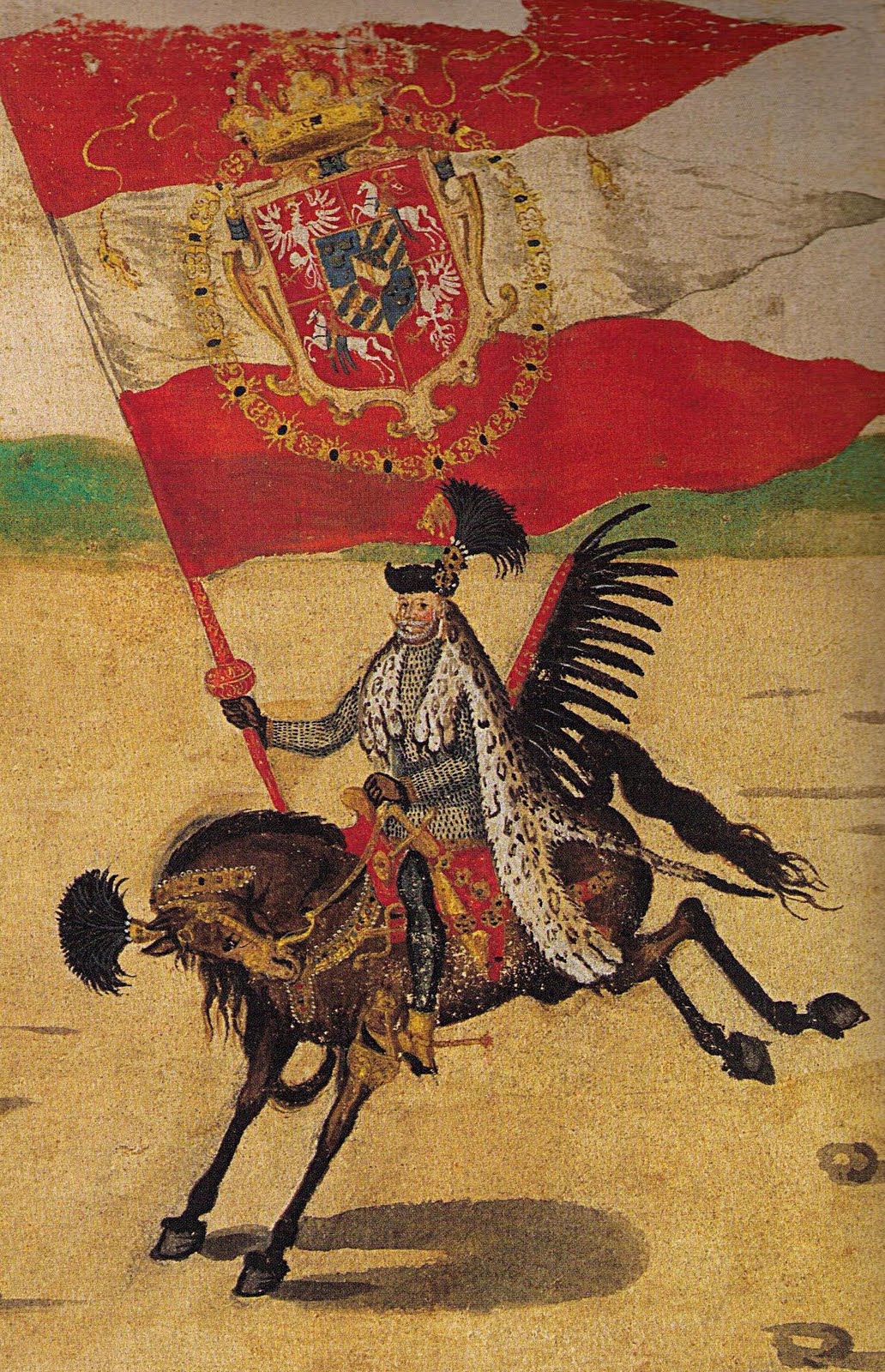
ps. on this day July 1, but A.D. 1569 Polish-Lithuanian Commonwealth was legally started .... here a Great 'Chorąży' of the Polish Crown with the Royal Banner of king Sigismund III Vasa
just wanted to share a link - king Jan III Sobieski's former residence now a Museum Palace in Wilanow in Warsaw, Poland on its website published a glossy of Old Poland military equipment in form of painted illustrations done by a Polish artist Bohdan Wroblewski, painted circa 1983, and line drawings by other artists, each plate with a side description, albeit in Polish only, wilanow-palac.pl glossarium
I have the set painted by Wroblewski in 1983 for the anniversary of the Vienna 1683 (prior to Richard Brzezinski's books for Osprey) and the light cavalry and infantry plates of that set are missing in the Museum's glossarium...
Enjoy perusing :)
Wroblewski's light cavalryman:
Wroblewski's Hussar companion:
ps. on this day July 1, but A.D. 1569 Polish-Lithuanian Commonwealth was legally started .... here a Great 'Chorąży' of the Polish Crown with the Royal Banner of king Sigismund III Vasa
Saka/Scythian saddled horse sketch
Salve,
its is summer here in the Northern Hemisphere, and on this nice day of July 1 I would like to share with you my sketch of a Saka/Scythian horse. For the saddle blanket I used the one from Pazyryk, Altai Mountain in Siberia,
I wrote about Scythian/Saka horse tack here nomad-horse-saddle-and-bit , but you can read further about the Pazyryk culture here hermitage Pazyryk and artifacts from Pazyryk here washington.edu/silkroad/museums/ pazyryk Since the finds at Pazyryk by Rudenko (well, the official discovery, for the kurgans were looted in the past, of any gold and precious materials) brought to us astonishing world of Eurasian nomads almost 2,500 old, some of the most interesting aspects have been the textiles - here article on the Pazyryk_Carpet
Here an UNESCO publication about the preservation of the frozen kurgans of Pazyryk unesco.org Pazyryk
its is summer here in the Northern Hemisphere, and on this nice day of July 1 I would like to share with you my sketch of a Saka/Scythian horse. For the saddle blanket I used the one from Pazyryk, Altai Mountain in Siberia,
I wrote about Scythian/Saka horse tack here nomad-horse-saddle-and-bit , but you can read further about the Pazyryk culture here hermitage Pazyryk and artifacts from Pazyryk here washington.edu/silkroad/museums/ pazyryk Since the finds at Pazyryk by Rudenko (well, the official discovery, for the kurgans were looted in the past, of any gold and precious materials) brought to us astonishing world of Eurasian nomads almost 2,500 old, some of the most interesting aspects have been the textiles - here article on the Pazyryk_Carpet
Here an UNESCO publication about the preservation of the frozen kurgans of Pazyryk unesco.org Pazyryk
Labels:
ancient horse tack,
Saka,
Scythia,
sketches
Thursday, June 30, 2011
Eurasian nomadic warriors in sketches
Salve,
I am going to finish today's outpouring with some progress sketches of my beloved Eurasian nomads, the Scythians...
Labels:
ancient horse,
ancient horse tack,
Saka,
Scythia,
sketches
Traditionally some Persians of the pre-Islamic era
Salve,
long weekend ahead of us here in the US, so I am sharing more of my work with y'all :)
Since I love ancient Persian history then two sketches of Persians of the pre-Islamic era...
Achaemenid period (perhaps :) )
A Sassanian, but I think I am going to add here a second horse and change his hands position, add more adornments on his tunic and some necklaces etc
The horse chest covers I sort of took from the plate in Kaveh Farrokh's book ''Sassanian Elite Cavalry AD 224-642,'' but now I think the chest covers belong the the Acheamenid period, based on the clay rhytons discovered in Susa showing saddled and covered horses circa VI century BC.
long weekend ahead of us here in the US, so I am sharing more of my work with y'all :)
Since I love ancient Persian history then two sketches of Persians of the pre-Islamic era...
Achaemenid period (perhaps :) )
A Sassanian, but I think I am going to add here a second horse and change his hands position, add more adornments on his tunic and some necklaces etc
The horse chest covers I sort of took from the plate in Kaveh Farrokh's book ''Sassanian Elite Cavalry AD 224-642,'' but now I think the chest covers belong the the Acheamenid period, based on the clay rhytons discovered in Susa showing saddled and covered horses circa VI century BC.
Labels:
ancient horse,
ancient horse tack,
ancient Iran,
Sassanian,
sketches
My old interest - Woodland Indian cultures pre-1815
Salve,
this post is not about horses and horsemen, but about my older interests, namely the American Woodland Indians and their culture of the so called Old Northwest, especially the Shawnee people, and about my plan to publish here my old senior projdect titled ''Wolves of the Middle Ground - Shawnee confederacies against the aglo-Americans 1774-1795.'' I wrote this project when I studied history at the SUNY college in upstate New York, part of my Bachelor of Arts requirement.
The project is some 120 pages long, includes maps and drawings and I shall post several chapters here on the warfare and war customs of the Woodland Indians
.
I did some sketches back then to add to the text, and I may rework them yet (did not know the work of Robert Griffing and others back then frontier/griffing , but here I hope you will enjoy some pen and ink old sketches.
this post is not about horses and horsemen, but about my older interests, namely the American Woodland Indians and their culture of the so called Old Northwest, especially the Shawnee people, and about my plan to publish here my old senior projdect titled ''Wolves of the Middle Ground - Shawnee confederacies against the aglo-Americans 1774-1795.'' I wrote this project when I studied history at the SUNY college in upstate New York, part of my Bachelor of Arts requirement.
The project is some 120 pages long, includes maps and drawings and I shall post several chapters here on the warfare and war customs of the Woodland Indians
.
I did some sketches back then to add to the text, and I may rework them yet (did not know the work of Robert Griffing and others back then frontier/griffing , but here I hope you will enjoy some pen and ink old sketches.
Labels:
American Woodland peoples,
sketches
Reworking old sketches of the Great Plains horsemen
Salve,
I am practicing with different 'brushes' and 'pencils' in MyPaint and I have started reworking some old sketches of the Great Plains warriors
I must add that three of these sketches were based on the books by Thomas E. Mails in my collection - biography he was a great man whose work and art I greatly admire - Mistic Warriors of the Plains and ''Dog Soldiers Societies of the Plains'' - Mails Dog Soldiers
I am practicing with different 'brushes' and 'pencils' in MyPaint and I have started reworking some old sketches of the Great Plains warriors
I must add that three of these sketches were based on the books by Thomas E. Mails in my collection - biography he was a great man whose work and art I greatly admire - Mistic Warriors of the Plains and ''Dog Soldiers Societies of the Plains'' - Mails Dog Soldiers
Sketching early Hungarian hussars
Salve,
just sketching early hussar from a German woodcut - this subject I discussed in my post early-hussars-1510-20s
Tuesday, June 28, 2011
Sunday, June 26, 2011
Greasy Grass -Little Big Horn 1876
Salve,
yesterday, June 25, 2011, there was the 135th anniversary of the battle of Little Big Horn that is the best recognized battle between the Native inhabitants of the Americas (Native Americans, American Indians - that includes all Native peoples, even those from down south of the US-Mexican border :) ) - and the European colonizers of their Homeland. In this case, the war was fought by the members of various bands of the Lakota Sioux and their Cheyenne and Arapaho allies against the US Army, the instant battle was fought between the mounted Plains warriors and US 7th Cavalry regiment led by the Civil War hero Armstrong Custer.
There are two heroes that come to my mind when recalling the battle - Crazy Horse and Sitting Bull
here Sitting Bull, in his own drawing done circa 1881, more of his art here collections.si.edu Sitting+Bull+drawing
And in this drawing by Amos Bad Heart Bull these two principal leaders of the Oglala Lakotas and their allies during the war of 1876-77 drawn together
Warriors, who took part in the battle, drew their own recollections of this conflict, in form of ledger books drawings or single sheet drawings, collectively known as ledger art. One of the most famous was the Amos Bad Heart Bull ledger art, the original lost now, bu the photographs of the original drawings were published by Szwedzicki and then in 1967 by the University of Nebraska Press as Pictographic History of the Oglala Sioux by Amos Bad Bull Heart In 1999 Herman Viola published Little Big Horn Remembered, Untold Indian Story of Custer's Last Stand that included numerous Indian warriors drawings showing the battle and Plains Indians combat lore - . Recently, in 2003, there was a book published in Spokane title ''For All to See: The Little Bighorn Battle in Plains Indian Art'' by Sandra L. Brizée-Bowen, having been a compilation of art draw by the Plains Indians on the subject (I am waiting for this book from my interlibrary loan :) ), and last year another book has been published - Rubbing Out Long Hair Pehin Hanska Kasota: The American Indian Story of the Little Big Horn in Art and Word by Rodney G. Thomas, here a review www.custerbattlefield.org Rubbing Out review.
Interesting blog article here, in the context of American Indian, artists and Little Big Horn danielduford.blogspot.com
Obviously one interested in the Plains warrior art must visit this awesome site, already listed on my blog, plainsledgerart.org
yesterday, June 25, 2011, there was the 135th anniversary of the battle of Little Big Horn that is the best recognized battle between the Native inhabitants of the Americas (Native Americans, American Indians - that includes all Native peoples, even those from down south of the US-Mexican border :) ) - and the European colonizers of their Homeland. In this case, the war was fought by the members of various bands of the Lakota Sioux and their Cheyenne and Arapaho allies against the US Army, the instant battle was fought between the mounted Plains warriors and US 7th Cavalry regiment led by the Civil War hero Armstrong Custer.
There are two heroes that come to my mind when recalling the battle - Crazy Horse and Sitting Bull
here Sitting Bull, in his own drawing done circa 1881, more of his art here collections.si.edu Sitting+Bull+drawing
And in this drawing by Amos Bad Heart Bull these two principal leaders of the Oglala Lakotas and their allies during the war of 1876-77 drawn together
Warriors, who took part in the battle, drew their own recollections of this conflict, in form of ledger books drawings or single sheet drawings, collectively known as ledger art. One of the most famous was the Amos Bad Heart Bull ledger art, the original lost now, bu the photographs of the original drawings were published by Szwedzicki and then in 1967 by the University of Nebraska Press as Pictographic History of the Oglala Sioux by Amos Bad Bull Heart In 1999 Herman Viola published Little Big Horn Remembered, Untold Indian Story of Custer's Last Stand that included numerous Indian warriors drawings showing the battle and Plains Indians combat lore - . Recently, in 2003, there was a book published in Spokane title ''For All to See: The Little Bighorn Battle in Plains Indian Art'' by Sandra L. Brizée-Bowen, having been a compilation of art draw by the Plains Indians on the subject (I am waiting for this book from my interlibrary loan :) ), and last year another book has been published - Rubbing Out Long Hair Pehin Hanska Kasota: The American Indian Story of the Little Big Horn in Art and Word by Rodney G. Thomas, here a review www.custerbattlefield.org Rubbing Out review.
I mustn't forget the fine little book, size wise, published by Osprey, where late Richard hook wrote and illustrated the Indian warriors of the Little Big Horn - ospreypublishing Hook Little Big Horn . I must recommend books by Richard M. Hardorff – author of “ Lakota recollections of the Custer fight: new sources of Indian-military history” (U. of Nebraska 1997),''Cheyenne memories of the Custer fight'' (U. of Nebraska Press, 1998), ''Hokahey! A good day to die!: the Indian casualties of the Custer fight'' (U. of Nebraska 1999), ''Indian views of the Custer fight: a source book'' ( U. of Oklahoma 2005)
Cheyenne warrior and artist Wooden Leg story of the battle wooden_leg_little_big_horn
Fine article on the Half Moon Ledger with images booktryst.com rt-of-war-lakota-style here a very interesting side story, the return of tribal artifacts to the tribal museums and burial grounds under wiki/Native_American_Graves_Protection_and_Repatriation_Act , as may be the case with this ledger as it was allegedly taken from the funerary lodge.Interesting blog article here, in the context of American Indian, artists and Little Big Horn danielduford.blogspot.com
Obviously one interested in the Plains warrior art must visit this awesome site, already listed on my blog, plainsledgerart.org
Subscribe to:
Posts (Atom)