Showing posts with label lectures. Show all posts

Thursday, December 30, 2021

Marija Gimbutas lectures from the Oriental Institute

 Salvete Omnes,


yet again more links to videos and archive books: 
The Oriental Institute of the University of Chicago made available three memorial lectures on and about Marija Gimbutas life and her Kurgan hypothesis in relation to the DNA research. 

three lectures in order presented:

Colin Renfrew -  lecture  2018 

Petra Goedegebuure - lecture 2020  - on the Hittite branch of the Indo-Europeans

Ruth Tringham - lecture 2021


and some books on the archive world library  by Gimbutas, including plenty of books you can borrow:

The Balts (1963)

Bronze Age cultures in Central and Eastern Europe (1965)

The Living Godessess .. 

Civilization of the Goddess - 


Valete

Thursday, December 16, 2021

Lecture on the armour - dr Toby Capwell

Salvete Omnes,


a nice treat to all armor aficionados and art historian types et al., - dr Toby (Tobias) Capwell is currently delivering a lecture - via The Wallace Collection page on Ytube - on the  armor made by the famous armorer  Konrad Seusenhofer et consortes at Innsbruck. 


Here an earlier video on the Seusenhofer armor samples at the Wallace Collection.
So if you can then join the lecture - :) 


Nota bene Toby Capwell et al.,  An Experimental Investigation of Late Medieval Combat with the Couched Lance via academia.edu .


Valete

Saturday, May 22, 2021

East Iran in Late Antiquity - oldies but goldies

 Salvete Omnes,


     I have been shifting between subjects in my studies, and recently the ancient and early medieval topic popped out. Namely, I listed to two lectures from 2016 -  hence 'oldies but goldies' - :) 


The Silk Road and the Iranian Political Economy in Late Antiquity - by prof. Richard Payne
and
East Iran in Antiquity: Silk Road and Central Asia outside the Paradigm of Eurasian Trade -  prof. Khodadad 

Rezakhani .


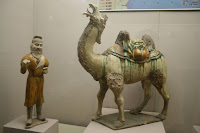
and to go along with the lectures, there are some Sogdian images (including Rustam) or the Sogdians and their famous traders in the Han, Tang Chinese etc art, especially the sculpted figures of the land cruiser of the Eurasian land trade routes - the  camel, the Central Asia context it is the Bactrian camel.
On the Silk Road foundation site   you can read a rather intriguing article by Daniel Potts on the Bactrian Camels and Bactrian-Dromedary Hybrids.


valete

Monday, September 11, 2017

Dr Anthony - Indo-Europeans and horses

Salvete omnes,
finally I got his book - The Secrets of Silk Road -edited by dr Victor Mair with articles by various scholars, including dr David Anthony, whose book on the horse domestication and Indo-Europeans I also have. In May 2012 I provided some links to the video lectures made available by Penn Museum, from their symposium on the Silk Road. The links in my 2012 post are still good and all lectures are still available.

So I did a little sweep of youtube for interesting lectures and in therms of the Bronze Age and horse domestication some of the lectures and discussion involving dr David Anthony (who represents the research done by his wife Dorcas Brown and he).
from 2012 - Roots of Europe - Language, Culture, and Migrations, University of Copenhagen, 12-14 December 2012:
Early Indo-European migrations, economies, and phylogenies
Wheeled vehicles, horses, and Indo-European origins
and the discussion - Tracing the Indo-Europeans: Origin and migration.

also, Dr Anthony's page on academia- great stuff like this article on the warbands and ritualised canine consumption.enjoy

Wednesday, May 10, 2017

1177 BC: The Year Civilization Collapsed - videos

salve,
Let us pivot a bit from Central Europe and our early modern warrior-cavalryman winged hussar  to the eastern Mediterranean, into the world of the great Bronze Age civilizations that around 1200 BC collapsed suddenly under the might of many factors that apparently overcame  them at once, or how it appears to have taken place according to the researchers.

Naturally I have a lot of interest in the Bronze Age civilization and studied it a bit at the university, especially interesting is the moment in history when we see the  arrival of the chariot and horse in the eastern and southern Mediterranean states like Egypt, Canaan, Anatolia and so on around XVII century BC.
The collapse of the Bronze Age civilisation [here a short entry from the Ancient Warfare magazine ] is very intriguing.
I am most interested in the Indo-Europeans: for obvious reasons the people who domesticated the horse, invented two-wheel chariotry and trained horses for war and hunt.


the Hittites, [there are two short  studies on their military - Hittite Warrior, and Hittite Fortifications 1650-700], and the Bible History Daily has this article on the last days of Hattusa.


and proto-Greeks also known as


the Mycenaeans (study of their citadels Mycenaean Citadels c. 1350-1200 BC and another study about Troy's fortifications)
and Sea Peoples,


Egyptians and their New Kingdom are also of great interest to me as well, their horses and chariotry especially - short study on their military here - with great Angus McBride plates, also there is a much better book on the New Kingdom's military.

 Also the Canaanites and Minoans hold my interest, the Mionoans famous for the Minotaur myth and the bull dancers (and their figurative art in general)

  since they all had much developed horse culture  and chariotry.
There is this rather very weak study of the Bronze Age chariotry.
Previously I have read Robert Drews' books on the subject
* The End of The Bronze Age: Changes in Warfare and the Catastrophe ca. 1200 B.C [a review by D. Gill ]
* The Coming Of The Greeks: Indo-European Conquests in the Aegean and The * Near East [a review in French by H. Cassimatis ]
* Early Riders: The Beginnings of Mounted Warfare in Asia and Europe [a review by Denis Sinor ] but would like to read this one.
Also, Nicolas Grguric study
* The Mycenaens c. 16500-1100 BC
and lately there are newer and much more radical and exciting studies by  Raffaele D'Amato & Andrea Salimbeti [messer Andrea fabulous website]  :
  * Bronze Age Greek Warrior 1600-1100 BC.
 *  Sea Peoples of the Bronze Age Mediterranean c.1400 BC-1000BC.


Going back to the tittle work, the 1177BC author Eric H. Cline was recorded giving these lectures on the very subject:
video from 2015 [link]
video from 2016 [link]
Yale lecture  [link]
Getty Villa lecture [link]
Sailing the Wine Dark Seas  - another lecture [link]

 One of my more favorite books as per reconstructions is the work by Peter Connolly on the ancient world of Odysseus and Achilles.

a different lecture on the same subject - Bronze Age collapse

..and do read (Chapman's translation) or read and listen to the Iliad - eg this recording of Buckley's translation  (also can be view in a form of graphic story telling  ) and the Odyssey. 
enjoy

Sunday, May 6, 2012

Tarim Mummies et al. - lectures from Penn Museum


Salve,
yesterday I came across a series of video lectures by some of the most pre-eminent scholars researching the history of the Great Eurasian Steppe and Central Asia ancient civilisations.

Last year the Penn Museum held this very important symposium devoted to the history of the Silk Road (here an article on the history of the Silk Road) in light of new discoveries and analysis of the discovered material, especially as related to the Tocharians (the image above shows Tocharian warriors from the Qizil Cave in Tarim Basin, dated to late V - early VI century AD).

   I am going to list my favourite lectures out of the whole symposium, by names of the scholars who presented them.

Prof. David Anthony - "Horseback Riding and Bronze Age Pastoralism in the Eurasian Steppes"- my favourite lecture.

Prof. Elizabeth Wayland Barber - "The Xinjiang Textiles: More Corridors in the Goldmine"
 She wrote a very interesting book on the textiles of the Tarim Mummies, titled "The mummies of Urumchi."

Prof. James P. Mallory -  Indo-European Dispersals and the Eurasian Steppe - who, amongst other works, wrote a very important book "In Search of the Indo-Europeans: Language, Archaeology and Myth" (1989), and together with Victor Mair  ''The Tarim Mummies''- ground-breaking work on the subject of the ancient Indo-Europeans in Central Asia.

Prof. Victor H. Mair - The Northern Cemetery: Epigone or Progenitor of Small River Cemetery No. 5? , in addition, there is also his very interesting lecture  on the Tarim Mummies, given at Penn Museum as well.

Prof. Colin Renfrew - Before Silk: Unsolved Mysteries of the Silk Road - author of too numerous books and articles to list. In this lecture prof. Renfrew, amongst others, shows an photo of a leather pad saddle with a bridle and a bit with cheekpieces unearthed in the Tarim Basin, and a rather crude drawing showing a reconstruction of this very ancient horse tack. also images of Sintashta chariots

Dr Michael Frachetti - Seeds for the Soul:  East/West Diffusion of Domesticated Grains along the Inner Asian Mountain Corridor. - I happen to have his book "Pastoralist Landscapes and Social Interaction in Bronze Age Eurasia." (2008)


ps
!thanks! my Persian friend Nadeem I am going to share with you a link to this great  magazine - The Silk Road Journal -  devoted to the archaeology, history and culture along the Silk Road - and it is free to download - :)


ps'
A sketch-in-progress of a North Iranian nomadic warrior performing a rite; they worshipped both wind (''breath'') and the sword, because they believed that the wind gave life, the sword because it took it [Lucian, Toxaris - after Prof. Mariusz Mielczarek, ''The Sarmatians'')