Showing posts with label Polish Arabians. Show all posts

Saturday, September 2, 2023

Sorrows of September 1939 & Horse Studs I

 Salvete Omnes,


Today's post is about yet another anniversary of the German September invasion of Poland( in 1939), the quintessential beginning of World War II, but this time from more of a horse side angle.

Before the war Polish governmental and private stud farms bred fine quality riding and draft horses, those herds-  dame and sire lines rebuilt from the destruction of 1914-20 wars. 


So when Germany invaded on September 1 1939 many of the goverment owned  stud farms were put on the evacuation orders, and started marching their precious stallion, mares and their progeny east or south east. Many of the farm workers still remembered the Great War, march of the German troops into the Russian Poland, and then the Bolsheviks war and mayhem and murder that followed the March Revolution of 1917 and German conquest(including robbery and pillaging) of eastern Old Poland and their riches there. 
Note that Polish goverment started the governmental studs with three farms in 1920s, - Racot (in Greater Poland), Kozienice (Mazovia) and Janow Podlaski (Podlasie), they were to provide remounts for the Polish army horse cavalry and to provide better horses for the agricultural farms etc via better quality stallions etc. Later more stallion farms were created - Boguslawice, Sadowa Wisznia, Łąck, Białka etc.
So when the German invasion of 1939 consumed more and more of Polish Republic's territory as the second week of September progressed then the stud farms marched east. They were joined by the privately-owned stud farms and individual horse breeders and owners, it was as if a stream of horse aristocracy flowed east away from the front, but not away from the bombs and machine guns of the German air-force aka Luftwaffe. 


One of such stud farms ordered by the officialdom to march east was the Janow Podlaski governmental stud farm (PSK). During these times Stanislaw Pohoski was the managing director of this farm  with 2 deputy directors and a veterinarian, master of the stables and deputy master of  the stables, accountant , along with some 40 grooms and horse handlers employed.   Next to this breeding farm, there was also a stallion training farm (PSO) training about a 125 stallions with about 40 grooms  under  master of the stables Jan Stasiak , nominally presided over by Walenty Jachmimowicz but the outfit in fact run by Tadeusz Marchowiecki.
The stud, in its most fantastic 'blooming' period since prior to 1914, was bombed and its rooftops  raked with machine gun fire on September 4, 1939, but no horses were injured. 

On September 8 all personnel was paid wages  3 months in advance, stallions (top ones, the PSO ones etc) and horses designed to pull wagons were being shod and prepared for marching out.
on September 10 he had the whole  stallion farm horse population moved  out -  some stallions in hand led by mounted grooms, others tied to the wagons with fodder and foodstuffs etc. 

On September 11 at 1700 hours director Pohoski commenced his stud's trek - about 260 horses and foals and 16 horse wagons left the Janow Podlaski farm - since they had no enough grooms or other personnel to led the horses out, with help from Witold Pruski and town's mayor they recruited men from Janow  town and thus this huge herd moved out marching south-east towards Volhynia land, without any particular final destination . 

They watered the horses 2-3 times a day, bought hay along the way, and only stallions and draft horses pulling wagons got oats twice daily - while marching about 20-30km nightly - while resting at various stables, shacks and barns along the way.

Kuhailan Said from Baza Koni


  Kuhailan Said got a little fever at first, but two veterinary doctors - Gruszka and Wilczynski - cured the stallion's malady and he resumed being used under saddle. 


The roads were full of refugees going east, demoralized soldiers and regular army units , so from the start there were losses to panics and alarms, or common human stupidity. During the first night hey last about 80 horses that panicked run away. Among the lost was the daughter of Kuhailan Haifi Oda with a foal, 

Oda from Baza Koni 


while stallion Taki Pan returned on his own.

Taki Pan from Baza Koni 


Once they crossed the bridge over the Bug River, the country was less panicked and there was less traffic, but the populations was less  friendly. During this march they learned that during the German bombardment of the marching refugee columns near Maciejowice, the horse column for Racot was also bombed and their director Wladyslaw Sieminski was killed, while during the bombing of Nowe Miasto on Vistula River the director of PSO Boguslawice Tadeusz Nosarzewski was killed. The director of Bialka Horse Farm Kalikst Sosnowski  committed suicide.  Losses were mounting within the Polish civilian horse community..
The Janow Stud Farm marched on, towards Kamien Koszyrski, where they hoped to find Polish officials and administrative help in their trek. 
During the night march from the village of Postupula towards Kletyck  the horse column, augmented by some refugee horse wagons, including people from Poznan  Land, the horses  were marched over a rather narrow and wet road with some barbed wire fences along the edges, so in the darkness many horses got entangled in those barbed wires. By morning they  were able to untangle horses and asses the losse. Three horses had to be put down, while overall losses were 8 horses, including the sister of Kaszmir, named Laka (Farys  & Hebda) was put down due to her injuries. 
Famous Ofir got entangled and fell, but they managed to save him without injury. 
Ofir from Baza Koni 


When they got to the village of Kletyck  they learned that the Rad Army crossed into eastern Poland and their nightmare doubled suddenly.. Note that the leadership of Polish Republic, sitting in Zaleszczyki and Kuty,  did not declare this invasion of the Soviet armies as the actual transgression and hostile invasion and thus left Polish commanders and officials bewildered and often confused...  

to be continued 

Based on Andrzej Krzysztalowicz' recollections about 1939 from this Polish language site.

Valete

Tuesday, December 13, 2022

Juliusz Holzmuller and his watercolors

 Salvete Omnes,

today a short entry with yet another Polish horse painter. 


Juliusz Holzmuller was a Polish watercolor, gouache, and ink painter active during the first part of the XX century.
Maestro Juliusz was born in Bolechow (now in Ukraine) in 1876, the year George Custer and his command died at Little Big Horn in Montana.


He went to school in Lwow (about 90 km from his hometown), known then as the C.K. State Industrial School, where he studied decorative painting with  professors and artists like Roman  Bratkowski, Stanisław Józef  Rejchan , and Tadeusz  Rybkowski. Then in 1898 he became a student at the Krakow's Fine Art Academy with Florian Cynk,  Józef  Mehoffer  i Teodor  Axentowicz etc where he studied until finishing his academic studies in 1906. In 1903 through 1904 he took one year leave or 'sabbatical'  from his Krakow studies and went on to study at the Munich Art Academy.
Upon terminating his studies he settled in Stanislawow (now Ivano-Frankivsk in Ukraine), where he worked a teacher of drawing at the town's middle and high schools etc. He showed his work at Krakow Society of Friends of Fine Arts and other venues throughout  partitioned Poland. He eventually moved to Lwow, here he became a drawing teacher at the Nikolaus Copernicus' 1st State (c.k.) High School. He painted large size watercolors, and one of them, showing Japanese Imperial cavalry, was purchased for the officer club in Tokyo, where it may still be surviving.
Also he painted portraits  of the famous Taurow Polish Arabian stud farm* horses at the request of Longin Łobos, nephew of the founder, Dionizy Trzeciak. Pan Juliusz passed away in 1932 in Lwow, 7 years before his world become no more (Soviet, Germand and Ukrainain UPA eradication of the Poles in this beautiful land of Red Ruthenia aka eastern LittlePoland.


He painted horses, horse people, Huculs and local topics like markets or hunting, also landscapes and many other topics.


You can explore - via your browser's search engine - his watercolors and other works in various galleries and auction houses around the Internet.


Hucul wedding party

Hucul wedding party with musicians


Valete

*Taurow stud farm and estate was located in the vicinity of Taurow village in present day Ukraine, 28 km north-west of Brzezany,  Tarnopol oblast,

Thursday, October 13, 2022

Kossak - 1877 Lwow (Lemberg) Expo horses

Salvete Omnes,
a short entry -
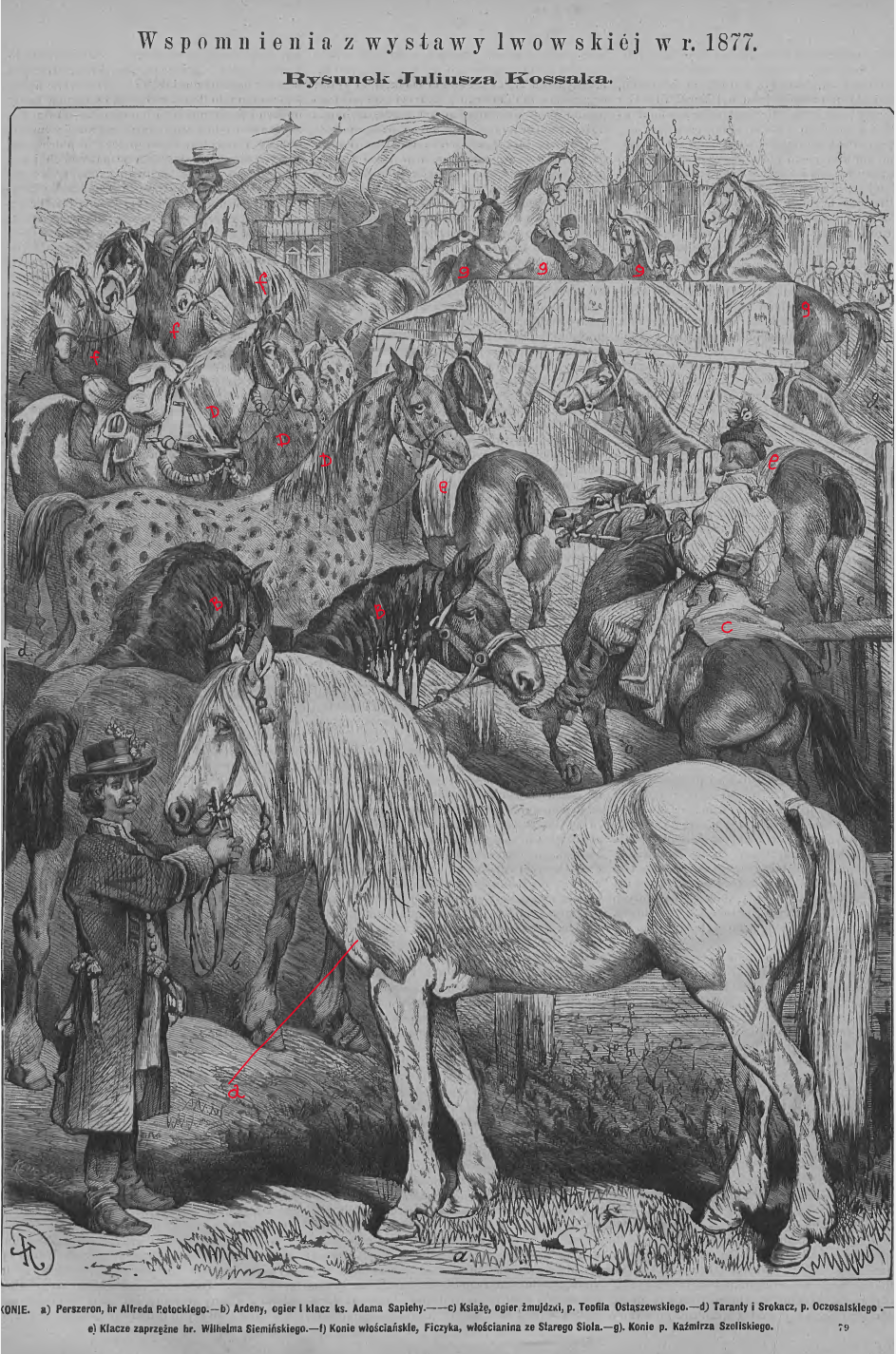
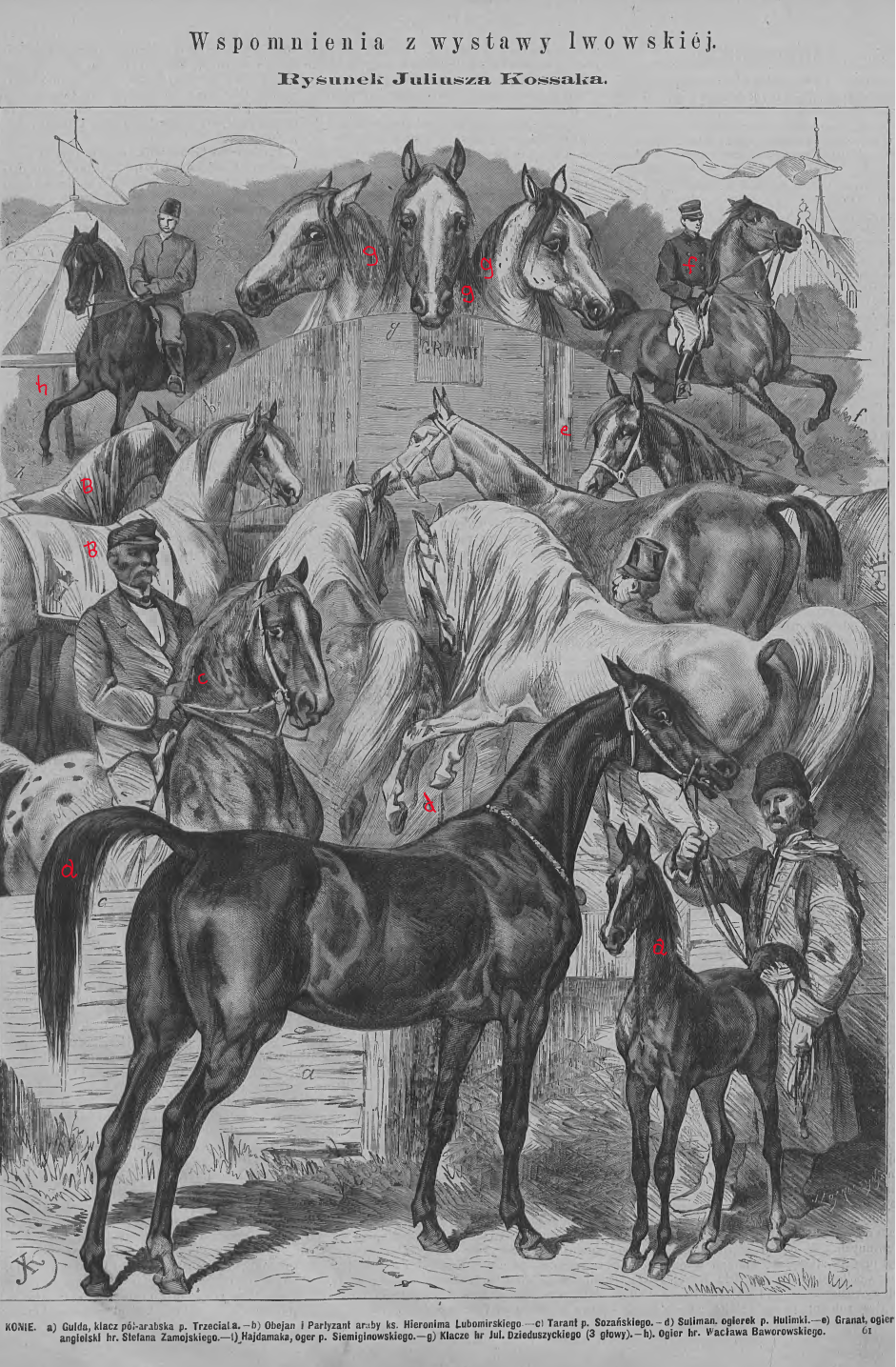
I would like to bring to your attention two published prints from Tygodnik Ilustrowany (1878 - The Illustrated Weekly) that were intended to depict notable horse presented at the Lwow (then Lemberg, Austrian Partition or the invented by the Austrians  Galicia & Lodomeria) Provincial Expo in 1877AD.
The drawings for these two plates were done from life by one of my favorite Polish artists of all times - Juliusz Kossak.

The plates were published the following year and did no have any more text or description but the small print at the bottom of each plate.

First Plate - 


the horses depicted above with the owner's name:

a- Percheron horse- by count Alfred Potocki

b-Ardennais, stallion & mare -  by prince Adam Sapieha

c- Ksiaze, konik zmudzinek aka Samogitian stallion, by Teofil Ostaszewski

d-Tarant (spotted horse aka Appaloosa ) and srokacz(Paint) - by Oczosalski

e- carriage mares - by count Willhelm Sieminski

f- peasant horses - by Forczyk, a farmer from Stare Siolo village

g- horses- by Kazimierz Szeliski


Second Plate -

the horses depicted:

a- Gulda, part-Arabian mare - by Trzeciak

b-Obeyan & Partyzant - Arabians - by prince Heronim Lubomirski

c-Tarant - by Sozanski

d-Suliman, young stallion or colt by Hulimek?

e-Granat - English Thoroughbred stallion - by count Stefan Zamoyski

f-Hajdamak, stallion- by Siemiginiowski

g- 3 mares - by count Juliusz Dzieduszycki

h- a stallion - by count Waclaw Baworowski


Valete

Thursday, January 20, 2022

Zbig Kotowski amazing horses

Salvete Omnes,

from time to time I ask working artists for permission to put some of their art on my blog - I tend to favor creators who work in equestrian-related theme as their art and better yet  the main object of their creativity.

The artist of today's post has been captivating , via his brushes and pastels etc, the very amazing beauty and majesty of the domestic horse, especially the beauty of the most noble of the equine breeds ever created by the humans: the purebred Arabian horse.

So here comes the art of a Polish master painter Zbigniew Kotowski - his Arabians, historic one that he has recreated from some ancient black and white photos and prints, or modern and contemporary dames and stallions seen in real life or via the art of photography.
The images created by Zbig Kotowski are some of the most beautiful horse painting I have seen in a long time. Not to mention the mastery of the difficult medium of pastel painting or the mastery of the horse anatomy and conformation.
So recently I have obtained a special permission from maestro Zbigniew 'Zbig' Kotowski to show some of his fabulous pastels here, on my blog.
Obviously, you can or you must view more images and even get in touch with the maestro himself via Zbig's Facebook page or maestro's own webpage.

So here they go, the glory of our Polish Arabian Horse - 

Skowronek


Ofir


Witez


Witraz


Bandos


and my favorite mare of the the 20th century - the famous dame Bandola


Valete

Wednesday, July 29, 2020

Bogdan Zietarski - Pod namiotami Beduinow VIII

Salvete Omnes,
i ostatnia cześć felietonu imć Ziętarskiego -  Pod namiotami Beduinów - z Jeździec i Hodowca - 


Valete 


Bogdan Zietarski - Pod namiotami Beduinow VII

Salvete Omnes,
kontynuacja rozważań imć Ziętarskiego o koniach Beduinów - o asil Kuhailan, Saklawi, U'Bajan, Hamdani, Hadban, Munighi i Dzilfan - z felietonu w Jeździec i Hodowca o podroży do Beduińskich stad pustyni. 


Valete

Bogdan Zietarski - Pod namiotami Beduinow VI

Salvete Omnes,
i kolejna odsłona felietonu 'Pod namiotami Beduinów' Bogdana Ziętarskiego,  - i znów Kuhailany, ale tym razem już powrót do Europy z nabytym jakże cennym materiałem hodowlanym.
z czasopisma Jeździec i Hodowca, Ad 1931:


Valete

Sunday, July 19, 2020

Bogdan Zietarski - Pod namiotami Beduinow V

Salvete Omnes,
[in Polish]
w dzisiejszym fragmencie felietonu imć Bogdana Ziętarskiego z czasopisma Jeździec i Hodowca występuje przyszła 'gwiazda' polskiej hodowli koni czystej krwi arabskiej ogier Kuhailan Haifi , choć glownie dowiadujemy się o gościnności Beduinów Ruala, roli wielbłądziego mleka i czarnej kawy, przy okazji o istnieniu instytucji niewolnictwa wśród Beduinów w latach 1930tych, i przede wszystkim możemy się zaznajomić z rodowodem słynnego gniadosza z gwiazdką na czole. 


opis pierwszego spojrzenia na ogiera i negocjacji gwoli  Kuhailana Haifi oraz innych koni od szejka Kalif al Aouad, z plemienia Ruala (lub Rouallah) w następnym odcinku.
valete

Thursday, July 16, 2020

Bogdan Zietarski - Pod namiotami Beduinow IV

Slavete Omnes,
[in Polish] - Kanikuła w toku:
cześć IV felietonu Bogdana Ziętarskiego z podroży wraz Carl'em Raswam'em po konie do Beduinów Syrii i Iraqu (Jeździec i Hodowca, 1931).
Milej lektury:


Valete

Tuesday, July 14, 2020

Bogdan Zietarski - Pod namiotami Beduinow III

Slavete Omnes,
[in Polish]
- cześć III felietonu Bogdana Ziętarskiego z podroży wraz Carl'em Raswam'em po konie do Beduinów  Syrii i Iraqu.
...


Valete!

Monday, July 13, 2020

Bogdan Zietarski - Pod namiotami Beduinow II

Salvete Omnes,
[in Polish]
cześć druga felietonu Bogdana Ziętarskiego (z Jeździec i Hodowca) o wyprawie do Beduinów -
..


..
cdn
Valete