Showing posts with label Horace Hayes. Show all posts

Wednesday, May 15, 2024

MIlitary seat - Hayes, Dodge, Boniface

Salve,
a little jump to the last equestrian century i.e., the1800s but first - 
  # my prayers are with wounded and hospitalized Prime Minister of Slovakia Robert Fico, who today was wounded in the attempted assassination in Slovakia. The shooter is an elderly poet and member of the  Literary Club in Slovakia.* 


                                                                                  ***
on military seat -
 
 Cpt. H. Hayes  et al., - from his book 'Riding and Hunting'

''The position without stirrups is described as follows in Cavalry Drill: "Each man should have his body balanced in the middle of the horse's back, head erect and square to the front, shoulders well thrown back, chest advanced, small of the back slightly bent forward The thigh should be stretched down from the hip, the flat of the thigh close to the horse's side, the knees a little bent, and the legs hanging down from the knee and near the horse's sides. The heels should be well stretched down, and the toes raised from the insteps, and as near the horse's sides as the heels. A plummet line from the front point of the shoulder should fall one inch behind the heel.
"While following these instructions, the man must, however, sit easily on his horse, without having his muscles unnaturally braced, and without stiffness. In order to get his toes and heels into a proper position, he should be taught to turn the flat part of the thigh from the hip towards the horse's side, and not merely to twist the foot inwards from the ankle or knee.
"This is the position halted, or at the walk; at the trot the body must be inclined a little backward, the whole figure pliant, and accompanying the movements of the horse. The elbows and lower limbs must be kept steady.
"The position with stirrups is nearly the same as without stirrups, the knee being a little more bent.
"A plummet line falling from the point of the knee should drop directly on the ball of the foot. The foot should be kept in its place by the play of the ankle and instep, the stirrup being under the ball of the foot. The lower edge of the bar is, as a general rule, to be from two and a half to three and a half fingers' breadths above the upper edge of the heel of the boot, when the man is sitting in the proper position.The Instructor must remember, however, that, though he should follow the general rules in fitting the stirrups, a great deal depends on whether the rider has a thin flat thigh or the reverse; a man with a thick thigh requires slightly shorter stirrups, otherwise, when the horse is in motion and the muscles are brought into play, he will not have a proper hold of the stirrup."

Theodore Arayult Dodge in  a few words on the riding seat:
''[...] then, it is quite impossible to say, as a whole, what seat is intrinsically the best, or what nation furnishes the best of riders. It appears to me that there is such a thing as a natural seat. Such a seat is clearly shown on the frieze of the Parthenon, and in a less artistic way may be seen among any horsemen riding without stirrups. Although Xenophon has been misunderstood in this particular, I feel convinced that his description calls for what I understand to be the natural seat. And the best military riders make the nearest approach to this position. By military seat I by no means intend to convey the idea of a straight leg, forked radish style. That is not the military seat proper. It is only in spite of such a seat, or in spite of the short stirrup of the East, and because they are always in the saddle, that the Mexican gaucho and the Arab of the desert both ride as magnificently as they do. The best military rider should and does, carry the leg as it naturally falls when sitting on his breech, not his crotch, on the bare back of a horse. The steeple-chaser, or crosscountry rider, for perfectly satisfactory reasons, has a much shorter stirrup. But on the road, he should, and generally does, come back more nearly to the natural length. The main advantage in the very long stirrup which obtains among so many peoples lies in the possibility of sitting close on a trot with greater ease, and of using the lasso or whip, or in having a free hand for their sundry sports or duties. And a high pommel and cantle are advantageous in helping the rider preserve his seat when he might be dragged — not thrown — from it in some of his peculiar experiences. But the perfectly straight leg always bears a suggestion of the parting advice of the groom to a Sunday rider just leaving the stable: "Look straight between his hears, sir, and keep your balance, and you can't come off." On the other hand, the advantages of an extremely short stirrup, such as prevails in the Orient, are very difficult to be understood at all.
Now the acquisition of this natural seat should be the first aim of every one who desires to become an expert rider, either in the manege or in riding to hounds.[...] But no man's seat can be too firm and strong. Bareback Riding.
Nor can light hands exist without a firm seat. There have been men of such abnormal muscular development that they distressed a horse by their grip. But this is unnecessary. Seat is not only a question of grip; balance comes in for a share of the credit.
You want to get down as close as possible to your horse. Some horses have what are called good saddle-backs (without having sway-backs, — a sign of weakness), which enable you to sit very close to them. Many very good horses have a high, straight back, which, however strong, makes your seat on them far less agreeable. But the best way for you, Tom, to acquire this natural seat, is to ride bareback a good deal, and afterwards to ride in a saddle without stirrups.
In the South all boys and girls learn to ride bareback; often without bridle, guiding their horses with a stick. Southern horses are treated with common sense and are usually very tractable. In all country districts, children who learn at all are apt to learn bareback. This develops the natural, or best, seat. And after riding in a saddle, it is well, as often as practicable, to revert for practice to the bareback, or the stirrupless seat in the saddle.
It of course attracts attention for a man thus to ride along the road; and no man, I ween aspires to be " the cynosure of neighboring eyes." 
But it is easy at any time to get off on lanes and wood-roads, throw your leathers across the pommel, and practice this thing. And nothing will get you closer to your horse, or make you feel more at home upon him, than this very habit.
There is no better way to determine the proper length of your stirrups than to ride without them for a week, and then to put them in so that your feet, heels well down, will conveniently hold them.
(from Patroclus and Penelope, a chat in the saddle)


Back to the military - Boniface in not a few words -
Cavalry horse and his pack :
The "tongs across the wall" seat is used largely by inexperienced riders and rarely by good ones. Its chief characteristic consists in keeping the knees stiff and straight and sticking the feet out to the front. Whenever the trot is taken up, it is necessary to materially alter the position of the legs, and in fact the entire position of the seat changes, owing to the difficulty of clinching with the thighs while keeping the legs stuck out stiffly. Riders who use this seat generally manage to ride horses possessing easy gaits, especially at the tiot. When using this seat, there is a tendency to lean back, thus boring the cantle of the saddle into the horse's back—in fact, it is next to impossible to ride at an increased gait and lean any other way in this seat. Among even good riders this seat is occasionally seen on- parade and at reviews, it being especially a "pose" seat. Some men in a troop learn this seat and they hold to it persistently, despite constant
efforts to teach them its inadaptability for cavalry riding. The seat, like the "fork" seat, though to a much greater extent, is not only uncomfortable to the rider when in line, but is very exasperating to the adjacent men, who, before the drill is over, generally manage to kick the man's legs and feet repeatedly, to break him of it. It may be taken for individual riding out of ranks, but the rider who attempts to use it in a cavalry troop will suffer many hard kicks and jolts and be the recipient of much hard swearing from his comrades.
The "hunting" seat, known also as the "long" or "chair" seat, is the typical cross-country seat when riding after hounds or in park-riding, and, in its place, is found to be very excellent, especially where jumping of four-barred country fences forms such a particular part of the riding. In this seat it is customary for the rider to hold the reins, together, with both hands. This is impossible in the "military" seat, where the trooper needs one hand for his weapons at all times. The stirrup used with the saddle usually employed by these riders is of steel and open. The hooded stirrup of the American cavalryman would be unwieldy and unnecessarily bulky on this saddle, while it has always been one of the parts of our military saddle especially held to; and for keeping the trooper's feet dry and shielded from the cold and wet of his long rides, as^well as for the safety to the rider, the hood is an important part of the military saddle, and affects the seat in a way, by defining the length of foot that can enter the stirrup, while with the open steel stirrup of the hunting saddle the foot usually goes in clear to the heel of the riding-boot. In the "hunting" seat the rider rests well down on his buttocks, the thigh is extended forward, generally at an angle somewhat more obtuse than that of the horse's shoulder; the leg from the knee to the ankle is loose and straight down, and if inclining in either direction, generally somewhat forward; the stirrup is very short, and the heel of the rider's fool; is considerable lower than his toe; the calf of the leg touches the sides of the horse, and it will be observed that this is the only one of the seats described in which this is the case; the calf does not press against the horse, but, owing to the entire seat and the short stirrup, it touches slightly, especially when jumping or galloping. In this respect the "hunting" seat resembles the Indian seat somewhat, except that in the Indian seat the leg from the knee down is drawn back and the heels touch the horse's flanks when the rider is, as the Indian generally is, riding without a saddle.

The "military" seat in the American Cavalry is the result of years and years of hard riding on the vast Western plains, and is well calculated to have the best effect on both horse and rider of any seat known for long rides, singly or in column, and for all drill purposes when security of seat, closeness of legs and feet, use of one hand, and comfort to the rider and his adjacent trooper comrades are considered. In this seat the rider sits evenly on his buttocks, inclining neither forward nor backward; the elbows are reasonably close to the body and somewhat drawn back; the reins are carried together
in the left hand, thus leaving the right hand free; the thigh is nearly parallel to the slope of the horse's shoulder; the leg from the knee down to the ankle is loose and straight down, and the heel is slightly lower than the toe, which is inserted in the hooded stirrup so that the ball of the foot rests on the stirrup tread; the rider's back is straight, head erect, and chin slightly drawn in without constraint. It is especially taught to keep the toes parallel to the sides of the horse, and thus the heels and spurs do not touch the animal's flanks except when the rider uses them intentionally. This latter position of the feet, it may be remarked, is difficult to acquire, and many men neglect it and apparently fail to appreciate its two excellent purposes—of keeping the spurs and heels out of the horse's flanks and keeping the flat of the thigh against the horse. The stirrup used with this seat is such that the rider, by standing up in them, can pass two or three fingers between his crotch and the saddle. The American cavalryman is disposed to use the long stirrup, and even in our correct regulation seat the length of the stirrup is much longer than that of any seat used in European cavalry, but experience has taught us that this length of stirrup is the most satisfactory one to use, especially on long marches.
The seats used in the various European cavalry services are more like that of the "hunting" seat, before described, than any other, and it is a general practice to use the short stirrup; the saddle used, being low and flat, with a covered seat of leather, enables the rider to assume this seat with much more comfort than can be done in the "McClellan" saddle; in fact, the correct "hunting" seat is almost an impossibility in the "McClellan" saddle, owing to the high cantle. The short stirrup is not used by any of those classes of riders who have bcome famous the world over for their hard rough-riding, excepting the Cossacks of Russia, who still adhere to it. However, as the Cossack rides in a saddle considerably above the back of his horse, this short stirrup is probably necessary. On the other hand, the use of a stirrup too long will, of necessity, subject the rider to much pounding, and though many men use it, they acknowledge that the pounding is harder; but, on the other hand, they claim that the entire seat is more secure, especially in the "fork" seat.
The best seat will be that in which balance, friction, and stirrups are combined in the right degree. To ride by balance alone would be very exhausting. To illustrate this, watch a recruit taking his first bare-backed lessons, before he has learned to use friction. Clinching the horse with the thighs, or "friction," as it is called, comes naturally and almost unconsciously as the result of training. At first requiring considerable effort, the rider gradually learns how to clinch without tiring himself, and eventually his clinching becomes very powerful without' tiring him. The writer remembers a Western rider with one wooden leg who declared that he had such power of clinching with his thighs on the horse's sides that he felt satisfied that*he could still ride should he lose the other leg. The leg that was gone had been amputated years before, from the knee down, and from what was seen of this man's riding, it is very likely that this rider could have done what he said. The early saddles possessed no stirrups, and the riders of those days must have been very perfect riders, using only balance and friction, judging from many authenticated accounts in military history; but gradually experience taught riders the world over that stirrups saved them much unnecessary fatigue by bearing the weight of the legs and feet, and also made the seat more secure in every way. The use of stirrups on all saddles, military or civilian, has now become universal, and their adjustment is a matter of great importance in riding and training, both as affects man and horse.
The proper length of stirrup will not be the same for any two men, as men differ in length of leg and in size too much. A man having a long, thin, flat leg will require a longer stirrup than a man having a short, fat, round leg, and no arbitrary length should be required for all troopers. A good method for securing the proper length is to hold the bottom of the stirrup-tread under the left arm with the right hand, snug in to the arm-pit, and then place the left hand, fingers extended, on the "D" ring (stirrup-loop) of the saddle, and then straightening out the left arm until the length of the stirrup thus measured corresponds with the length of the left arm placed as described. When the trooper is in the saddle, he should be able to place two fingers between his crotch and the saddle as he stands in his stirrups. All the men in the troop should be required to ride with a reasonably uniform length of stirrup; otherwise some of them will affectMa length of stirrup both unsightly to look at and absurd as regards the particular troopers. Both the Romans and the Greeks were ignorant of the use of stirrups, and either vaulted on their horses or used the back of a slave as a stepping-stone, or sometimes had recourse to a short ladder. The earliest time when it can be proved that the stirrup was in use was in the time of the Norman invasion of England. The incidents of this event were depicted upon the Bayeaux tapestry by the wife of William the Conqueror, and on this the stirrup was shown, according to the authority of Berenger, as a part of the trappings of the horse.
The position of the rider in the saddle is most important, because of its quick effect on the horse. If the rider leans back, his weight bores down upon the cantle, which in turn bores down upon the horse's back under the cantle, and the result; especially on the march, is a very sorebacked animal at least; the contrary fault of leaning forward causes the additional weight to bore into the horse's back under the pommel, in the region of the withers where several large, strong muscles and tendons are located, a free action of which is absolutely necessary at all gaits. The result of this leaning forward is not only a sore-backed horse, but probably it will also stiffen the animal up for weeks, especially if this fault exists during long marches. Leaning forward also makes the seat more insecure, and any stumbling or stopping of the horse at once throws the rider forward. The rider in the Cavalry should realize that the pommel and cantle on the "McClellan" military saddle are put there for the purpose of holding the pack up off the horse's back, and not as a means of support to the rider. The rider should sit in the middle of the saddle, erect, and support himself wholly by balance, friction, and stirrups. The pommel and cantle and reins should be used for what they are intended, and the seat of the rider should not depend upon them. The reins especially should be used only to guide the horse, and never as a support for the man on the horse's back. The continual sawing on the horse's mouth is a sure way of ruining the horse and tiring the rider, who not infrequently relieves his feelings by a sharp, savage tug at the reins.
The manner of riding known as "posting," whereby the rider rises at the trot, is much used in civil life and even in some European cavalry services; but, although permitted by our Cavalry Drill Regulations as a change from our close seat when in the field, is never so used, and has never found favor with American cavalry officers or troopers. Those who have thoroughly learned it speak highly of it as a seat both easy and simple, and not by any means the hard work to use that it is generally believed. Whether or not this "posting" is easy or hard on the horse has never been satisfactorily demonstrated, because no one ever has maintained it for long-distance riding. While perhaps good in park riding for pleasure, for short distances, in English saddles, this seat does not lend itself to long, hard rides, yet much praise is bestowed upon it by some European cavalry services.
The close seat is the typical American cavalry seat. There are many men, however, who never wholly acquire this close seat, but the mistake must not be made of thinking that the man who leaves the saddle more or less at the trot is a poor rider; on the contrary, many men leave the saddle somewhat at every trotting stride of the horse, and yet are excellent hard riders of record. The slight leaving of the saddle referred to, however, is very different from the awkward "bouncing" of the inexperienced rider, which is readily recognized wherever seen. Until the rider is himself proficient, he can do little but irritate the horse, and for this reason the recruit should be given a different horse every day, to enable the horse he rode the day before to recover from the awkward handling he has received. The recruit will learn more quickly to ride if given a different horse each day, although it will be hard upon him; but to ride well one must ride many different horses, hard ones and easy ones, and not confine himself to one particular animal. The gait of every horse is different from the gait of every other horse, and thus the rider learns the various forms of movement, and understands what is meant by a "hard trotter" and an "easy trotter"; until the rider has acquired skill and confidence and has had much experience in actual riding and handling of horses, he is not capable of training a horse, and should not be allowed to do so except under experienced troopers.''
the end of citation


Valete
ps
*The Fico's attempted assassination reminds me of the attempted assassination, stabbed with a knife, of then-presidential candidate in Brazil Jairo Bolsonaro, who wounded in the belly survived and lived to lead Brazil as president 2019-22. Slovakia like the rest of Europe is facing European Union parliament elections in June 2024. 

Wednesday, March 4, 2020

Hayes on Horse Breaking

Salvete Omnes,
so it is March - a brand new month -  and we are back to Cpt. M. Horace Hayes' books and late XIX  century British approach to riding horses and their training and management.
I like to read and learn or even ponder about the ideas collected within his writings, with the hindsight that Hayes was a true example of XIX century horseman, with their vast experiences, practices and not  a few limitations - so today I will invite you to take a closer look at this book -  Illustrated Horse Breaking.
 
I selected these fragments from the text - the full text can be found on the Archive world library.


Necessity for obtaining control over the Horse.
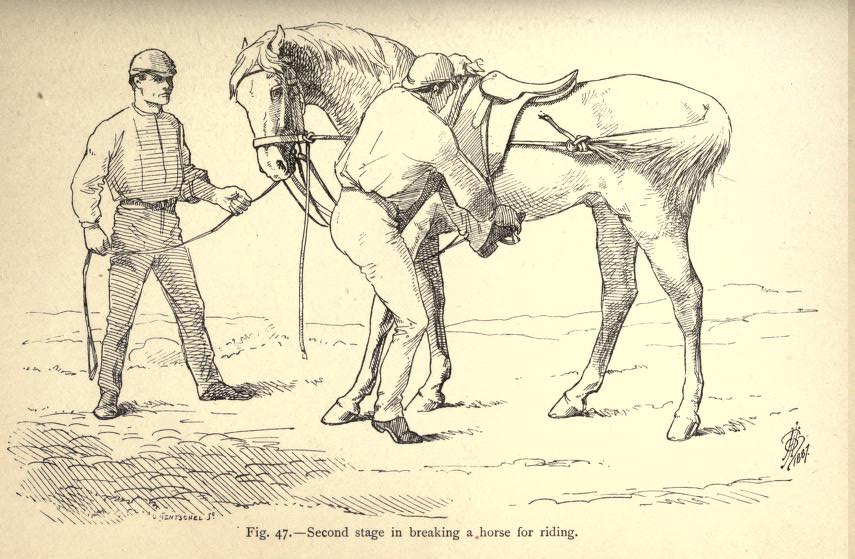
In order to fulfil the necessary conditions of safety for himself, the breaker should be able, by the system under which he works to quote the words of that admirable horse-master, Professor Sample to make the animal rideable and driveable before he is either ridden or driven. The breaker who employs the ordinary methods, is not alone exposed to danger when mounting, or even driving his pupils' for the first few times; but also in the preliminary handling, unless, indeed, in the case of young foals. The advice to go boldly up to the horse and show him that you are not afraid of him, so freely tendered on such occasions, should be treated by its recipient as a piece of "cheap swagger," or the outcome of pretentious ignorance; for, even granted that such a demeanour would efficiently soothe a terrified animal, or cow a treacherously-disposed one suppositions that are altogether absurd such counsel would in no way supply the necessary foolhardiness for such an undertaking. My advice to either amateur or professional is, never to give a horse a chance of doing wrong; so, in order to be consistent after having said this, I shall endeavour to describe a method by which any horse, unsecured, say, in a yard or loose box, can be brought under complete control with, practically speaking, no risk to the operator. 
On the nature of the coercion to be applied to unruly Horses. 
The only risk run in enforcing the obedience which it is absolutely necessary to exact from unruly horses, is that of spoiling the animal's pluck and spirit a contingency that can be incurred only when the fractiousness arises from "nervousness," or from want of comprehension; for what we term pluck and spirit in the horse should have no taint of stubbornness. The coercion employed should, naturally, be limited to what would be sufficient to overcome the wilfulness; for we should never employ a general effect, when a particular one will answer our purpose. Thus, suppose we had a high-couraged, generous animal, that had been made difficult to mount by a bad. rider, on various occasions, prodding the horse in the side with his toe, when attempting to get into the saddle, we might get control over the animal by Pratt's twitch (see page 113), or by tying him head and tail, and then prove to him that we would not touch him with our toe, when mounting. The Rareyfying of such an animal for this or any similar fault, would be injudicious in the extreme ; as it would, almost to a certainty, injuriously affect one of his most valuable qualities, namely, his pluck. As a sulky animal has little or no pluck to lose ; we may well content ourselves in gaining his obedience without troubling ourselves much about any possible deterioration of his courage.


Breaking by kindness alone. 
While fully admiring the kindness of heart of those enthusiasts who regard a horse as a friend to be won by affection, I must say that the better plan for making him a useful member of society, is to treat him as a servant who has to be taught his work, and from whom implicit obedience has to be demanded. Until he does his work honestly and well, the less petting he gets the better; for he is an animal that is very apt to become headstrong and fractious, by a small amount of indulgence in his own way. I entirely deprecate any fighting with the horse, or punishment with whip and spur, which he can resist; but I insist on the necessity after proving to the horse that he has nothing to fear, and after teaching him to understand one's wishes of shewing that he must obey. I shall endeavour, in due course, to explain to the reader how such obedience can be peremptorily enforced. 


The rough and ready style of breaking.
The method of reducing a horse to discipline, by forcibly securing him, getting on his back, and sticking on until he bucks himself to a standstill, is applicable only to unbroken animals of a more or less mature age, whose owners demand nothing further, than to have them made "quiet to ride." The objections to this method, as far as I can see, are : that it is not always possible to obtain the services of a rider of sufficient pluck and adhesiveness; that some horses, by " throwing themselves over," can get rid of any man off their back; that if the horse wins the fight, the victory will have the effect of making him much worse than he was before ; that the mastery, even if the process be repeated, is, often, not permanent, especially with a new rider ; that it is apt to spoil the horse's mouth ; and that, in the case of nervous or sulky animals, it is liable to increase their particular faults. The buckjumping style of breaking is, of course, only good as far as it goes, and has no just claim to teach the manners that make the horse, as assuredly as they do the man. 


Summary of the principles of the art of rendering Horses docile may be summed up as follows :
1. To obtain control over the animal.
2. To prove to him that he has nothing to fear from us, or from the surroundings in which we place him: in other words, to give him " confidence " and cure him of " nervousness."
3. To teach him to understand the meaning of the indications by which we desire to convey our orders to him.
4. To make him obey our orders in the most implicit manner, in the event of his offering deliberate resistance to them.
5. T o instruct him how to use his powers to the best advantage.
6. To make, by repetition, these acts of obedience and " cleverness " thus taught, into confirmed habits; so that the horse, who is, essentially, an animal of habit, may become a permanently useful servant. As an illustration, I may say that we should conduct the education of a colt or filly, according to the principles we should adopt with a recently- caught young savage whom we desired to make a useful servant. While shewing him that we had complete control over him, we should prove to him that he had nothing to fear from us, and, in doing so, would gain his confidence and affection. We should teach him our language, and, according as he understood our words, so should we demand implicit obedience to our orders, and would, thus, quickly establish the desired habit.

 
Valete

Thursday, December 19, 2019

James Fillis - ecuyer on Archive.org

Salvete Omnes,
our 2019 is rapidly closing, with the beautiful holiday of Christmas still several days away.
so on the gift giving and receiving note perhaps you may be interested in this 'libre' collection of two translations of the European ecuyer James Fillis' famous French work on equitation -

Principes de dressage et d'équitation - the 2nd, 1891 edition - the photos of exercises come from that edition, eye friendly  -
below ecuyer Fillis in the Russian cavalry school uniform?


Breaking and riding, with military commentaries  (American edition here) was translated by captain Horace Hayes, one of my favorite XIX century writers on horse.

Grundsätze der Dressur und Reitkunst was translated by Gustav Goebel( the published 1918 version).

 In pre-war Poland it was published under the title Zasady ujeżdżania i jazdy konnej in 1930.


Valete
ps
I think I will post the entire chapter on the army horse.

Tuesday, April 18, 2017

Gaited, ambling & pacing horses

Salve,
I just received a book by Lee Ziegler titled Easy-Gaited Horses. It is not a new edition, but the 2005 one. I have not read it yet,  but I am looking for any pertinent info on different experiences with horse training as I may do some horse groundwork later on in May. Naturally, I am watching my videos with Parelli and other natural horsemanship trainers that I can get from libraries etc.
Having said that, I admit freely I am very  interested in the easy-gaited horses. I have ridden some pacing horses like the Peruvian Paso, Standardbred, Paso Fino etc.
Loved the experience ...
So today I decided to add some information form M. Horace Hayes' treatise Points of Horse: on the ambling horses from the 1893 edition
Here finally a little note Captain Hayes made about the Peruvian Paso, but I would like to point that obviously he did not know much about the Spanish Caribbean horses, nor about the ambling horses of Mexico (this is before the nightmare of the Mexican Revolution) and Central America, nor Colombia and Venezuela, where pacing horsese were in vougue, still cherished, used and bred.

enjoy

Thursday, June 9, 2016

Some interesting video links

Salve,
just some videos to share with you all 
 Mr. Sheperd Paine, passed away in August 2015, was a great master of historical miniature art - and there is this nice tribute to His art available on youtube for all to see and enjoy.
Keep in mind that:
 'In that spirit and per his[Sheperd Paine]  wishes, the MMSI has established the Shep Paine Education Fund, which is accepting tax-deductible donations in his honor to continue his invaluable work as an educator and proselytizer for the art of miniatures via classes, seminars, and other projects. Contributions to this dedicated fund can be made via PayPal at MMSIChicagoShow@gmail.com or by mail to The Shep Paine Education Fund care of MMSI Treasurer Tom Surlak, 3136 Secretariat Dr., Aurora, IL 60602.'

Several outstanding horsearchers from Polskie Stowarzyszenie Lucznictwa Konnego ( Matuesz Gieryn et Michał Sanczenko, Michał Szubski i Michał Tomaszewski ) and stuntmen from Poland took part in the Bollywood production titled Mirzya - teaser trailer here
this the interview with them (in Polish) - they rode Kathiawari horses in the film - filmed at more than 3000meters above sea levels altitude,  (differences between Kathiawari and Marwari horses in this article)
From M. Horace Hayes - Points of Horse (circa 1893):


Caveat! if you watch the second video provided on the page in this link, then you could see the world's best horsearcher Anna Sokólska in action :) (her saddle seen in the video was made by Mr. Plachecki - link to his shop )
enjoy


Friday, August 22, 2014

South African Horses - Horace Hayes

Salve,
back to English :) - but I am planning to write an entry or two in Spanish - on winged hussars :) -
Ad rem, my favorite XIX century British horse writer M. Horace Hayes travelled extensively and widely during the Victorian era, and after his military career  he travelled around the globe studying and breaking (gentling) horses.
Captain Hayes wrote about his horse adventures and observations in many books, perhaps the most important and longest lasting being his book "Points of Horse," but for the purposes of this 'chain' of entries also "Among Men and Horses " and perhaps couple more works may be quoted etc.

Cpt Hayes wrote a bit about the South African horses, from his experiences of  riding them and observing these horses and horse practices in the British South Africa before and during the 2nd Boer War. In this part of the entries I am posting quotations about Cpt Hayes's observations and quotations on the history of horse breeding in South Africa, fodder, coach travel etc.

In the chapter titled "Colonial* Horses' of his treatise 'Points of Horse' our horseman tells us that:
 
''My first introduction to Cape horses was in the early
sixties, when I was a subaltern in an Indian field battery.
Throughout the fifties, the Cape Stud Department, which
was under the control of that good horseman. Colonel
Apperly, furnished a large number of very useful remounts
to the Indian Army; but soon after the Mutiny, the supply
dwindled down almost to vanishing point. To judge by
the remainder which I saw and by a couple I owned,
they were remarkably hardy and wiry animals, and were
up to a fair amount of weight ; although somewhat under-
sized (about 15 h) and rather plain about the head and
croup. They were certainly well adapted for campaigning
in India, on account of their having been bred in a dry
and warm climate. This type of Cape horse is now prac-
tically extinct. The thick-set Transvaal gelding shown in
Fig. 499 is, however, a near approach to it''


Then he goes to say that:                           
 ''We should
here bear in mind 'that in South Africa there are few
districts suitable for the breeding of valuable horses, and
that the horse-breeders of that part of the world are,
during the spring, summer and autumn, beset by the
danger of " horse sickness." This disease and want of
water are the two great banes of horse-breeding there ;
and the inordinate dryness of the country greatly reduces
the supply of fodder and the amount of arable land.
Also, the indigenous locusts have an unpleasant custom
of eating up every green thing during their frequent
visits.
Nearly all the grass in South Africa is natural ; " tem-
porary " and '' permanent " pastures being comparatively
unknown. Consequently, on the grazing grounds there is
a very large admixture of weeds and deleterious herbs.
Therefore the Cape horse, which has existed for many
generations under this condition of pasture, has acquired
the useful ability of being able to distinguish good grass
from noxious herbage. If he is turned out on the veldt
with several new arrivals from foreign lands, there will
be no difficulty in recognising the native equine product
from the others, by the peculiar way he grazes ; because,
instead of eating the plants as they come, he plucks his
favourite grasses in small tufts, here and there, at com-
paratively wide intervals of space. This faculty of
selecting proper food on the veldt is undoubtedly the
chief cause which made him the best campaigner during
the late Boer war.''
 History: 
''The Dutch East India Company appears to have founded
the race of Cape horses towards the end of the seventeenth
century by the importation of Barbs and Gulf Arabs.
Mr. Duncan Hutcheon, who is the Colonial Veterinary
Surgeon, tells us in his interesting pamphlet, Military
Horses and Hoiv to Breed Them, that " in 1792 eight stud-
horses were imported from England. They are believed
to have been of the early English roadster breed. In the
same year, five stud-horses arrived from Boston, and the
following year a number of horses and mares were brought
from the New England States, and are described as of
Spanish or Eastern blood. In addition to these, in March,
1807, during the Peninsular War, two French vessels were
captured at the Cape, containing some Spanish horses
en route to Buenos Ayres for breeding purposes. It is
said that from these were obtained the blue and red roans
which were considered by the colonists as so valuable
for their great power of endurance. ... It was in
1813, however, that the dawn of a new era in horse-breeding
commenced at the Cape. In that year Lord Charles
Somerset was appointed Governor of the colony, and soon
after his arrival he directed his attention to the improve-
ment of the Cape horse by means of the English thorough-
bred, and during his term of office he imported a con-
siderable number of first-class thorough-breds, both stallions
and mares. During the three following decades, first-class
thorough-breds continued to be imported by the leading
horse-breeders of the Western Province, and the male
progeny of these were distributed all over the colony as
stud horses. It was after these importations had im-
pressed their character and qualities on the native-bred
stock — from 1840 to 1860 — that the Cape horse reached
the highest stage of perfection which it has ever attained.
It was during the latter part of this period that large
consignments of horses were shipped to India, which
earned for the Cape horse such a high reputation with the
Indian authorities."
''The decay of horse-breeding at the Cape, which began
about forty years ago, was considerably hastened by the
importation of weedy and worthless English thorough-
breds, few of which I venture to think cost more than
£50. At the same time, some of the Cape breeders, like
Mr. Hilton Barber and Mr. Alec Robertson of Storm-
fontein, employed good thorough-bred sires, and bred
animals that were able to hold their own on the Turf
against imported English race-horses. Like other dry
countries (Arabia and India for instance), South Africa
possesses the great advantage, from a horse-breeding
point of view, that its equine produce hardly ever suffer
from that form of laryngeal paralysis which is commonly
termed " roaring," even when their dams and sires are
'' musical." Hence the fact of a sire being wrong in his
wind is of little detriment to his stud career in that
country. The noisy Belladrum and the still more obstre-
perous Candlemas, who was own brother to St. Blaise, are
cases in point.''
 
''Mr. Mellish, whom I have the pleasure of knowing,
has imported several high-class Cleveland bays and Hack-
neys for crossing with South African mares, and may
probably be successful in producing fashionable trappers
by their means; but such an admixture of blood would be
useless for saddle purposes, if we may judge by the result
of similar experiments which have been tried in India. ''

''At present, the vast majority of South African horses
might be fairly classed as ponies, from an English polo-
pony point of view. Their blood is so mixed that it is
impossible to divide them into distinctive classes, according
to the districts in which they are bred. Of course I here
refer to the ordinary South African horse or pony, which-
ever name we may hke to give him ; and not to thorough-
breds specially intended for racing, or the produce of
recent foreign crosses. The South African as a rule is
hardy, docile, sound, capable of standing a great deal
of hard work, but is somewhat lacking in speed. Although
his want of size and substance put him altogether out of
the hunter class or the misfit hunter class, from which
the English cavalry trooper is obtained, he makes a very
useful hack, and an admirable mounted-infantry remount.
His deficiency of blood and the semi-starvation diet which
he has had to endure for several generations, unfit him as
a rule for high-class polo.''
''The best horse-breeding districts I have seen in South
Africa are those of Colesberg in the Eastern Province,
and of the Mooi River in Natal. ''
Captain Hayes goes to elaborate about his further personal and very close experiences with the South African colonial horses when
''during a horse-breaking tour which I made through South 
Africa in 1891-92, I had excellent opportunities of studying the 
horses of Cape Colony, Orange River Colony, the Transvaal, 
and Natal; for I broke in many scores of them, and was
asked to judge horses at several agricultural shows which
were held, while I was staying in that country. During
1901 [during the 2nd Boer War], I had the pleasure of renewing 
my acquaintancewith these animals on two occasions 
when I went out to the Cape in veterinary charge of remounts,
and of taking the photographs which illustrate these pages.''
 Now we will cross over to ''Among Men and Horses'' where Cpt hayes tell us about his arrival and about the manner of his travel in South Africa :

''As the journey from Kimberley to Johannesburg, where
I had arranged to go, was rough and costly, I thought
it best to leave my wife at Kimberley, where we had several
pleasant friends, and to attack the Randt alone. After a
wearisome journey of two nights and a day in a most un-
comfortable train service, I arrived in Kronstadt, which is a
small town in the Orange Free State, and had then to travel
twenty-four hours in a coach before arriving at Johannesburg,
the capital of the gold fields. 

The coaching in South Africa is of a primitive kind, and
would not commend itself to old Charlie Ward, or even to
his son Frank. Yet for all that it admirably accomplishes
its purpose. There are no roads either to speak of, or to see.
After saying that the country is an open one and not fenced
in, I have praised the 'going' as far as I may truthfully
venture. The coach is of the old American backwoods sort,
is hung on leather springs, and is capable of holding twelve
closely-packed inside passengers, with a few less hampered
ones outside. Having to be very strong to resist the terrible
jolts it receives on its cross-country travels, it is heavy,
and as the cattle are either weedy ponies, or small mules,
their individual deficiency in pulling power has to be made
up by an increase in their numbers. Consequently, a team
of ten or a dozen has to do the work of four or six ordinary
horses. These animals are harnessed two by two, with one
pair of reins for the leaders, and another for the wheelers.
The intermediate pairs follow the leaders and do not require
any special guidance. The man who holds the reins is an
unconsidered cypher. The driver, who is the ornamental
man of the show, amuses himself with a light fifteen foot
pole, from the end of which hangs a long thong, finished
off with a lash of gemsbok raw hide. This sportsman prides
himself on the dexterity with which he can manipulate this
funny-looking whip, and has more tricky ways of ' catching '
and ' double thonging ' than ever entered into the mind of
even poor Jim Selby. With this flail he can reach either the
near or off leader, and can, if he likes, cut ' chunks ' out of
any of his team. He is, however, supposed to show his
skill less by punishment, than by describing figures in the
air with the thong, and by shrieking in a peculiarly terrifying
manner at his horses. Besides the fifteen-footer, he carries
a kind of magnified dog-whip for the special benefit of the
wheelers. The third and last person of the coaching show
is the guard, whose business is to take tips, tell the passengers
yarns, and induce them to patronise the halting-place shanties,
at which he is on the free list for food and drink.''
 
''The ponies, or horses, if I may dignify them by that term,
are admirable workers for their weight, and will trot along
merrily and pull gamely up hill and down dale over bad
ground, a stage of twelve miles, once, and sometimes twice a
day. Their sole food is Indian corn, oat hay, and any grass
they can pick up on the veldt. The ' mealies ' are given in a
dry state, whole or crushed, or after having been soaked over
night in water. The oat hay, or ' forage ' as it is called,
consists of oats which have been cut before the grains in the
ears have lost all their milky character, and which have been
dried in the sun like ordinary hay. If the ears were allowed
to ripen more than I have stated, the grains would become
so much loosened that they would fall out of the ears on
too slight provocation to bear transit, or ordinary handling.
This ' forage ' is an excellent food. Although I have used
a good deal of it with horses when I lived in Calcutta, to
which city it is often brought from Australia, where it is
known as oat hay, in steamers that are loaded with horses,
I am unable to decide whether or not it would be a good
substitute for English hay. Anyhow, it is a valuable adjunct
or change to a horse's food. It is sometimes used in
England during years in which there is scarcity of ordinary
hay.
to be continued
ps
Original spelling in quoted passages
*  British Empire prior to 1945
ps
Battle of Falaise Gap took place 70 years ago and our Polish Armoured Cavalry fought and attained  immortal glory in this decisive engagement during the battle of Normandy 1944. Let us remember and hope that Europeans would stop fighting one another,  eg the present and terrible war in Ukraine. 

Friday, August 13, 2010

Horace Hayes on horses


Horace Hayes in his book 'Points of horse,' published in the 1897, presented his very learned opinions regarding what a particular type of horse should have been, his description was based in his extensive travels and experiences as cavalryman, scientist,  horse trainer, equine historian etc. I am giving his horse conformation description and views here, because I think,  H. Hayes gives us a very sound opinion on what a war horse should have been built like prior to the XX century, and I think it applies to horses throughout their use in human warfare since North Iranians on the great Eurasian Steppe first took to mounted warfare,  at least 3000 years ago. Note his insistence on the trooper and officer horse's height when in war conditions, very important! The shortness of legs, and his stoutness in general, in cavalry trooper horse brings to my mind the Mongol-Tatar bachmats of the Pontic-Caspian steppe.

The Cavalry Trooper.—The ideal cavalry horse should (if price has not to be considered) be of the heavy weight (Fig. 433) or thick-set (Fig. 322) hunter type. His chief requirements as regards conformation are as follows :—
1. That he should be up to the weight he has got to carry, which is usually about 18 stone. But he should on no account be too heavily topped for his legs, or for the work he will be called upon to do. His loins, therefore, should be strong, his shoulder-blades long, and his legs should be as short as is compatible with the possession of sufficient speed for military purposes.
2. His legs and feet should be particularly sound and well able to stand work. As he will be called upon at times to go fast and to leap ; his back tendons should be more or less parallel with the cannon bone, and he should have no tendency to undue width of fetlock (p. 282, et seq.).
3. His fore-hand should be light, so that his legs and feet may continue sound, and that he may be able to do his school work properly.
4. He should have a good carriage of the head and neck, so that he may be obedient to the rein.
5. He should be a " good doer," and have a strong constitution, which will usually be the case with a horse that has a bright eye ; soft, cool skin ; deep rounded barrel (pp. 232 to 236); full flank ; firm, prominent anus; and is well ribbed up.
6. In times of peace, the height will usually vary from about 15.1 to 16 hands; but for war purposes, when endurance is of paramount importance, the height should not exceed 15.2, and may be as low as 14.1, especially if Arabs are employed.
The Officer's Charger.—A cavalry officer's first charger, with all the useful points of the cavalry trooper, should have undeniably good looks, and a showy carriage of the head and tail, which should not be docked. As he will have to carry less, and will cost considerably more than an animal in the ranks, he should be well bred, and, with a rider of ordinary weight, he should approach the type of a handsome thorough-bred hunter. A second charger should have all the useful points of a first charger ; but need not be so good-looking. The colour will, as a rule, depend on regimental regulations. Speaking generally, he should not be less than 15.3, during peace time, because a man at the head of a regiment of cavalry, or of a battery of Horse or Field Artillery, looks best on a tall horse. On a campaign, the height should be the same as that advised for a cavalry trooper.
The Artillery Horse.—Artillery horses are divided into those for Horse Artillery and those for field batteries. As the teams of the former have to manoeuvre with cavalry, and also drag their guns, they require to be exceptionally strong, smart horses. The latter, as they are supposed not to go faster than a trot, are stronger and slower horses than those of light cavalry. The wheelers are active, light-built cart-horses. For their work, they need to be somewhat thick in the shoulders, short on the leg, and of considerable weight to stop the gun when the order to halt is given. Their hind-quarters, loins, and hocks should, therefore, be particularly strong. The riding horses of the Nos. 1 and markers of field batteries should be of the light cavalry type.
The Mounted Infantry Horse should be of the same type as the cavalry charger, and should be about 14.2 high. Fig. 437 shows a good specimen of a remount, which did excellent service during the late Boer war. The pony in Fig. 438, though small, was of a useful kind, and also served in South Africa during 1900 and 1901.

The Polo Pony.—Handiness and speed, with sufficient staying and weight-carrying power, are the two chief requirements of the polo pony. Consequently, he should be light in front, should carry his head and neck well, have sloping shoulders, strong hocks, and his hind legs well under him. The fact of his being rather " goose-rumped " will be no detriment. These views are strengthened by the remarks made on pages 310 and 311 about the conformation of the zebra; for the polo pony, like his striped relative, requires great ability of suddenly stopping, turning round, and galloping off in the opposite direction. This turn has to be done chiefly on the hind legs, which in this case will be more or less bent, and will then have full power to project the pony in the new direction. The best English polo ponies, such as the once matchless Dynamite,  are animals which, but for an accident of breeding, would have been high-class hunters or brilliant chasers.
source:
Points of Horse pp392-95

another horse so called Hack  pp389
The Hack.—The chief points about the hack are that he should be " light in front," have sloping shoulders, and sound legs and feet, so that he may be sure-footed and able to stand work ; and he should be rather high in front (pp. 177 and 178). The conformation of his head and neck should be such as to allow him to bend readily to the rein. The action of the hack should be somewhat " high" and should be " true," so that, when viewed from behind, the near pair of limbs, in the walk, trot and canter, should move in a line parallel to that of the off pair. Action, good looks, and a showy carriage of the head and tail are essentials in the high-priced hack.
 According to hipologist Juan Carlos Altamirano, great historian and specialist on the Pura Rasa Espanola or Spanish Horse,  the XVI century nondescript  hacks or 'haquas' imported from England, Northern Europe and Poland were foundation horses along with particular Barb, Neapolitan and Andalusian stallions and Marismenas mares when king Felipe II (Philip II) ordered creation of the breeding program at the Yeguada Real in Cordoba, Spain in 1567 AD.

H. Hayes' entire book can be read here, but my text belongs to 1904 edition and the  photos of the horses given in the text as well   http://books.google.com/books?id=P1sCAAAAYAAJ&printsec=frontcover&source=gbs_atb#v=onepage&q&f=false
ps
 at the top some old sketch of mine