Showing posts with label Spain. Show all posts

Monday, November 24, 2025

Spanish Lance manual - 1814 AD

 Salvete Omnes,


November - Somossiera etc, so the lancers on my mind, And I would like to invite you to  this interesting material from Spain dating back to the last year of the War of Independence, 1814AD.

Laminas del ataque y la defensa del arma de la lanza

Created by the officers of the Legion de la Extremadura, a unit famous  also for a Scottish officer John Downie.


.


this manual was the second manual after the work of general Wincenty Krasinski et al., of the 1st Lancers of the Guard [Napoleonic].
enjoy 

Valete

Sunday, May 30, 2021

Jose Garcia y Ramos - late XIX century horses & people of Andalucia

 Salvete Omnes


another short entry this morning - just a number of works of art from Wiki Commons, all created by a Spanish painter Jose Garcia y Ramos(1852-1912).


Souther Spain, Andalucia (Andalusia), its religion and festivities, architecture, people and horses executed in  pen, engraving tools and brushes of this Spanish maestro native to Sevilla.


this horse's conformation looks a lot like a criollo horse of Argentina, doesn't it?


Valete

Tuesday, November 27, 2018

Hispalis known as Sevilla AD 1619 p. I


Catedral de Santa María de la Sede de Sevilla
Salvete omnes,

in May and June this year I showed some details from Baroque panoramas of Gdansk and Lisbon (click on the labels portion to look at them), and this late in November I am inviting you to take a look at some chosen details from the panorama showing the horse and rider, carriage and wagons, mules, donkeys, oxen etc in Seville/Sevilla, the most opulent and splendorous city of then largest empire on earth, the Spanish Hapsburg Empire, where the sun never set and where old the gold and silver came from the New Indies. This is the city before the great plague of 1649AD, still the center of the international trade with the Americas and Spanish (and Portuguese) possessions in Africa and Asia.
Curiously we see various styles of riding - la gineta and la brida - popular in the Iberian peninsula since the Middle Ages.


Valete!

Thursday, October 12, 2017

Columbian exchange & horse in the Americas

Salve,
well, from the northern Europe of the Bronze Age lets jump to Anno Domini 1492, as today is Columbus Day/Fiesta Nacional de Espana / el Dia de la Raza  etc,  thus  another anniversary of the beginning of our modern Americas.

Incidentally, on this day we, the horse people, celebrate or should celebrate the return of equus caballus to the Americas - obviously the date is general, as the horses did not arrive AD 1492, but begun arriving with the Colon's (Columbus) second voyage of conquest and settlement  and so on, in la Hispanola(1493), Cuba(1494) and later continuing onto the mainland with the entradas.
I want to signal the new thread in my blogging - that is the Age of La Conquista (Conquest), Colonial Spanish empire and the horse in the Americas.
Slowly, probably very slowly but surely, for I really enjoy studying this period of the horse history.

We are blessed with abundant primary sources for this period, and later secondary works, and nowadays in the Age of Internet many previously inaccessible article and books can be read directly in one's computer.
I hope to corral for us all some interesting equestrian histories and art, including some of my own.

....so, to begin with this thread, I would like to bring to your attention the person of a conquistador, cavalryman and later a lay priest Juan de Castellanos who wrote and later published his epic and very long poem - Elegias de varones ilustres de Indias,; in there de Castellanos put the following verses as allegedly spoken by some conquistador companions during la entrada of Gonzalo Jimenez de Quesada and the conquest of Nueva Granada (Colombia), crude words spoken upon a desperate victory over some brave native warriors in or near the valley of Opon:
[fragment can be easily translated via google translate]
Tierra buena, tierra buena,
Tierra que hara fin a nuestra pena.
Tierra de oro, tierra bastecida
Tierra para hacer perpetua casa.
Tierra con abundacia de comida,
Tierra de grandes pueblos, tierra rasa,
Tierra donde se ve gente vestida
Tierra de bendicion, clara y serena,
Tierra que hara fin a nuestra pena.
[1857 edition, p. 309-10, can be read or downloaded from archive.org]
Monument to Pizarro and his horse in Lima, Peru
For the victorious Spanish conquistadors the conquered land would be the land of prosperity and wealth, and so would the Americas prove themselves to be the greatest land for the horses.
But first the horses would replenish and grow abundant in the Caribbean pastures, before really making for the continent with the conquistadors. we could say that the American horses were born in the Caribbean in the early XVI century.
ps
I have been watching the Spanish Kingdom (Spain) troubled internal conflicts taking place in their autonomous regions, especially in Catalonia (but Pais Vasco is not far behind nor is Galicia etc).

Tuesday, December 8, 2015

Diego Ventura & his horses video tribute


                                           'El hombre hace al caballo y el caballo al caballero.'
Salve,
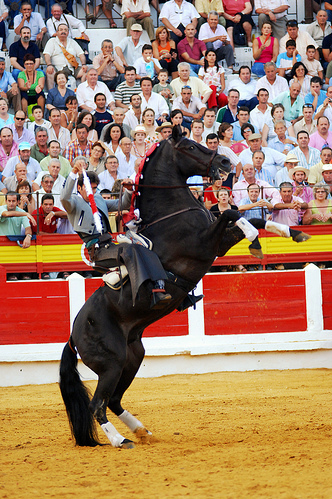
I am an admirer of the Iberian equestrian arts, including the art of el rejoneo or 'toreo a caballo' (bullfighting from horseback).

I came across this short but stunning video showing one of the modern masters of this equestrian martial art Diego Ventura and his partners, those being his brave Iberian horses.
                     
The video is official and free to all via youtube.

Wikimedia Commons library  of el rejoneo - what a great display of unity of horse and rider, brave bulls and splendid horsemanship. 

Caution, it is about killing per se and therefore it is graphic, violent and  very real, and perhaps disturbing to many of you, hence make your own decision if you want to watch it.
enjoy

Monday, August 10, 2009

CURB BIT of Byzantine provenance


Salve,
 we went to the MET today, to see the Afghanistan treasures of the Bactra-Margiana, Saka and Kushan eras (hope to address these in the future posts), and also the old medieval drawings (I will do a post on some nice drawings I found at the exhibit dating to 12th century AD Turnai, France), and passing by the Byzantine art section I took some pictures of a curb bit dated between 600 to 800 AD (Anno Domini or Christian Era), an example of early Medieval art and following both the Persian and Sogdian traditions of the Sassanid era and prior ancient Roman traditions.

The bit is beautiful, inlaid with various motifs and nicely preserved - it was found in Spain, and most likely is of the Byzantine provenance, perhaps it was traded or captured by the Visigoth or Moorish conqueror of Spain, as the times were very tumultuous.

The horse's bridle  must been attached via these 2 rectangular movable pieces attached to the bit mouthpiece's 'rings.' The reins could have been attached to the surviving rings on the mouthpice or down below at the end ot the shank, where there are two rein rings welded to the shank bar. It looks as if the purchase was not attached directly to the bridle, as if in the ancient 'psalion'/cheekpieced bit. It was  quite powerful device of control, most likely used on a mount destined for war and close combat.

One day  I shall do a drawing of this bit as could have appeared  when placed in a horse's mouth etc ...