Showing posts with label quintain. Show all posts

Sunday, February 12, 2023

Wilhelm Peter Zimmermann - quintain at the wedding feast

Salvete Omnes,

back to the XVII century 

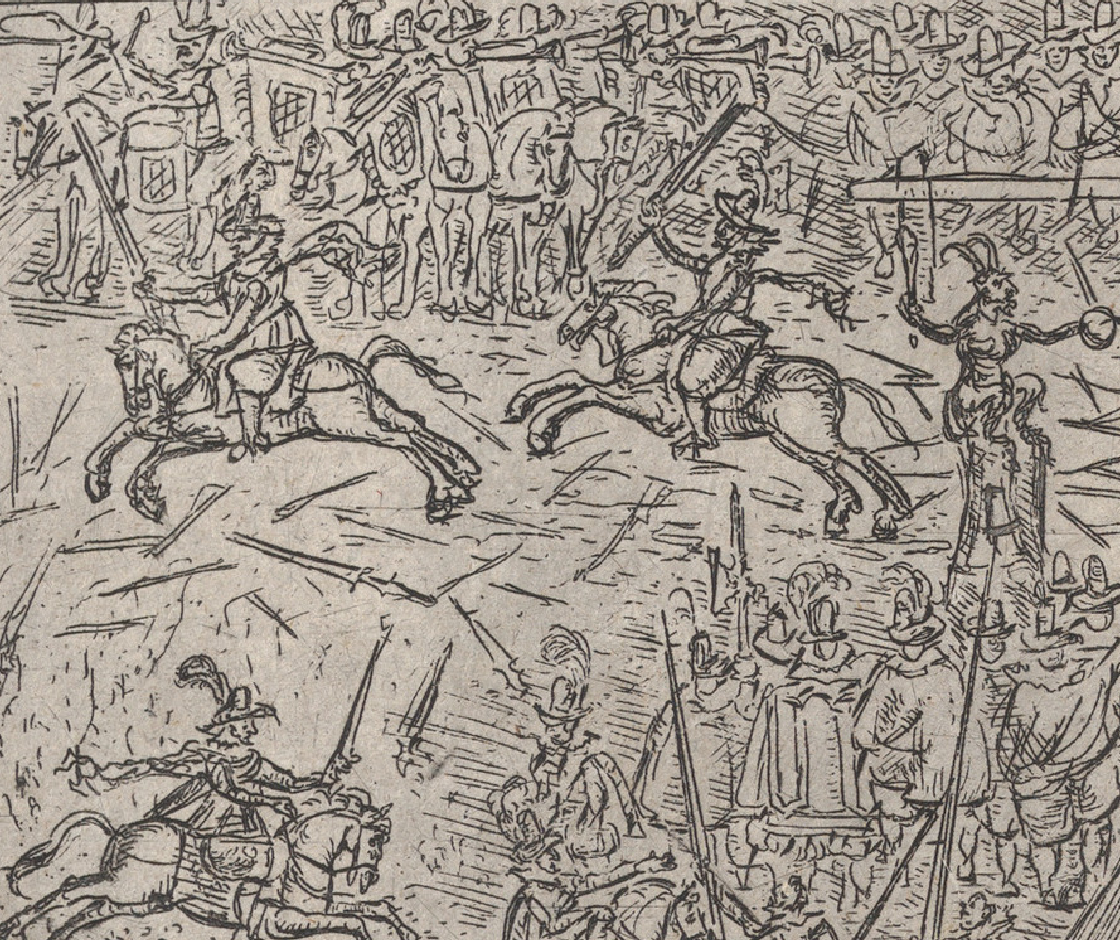
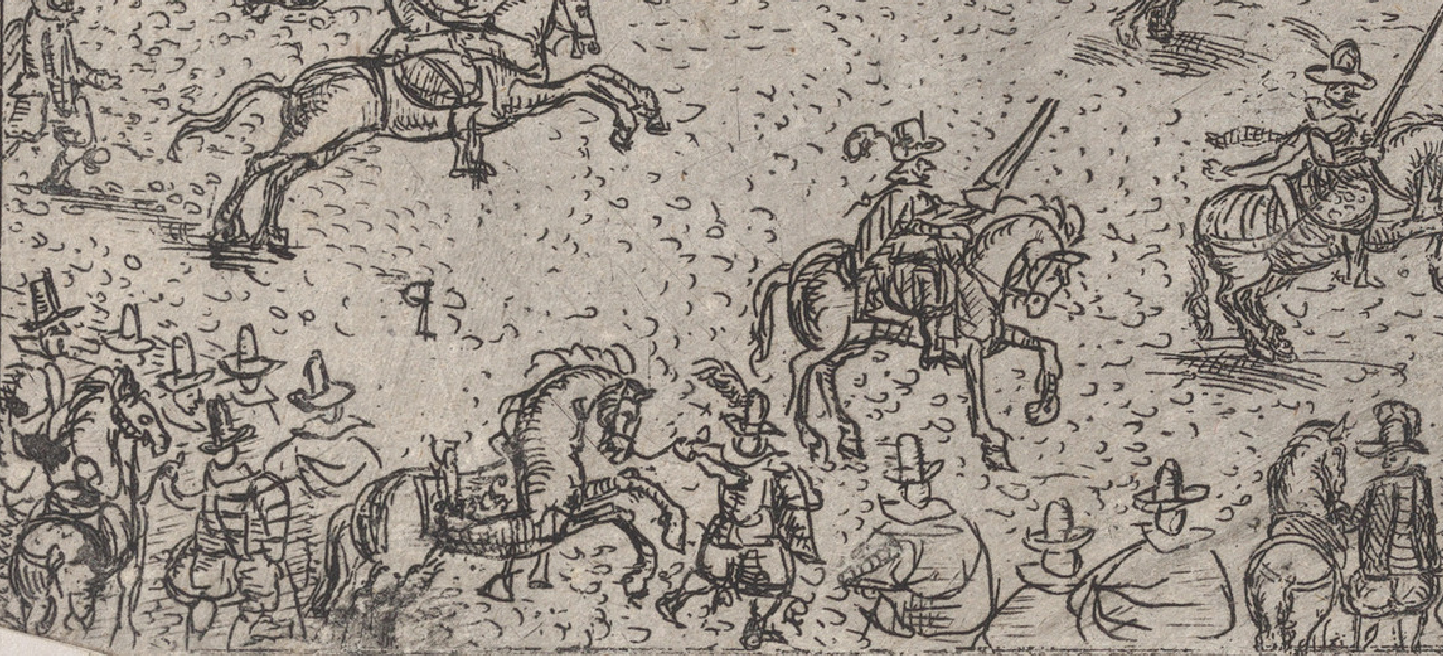
quintain with lances


 let us move fast - so, the German printmaker Herr Wilhelm Peter Zimmermann (1589-1630) did execute 11 etchings and based on them a number of  prints celebratory of the noble wedding of the houses of Bavarian Wittelsbach  and Pflaz(Palatinate)-Neuberg Wittelsbach.
From MET description:

This print is one of 11 etched illustrations from a book containing a description of the wedding festivities for 

Wolfgang Wilhelm, Duke of Pfalz-Neuberg, Pfalzgraf (1578–1658 - great portrait with his dog) and Magdalena, Duchess of Bavaria (1587–1628) (beautiful portrait here). 

The marriage took place in Munich on November 12, 1613, and the commemorative book was published by

 Wilehlm Peter Zimmermann in 1614 in Augsburg. 
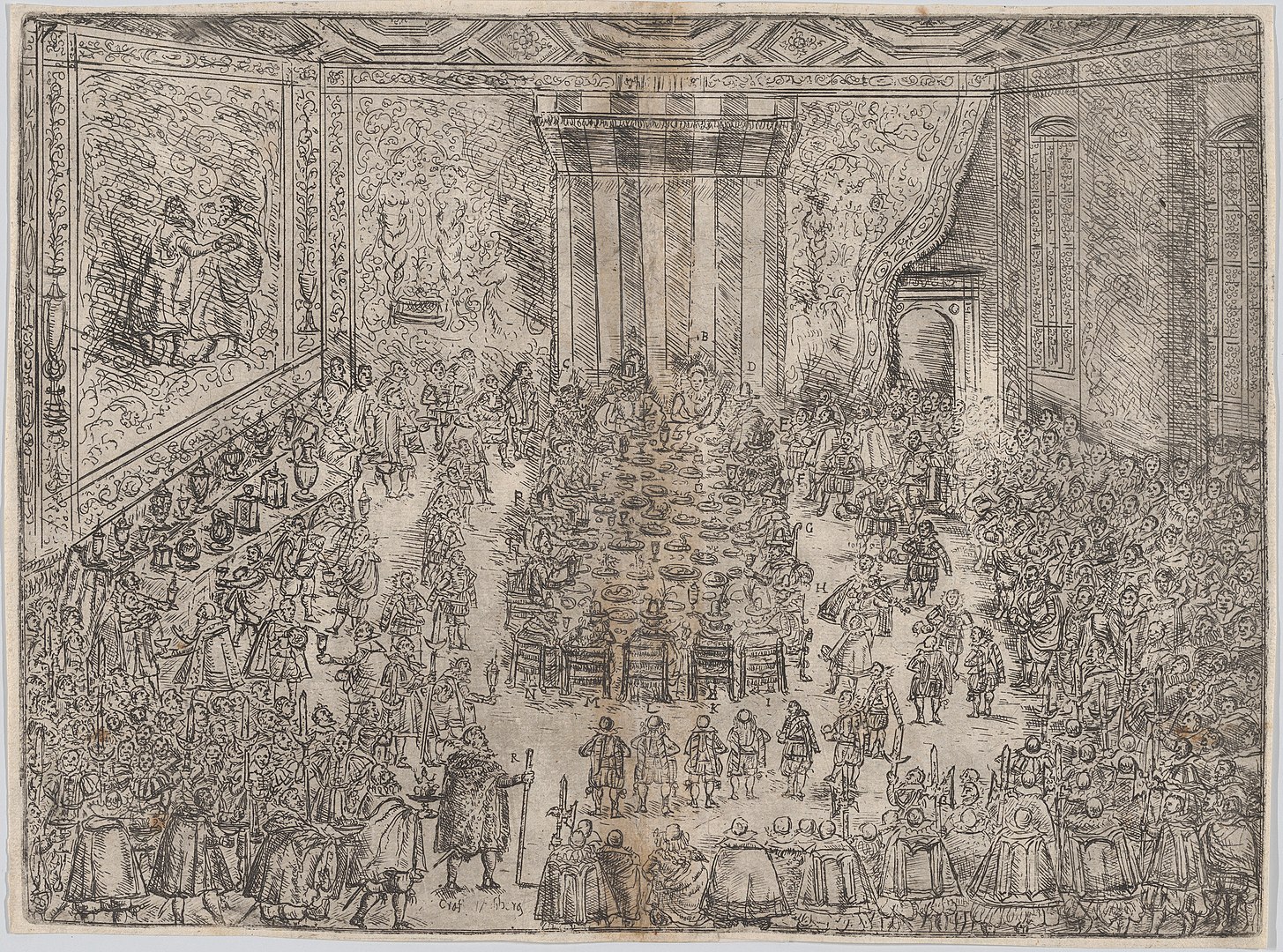


Plates 4, 7, and 10 are in the collection of The Metropolitan Museum of Art.

Book title: Beschreibung und kurtze Radierte entwerffung der Füsrtlichen Hochzeit So Der Durchleuchtig und

Hochgeborn Fürst und Herr Herr Wolffgang Wilhelm Pfalzgraff bey Rhein/ Hertzog in Bayrn... Mit.. Fürstin Fraw 

Magdalena Pfalzgräfin bey Rhein Hertzogin in Obern und Nidern Bayrn. 

Zu München im sechszehenhunfert und dreyzehenden Jahr den zwölfften Novembris Celebriert und gehalten

 (Wilhelm Peter Zimmermann, Augsburg, 1614)
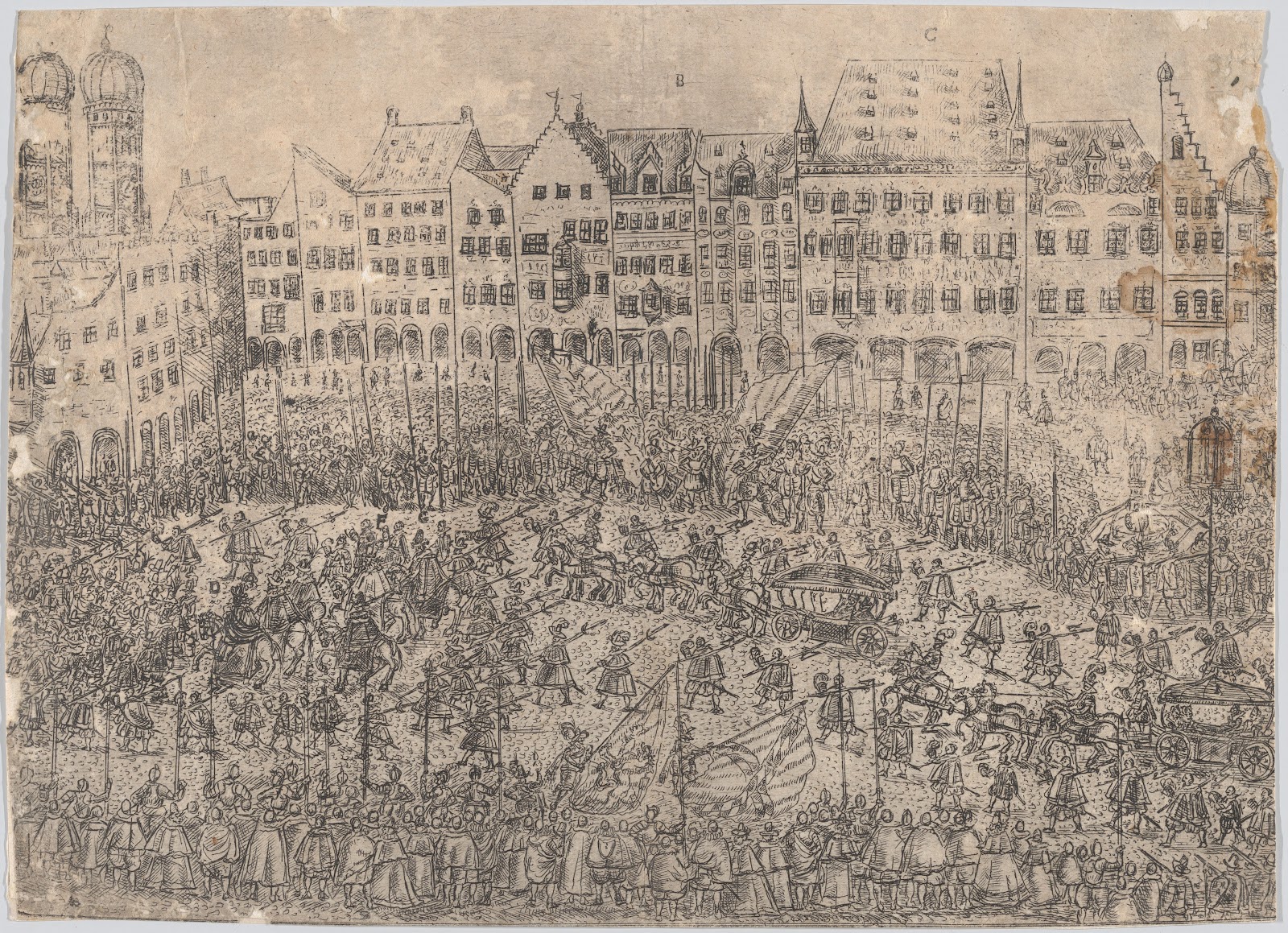

...
 I will 'dissect' a bit the plate showing lancers on horseback , showing the stages in this quintain


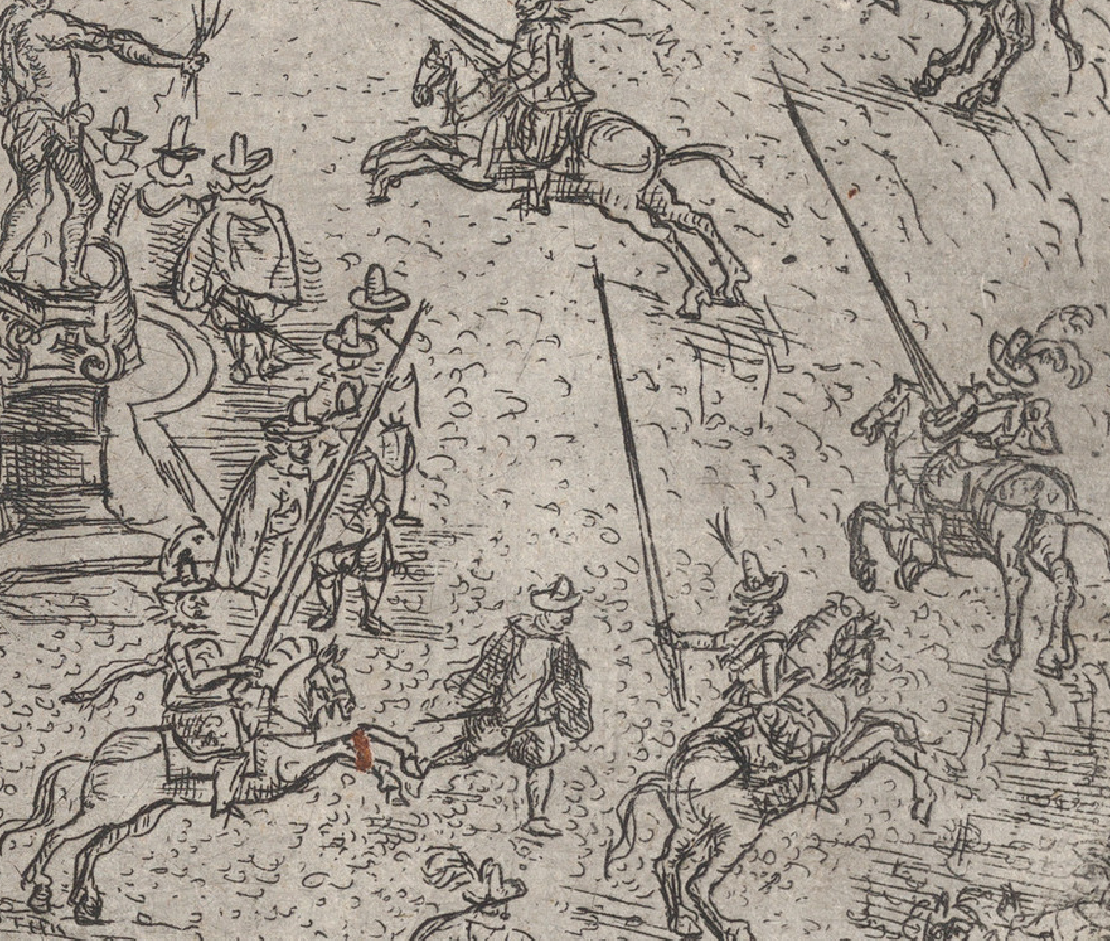

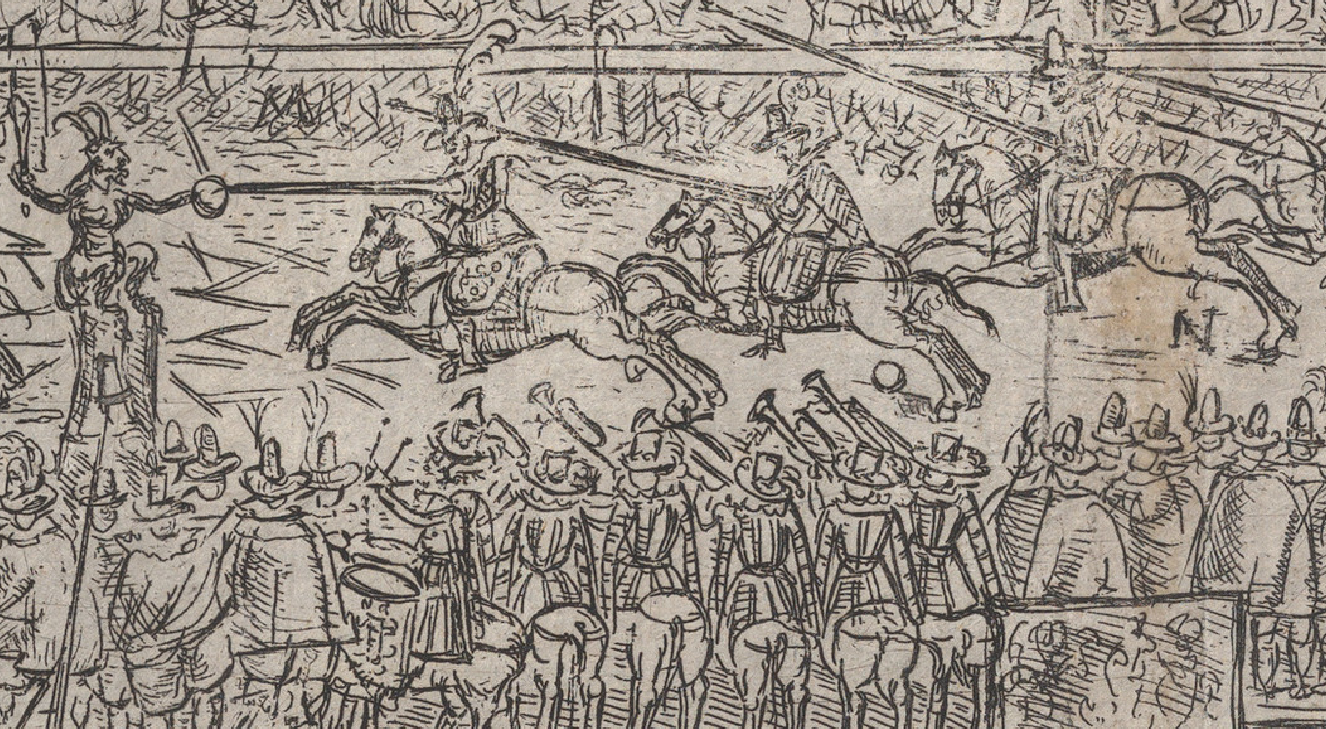


Herr Zimmermann executed plenty of etchings showing Hapsburg-Ottoman wars in Hungary, but these we will save for later.


enjoy

Valete

Thursday, March 19, 2020

the tilt at Quintain in the early modern England

Salvete Omnes,
a short post or perhaps not so short - :)
one of the great and rather fundamental exercise to learn and to hone one's  skills with a lance while on horseback was the tilt at the 'quitain.'
Samuel Johnson (1805) in his A Dictionary of the English Language has this definition -
Quintain - a post with a turning top, and the he tells us to look up a Quintin -
An upright post, on the top of which a cross post turned upon a pin; at one end of the cross post was a broad board, and at the other a heavy sand bag: the play was to ride against the broad end with a lance, and pass by before the sand bag, coming round, should strike the tilter on the back.
 
I have been perusing the Wiki Commons collections and came across this image of a quintain:

Apparently this Kentish village's quintain is quite old, as the ancient   lance exercise - tilting at the quintain - had been alive into the early modern or even post-Puritan revolution (aka English Civil War) period. 
well, I say that because it appears that during the later part of  XVII century there was still some practice with lances (ok, strong poles or staves) in the countryside.

For evidence we have this interesting description taken from 'The Natural History of Oxfordshire' (Robert Plot, 1677):
''They first set a post perpendicularly into the ground, and then place a slender piece of timber on the top of it on a spindle, with a board nailed to it on one end, and a bag of sand hanging at the other; against this board they antiently rode with spears. Now, as I saw it at Deddington on this county, only with strong staves, which violently bring about the bag of sand, if they make not good speed away, it strikes them in the neck or shoulders, and sometimes knocks them off their horses; the great design of this sport being to try the agility both of horse and man, and to break the board, which whoever does is for that time accounted princeps juventutis. It is now only in request at marriages, and set up in the way for young men to ride at as they carry home the bride, he that breaks the board being counted the best man.''

In 1813 J.N. Brewer (Topography of Oxfordshire) remarked that ''the sport is now  entirely disused, and the oldest man in the town does not remember to have heard his father mention the custom in any other than a traditional way.''

Curiously, during the Peninsular War the British and Spanish forces were truncated more than a dozen times by the Polish lancers in the French service.
In 1816 some of the British cavalry regiments (eg 12th  Royal Lancers, 16th Queen's Lancers  ) became lancer regiments, and tilting must have resumed as part of the training.

a photo of modern reenactment from the famous Malbork castle in Poland (naturally famous for the Teutonic Kinghts, but also the seat of the Malbork voivodeship in the Polish Kingdom AD1466-1772)

Valete