Showing posts with label lisowczyk. Show all posts

Friday, November 8, 2024

White Mountain 1620-2024

 Salvete Omnes,


..

on this day in November 1620 AD at White Mountain (  Bitva na Bílé hoře) Bohemian Protestant royal army aided by the Hungarian forces, commanded by Jindrich Matyas Thurn and Christian I, Prince of Anhalt-Bernburg, was defeated by the combined Catholic armies of Imperial forces, commanded marshal de Tilly and the Catholic League under  Count of Bucquoy.

Perhaps our Polish Lisowczyks

There was also a 1,500 riders-strong mercenary  contingent of Polish cavalry known as the Lisowczyks (Lisowski kozaks/cossacks as Polish light cavalry originated during the Polish-Muscovy War). There were also Croats and Imperial Hungarian on the side of the Catholic army.

imperial and League forces, the Polish contingent is on the bottom right

..

it was a very short battle considering the size of the armies and the seriousness of the struggle  - the actual battle lasted  more or less 1 hour, and more or less 2,000-4000 men were killed on the Protestant side and perhaps the same number on the Catholic side - the losing side also sustained 2000-5000 men prisoner out of 28,000. But actual losses are uncertain.  It is certain that the Protestant army was defeated and routed and in pursuit, in which  the Poles, Croats and Imperial Hungarian excelled. 
The battle was followed by steady collapse of the Protestant struggle and armed  opposition within Czechia proper, while the contingent of the Protestant army were withdrawing, bleeding men and equipment, to the north into Silesia  (part of the Bohemian Crown) and German states to the north-west or even further to the Dutch Republic. The war was far from over and would last for 28 years more, but the very heart of it, the Bohemian Crown, was finished.
 The most serious social and political outcome of this battle  would result in the total destruction of the Protestant Czechia, especially the Protestant aristocracy and upper levels of the other parts of society,  during the subsequent months and years of the XXX Years War and further  anti-Czech policies of the Imperial politicians. Czech language and culture would begin its revival in the late XVIII century in a complete different set of circumstances. 
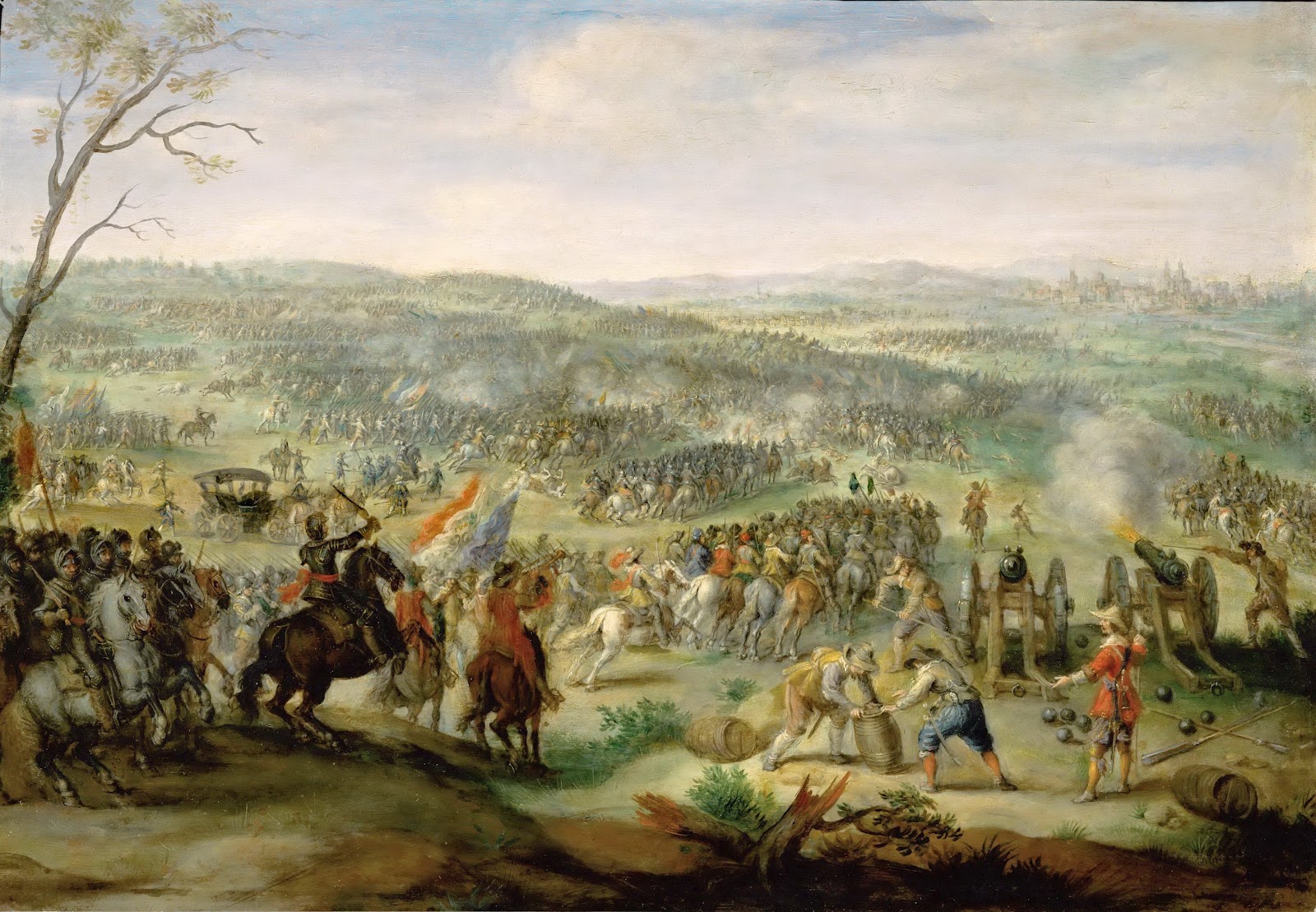
Snayers' vision of the battle

. Polish cavalrymen delegation led by captains Stanislaw  Strojnowski and Wojciech Sulimirski, presented to their commander-in-chief the  captured flags: 38 Hungarian colors, 5 infantry banners or colors and 9 cavalry standards.
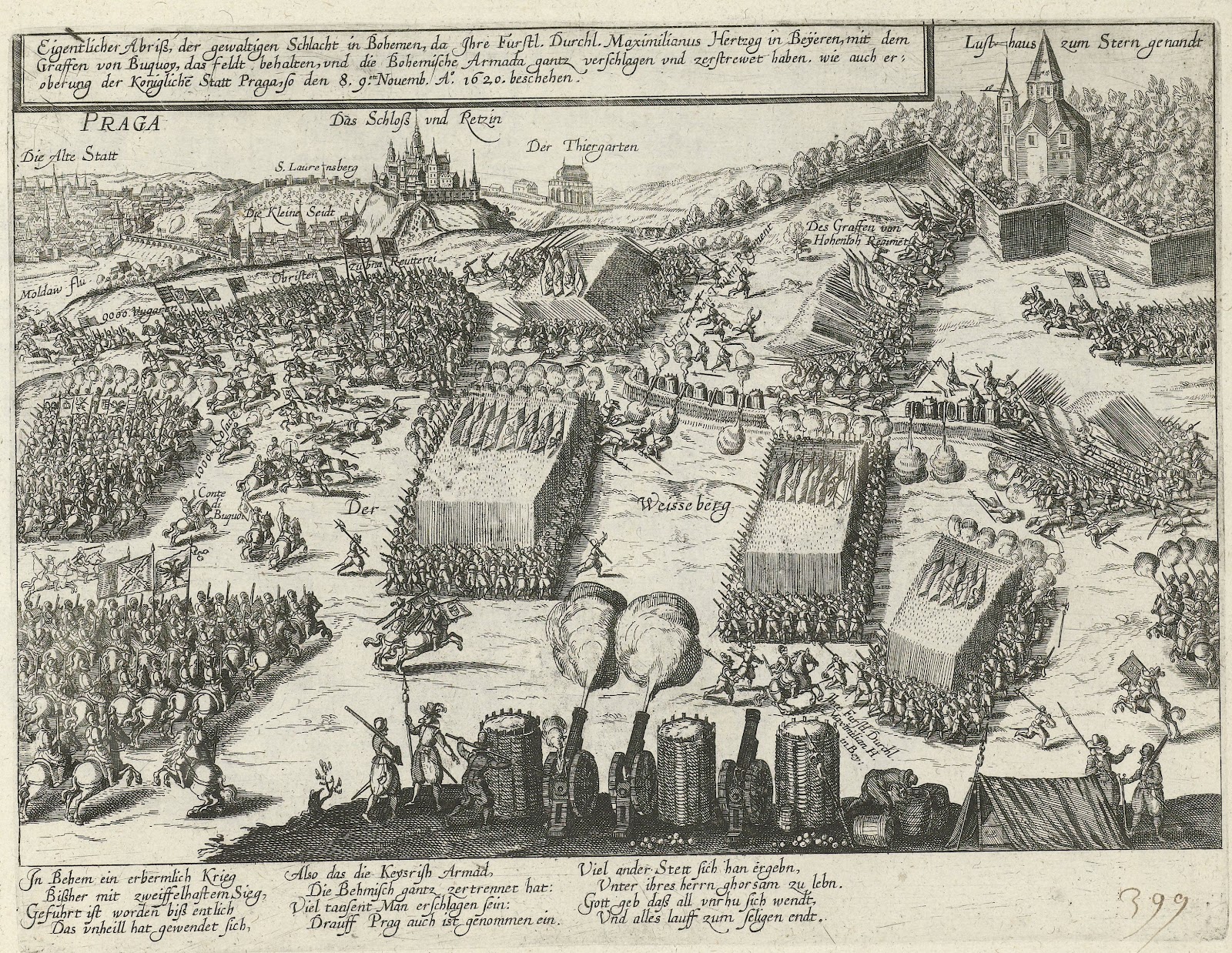


Perhaps worth noting is the taking of the capital - Prague. 
On  Nov 9, 1621 the imperial & League forces entered undefended Prague, while on the 10th the  soldiers of the Royal Castle surrendered to Count Bucquoy . What followed was the great pillage and mayhem of the Bohemian Crown capital. 


Maximillian of Bavarian ina cuirassier armor


 For example Maximilian of Bavaria, commanding his Bavarian contingent,  had 1500 wagons of loot carried for his pleasure and onwerhsip, but when the unruly Imeperial soldateska continued looting and pillaging within the city and its environs  Maximillian asked commander-in-chief Bucquoy to stop the lawless pillage by the soldiers. But the war being war and the scoundrels and mercenaries alwyas hungry the pillage lasted for some time, our Lisowski kozaks not being the worst among the victorious soldateska. 


Valete

Monday, September 27, 2021

Cecora 1620 - Royal army of Commonwealth or Respublica

 Salvete Omnes,


before there was Chocim 1621 there had been the Cecora campaign, Polish invasion of Moldavia  that ended in a major disaster for the Commonwealth army and most of its participants - including the heroic death of the commander in chief Stanislaw Zolkiewski and his reiter bodyguard.


The Royal army the marched across the Dniester River into the Moldavian territory;
the army had circa 7,000 horses and portions, divided into a  'pulk ' (temporary divisions) large operational units[1]:

Commander in chief - Crown grand hetman Stanislaw Zolkiewski 

 (all units identified by the commanders' names)

1 pulk - commanded by the grand hetman de jure, but it was actually commanded by a winged hussar banner captain Makowiecki

- cavalry in total 1,220 lances and horses:

Winged hussar banners:

1. grand hetman banner led by Malynski - 270 lances

2. starost of Chelm Danillowicz - 150  lances 

3. starost of Halicz Makowiecki - 150 lances

Pancerni kozak cavalry:

1.starost of Winnica Aleksander Ballaban banner- 150 horses

2. Dworycki/Dworzycki banner - 150 horses

3.  voivode of Ruthenia Jan Danillowicz banner -300 horses 

4. Wolmar Farensbach banner - 50 horses

 Infantry  450 portions

1. Royal court Polish infantry company -300 portions

2. Farensbach's company - 50 portions

3. voivode of Ruthenia Jan Danillowicz's German infantry company  - 100 portions

total 1,670 lances, horses and portions


2nd pulk - Crown field hetman Stanislaw Koniecpolski

 Cavalry in total - 1,100 lances and horses

Winged hussars banners:

1. field hetman own banner - 200 lances

2. Marcin Kazanowski - 150 lances

3. voivode of Braclaw Potocki - 150 lances

4. Strzyzowski - 150 lances

Reiiters or German pistoliers

1. Herman Denhoff's banner - 200 horses

Pancerni kozak cavalry

1. Odrzywolski (actually commanded by Ujazdowski) - 150 horse

2. Lewikowski - 100 horse

Infantry 430 portions

1. field hetman's own company commanded by Damiecki - 230 portions

2. Rybinski Polish levied infantry-  200 portions

total pulk number of lances, horses and portions - 1,530 


3rd pulk -starost of Halicz Mikolaj Strus (famous 'defensoe' of the Kremlin in Moscow in 1611-12)

all Cavalry unit

Winged hussar banners

1.son of voivode of Podolia Sieniawski - 100 lances

2 Malinski - 150 lances

Pancerni kozak cavalry

1. Mikolaj Strus own banner - 100 horses

2. starost of Chmielnik - 100 horses

3. Kowalski - 100 horses

Private volunteers and their retainer - 1500 horses

total pulk number of lances and horses - 2,050 


4th pulk - prince Samuel Korecki

Total cavalry numbers - 600 lances and horses

Winged hussars banners:

1. prince Korecki's own banner -150 lances

2. castellan of Kamieniec Podolski - 100 lances

3. Wrzeszcz - 150 lances

Pancerni Kozak banners:

1.prince Samuel Korecki's own - 100 horses

Light cavalry -

Lithuanian? Tatars - 100 horse archers

Infantry companies - total 300 portions

1.Wiadrowski - 200 portions

2.Ujazdowski - 100 

Total pulk numbers - 900 lances, horses and portions


5th pulk - starost of Kamieniec Podolski Walenty Kalinowski

  total number of lances and horses - 500

Winged hussar banners:

1. starost of Kamieniec Podolski  own - 150 lances

2. Firlej -  150 lances

Pancerny Kozak - 

1.  Kalinski - 100 horses

2. Wachowski - 100 horses

 Infantry

1. Starost of Kamieniec Podolski own Polish infantry - 100 portions

2. Starost of Kamieniec Podolski own Ruthenian infantry - 100 portions

total pulk number of lances and horse and portions - 700


Finally, Teofil Szmberg was nominated  as the commander of all artillery (16 small field peices and some heavy muskets mounted on wagons  ), while Stanislaw Trzebuchowski became  the general commander  of infantry.

Master of camp/wagon laager was Jan Odrzywolski.


about 3,200 men of this army were the so called 'state soldiers' and under the direct command of the grand hetman, while about 3,600 belonged to the private banners and companies owned and paid for by magnates and lords, esepcially Kalinowski and prince Korecki and their 'vassals' and partisans.
additionally, other private and mercenary units came streaming in to join the marching  royal army between the 1 of Spetmeber and 12th of Septmeber, like the 800 soldiers under Stefan Chmielecki, who was a partisan of prince Korecki.   Janusz Tyszkiewicz joined the army with 400 Cossacks and 200 infantry.

Then,  there were the 12 banners of Lisowski kozaks or  Lisowczyks - various sources Hurmuzaki and Miaskowski etc state different numbers, perhaps between1,300 to 1,700 most seasoned horsemen - -  under Walenty Rogawskiwith very few retainers if any, but for their commander and officers retinues. They came late on the 11th of September, with a 100 horse banner of Slowinski,, and with another 150 horses banner of prince Zbaraski?.

In total, before the hostilities on the 17th of September the Royal army might have been circa 10,000 lances, horses and portions, and in addition  perhaps 8-10,000 camp servants (the infantry was very small in number while cavalry companions relied on their service), that provided for horse fodder, food and herding horses.

 On the 2nd and 3rd of September this army, already divided by politics and personal dislikes, crossed te Dniester River, without awaiting the troops coming to join them from the interior of Commonwealth.

On the 7th of September hospodar or prince Graziani join the royal army with as little as 600 Moldavians and mercenary Serbians (Graziani had promised 15,000 troops, but as we can see he  failed miserably). Additional 400 Wallachians  horsemen led by two captains broke away from the Ottoman command and joined the royal army.

On the 12th of September the entire army reached the old fortified campground near Cecora on the Prut River and on that date perhaps as many as 11,000 thousand lances, horses and portions camped at Cecora war laager. Instead of marching on to contain and  besiege   the Iskander-Pasha small Ottoman army at Tehinia/Bender, our grand hetman chose to await the enemy at the fortified war laager.


[1] army and war camp organization near the so called 'Gruszka' wilds (12 km east of Mohylev)  Sept 1, 1620AD re , Majewski, Cecora, p. 142-45

Valete

Tuesday, August 24, 2021

Chocim 1621-2021 - via YT

 Salvete Omnes,

[in Polish]


zbliża się szybkimi krokami wrzesień i rocznica rozpoczęcia oblężenia albo bitwy obronnej wokół zamku w Chocimu nad Dniestrem połączonych armii Rzeczpospolitej Obojga Narodów dowodzonych przez hetmana wielkiego litewskiego J. K.Chodkiewicza(po jego śmierci przez Stanisława Lubomirskiego (herbu Szreniawa bez Krzyża) przy obecności królewicza Władysława, a kozacy zaporoscy przez swego hetmana Piotra Konaszewicz Sahajdacznego),  z armia Imperium Osmańskiego sułtana Osmana, młodzieńca wspomaganego przez swych doradców i dowódców.


Na YT pojawiły się wywiady i prezentacje związane z sama bitwa, kampania, wojną1618-1621, z wojskowością polska tamtej epoki i innymi podobnymi  tematami (filmików jest więcej - należy tylko wpisać szukaj w przeglądarkę YT, eg na Bitewnym szlaku)

Dr Przybył gości u Sebastiana Pitonia, gdzie opowiada wokół wojny z Porta Ottomańską i problemie kozactwa zaporoskiego, tak źle rozegranego przez włodarzy ówczesnej Rzeczpospolitej, przy koncertowej grze naszych ówczesnych wrogów.


Imć pan Jacek Komuda, Stadnicki wciąż was/nas potrzebuje, gości w swym dworze imć Jacka Bartosiaka, gdzie sobie gaworzą o wojskowości szlacheckiej epoki (bardziej rozrywkowo niż naukowo, ale momentami bardzo zgrabnie)

I finałowy film to wywiad a może prawie monolog mego druha dr Radosława Sikory, który opowiada o potrzebie chocimskiej AD 1621 w kontekście militarnym


miłego słuchania i/lub oglądania.

Valete

Saturday, November 28, 2020

Moskiewska ladacznica

Salvete Omnes,
[in Polish]


Lepiej późno niż wcale :)  zwłaszcza, ze zbliżają się Święta i o książkę pod choinkę - powieść historyczną-   można poprosić Świętego Mikołaja   - :)

Moskiewska ladacznica to wydana we wrześniu 2017 powieść imć pana Jacka Komudy  - wywiad z autorem.  -dziejąca się w czasie Dymitriad/Wielkiej Smuty i sukcesów staropolskiego oręża w wojnach z Wielkim Księstwem Moskiewskim.


primo, trochę danych :
wydawca - Fabryka Słów
data wydania 22 września 2017
ISBN 9788379642571
liczba stron 353

powyższa powieść to kolejny, bo V,  już tom oznaczony logo serii  'Orly na Kremlu', cyklu o Samozwańcu . 

Ta powieść dostała numer 'I', choć wciąż jest to cykl Samozwańcowy-Orły na Kremlu, jako, ze i spotykamy się z 'Samozwańcem' i jego obozem popleczników i oportunistów, choć jest to inny już pretendent bo podszywający się pod zamordowanego na Moskiewskim Kremlu przez zdradzieckich bojarów cara Dymitra*, syna cara Iwana IV. Ów pretendent to  Łżedymitr Samozwaniec alias  Лжедмитрий, którego 'rozpoznaje'  wdowa po zamordowanym Dymitrze caryca Maryna, de domo Mniszech, i historia nabiera rozpędu. 
Niestety, nie ma już w niej  znanego i ulubionego z  pierwszych czterech tomów serii  imć pana Jacka Dydyńskiego, który był powrócił do swego gniazda rodowego i sprawiedliwie rozdzielił  majątek na brata i dzieci stryja.
Nota bene pana Jacka  'po-samozwańcowe' dzieje są przedmiotem wcześniejszych powieści i zbiorów opowiadań mości Komudy.
I tak zamiast Dydyńskiego  pojawia się a może raczej rodzi się nowy bohater czyli imć pan Aleksander Lisowski, który od początku tej książki jawi sie jako infamis, dusza potępiona, rebeliant i rokoszanin.  I już wkrótce  przeistacza się  w  jednego z największych zagończyków epoki Dymitriad, pod drodze dając swoje nazwisko na nazwę 'nowego' rodzaju kawalerzystów którzy będą istnieć długo po epoce Dymitriad..
Co  mogę rzec - przeczytałem prace galopem i z pasja, choć początkowo bylem nieufny co do paru rzeczy, min do tytułu, jak i do rozpoczęcia akcji - tuz po przegranej przez rokoszan  bitwie pod Guzowem (tutaj ciekawa książka na temat z Infort Editions na temat z 2009 ) etc, ale po paru stronach moja nieufność zniknęła i zanurzyłem się w pana Jackowe wizje świata przymierzy, przyjaźni, miłości, nienawiści a konfliktów w Wielkim Księstwie Moskiewskim.
 

                                                                      ***

Ergo, nie będę się rozpisywał o dziele więcej, bo i nasz  świat galopuje i z wielu powodów 2020 zaowocował wieloma pracami naukowymi, esejami, rozprawami oraz powieściami historycznymi , i powiem krotko:
  jako godną grzechu 'czytania' powieść imć Komudy  polecam szczerze :)


Valete

Wednesday, August 21, 2019

Joos de Momper - Polish horsemen?

Salvete Omnes,
summer in its last month, so keeping it light - let me introduce to this blog a new painter  from the Flemish lands under the Spanish Crown:  Joos de Momper.

Well, we will start with the following image, there is painting of his titled  winter landscape with soldiers looting the village. It had to be painted sometime during the period of the 30 Years war, perhaps during the 1620s  ?

and someone posted the detail from the canvas showing two soldiers armed with lances and sabres. They could be Polish Lisowski cavalrymen in the Imperial service.   


 Perhaps someone from  the Neuburg an der Donau's museum could have some info on this painting.
With the wiki commons gallery I think we will  revisit more of the  maestro Momper's works  in the future.
valete!

Tuesday, December 5, 2017

Lisowczyk

Salvete Omnes,
researching FBC  I came across this image:
It is a photo taken by Alwina Gossauer of Rapperswil of a watercolor painting by Juliusz Kossak, they say, showing artist's idea of a famous XVII century Polish Lisowski Kozak .
I love Juliusz Kossak's art and this one is a bit different. Perhaps it is a copy after Kossak's ?
 Polish Museum at Rapperswil. 
***
Powyżej, reprodukcja fotograficzna obrazu przedstawiającego, podobno,  Lisowczyka pędzla Juliusza Kossaka namalowanego w 1872 roku a wykonana przez Alwine Gossauer z Rapperswilu.

valete*

Thursday, September 15, 2011

Sketches in the Old Poland tradition

Salve,
I have been quite busy these last four weeks, amongst other things trying to adjust to new developments around us, so instead of writing a lengthier post I am simply going to share with you some of my sketches-in-progress (of old and new drawings) I have been playing with using updated GIMP. Digital image manipulation allows for working on the same image over and over creating many versions so I am showing here one image that I have  four versions already...

... Porucznik1

...Porucznik2

... warrior who will eventually hold a long sword a la Skienkiewicz's Podbipieta

... winged hussar theme

.. winged hussars circa 1683

... Dragonensign with the musicians of mid-XVIIc

.. retainer with a horse, long firearm holster arranged in the same fashion as on the hetman Zolkiewski coffin.

...
well, lots of work to be done yet , so please enjoy the work-in-progress images
 :)
ps
on Sept.12 we had another anniversary of the Jan III Sobieski victory over the Ottoman army at Vienna A.D. 1683

Sunday, November 28, 2010

a sketch in progress - Lisowczyk

Salve,
a sketch in progress - working over an old watercolor -  I am using GIMP and MyPaint

This time the subject is loosely based on the Lisowczyk - lisowczycy (plural) or Liswoski kozaks theme -
wiki/Lisowczycy
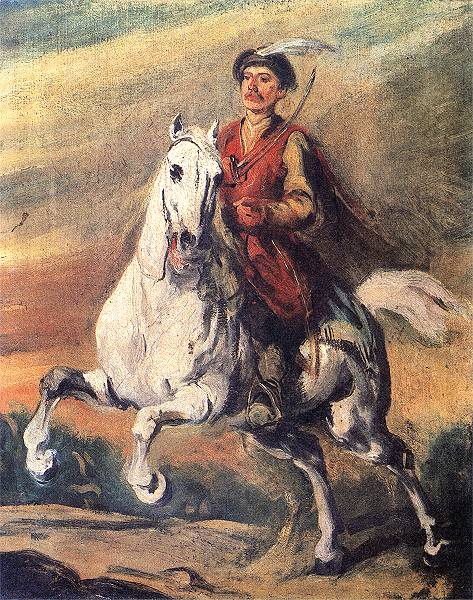
 Juliusz Kossak's Lisowczyk 
Kossak's lisowczyk2
Michalowsk Jezdziec Lisowczyk
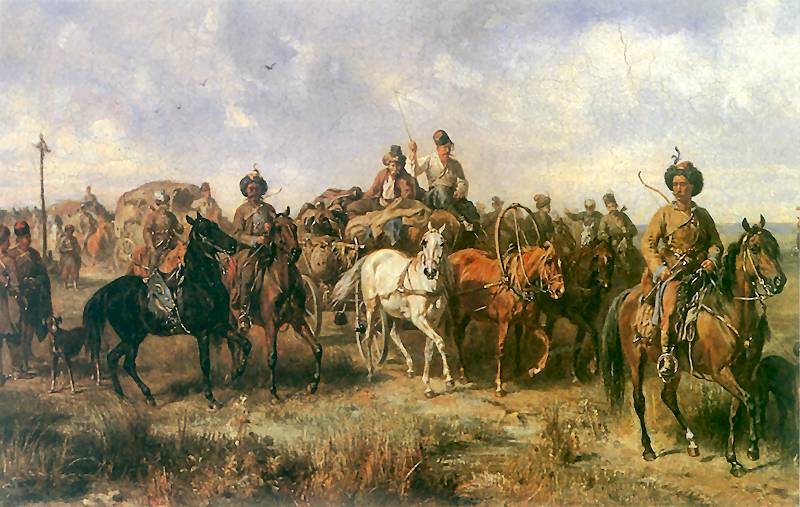
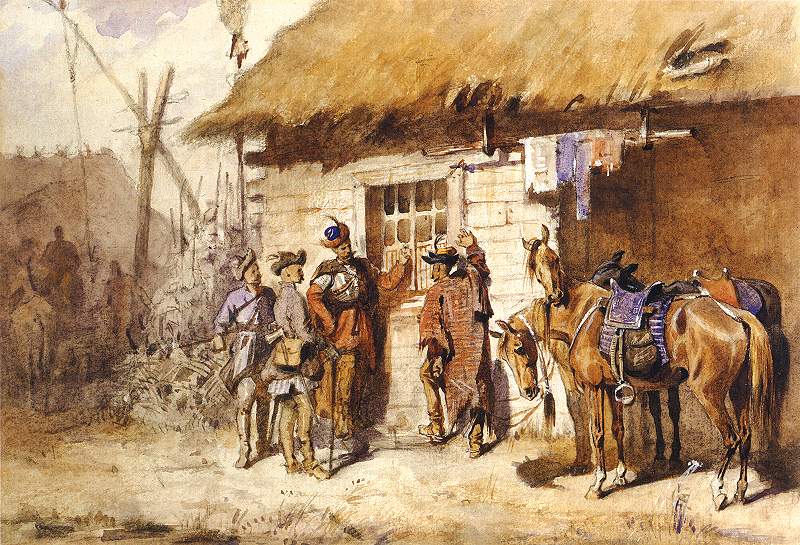
  Brandt Pochod_Lisowczykow.jpg
Brandt Lisowczycy_przed_gospoda
  Brandt Lisowczycy Strzelanie z luku 
in the last painting please note the Moldavian border fortress of Khotin (Chocim) in the background  wiki/Khotyn  .
The Polish-Lithuanian  Commonwealth army is pictured in the foreground, the gathered banners and regiments and Cossacks are already getting a horsearchery show by the lisowczycy while the Polish forces have been preparing to fight to death at  this southwestern border of Commonwealth, being entrenched within their much fortified camps around the Khotyn fortress, they know the Ottoman Turkish army augmented by the Tatars would come soon, it is AD 1621.


I will post progress of this one too, later next month, I hope..

ps
  interesting blog (in Polish)  by painter Jarek Glod who is copying/painting great Kossak and other masters' works and showing his own works' progress  http://nabial.blogspot.com/2008_11_01_archive.html