Showing posts with label Alfred Jacob Miller. Show all posts

Wednesday, September 4, 2024

Caravan 1839- Friedrich Adolph Wislizenus

 Salvete Omnes,


Archive World Library has a  number of works on or about dr Friedrich Adolph Wislizenus. German-American medical doctor, somewhat a revolutionary, American diplomat and traveler, who in 1839 made a journey along the Rocky Mountain Fur Company caravan to the Rocky Mountains. 


The journey produced a journal or sketches in German, published in 1840 in St. Louis,  that was published in English by the Missouri Historical Society in 1912.


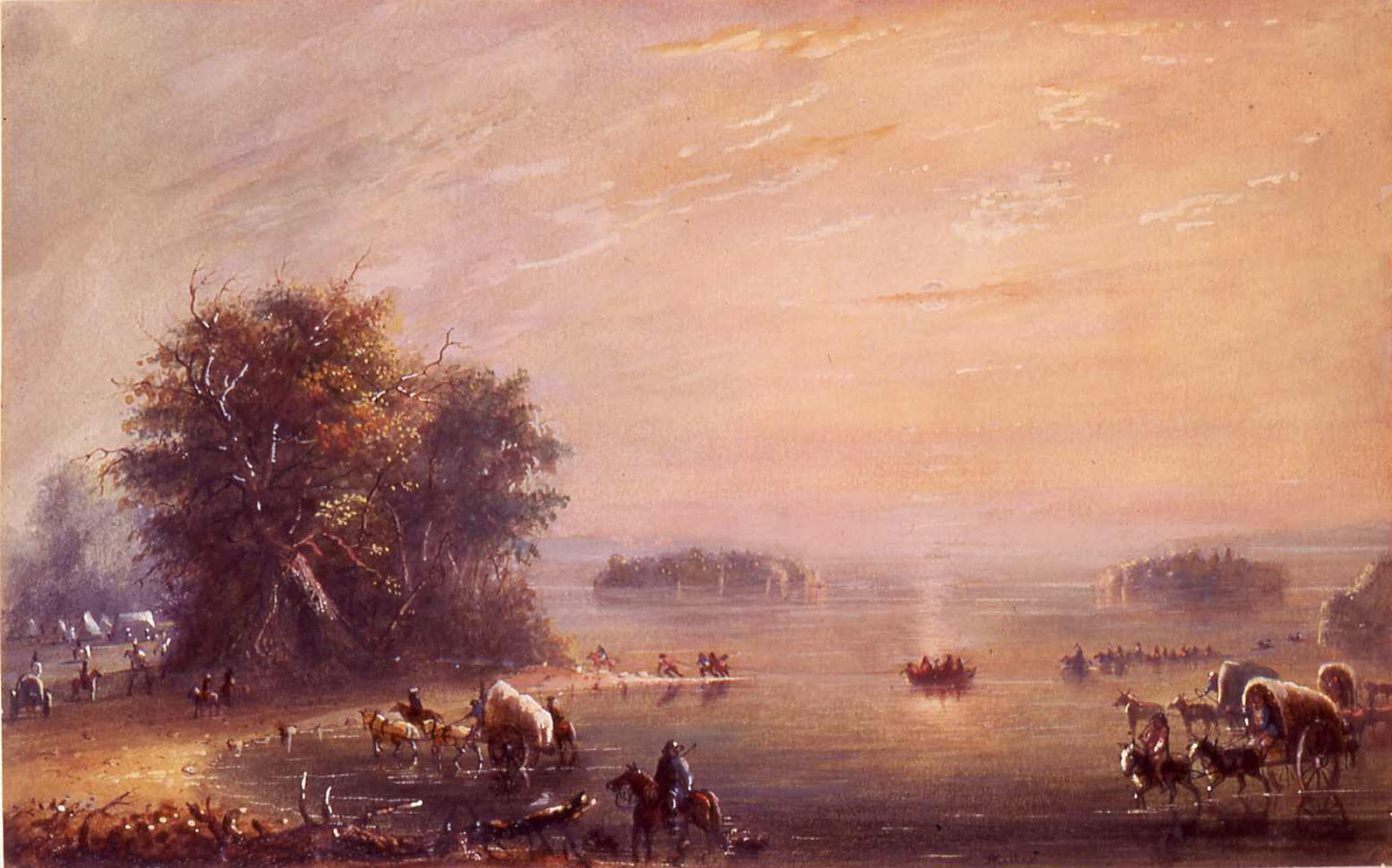
I would like to point your attention to the chapter on the caravan or the daily activities of this outfit going west from Sapling grove, 80 miles from West Port, a border village not far from Chouteau's Landing in Missouri in April 1839. 

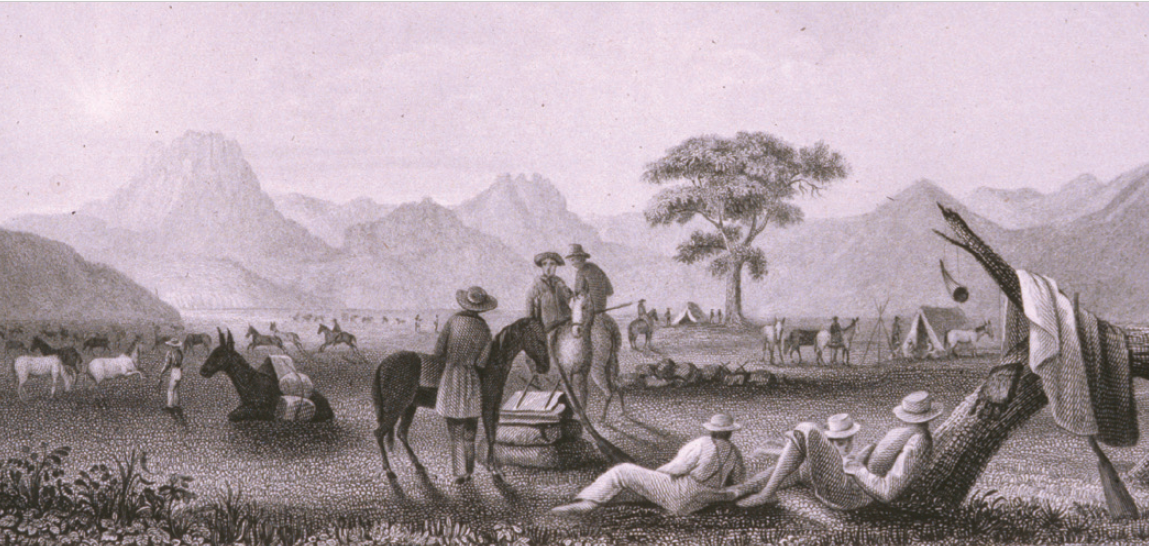
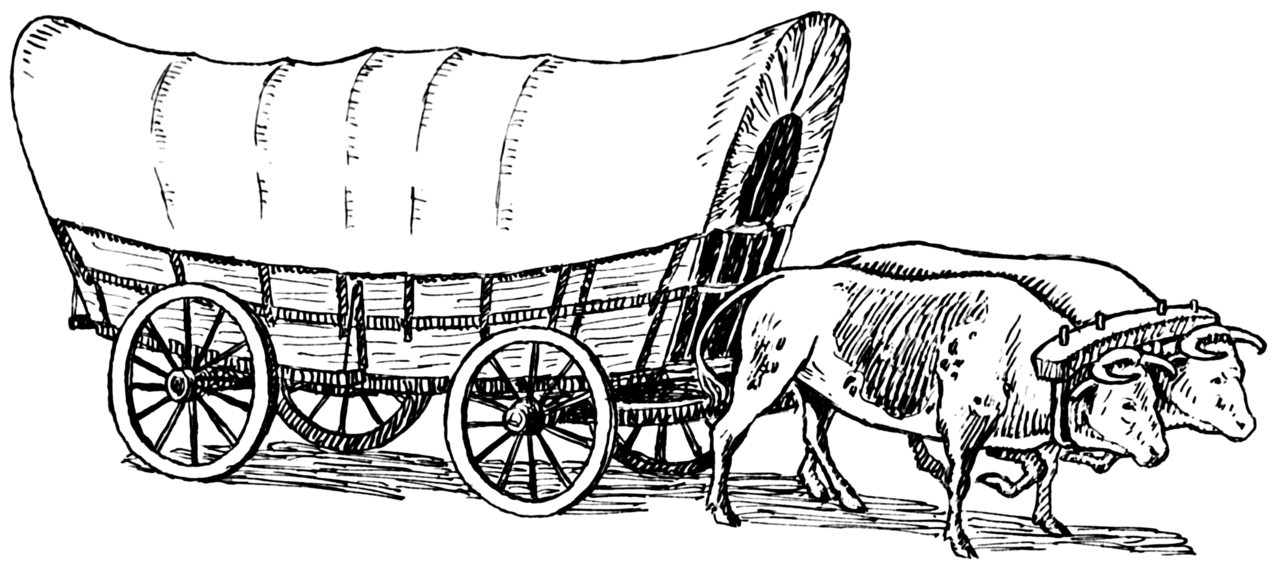
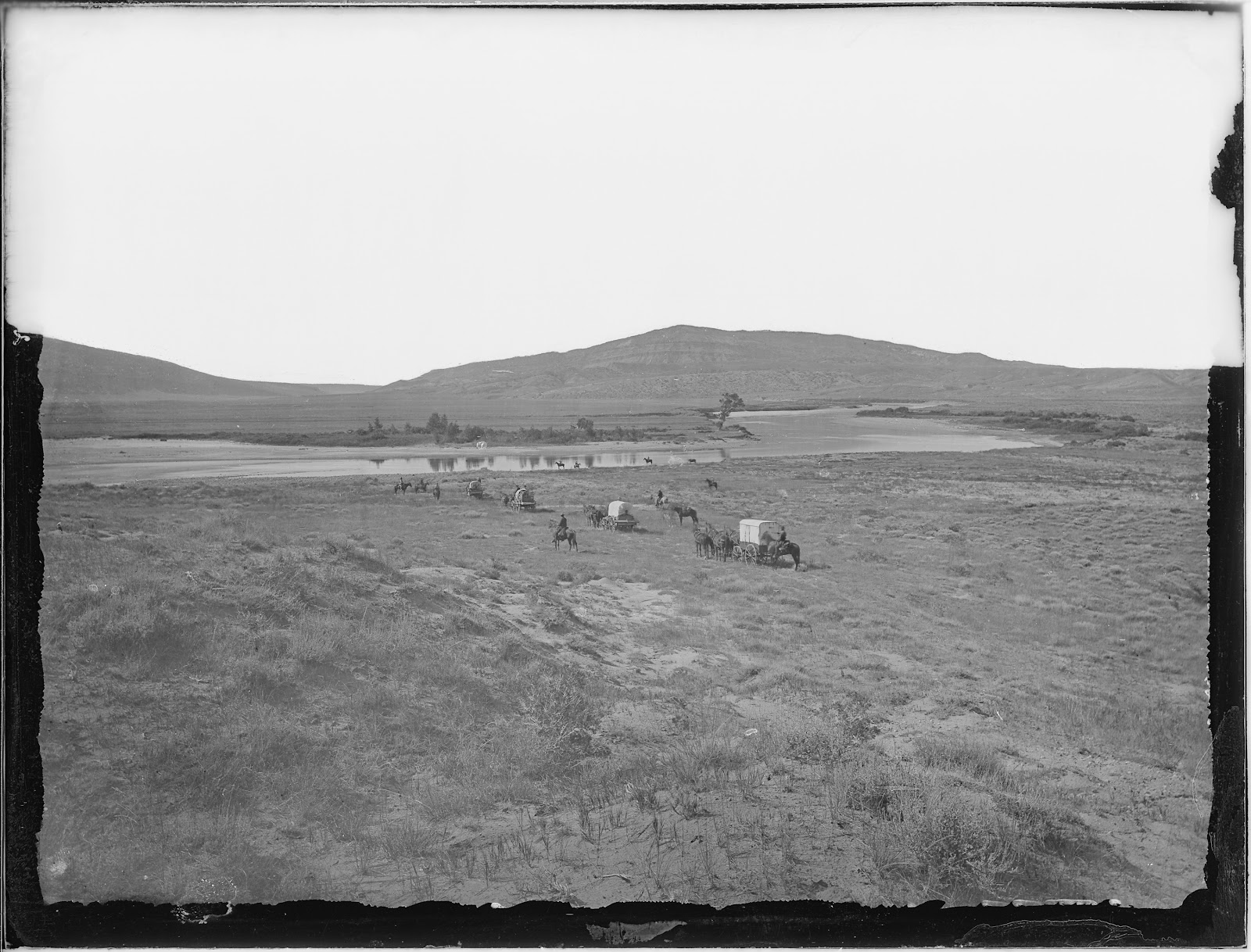
The caravan, led by  mountain man Harris,  included 27 persons, including two women, wives to two missionaries, the 3rd missionary was single. They had 4 two-wheeled carts drawn by two mules. 

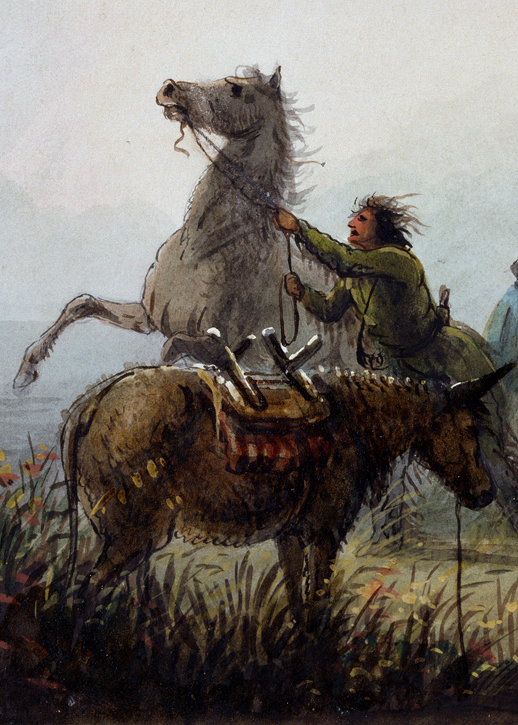
saddlin' the pack saddle on the mule

We learn that first they let the animals graze - to prevent them from straying far they hobbled them (details on page 30), each animal drag a long rope of buffalo leather - a trail-rope.


.

at night the horses and mules were fastened to stakes (pickets)  by their trail-ropes.

the caravan moved with the leader with his company carts in front, the line behind him with riders and pack animals

this way the caravan covered 20 to 25 miles daily across the western prairies...


.


Valete

Thursday, June 6, 2024

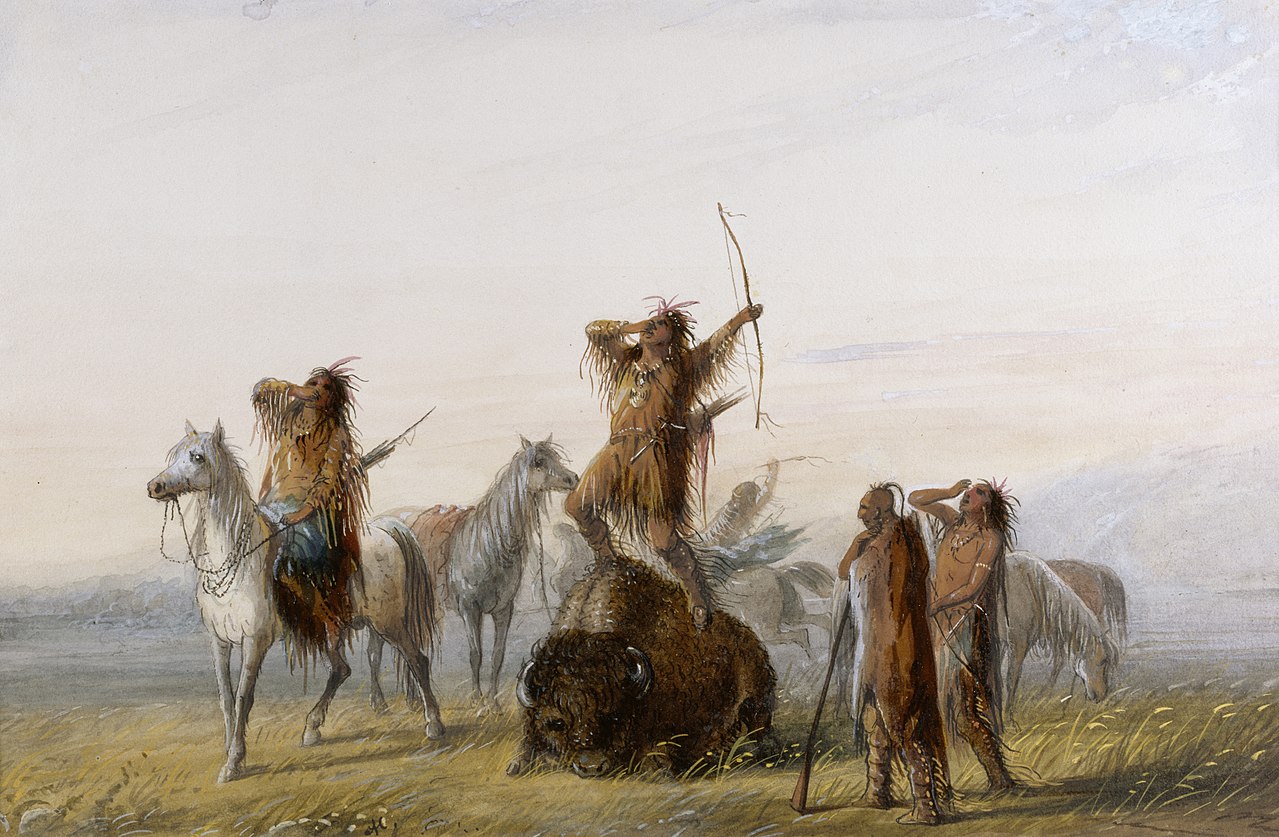
Alfred Jacob Miller - hunting on the High Plains - elk or wapiti

 Salvete Omnes,


a little visit to the High Plains  and the hunting of various beast, be it on horseback or on foot- from ubiquitous bison, plentiful elk to mountain sheep and fleetest antelopes - as shown in the sketches and paintings by Alfred Jacob Miller. 

Today just our American wapiti aka  the elk -  


From Miller's notes on the elk -

'The hunters are taking a flying shot at a herd of elks as they pass, for running the Elk is useless, their speed far outstripping that of the horse. The stratagems resorted to. are - creeping to the point of bluff when they are known to be lying under it; heading them off when practicable; forcing them into a river; or lying concealed at some point where they are likely to pass. When the buffalo became scarce, we found the Elk to be most desirable acquisition on the prairie larder, more from the quantity of meat than the excellence as food, as we considered it inferior to either Buffalo, Bear, Mountain Sheep, or Antelope'
 'the Indians manufacture a beautiful buckskin  from their hides, very soft and strong, which they make leggings, giving it a rich tint by a peculiar process of smoking; -they form  of it also sacks to carry their pemnican and jerked meat, and from the horns they make the most efficient bows. [...] The herds of elk  rarely number more that four or 500 [elk] [...] and they were very shy and wild.'


ps


driving from New Mexico into Colorado across the mountains I have seen large herds of elk grazing on the Rocky Mountains' slopes... 

Valete

Tuesday, February 20, 2024

Cheyenne buffalo runner - Marxist view on Plains nomads labor

 Salvete Omnes,


A little entry, on the Marxist side in tone and character, on the hours of labor/work Plains horse people spent getting a buffalo/bison in their mounted bison chase/hunt.


 from 'Native Americans and Wage Labor' – Alice Littlefield & Martha Knack editors (1995)


John Moore’s article -  Cheyenne  work in the history of U.S. Capitalism.


The Cheyenne buffalo horse


p.127-128 – the last Cheyennes horse trainers aka consultants were interviewed: 

Edward Red Hat Sr., Roy Bull Coming, Henry Mann (Horse lodge members).

Provided estimates for horse & equipment:

  -   a horse, less than 2 years old when started, is gentled daily 

by the boys who herded the horses as well as by the owner.


After the training period this horse - about 4 years old - hunts for 4 years, [participated] in

in killing of 200 buffaloes [bisons].

Horse's saddle and tack lasted also for 4 years. 


Three bows and 80 arrows were used during this period of hunting(conservative estimate). 


Training - 200 hours

Making saddle – 80 hours

making tack – 80 hours

making 3 bows – 120 hours

making 80 arrows – 320 hours

finding bison – 800 hours

total 2,150 hours or 10,7 hours per buffalo killed


Valete

Wednesday, April 26, 2023

Days on the road - Sarah R.H. crossing the Plains on her bay pony

 Salvete Omnes,


I just have finished listening to Days on the Rad  (Archive audiobook) - by Sarah Raymond Herndon, a Missourian who along with her family crossed Great Plains going to Virginia City , Montana in 1865.   

You can read the book too - also on archive.org. 

The book - based on the journal written during the travel from Memphis, Tennessee to Montana,- starts on May1, 1865. Our narrator was sort of an Amazon, she rode her horse or rather a pony named Dick, and she was not alone, more girls rode  with Sarah, often ahead of the train or along with the moving train.
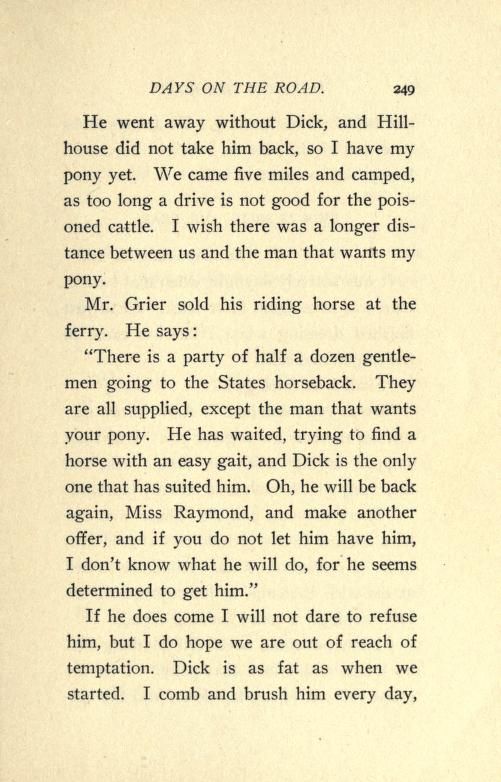
We read about Sarha saddling and riding her pony, but more about this horse appearance we learn at the very end when Sarah was sort of bullied into selling Dick (for 125 dollars in gold dust ) to a miner returning to the 'States' from the gold fields of  Montana. Here is the tale as she told it:


Sarah not only rode her pony, but also drove the wagon, as she was traveling and living in it with her mother and 2 sisters. 

prairie schooner and a pair of oxen


Their small wagon train crossed the Plains during the Indian war and hostilities, causing this small group of migrants to be fearful and very watchful, but thankfully they suffered no encounters with the Sioux and Cheyenne warriors scrimmaging with US Army's cavalry and infantry deployed on the Plains. She said in her diary that she was afraid more of a wind- storm  than of Indians.

They suffered one killed from a loaded gun accident, the negligence on the part of the gun owner. 

McClellan saddle at Fort Kearney


At Fort Kearney, Nebraska, Sarah came across the former rebel (Confederate) soldiers and officers from Georgia and Alabama, who were forced into the federal army and service on the wild Indian frontier. Arriving at Julesbourgh they came there 2 weeks(she says 3,, but the fight took place on  June 7, whereas she arrived there on June 21)  after the big fight between the Army and Indians had occurred there. She saw some Indian women and children prisoners taken at Fort Laramie, and spoke with more former Confederate soldiers forced into US Army.


Sarah had no high opinion of the Indians she encountered on her trek, and her depictions of her encounters rather shows the destruction of the native peoples in face of the progress and passing of their way of life (still some 10-20 years away).
I like this book for what it is, and if you are interested in the 1860s pioneers' experiences  while crossing the Plains  and told by a young woman then this book is for you too. 

nota bene, here is a link to Goodreads with their ratings and little 'reviews' about this historical diary.

Valete

Monday, August 14, 2017

Hunting bison - bison jump

Salve,
we are going to return to the bison hunting in North America.
The story of Lewis and Clark Expedition provides the reader with many glimpses into the life of the Great Plains peoples, including the hunting methods and customs.
Today I would like to point you to the part where they describe the method of killing bison by stampeding them down a cliff - or so called bison jump - famous Head-Smashed-In Buffalo site in Alberta, Canada, and many others in the US. The method, if successful resulted in huge number of killed animals and many wounded and led to the extermination of the entire stampeded herd. In the days before the coming of the horse this was probably the most common technique used to secure large kills, perhaps the summer-autumn hunts when bison was in its peak condition.
In his paintings Alfred Jacob Miller gives us examples of this hunting technique - one here, and one below. He, however, left no written description of such event, only painting the scenes.
Interestingly the hunters are mounted in his works, whereas in the Lewis & Clark description the horses are not mentioned at all. It does not appear from the description that the expedition members witnessed such hunt themselves.


Lewis & Clark
chapter - UP THE MISSOURI
[p307-308] Near this spot are a few trees of the ash, the first we have seen for a great distance, and from which we named the place Ash Rapids [Drowned Man’s rapids]*. On these hills there is but little timber, but the salts, coal, and other mineral appearances continue.
On the north we passed a precipice about one hundred and twenty feet high, under which lay scattered the fragments of at least one hundred carcases of buffaloes, although the water which had washed away the lower part of the hill must have carried off many of the dead. These buffaloes had been chased down the precipice in a way very common on the Missouri, and by which vast herds are destroyed in a moment. 
The mode of hunting is to select one of the most active and fleet young men, who is disguised by a buffalo skin round his body; the skin of the head with the ears and horns fastened on his own head in such a way as to deceive the buffalo; thus dressed, he fixes himself at a convenient distance between a herd of buffalo and any of the river precipices, which sometimes extend for some miles.
His companions in the meantime get in the rear and side of the herd, and at a given signal show themselves, and advance towards the buffalo; they instantly take the alarm, and finding the hunters beside them, they run towards the disguised Indian or decoy, who leads them on at full speed towards the river, when suddenly securing himself in some crevice of the cliff which he had previously fixed on, the herd is left on the brink of the precipice; it is then in vain for the foremost to retreat or even to stop; they are pressed on by the hindmost rank, who, seeing no danger but from the hunters, goad on those before them till the whole are precipitated and the shore is strewed with their dead bodies. 

Sometimes in this perilous seduction the Indian is himself either trodden underfoot by the rapid movements of the buffalo, or missing his footing in the cliff is urged down the precipice by the falling herd. The Indians then select as much meat as they wish, and the rest is abandoned to the wolves, and creates a most dreadful stench.

The wolves who had been feasting on these car- cases were very fat, and so gentle that one of them was killed with a spontoon.


*originally the place was called Rapids of the Drowned by the French-Canadian voyageurs but when translated into English, it erroneously became Drowned Man’s Rapids, despite numerous deaths, L. Wischmann, Frontier Diplomat, Alexander Culbertson and Natoyist-Siksina’ among the Blacfeet, p 71

enjoy

Wednesday, June 22, 2016

Batty - HOW INDIANS HUNT THE BUFFALO

Salve,
Joseph Batty wrote on How Indians Hunt the Buffalo [on horseback and in 1870s].
Hopefully in the future I will provide more primary accounts describing the bison hunting techniques of the Great Plains tribal peoples:


Were it not for the buffalo, the Indians of the southern plains would be deprived of food, and also of bedding, clothing and teepies which the skins furnish ; even now there is so much hunting by the Whites that the number of buffalo are greatly reduced, and the Indian's comfort, comparatively speaking, is already gone. On the northern plains they remain yet in greater numbers, but their final destruction is inevitable everywhere.

The Great Fall Hunt

" The great Fall hunt " is the Indian's harvest and annual feast. 
Never is he in such good spirits, never does he hunt with such excitement, and never is his insatiable appetite so gratified.
 In September, bands start out well provided with teepies, guns, ammunition and horses. They travel sometimes hundreds of miles before reaching a buffalo country, camping each night when darkness overtakes them. When finally reaching a place where buffalo are known to abound, runners are sent out to sight them. When they return with good news, the Indians, anticipating the hunt, are thrown into great commotion; they strip themselves of all clothing except breech clout, and moccasins, and some deck themselves with feather head-dresses. 

Saddles are removed from ponies and riding pads substituted. 
Young bucks are sent out to choose desirable camping ground near water, and when a place is decided upon, squaws and trappings are sent for. The squaws get up the teepies, erect scaffolds for drying meat, and make all preparations needful to camp comfortably. 
The hunters that have started on their ponies ride until a favorable herd of buffalo is dis- covered, then, as well as diversity of country will admit, they slowly surround them at a distance. It is seemingly understood that they shall all dash forward after a certain length of time, and they come in a fury of speed, yelling inhumanly, and shouting the "whey! whey! whey !" to their horses. 

Each Indian singles a buffalo and follows it in every direction, and the form of the surround is lost. So perfectly trained is the pony, and so skilled in hunting is the Indian, that in every effort to turn or get away, the buffalo is pursued as it were in shadow, and unto death. When the first buffalo falls, the Indian looks forward, and if any scattering ones are seen, a second chase ensues. Old men and young bucks not engaged in the fight stand at specified distances with extra horses, and when those in the chase give out, the rider drives up to those. in reserve and exchanges. 

The hunting is done as near camp as possible, and the squaws are sent for to skin and dress the buffalo that have fallen within reason- able distance. Each of the animals too far away to be reached, are partially skinned by the Indian who has killed them, and they will often tear the liver and heart from a buffalo while warm, and devour it with the relish of wild beasts; the best meat is cut out in flakes, and piled and tied on the ponies. They are cruelly overladen, and the meat hangs so low on each side that it usually drags upon the ground, gathering much dirt, which is never removed, but allowed to dry in ; then, as if the poor pony was not sufficiently loaded, the Indian takes his seat upon the top of the meat and rides to camp, the pony staggering beneath the load. Both pony and rider become saturated with blood, and neither are ever cleaned. If the chase has been a successful one, the remains of partially dressed buffalos are left; but if not, they return, and the carcass is cleaned and meat taken to camp. Sometimes those who have not been successful in the chase will assist others in dressing game. 

At night a great feast commences, in which men, squaws, bucks, children, and even the dogs participate. Singing, dancing and wild games are enjoyed, and the most immoderate eating that man or beast could be guilty of is indulged in. The intestines of the buffalo are considered the choicest parts, and are devoured by the Indians in a most disgusting fashion. They often eat, at this feast, the greater portion of the choicest meat of the first day's hunt, but on the second day and afterwards, meat is prepared for the Winter. 
Day after day the hunt is continued, a chase often being six miles long, until meat enough has been obtained for the Winter, or until intense weather puts an end to the sport.
[...]
The squaws do all the drudgery; they prepare the meat, and hang it on the scaffolds to dry. In damp weather it is often partially smoked by fires being made beneath it when drying. The squaws often skin the buffalo, and always dress and tan the robes. Few skins are used early in the season, except for teepies and lodges.
When the Winter coat of the buffalo is half grown, it is at its best, and the squaws begin to tan robes for trade and their own use. Very strong lariats are woven by the Indians, out of the fine hair from the fore shoulders of buffalo, for which they get fabulous prices.
Some Indians use the army revolver in the hunt, some the carbine or Winchester rifle, while others use the bow. 
A warrior snatches an arrow from his quiver over the shoulder, springs the bow with a magic hand, and in an instant buries the arrow to the feathers in the flesh of the buffalo. 
The arrows are marked in colors near the feathers, so that each can be recognized, and the game claimed by the owner of the one which, by its position, indicates that death was caused. 
 
***

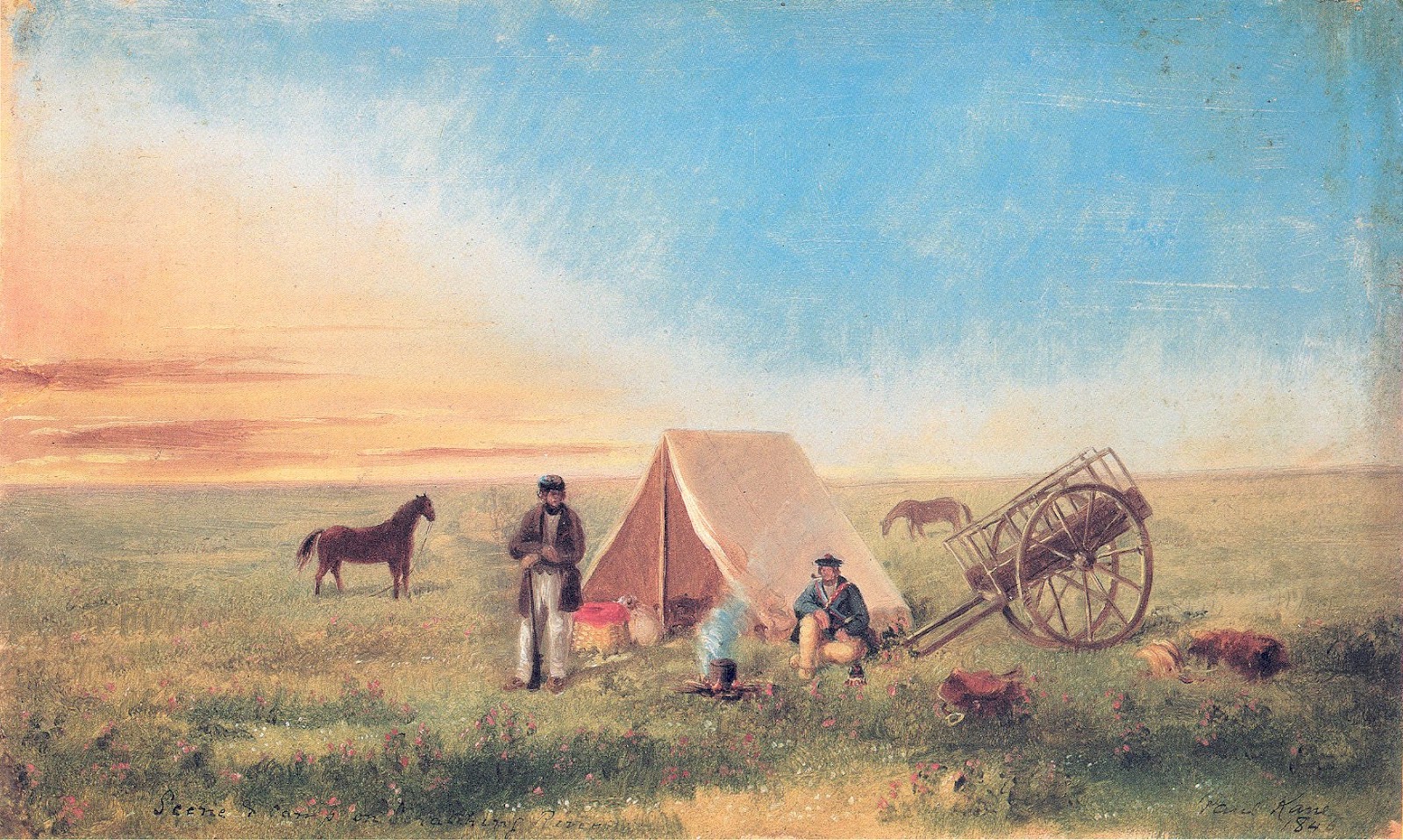
Images are from Wikimedia Commons and are photos of paintings done during the XIX century - Alfred Jacob Miller, George Catlin, John Mix Stanley, Paul Kane & Karl Bodmer.

Monday, June 18, 2012

Plains Indian Shields - historic references II

Salve amigos y amigas,
this is a continuation of my Plains Indians shield historic references theme
George Catlin


.


 Keokuk, chief of the Sauk [and Foxes], a frontier (woodland and prairie) tribe that was affected by the horse and Plains Indian equestrian culture, and eventually fought wars with US - Black Hawk War - and the tribes of the Great Plains

 Karl Bodmer


 Alfred Jacob Miller

.


.
Photos


Remington's warrior
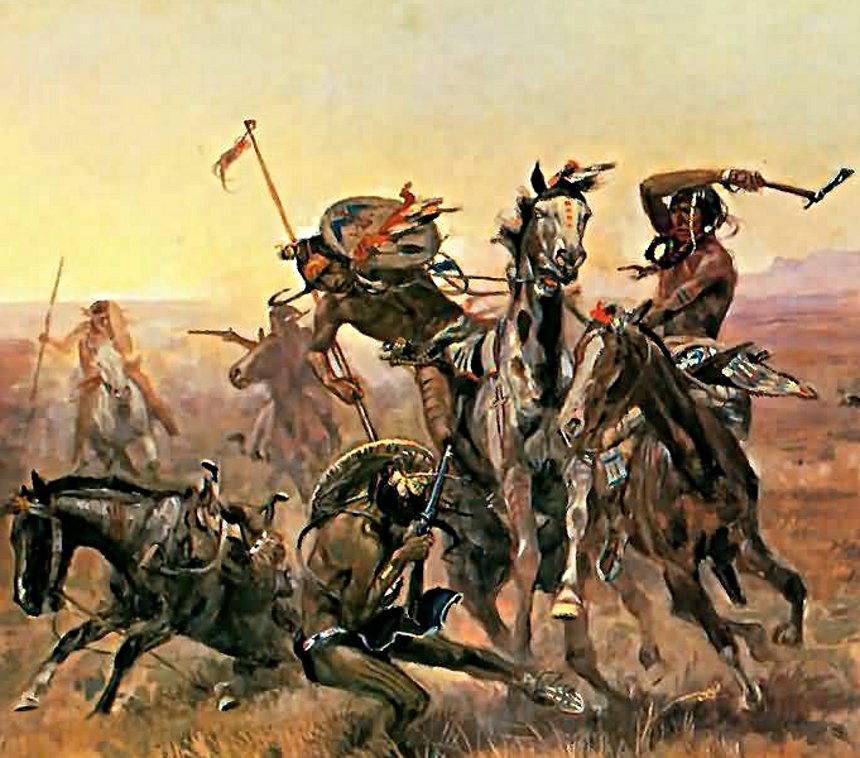
and finally the best late XIX century and XX century 'Plains chronicler' Charles M. Russell