Showing posts with label tilt/jousting. Show all posts

Thursday, March 20, 2025

Dequitem - mounted lance vs pedestrian knight video

 Salvete Omnes,


a short entry - modern jousting & armored knight reenactment.

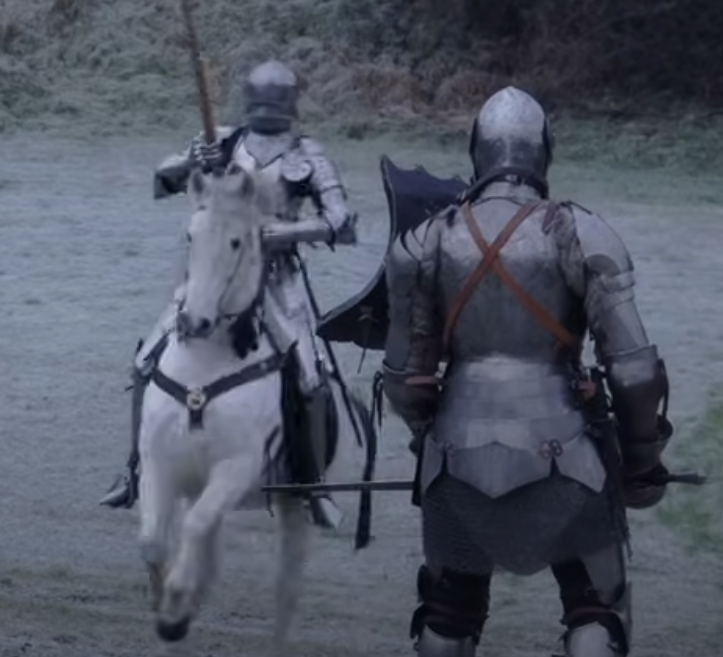
about a month aga two European knightly reenactors Messers Arne Koets and Dequitem presented two video recordings on the subject of a Knight Duel in plate armor, a sort of experimental archaeology


1. How does it feel to get hit by a lance as men at arms on foot? - link.


2.The Knight Duel | realistic, non-choreographed medieval combat - link.


attached a a few screen shots from both video recordings - enjoy

Valete

Saturday, June 22, 2024

Wilhelm Peter Zimmermann - running at the ring - illustration circa 1613AD

 Salvete Omnes,


a little canter into the early XVII century Hapsburg realms - back in 2023 I discussed the topic of these prints when talking about the quintain. You can read the details of this wedding and personages present & depicted in my post.
The art of Wilhelm Peter Zimmermann was the author of these images, a rather prolific artist who documented events and wars  of this period.

Gottinger Digital Library contains this volume - Beschreibung und kurtze Radierte entwerffung der Füsrtlichen Hochzeit/ So Der Durchleuchtig/ und Hochgeborn Fürst und Herr/ Herr Wolffgang Wilhelm/ Pfalzgraff bey Rhein/ Hertzog in Bayrn... Mit.. Fürstin Fraw Magdalena/ Pfalzgräfin bey Rhein/ Hertzogin in Obern und Nidern Bayrn. Zu München/ im sechszehenhunfert und dreyzehenden Jahr/ den zwölfften Novembris Celebriert und gehalten (Wilhelm Peter Zimmermann, Augsburg, 1614).


When a princely wedding gave occasion to the displays of equestrian, chivalry,  of horsemanship and lance skills in this German state on the eve of the Thirty Years War (1618-148). 


.


Valete

Thursday, March 19, 2020

the tilt at Quintain in the early modern England

Salvete Omnes,
a short post or perhaps not so short - :)
one of the great and rather fundamental exercise to learn and to hone one's  skills with a lance while on horseback was the tilt at the 'quitain.'
Samuel Johnson (1805) in his A Dictionary of the English Language has this definition -
Quintain - a post with a turning top, and the he tells us to look up a Quintin -
An upright post, on the top of which a cross post turned upon a pin; at one end of the cross post was a broad board, and at the other a heavy sand bag: the play was to ride against the broad end with a lance, and pass by before the sand bag, coming round, should strike the tilter on the back.
 
I have been perusing the Wiki Commons collections and came across this image of a quintain:

Apparently this Kentish village's quintain is quite old, as the ancient   lance exercise - tilting at the quintain - had been alive into the early modern or even post-Puritan revolution (aka English Civil War) period. 
well, I say that because it appears that during the later part of  XVII century there was still some practice with lances (ok, strong poles or staves) in the countryside.

For evidence we have this interesting description taken from 'The Natural History of Oxfordshire' (Robert Plot, 1677):
''They first set a post perpendicularly into the ground, and then place a slender piece of timber on the top of it on a spindle, with a board nailed to it on one end, and a bag of sand hanging at the other; against this board they antiently rode with spears. Now, as I saw it at Deddington on this county, only with strong staves, which violently bring about the bag of sand, if they make not good speed away, it strikes them in the neck or shoulders, and sometimes knocks them off their horses; the great design of this sport being to try the agility both of horse and man, and to break the board, which whoever does is for that time accounted princeps juventutis. It is now only in request at marriages, and set up in the way for young men to ride at as they carry home the bride, he that breaks the board being counted the best man.''

In 1813 J.N. Brewer (Topography of Oxfordshire) remarked that ''the sport is now  entirely disused, and the oldest man in the town does not remember to have heard his father mention the custom in any other than a traditional way.''

Curiously, during the Peninsular War the British and Spanish forces were truncated more than a dozen times by the Polish lancers in the French service.
In 1816 some of the British cavalry regiments (eg 12th  Royal Lancers, 16th Queen's Lancers  ) became lancer regiments, and tilting must have resumed as part of the training.

a photo of modern reenactment from the famous Malbork castle in Poland (naturally famous for the Teutonic Kinghts, but also the seat of the Malbork voivodeship in the Polish Kingdom AD1466-1772)

Valete
Monday, July 10, 2017

Passages d'outremer & Experimental Lance Technique

Salvete omnes,

the article by dr Tobias Capwell on the late medieval couched lance technique and experiments done by the reenactors using such technique.

 Also, the great French digital library provided us with a scan of the entire manuscript titled Passages faiz oultre mer par les François contre les Turcqs et autres Sarrazins et Mores oultre marins (short title Passages d'outremer and can be bought in a modern edition from Taschen), written by Mamerot and with the illuminations that were  painted by Jean Colombe  during AD 1472-75. These paintings, painted for Louis de Laval, are extraordinary and just beautiful - using the library is easy and illusminations can be enlarged and downloaded for your use and enjoyment.

Italian XIX century painter Ludovico Marchetti's painting - Before the trounament

enjoy

Monday, April 6, 2015

Smigus Dyngus

Salve,
I hope your enjoyed your Smigus Dyngus day :)

         Vízbevető - Easter Sprinkling or Water Plunge Day  according to the XIX century Hungarian master Mihaly Munkacsy

- :)
                                                             * * *
          this year Easter Tournament at the Royal Armouries Museum at Leeds is over, but you can always train for the next one  -
before you do,  here  there is a clip showing jouster Jan Gradon, team Poland, striking another knight Ben van Koert, team Burgundy, ending in  'pan' Jan scoring a direct head strike while 'ser' Ben a shield one, and no injuries....
Greatly trained horses, I must add ..

Monday, March 30, 2015

Easter Tournament - Leeds Royal Armouries Museum April 3-6, 2015


Salve,
this Easter holiday a very interesting event will be taking place at the Royal Armouries Museum at Leeds, UK.
Namely,  a knightly tournament ! 
Two  knights-reenactors from Poland will be participating in this serious championship event - pan  Jan Gradon and pan Jaroslaw 'Jarek' Struczynski

Facebook page of the Torournament
Blog devoted to the event, knights and horses (yes! )
Interview with Jan Gradoń on Jousting Life
Jarek Struczynski won 2013 Tournament of the Phoenix in California -  reported Jousting Life.
so if you near by perhaps visit and send me some pictures to share with the rest of us :)


                                                     ***
many thanks to imci pan Jan Gradoń for letting me use the photoshowing himslef and imci pan Jarek.
                                                     ***

                Wielkanoc tego roku w Leeds, UK to turniej rycerski  - od 3 do 6 kwietnia 2015. 
Dwóch Polakow, rycerzy szlachetnych a dzielnych,  będzie potykać się w szranakch turnieju Jej Królewskiej Mości Królowej Elżbiety II z plejadą rycerzy z reszty świata. 
                                          Życzę Waszmosciom powodzenia!! - 
                                                                    *** 

                                                   Audaces Fortuna Iuvat. 

Friday, September 27, 2013

Antoine de Pluvinel - images from the treatise part 4

Salve,
 again our good ecuyer Antoine de Pluvinel  and Crisspin de Passe's images from Pluvinel's treatise on horsemanship.
This time it is all about training horse for the tournament and eventually for war; in the final duel the rider must show chivalry, sensible deliberation and firmness in saddle (Piero Monte),  lightness of movement, cool head and loyal and courageous horse with strength and easy gait (Jean de Bueil), grace, courage, and strength, while playing with  lancework at the tilt  .


Enjoy
 By th way this is the end of Pluvinel/de Passe plates

By the way I found today this great site - Anthropark  - reconstructing prehistoric Europeans by Czech artist  Libor Balák.