Showing posts with label hussar shield. Show all posts

Friday, April 7, 2023

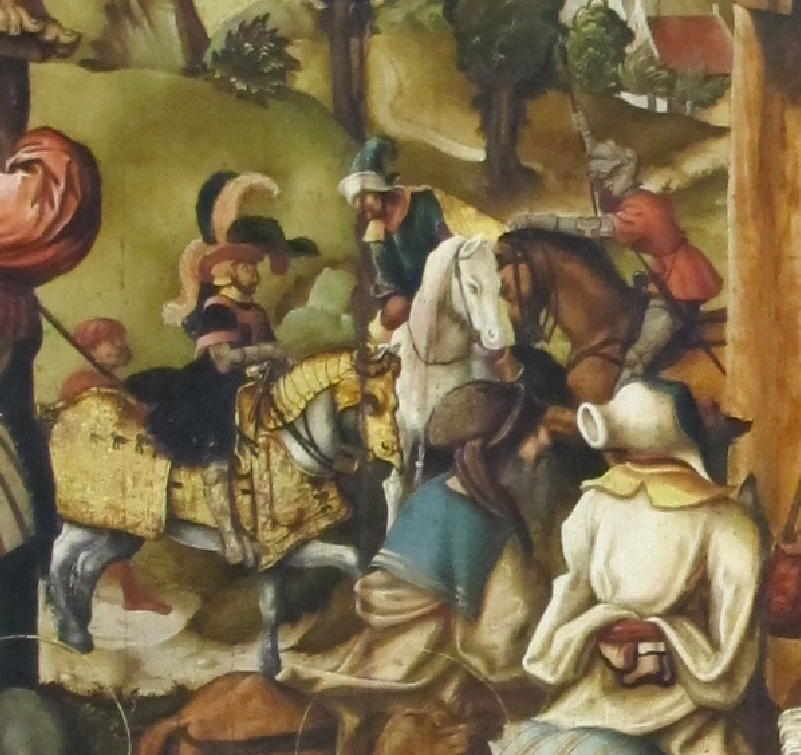
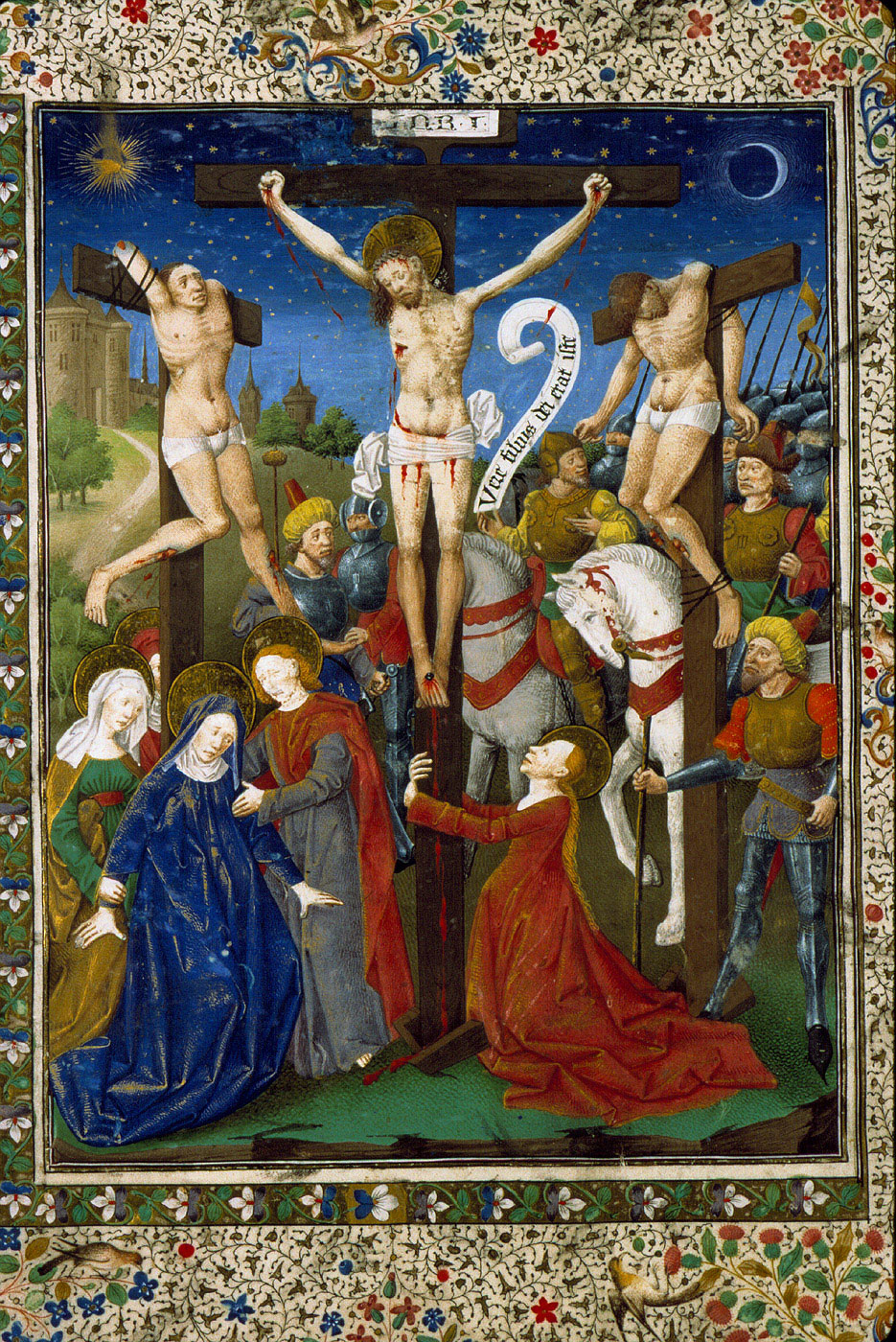
Jorg Breu the elder - Crucifixion & horsemen

 Salvete Omnes,


master of Missal of Jean de Rolin

Good Friday - Crucifixion -
Jorg Breu the elder (1475-1537) pinxit


splendid horse armor and lancer-knight armor


an early armored hussar with a Hungarian shield

beautiful horse armor on a gray horse

Valete

Thursday, September 8, 2022

Orsza 1514 -2022

 Salvete Omnes,


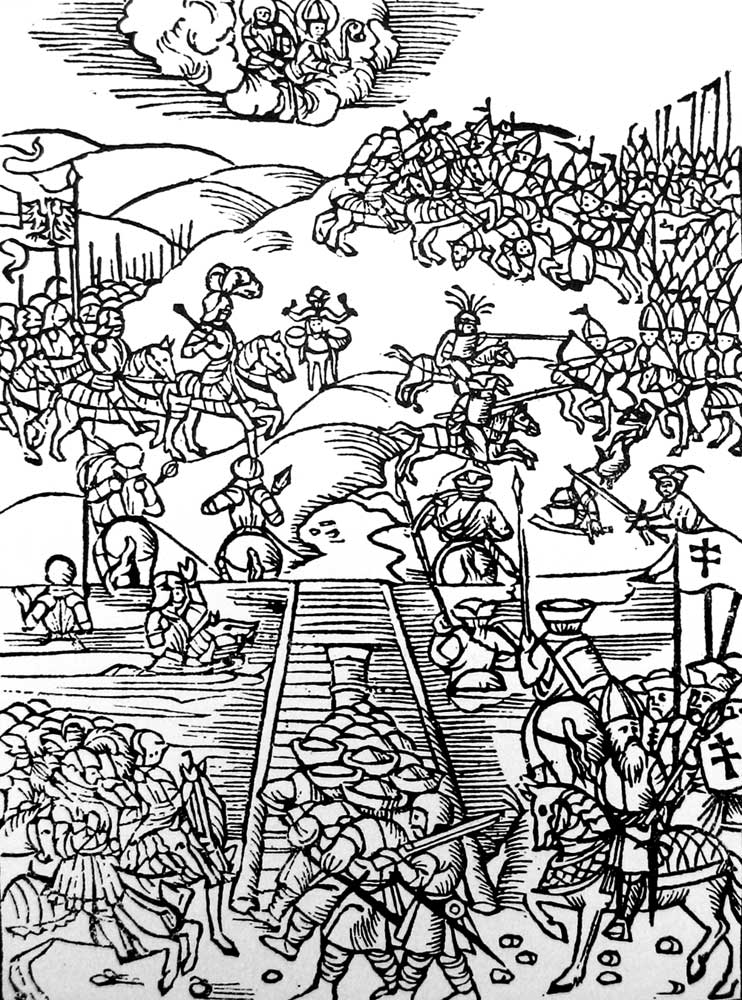
and as every year on this day we commemorate the 2nd battle of Orsza 1514AD.


King Zygmunt I Stary (Sigismund I the Old) and his army commanded by prince Konstanty Ostrogski, Ostrogski coat of arms, and hetman Janusz Swierczowski, Traby coat of arms,  won resounding victory over grand prince Vasili III and his  Muscovite army(augmented with the Tatar allied and converted recently into Orthodox Christianity).


 Our king lost Smolensk, his largest and most needed fortress, to Vasili III and his commander Lithuanian Michal Glinski in July 1514- perhaps a 80 thousand strong Muscovy army , with camp followers, servants and retainers, invaded our king's eastern realms in the Spring of 1514Ad.
Polish historian and prolific researcher of this period  prof. Marek Plewczynski puts some blame on the Lithuanian commander prince Ostrogski, who perhaps like the ancient Cuncator tried the tactic of  hanging on  awaiting for the expected large number of Polish Crown troops, but before they could have come to the rescue the fortress of Smolensk fell to mighty charm or magic spelled by prince Glinski. The stronghold at Orsza, however,  defended by Jan Spargeld with resolve and under much less assault than Smolensk withstood perhaps a weaker Muscovite siege and repelled their assaults until king's army came in August.

Having gathered his nobles, retainer, mercenaries and volunteers it was at Minsk in Grand Duchy of Lithuania where our king reviewed his armies before seeing them go east: 


 - 15 thousand Duchy horse - commanded by prince Ostrogski and prince Jerzy Hercules Radziwill.


 - 14 thousand crown horse (heavy lancers, early hussars and light horse armed with crossbows and bows and some early firearms perhaps, and 3 thousand crown  infantry -  this Crown contingent was commanded by Swierzowski, 

 -2,5 thousand court horse, and several thousand of Polish lords private volunteer retinues- commanded by Wojciech Sempolinski, Nalecz coat of arms.

Perhaps as many as 38 thousand horse and men including unknown number of guns, plus many thousands of camp followers and retainers had gathered at Minsk to march onto river and seek a return of captured Smolensk to our lord king's domain.

King decided to stay with 4 thousand soldiers at the fortified camp at Borysow, on the Berezina River, while the combined king's army marched having forded Berezina and forced, with artillery fire,  the vanguard of the Muscovite army to quit the vicinity of Berysow on August 27 and then the royal army marched after the enemy toward Orsza and Dnieper. On the 28 of August Polish vanguard led by Jan Pilecki defeated a Muscovite rearguard ambush, and our royal army continued on the Orsza Road to the Bobr River crossing where at this ford another action was fought, where starost of Rohatyn Jan Boratynski defeated 2000 strong Muscovite command and took their commander, voivode Kiselich(?), prisoner.  During another action by the royal vanguard rotmaister (Captain) Jan Sapieha's command defeated  another Muscovy command.
Voivode Ivan Chelyadnin, who now commanded the entire Muscovy grand prince's field army in this area of war, aided in his command by prince Mikhail Golitza and prince Dymitr Bulgakov withdrew across the Dnieper keen on attacking royal army during their fording of the big river, always a difficult and dangerous maneuver in warfare  for the fording command.

  and so the opposite armies stood, then during the night of 7-8th of September our royal army engineers built two wooden pontoon bridges, on top of wooden large kegs,  the whole royal army crossed fast and the battle joined and the men with lances, bows and arrows, swords, matchlocks and halberds, pikes and axes in hand went to achieve victory.


Ostrogski has become the field victor of this battle  - being supposedly the commander of the combined echelons of the royal army - and here we see this brave Ruthenian as he was seen in this 1540s? Radziwill family painting - now at the Polish National Museum at Warsaw.


Polish heavy lance cavalry and their commander 


early hussars


so let us celebrate with some imagery from the period or near in time period, with some caveat  - our king was unable to recover hie lost city of Smolensk, the most important fortress in that part of  the Grand Duchy of Lithuanian Ukrainian (borderland) zone with the Grand Duchy of Muscovy. It took   circa100 years and a decisive action by our king's namesake Zygmunt, but the III (and his grandson), who campaigned in Grand Duchy of Muscovy and captured Smolensk. 


 ..


Valete

Saturday, January 29, 2022

Winged Hussar and other images from the Book of friends

Salvete Omnes,


Book of friends -  or more properly Johann Joachim Prack von Asch's liber amicorum was a compilation of entries spanning 1587-1612AD, including the period of the so called Long War (thanks to Bruno Mugnai I have the 2-volume book  on the said war  ), with the paper coming from the ancient paper bazar in Constantinople. Joachim Prack von Asch from was a Hapsburg diplomat, who  traveled between Constantinople,  the capital of  Ottoman Empire and  Bohemia and other lands of his emperor, Rudolph II Hapsburg.

The Book of Friends is available either on the Getty Digital Collections site or on Archive - world's library - and from its pages come this gouache miniature showing a winged hussar killing his lancer adversary, a Turkish Ottoman lancer.


the Christian winged hussar is on the left - piercing with his hussar lance the throat of the Ottoman sipahi or perhaps the elite Deli lancer.
The winged huusar has a large wing on his left side, clearly visible shield, a shishak helmet with three feathers, a leopard pelt on his shoulder, short zupan, red close-fitting breeches, yellow boots with long spurs, under his thigh he carries a hussar war-hammer with pick (nadziak) - he is a picture-perfect winged hussar of the period, be it in Polish realms or the Hungarian lands.  His sorrel horse is caparisoned with an animal pelt, the bridle is with a curb-bit , reins and headstall without any visible adornments .
His Ottoman adversary has a shield,  tall Ottoman shishak with a wing on its front,  he has  some armor(perhaps mail), loose-fitting sharavari (Turkish salvar, from Persian sharavara) pants, a kilij sabre and a koncerz (estoc), also  a painted lance with lance apple.  His gray horse is caparisoned with a long textile fringed shabraque,  his bridle is ornate and sumptuous, at the throatlatch there is a long horse bunczuk(Turkish tug),  

and some other horse-related images


Valete 

Wednesday, July 1, 2009

Untitled - early hussars


Hello,
July is a good month in my Polish military history - on July 4 1610 small Polish army defeated 6 times its size Muscovite-Western army at Klushino. On July 15, 1410 Polish -Lithuanian armies under king Wladyslaw Jagiello dealt crushing and overwhelming blow to the mighty Teutonic Order army, thus securing the most magnificent victory over the Teutonic Order and their Western 'guest' knights (from France, England, Reich, Italy etc) on the fields of Grunwald (Tannenberg).

Returning to hussars - today perhaps it may be desirable to talk a bit about the appearance of the winged hussars in the XVI (16th) century.
Hussars started as Serbian cavalry back in the early XV (15th) century, and became known to the West during the reign of the famous Hungarian king Matthias Corvinus, who came close to become the Holy German emperor himself, and was many times a victor of the Hapsburg armies - amongst other his 'Black Army' took Vienna from them and made her his capital. Polish military commanders met with the Serbian hussars of king Corvinus during the Silesian campaigns of 1470ties. They learned and by 1500 AD we find first units of Serbian hussars in the Polish Army. By 1505 first Polish knights joined these newly appearing type of cavalry, thus our Polish hussars had been born :)
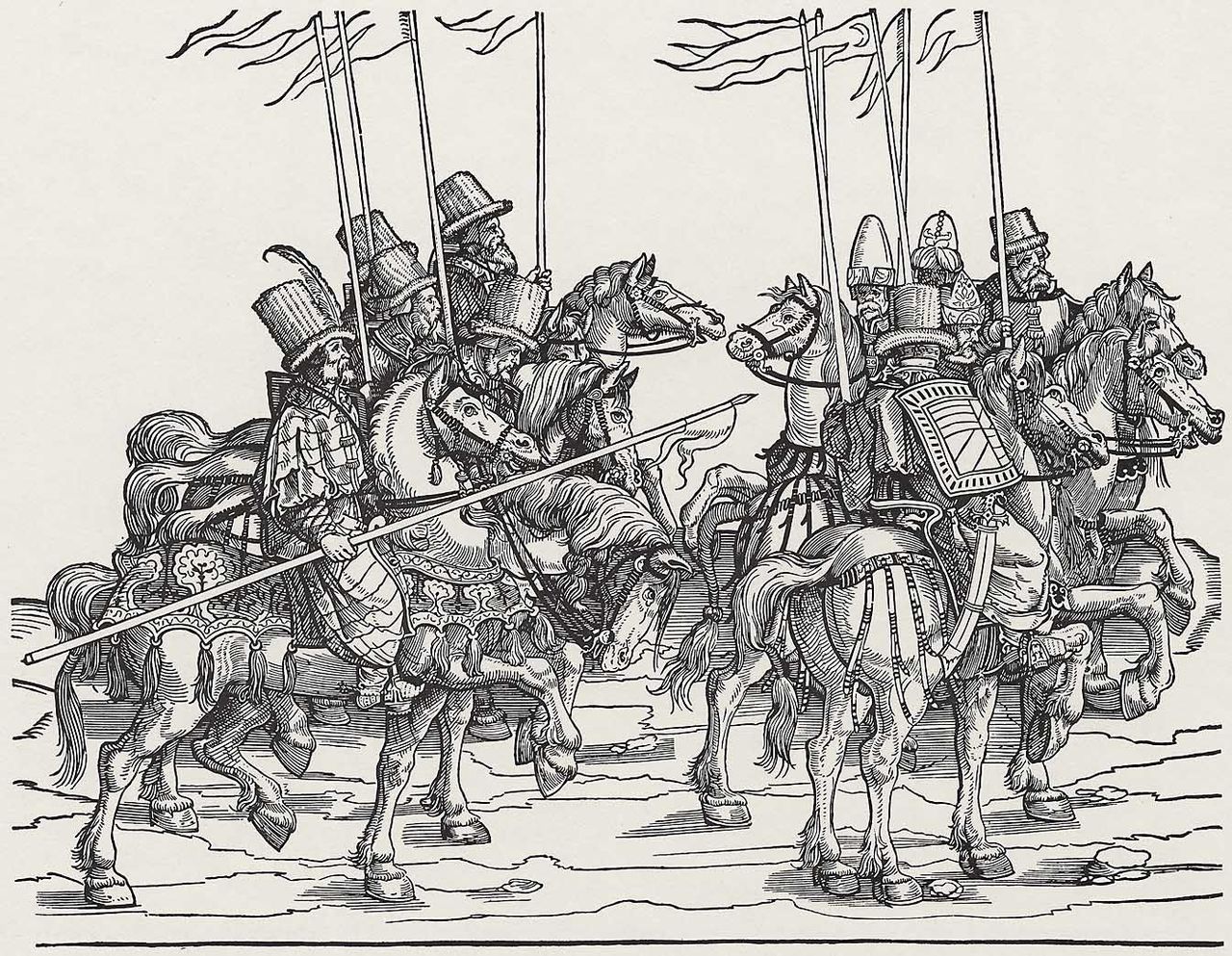
Here you can find two images of future winged hussars from the beginning of the century and more typical image of a parade-attired hussar from the second half of the same century. As you can see they started as a very light, estradiota type cavalry, and by the second half they were already moving towards more medium or even heavier cavalry, with Turkish helmet known as shiszak, curved sabre, Balkan (Serbian) shield, long lance painted and gilded ( Renaissance fashion) but yet empty inside to compensate for the tremendous length of this weapon - up to 6,3m (21 feet).
Horses, stallions or geldings, are bitted with curb-bits, ridden in rather shorter Turkish or even Eurasian steppe fashion - very similar to the Spanish la gineta - with long spurs and wider stirrups. Ornate horse harness is a must and a long Oriental carpet like shabraque or czaprak (from Turkish language) covers horse's back. The pennon seen here -of the early Serbian hussar - is small, the later hussar has quite a large pennon but soon their pennons would grow up to 2,7 m ( 9 feet) in length... The second rider has a large peacock feathers bunch on top of his shishak but our and Hungarian future hussars will be covered with eagle wings, ostrich feathers, wild animal skins and other wild beast symbolic imagery going back to the ancient Eurasian steppe traditions. Then add tuck ( koncerz, panzersrecher, estock), mace, pair of pistols, war-hammer or war-ax (in the ancient Eurasian steppe tradition going back to the Scythians-Saka) and armour, and we will see fully developed winged hussar.
tbc