Showing posts with label XIX century riding practice. Show all posts

Saturday, October 19, 2024

George Henry Laporte

 Salvete Omnes,


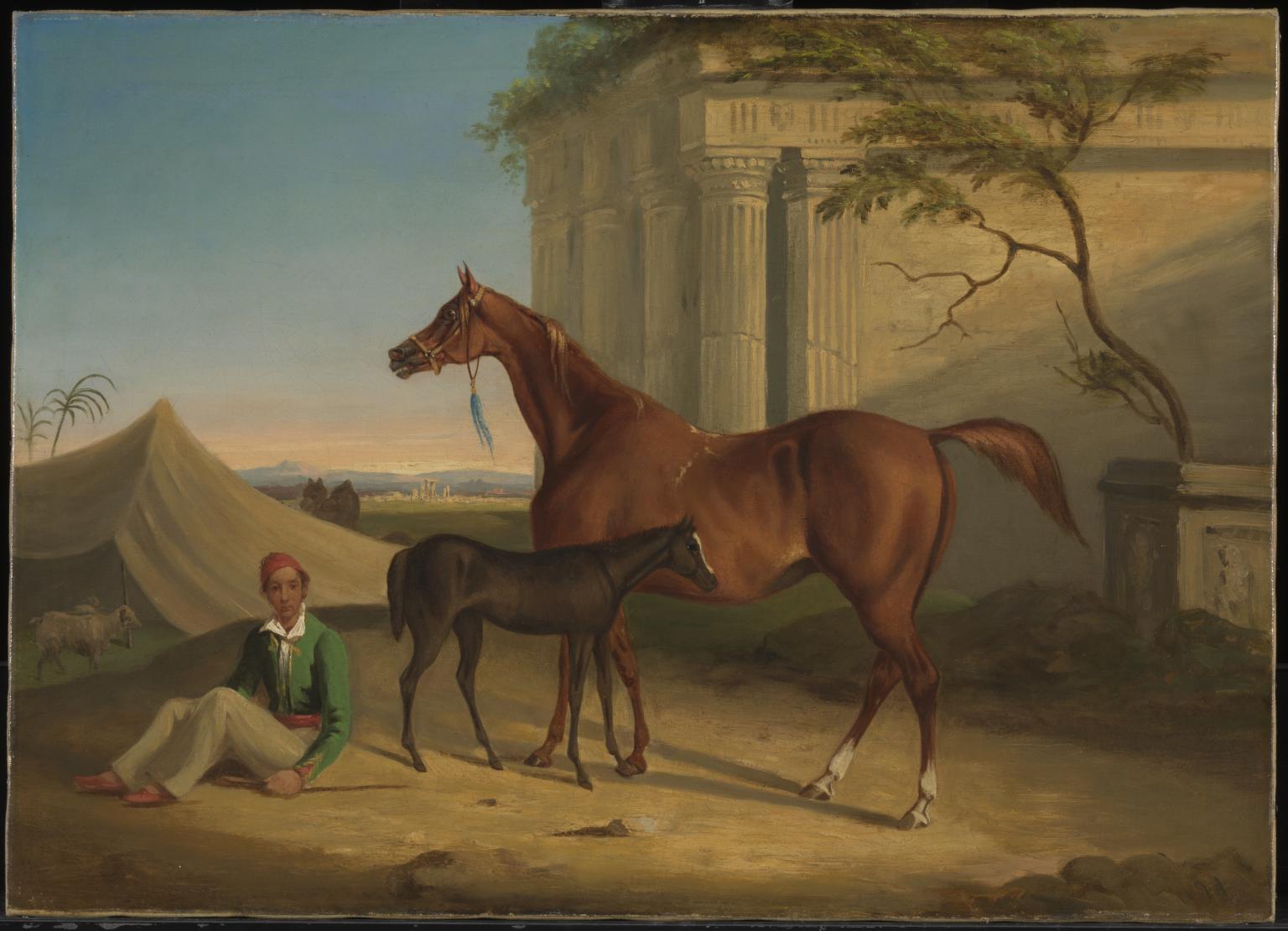
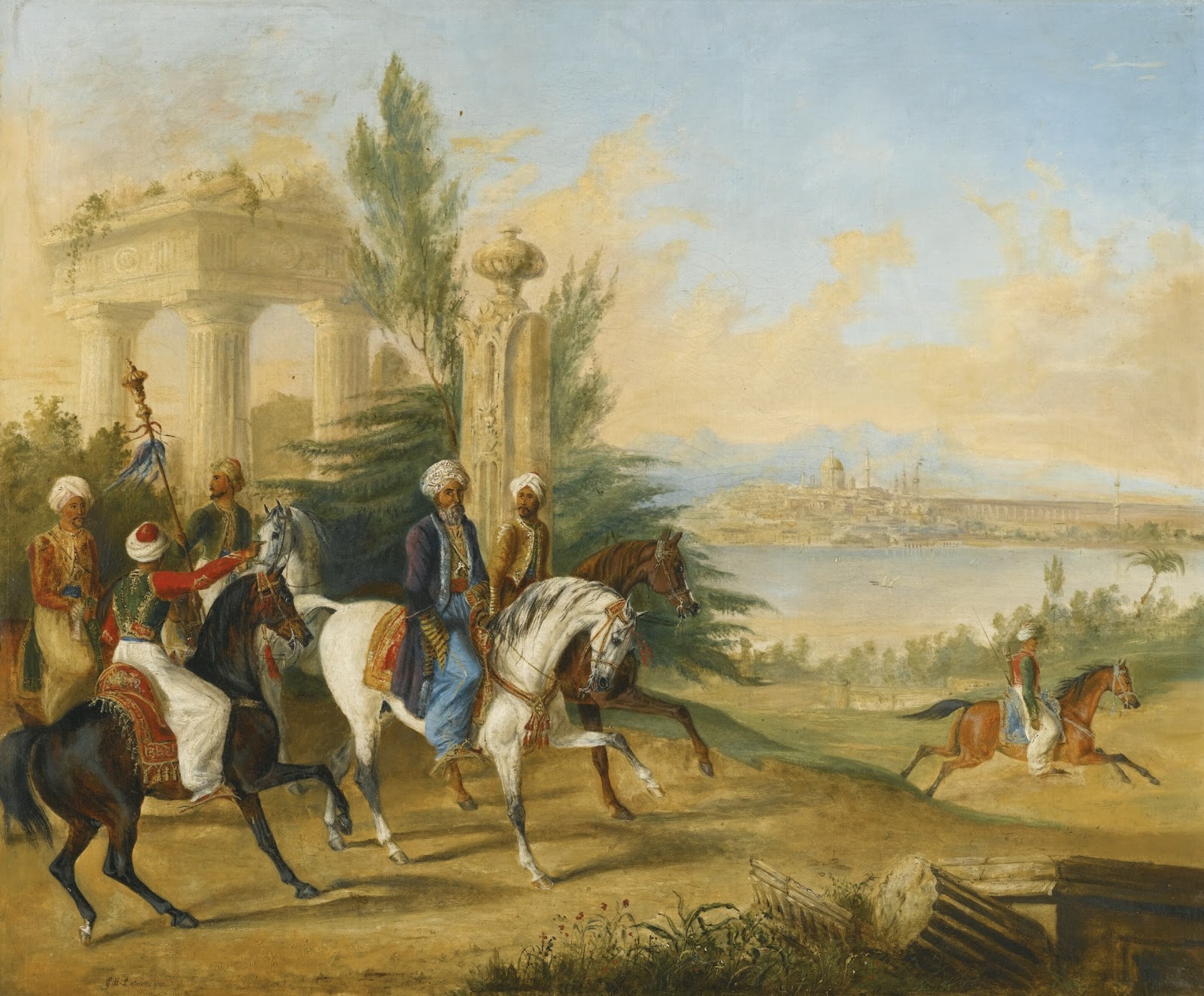
 today is Saturday and a good day to show some artwork by George Hnery Laporte, XIX century  English painter of Huguenot descent.

He was a son of John Laporte, a noted English watercolorist.


So without much ado - here are some of his fine equestrian works -


Arabian horse theme:


Tate Gallery - mare and foal and an attendant 


from Sothebys Orientalist Sale -

.


from Hungarian National Gallery 


enjoy 

Valete

Wednesday, May 15, 2024

MIlitary seat - Hayes, Dodge, Boniface

Salve,
a little jump to the last equestrian century i.e., the1800s but first - 
  # my prayers are with wounded and hospitalized Prime Minister of Slovakia Robert Fico, who today was wounded in the attempted assassination in Slovakia. The shooter is an elderly poet and member of the  Literary Club in Slovakia.* 


                                                                                  ***
on military seat -

 
 Cpt. H. Hayes  et al., - from his book 'Riding and Hunting'

''The position without stirrups is described as follows in Cavalry Drill: "Each man should have his body balanced in the middle of the horse's back, head erect and square to the front, shoulders well thrown back, chest advanced, small of the back slightly bent forward The thigh should be stretched down from the hip, the flat of the thigh close to the horse's side, the knees a little bent, and the legs hanging down from the knee and near the horse's sides. The heels should be well stretched down, and the toes raised from the insteps, and as near the horse's sides as the heels. A plummet line from the front point of the shoulder should fall one inch behind the heel.
"While following these instructions, the man must, however, sit easily on his horse, without having his muscles unnaturally braced, and without stiffness. In order to get his toes and heels into a proper position, he should be taught to turn the flat part of the thigh from the hip towards the horse's side, and not merely to twist the foot inwards from the ankle or knee.
"This is the position halted, or at the walk; at the trot the body must be inclined a little backward, the whole figure pliant, and accompanying the movements of the horse. The elbows and lower limbs must be kept steady.
"The position with stirrups is nearly the same as without stirrups, the knee being a little more bent.
"A plummet line falling from the point of the knee should drop directly on the ball of the foot. The foot should be kept in its place by the play of the ankle and instep, the stirrup being under the ball of the foot. The lower edge of the bar is, as a general rule, to be from two and a half to three and a half fingers' breadths above the upper edge of the heel of the boot, when the man is sitting in the proper position.The Instructor must remember, however, that, though he should follow the general rules in fitting the stirrups, a great deal depends on whether the rider has a thin flat thigh or the reverse; a man with a thick thigh requires slightly shorter stirrups, otherwise, when the horse is in motion and the muscles are brought into play, he will not have a proper hold of the stirrup."

Theodore Arayult Dodge in  a few words on the riding seat:
''[...] then, it is quite impossible to say, as a whole, what seat is intrinsically the best, or what nation furnishes the best of riders. It appears to me that there is such a thing as a natural seat. Such a seat is clearly shown on the frieze of the Parthenon, and in a less artistic way may be seen among any horsemen riding without stirrups. Although Xenophon has been misunderstood in this particular, I feel convinced that his description calls for what I understand to be the natural seat. And the best military riders make the nearest approach to this position. By military seat I by no means intend to convey the idea of a straight leg, forked radish style. That is not the military seat proper. It is only in spite of such a seat, or in spite of the short stirrup of the East, and because they are always in the saddle, that the Mexican gaucho and the Arab of the desert both ride as magnificently as they do. The best military rider should and does, carry the leg as it naturally falls when sitting on his breech, not his crotch, on the bare back of a horse. The steeple-chaser, or crosscountry rider, for perfectly satisfactory reasons, has a much shorter stirrup. But on the road, he should, and generally does, come back more nearly to the natural length. The main advantage in the very long stirrup which obtains among so many peoples lies in the possibility of sitting close on a trot with greater ease, and of using the lasso or whip, or in having a free hand for their sundry sports or duties. And a high pommel and cantle are advantageous in helping the rider preserve his seat when he might be dragged — not thrown — from it in some of his peculiar experiences. But the perfectly straight leg always bears a suggestion of the parting advice of the groom to a Sunday rider just leaving the stable: "Look straight between his hears, sir, and keep your balance, and you can't come off." On the other hand, the advantages of an extremely short stirrup, such as prevails in the Orient, are very difficult to be understood at all.
Now the acquisition of this natural seat should be the first aim of every one who desires to become an expert rider, either in the manege or in riding to hounds.[...] But no man's seat can be too firm and strong. Bareback Riding.
Nor can light hands exist without a firm seat. There have been men of such abnormal muscular development that they distressed a horse by their grip. But this is unnecessary. Seat is not only a question of grip; balance comes in for a share of the credit.
You want to get down as close as possible to your horse. Some horses have what are called good saddle-backs (without having sway-backs, — a sign of weakness), which enable you to sit very close to them. Many very good horses have a high, straight back, which, however strong, makes your seat on them far less agreeable. But the best way for you, Tom, to acquire this natural seat, is to ride bareback a good deal, and afterwards to ride in a saddle without stirrups.
In the South all boys and girls learn to ride bareback; often without bridle, guiding their horses with a stick. Southern horses are treated with common sense and are usually very tractable. In all country districts, children who learn at all are apt to learn bareback. This develops the natural, or best, seat. And after riding in a saddle, it is well, as often as practicable, to revert for practice to the bareback, or the stirrupless seat in the saddle.
It of course attracts attention for a man thus to ride along the road; and no man, I ween aspires to be " the cynosure of neighboring eyes." 
But it is easy at any time to get off on lanes and wood-roads, throw your leathers across the pommel, and practice this thing. And nothing will get you closer to your horse, or make you feel more at home upon him, than this very habit.
There is no better way to determine the proper length of your stirrups than to ride without them for a week, and then to put them in so that your feet, heels well down, will conveniently hold them.
(from Patroclus and Penelope, a chat in the saddle)


Back to the military - Boniface in not a few words -
Cavalry horse and his pack :
The "tongs across the wall" seat is used largely by inexperienced riders and rarely by good ones. Its chief characteristic consists in keeping the knees stiff and straight and sticking the feet out to the front. Whenever the trot is taken up, it is necessary to materially alter the position of the legs, and in fact the entire position of the seat changes, owing to the difficulty of clinching with the thighs while keeping the legs stuck out stiffly. Riders who use this seat generally manage to ride horses possessing easy gaits, especially at the tiot. When using this seat, there is a tendency to lean back, thus boring the cantle of the saddle into the horse's back—in fact, it is next to impossible to ride at an increased gait and lean any other way in this seat. Among even good riders this seat is occasionally seen on- parade and at reviews, it being especially a "pose" seat. Some men in a troop learn this seat and they hold to it persistently, despite constant
efforts to teach them its inadaptability for cavalry riding. The seat, like the "fork" seat, though to a much greater extent, is not only uncomfortable to the rider when in line, but is very exasperating to the adjacent men, who, before the drill is over, generally manage to kick the man's legs and feet repeatedly, to break him of it. It may be taken for individual riding out of ranks, but the rider who attempts to use it in a cavalry troop will suffer many hard kicks and jolts and be the recipient of much hard swearing from his comrades.
The "hunting" seat, known also as the "long" or "chair" seat, is the typical cross-country seat when riding after hounds or in park-riding, and, in its place, is found to be very excellent, especially where jumping of four-barred country fences forms such a particular part of the riding. In this seat it is customary for the rider to hold the reins, together, with both hands. This is impossible in the "military" seat, where the trooper needs one hand for his weapons at all times. The stirrup used with the saddle usually employed by these riders is of steel and open. The hooded stirrup of the American cavalryman would be unwieldy and unnecessarily bulky on this saddle, while it has always been one of the parts of our military saddle especially held to; and for keeping the trooper's feet dry and shielded from the cold and wet of his long rides, as^well as for the safety to the rider, the hood is an important part of the military saddle, and affects the seat in a way, by defining the length of foot that can enter the stirrup, while with the open steel stirrup of the hunting saddle the foot usually goes in clear to the heel of the riding-boot. In the "hunting" seat the rider rests well down on his buttocks, the thigh is extended forward, generally at an angle somewhat more obtuse than that of the horse's shoulder; the leg from the knee to the ankle is loose and straight down, and if inclining in either direction, generally somewhat forward; the stirrup is very short, and the heel of the rider's fool; is considerable lower than his toe; the calf of the leg touches the sides of the horse, and it will be observed that this is the only one of the seats described in which this is the case; the calf does not press against the horse, but, owing to the entire seat and the short stirrup, it touches slightly, especially when jumping or galloping. In this respect the "hunting" seat resembles the Indian seat somewhat, except that in the Indian seat the leg from the knee down is drawn back and the heels touch the horse's flanks when the rider is, as the Indian generally is, riding without a saddle.

The "military" seat in the American Cavalry is the result of years and years of hard riding on the vast Western plains, and is well calculated to have the best effect on both horse and rider of any seat known for long rides, singly or in column, and for all drill purposes when security of seat, closeness of legs and feet, use of one hand, and comfort to the rider and his adjacent trooper comrades are considered. In this seat the rider sits evenly on his buttocks, inclining neither forward nor backward; the elbows are reasonably close to the body and somewhat drawn back; the reins are carried together
in the left hand, thus leaving the right hand free; the thigh is nearly parallel to the slope of the horse's shoulder; the leg from the knee down to the ankle is loose and straight down, and the heel is slightly lower than the toe, which is inserted in the hooded stirrup so that the ball of the foot rests on the stirrup tread; the rider's back is straight, head erect, and chin slightly drawn in without constraint. It is especially taught to keep the toes parallel to the sides of the horse, and thus the heels and spurs do not touch the animal's flanks except when the rider uses them intentionally. This latter position of the feet, it may be remarked, is difficult to acquire, and many men neglect it and apparently fail to appreciate its two excellent purposes—of keeping the spurs and heels out of the horse's flanks and keeping the flat of the thigh against the horse. The stirrup used with this seat is such that the rider, by standing up in them, can pass two or three fingers between his crotch and the saddle. The American cavalryman is disposed to use the long stirrup, and even in our correct regulation seat the length of the stirrup is much longer than that of any seat used in European cavalry, but experience has taught us that this length of stirrup is the most satisfactory one to use, especially on long marches.
The seats used in the various European cavalry services are more like that of the "hunting" seat, before described, than any other, and it is a general practice to use the short stirrup; the saddle used, being low and flat, with a covered seat of leather, enables the rider to assume this seat with much more comfort than can be done in the "McClellan" saddle; in fact, the correct "hunting" seat is almost an impossibility in the "McClellan" saddle, owing to the high cantle. The short stirrup is not used by any of those classes of riders who have bcome famous the world over for their hard rough-riding, excepting the Cossacks of Russia, who still adhere to it. However, as the Cossack rides in a saddle considerably above the back of his horse, this short stirrup is probably necessary. On the other hand, the use of a stirrup too long will, of necessity, subject the rider to much pounding, and though many men use it, they acknowledge that the pounding is harder; but, on the other hand, they claim that the entire seat is more secure, especially in the "fork" seat.
The best seat will be that in which balance, friction, and stirrups are combined in the right degree. To ride by balance alone would be very exhausting. To illustrate this, watch a recruit taking his first bare-backed lessons, before he has learned to use friction. Clinching the horse with the thighs, or "friction," as it is called, comes naturally and almost unconsciously as the result of training. At first requiring considerable effort, the rider gradually learns how to clinch without tiring himself, and eventually his clinching becomes very powerful without' tiring him. The writer remembers a Western rider with one wooden leg who declared that he had such power of clinching with his thighs on the horse's sides that he felt satisfied that*he could still ride should he lose the other leg. The leg that was gone had been amputated years before, from the knee down, and from what was seen of this man's riding, it is very likely that this rider could have done what he said. The early saddles possessed no stirrups, and the riders of those days must have been very perfect riders, using only balance and friction, judging from many authenticated accounts in military history; but gradually experience taught riders the world over that stirrups saved them much unnecessary fatigue by bearing the weight of the legs and feet, and also made the seat more secure in every way. The use of stirrups on all saddles, military or civilian, has now become universal, and their adjustment is a matter of great importance in riding and training, both as affects man and horse.
The proper length of stirrup will not be the same for any two men, as men differ in length of leg and in size too much. A man having a long, thin, flat leg will require a longer stirrup than a man having a short, fat, round leg, and no arbitrary length should be required for all troopers. A good method for securing the proper length is to hold the bottom of the stirrup-tread under the left arm with the right hand, snug in to the arm-pit, and then place the left hand, fingers extended, on the "D" ring (stirrup-loop) of the saddle, and then straightening out the left arm until the length of the stirrup thus measured corresponds with the length of the left arm placed as described. When the trooper is in the saddle, he should be able to place two fingers between his crotch and the saddle as he stands in his stirrups. All the men in the troop should be required to ride with a reasonably uniform length of stirrup; otherwise some of them will affectMa length of stirrup both unsightly to look at and absurd as regards the particular troopers. Both the Romans and the Greeks were ignorant of the use of stirrups, and either vaulted on their horses or used the back of a slave as a stepping-stone, or sometimes had recourse to a short ladder. The earliest time when it can be proved that the stirrup was in use was in the time of the Norman invasion of England. The incidents of this event were depicted upon the Bayeaux tapestry by the wife of William the Conqueror, and on this the stirrup was shown, according to the authority of Berenger, as a part of the trappings of the horse.
The position of the rider in the saddle is most important, because of its quick effect on the horse. If the rider leans back, his weight bores down upon the cantle, which in turn bores down upon the horse's back under the cantle, and the result; especially on the march, is a very sorebacked animal at least; the contrary fault of leaning forward causes the additional weight to bore into the horse's back under the pommel, in the region of the withers where several large, strong muscles and tendons are located, a free action of which is absolutely necessary at all gaits. The result of this leaning forward is not only a sore-backed horse, but probably it will also stiffen the animal up for weeks, especially if this fault exists during long marches. Leaning forward also makes the seat more insecure, and any stumbling or stopping of the horse at once throws the rider forward. The rider in the Cavalry should realize that the pommel and cantle on the "McClellan" military saddle are put there for the purpose of holding the pack up off the horse's back, and not as a means of support to the rider. The rider should sit in the middle of the saddle, erect, and support himself wholly by balance, friction, and stirrups. The pommel and cantle and reins should be used for what they are intended, and the seat of the rider should not depend upon them. The reins especially should be used only to guide the horse, and never as a support for the man on the horse's back. The continual sawing on the horse's mouth is a sure way of ruining the horse and tiring the rider, who not infrequently relieves his feelings by a sharp, savage tug at the reins.
The manner of riding known as "posting," whereby the rider rises at the trot, is much used in civil life and even in some European cavalry services; but, although permitted by our Cavalry Drill Regulations as a change from our close seat when in the field, is never so used, and has never found favor with American cavalry officers or troopers. Those who have thoroughly learned it speak highly of it as a seat both easy and simple, and not by any means the hard work to use that it is generally believed. Whether or not this "posting" is easy or hard on the horse has never been satisfactorily demonstrated, because no one ever has maintained it for long-distance riding. While perhaps good in park riding for pleasure, for short distances, in English saddles, this seat does not lend itself to long, hard rides, yet much praise is bestowed upon it by some European cavalry services.
The close seat is the typical American cavalry seat. There are many men, however, who never wholly acquire this close seat, but the mistake must not be made of thinking that the man who leaves the saddle more or less at the trot is a poor rider; on the contrary, many men leave the saddle somewhat at every trotting stride of the horse, and yet are excellent hard riders of record. The slight leaving of the saddle referred to, however, is very different from the awkward "bouncing" of the inexperienced rider, which is readily recognized wherever seen. Until the rider is himself proficient, he can do little but irritate the horse, and for this reason the recruit should be given a different horse every day, to enable the horse he rode the day before to recover from the awkward handling he has received. The recruit will learn more quickly to ride if given a different horse each day, although it will be hard upon him; but to ride well one must ride many different horses, hard ones and easy ones, and not confine himself to one particular animal. The gait of every horse is different from the gait of every other horse, and thus the rider learns the various forms of movement, and understands what is meant by a "hard trotter" and an "easy trotter"; until the rider has acquired skill and confidence and has had much experience in actual riding and handling of horses, he is not capable of training a horse, and should not be allowed to do so except under experienced troopers.''
the end of citation


Valete
ps
*The Fico's attempted assassination reminds me of the attempted assassination, stabbed with a knife, of then-presidential candidate in Brazil Jairo Bolsonaro, who wounded in the belly survived and lived to lead Brazil as president 2019-22. Slovakia like the rest of Europe is facing European Union parliament elections in June 2024. 

Tuesday, August 9, 2022

Karmazyny i żuliki. - Polona

 Salvete Omne,

[in Polish]

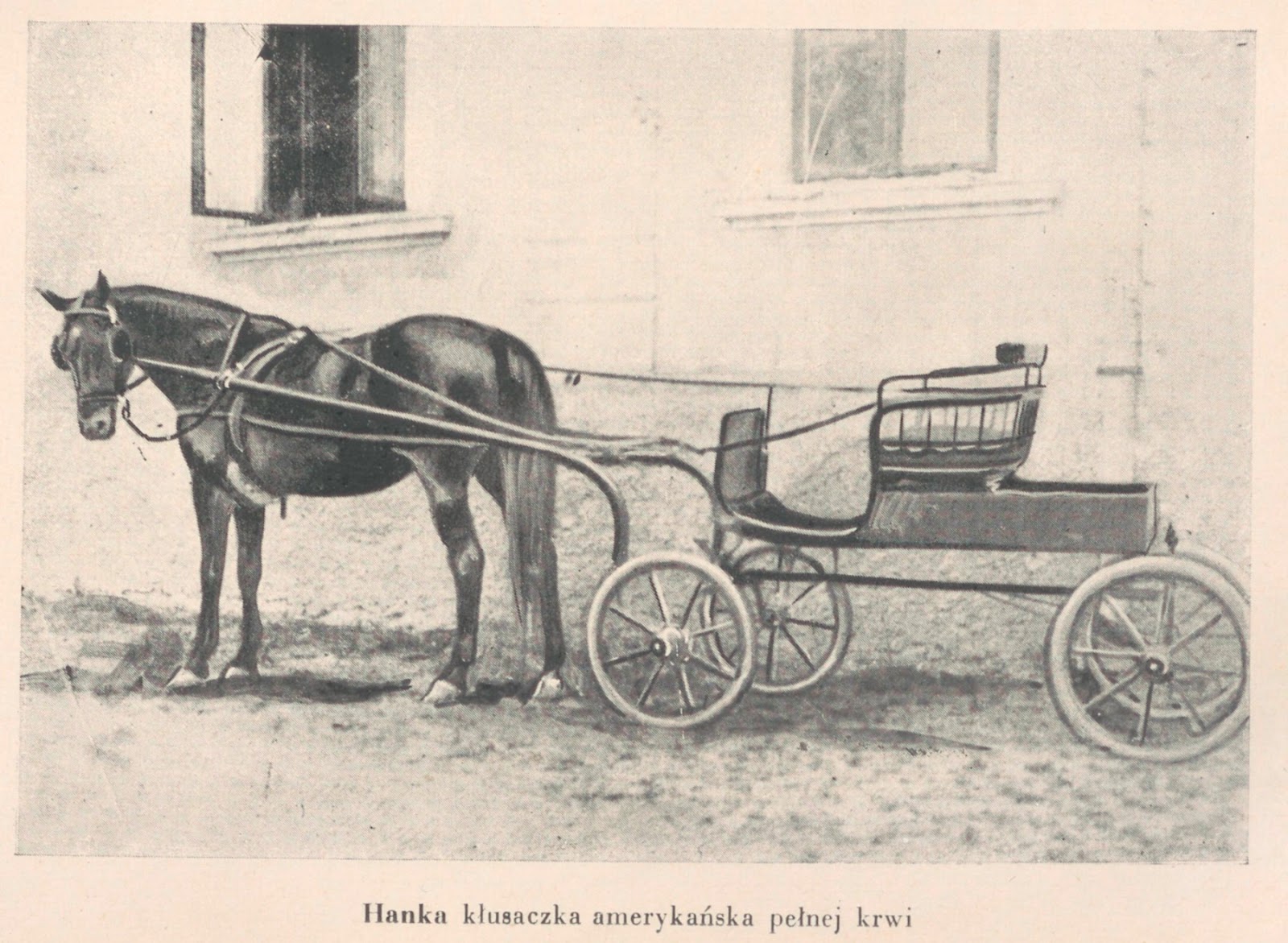
Mitzi 'Dumkollerka' - klacz irlanderka


Super 'wyścigowe' czytanie na lato czy inne 'końskie' pory roku sprzed 100 lat:
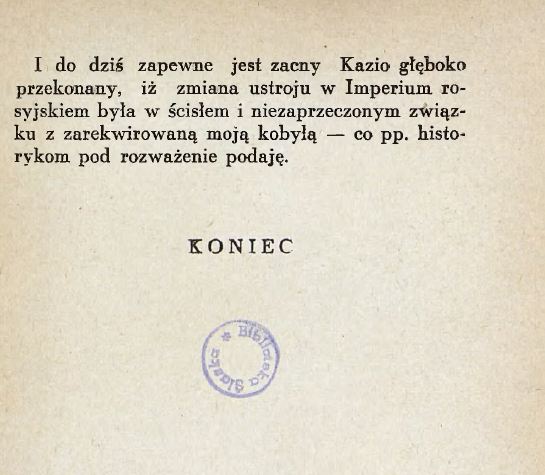
- Karmazyny i żuliki., pióra  Jerzego Strzemię Janowskiego (1888-1938), wychowanego i zyjacego w Strutyniu koło Złoczowa, którego był do 1919 właścicielem i majątku, i stajni wyścigowej a hodowlanej (nota bene tomy dzieła pt 'Słownik geograficzny Królestwa Polskiego i innych krajów słowiańskich' były ufundowane przez Witolda Leona Juliana Zglenickiego i innych polskich milionerów pracujących głównie w Baku przed 1917 rokiem). Książka nie jest li tylko opowieścią o koniach autora, ale i o świecie jeździecko-wyscigowo-hodowalnym przed 1914 rokiem w zaborze austriackim, a także o psach i pieskach autora etc... Gdyby były jeszcze krowy a trzoda, to pewnie można by było rzec, ze autor wyprzedził o wiele długości końskich Herriota i jego  ''Wszystkie stworzenia duże i małe'' . C'est la vie.

to i załączę pieśń o psach z książki


***


Spis treści - 


i opowieść z końca książki - 


Valete

Wednesday, July 6, 2022

Albrecht Adam - 1812 campaign cavalry and horses

 Salvete Omnes,


 there was this Bavarian painter, when Bavaria was still a kingdom, and had their own military, including cavalry arm of their armed forces.
Albrecht Adam lived a long and productive life - born in 1786 and died 1862AD, almost 10 years before the Prussian Hohenzollern kings unified Germanies into one state or empire. He was one of the foremost painters of horses and equestrian subjects ...


During the Napoleonic Wars he became a court painter to prince Eugene de Beauharnais and thus took part in the tragic and disastrous invasion of Russia in 1812. During the campaign Adam kept on drawing marching troops, camps, battles and scrimmages, and from these drawings he created a book of prints titled 'Voyage pittoresque et militaire de Willenberg en Prusse jusqu'a Moscou'  published in Munich in 1827.


Polish National Library Polona digitized this book and voila , you can peruse it here.

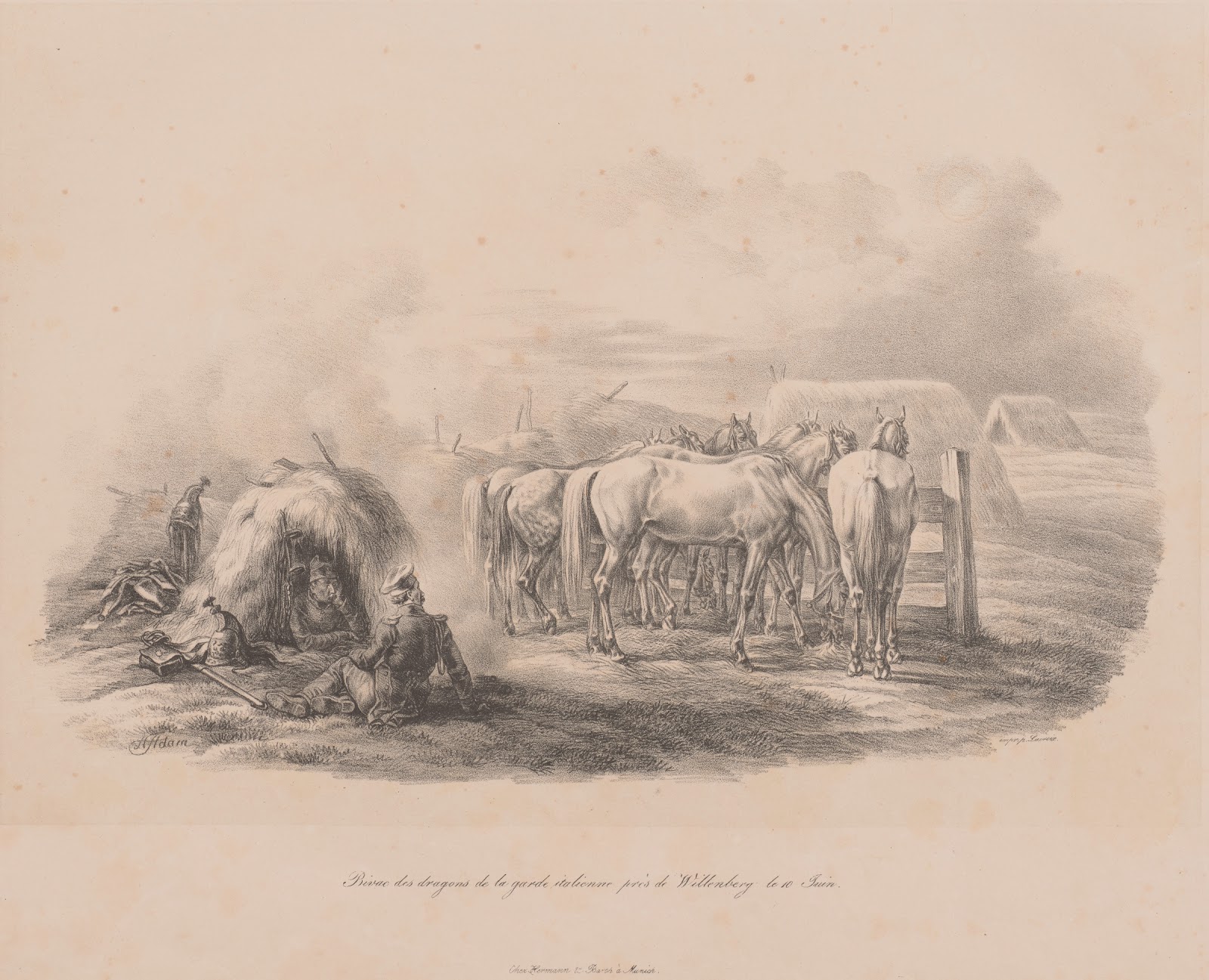
the 2nd plate in this book shows the dragoons of the Italian guard (there were 2 dragoon regiments of the king's guard within the Grand Armee IV Corps commanded by prince Eugene) encamped in Wielbark (Willenberg in then Kingdom of Prussia) on the 10th of June 1812.


and a close up on the horses

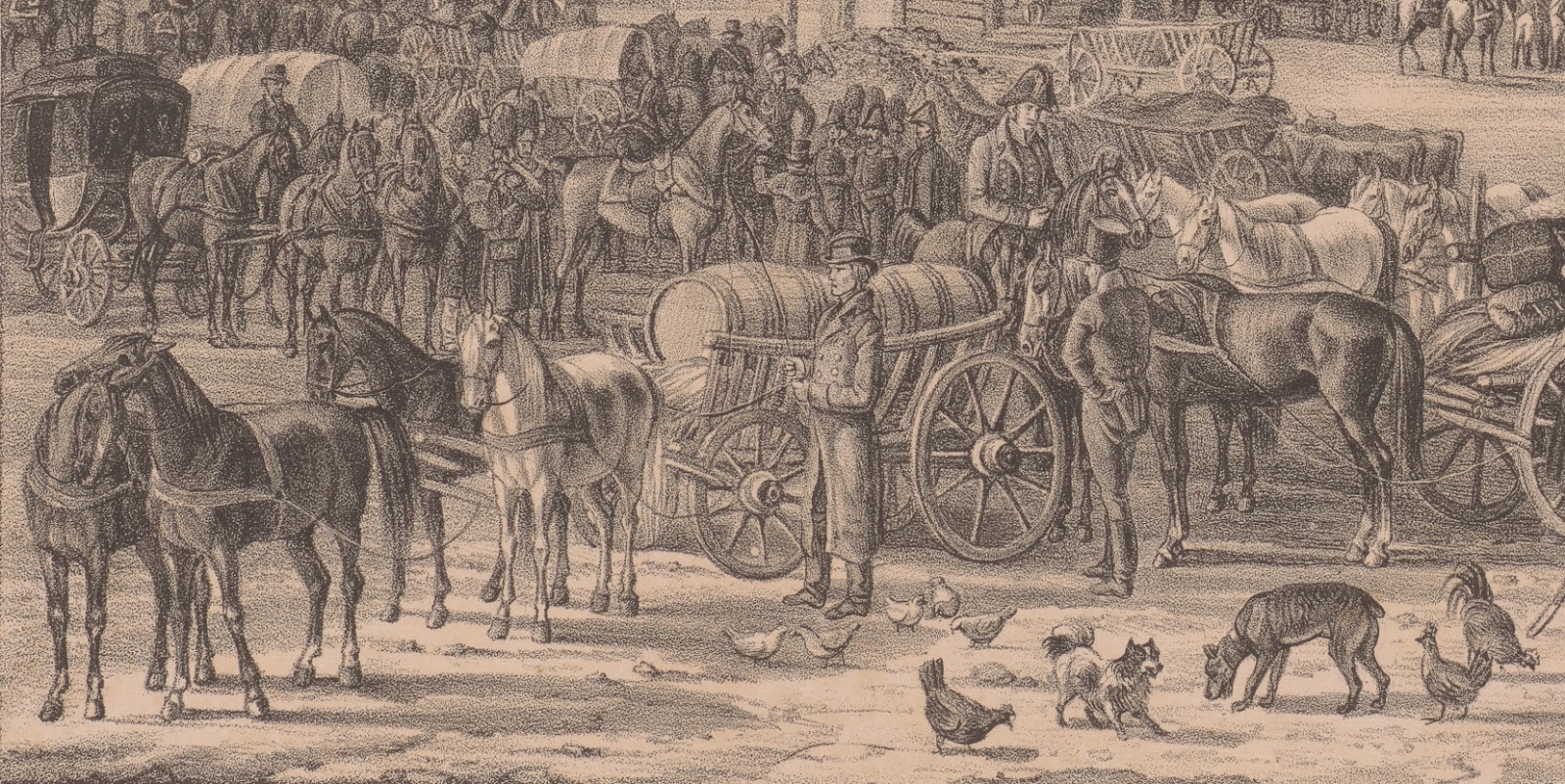
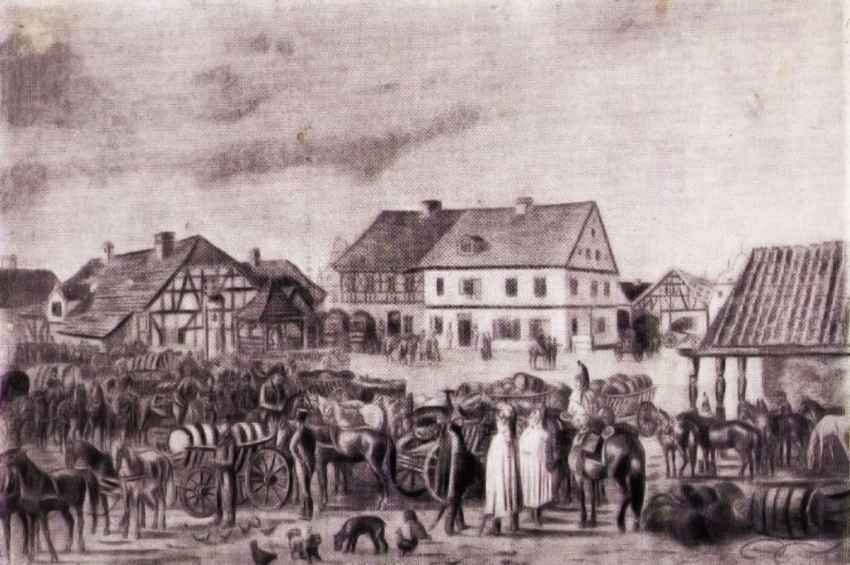
 and next plate showing the market in Mragowo (Sensburg of the Prussian Kingdom) on June 13, 1812. It was pretty much a Polish town as most of East Prussian was back then. Germanization of the local inhabitants was to follow during the XIX and XX century.


 we have here cavalry horses and cart horses and various wagons of the quartermaster of this corps


to be continued

Valete

Thursday, March 10, 2022

Bairactar or Bairaktar

 Salvete omnes,

peace in Ukraine must prevail! 

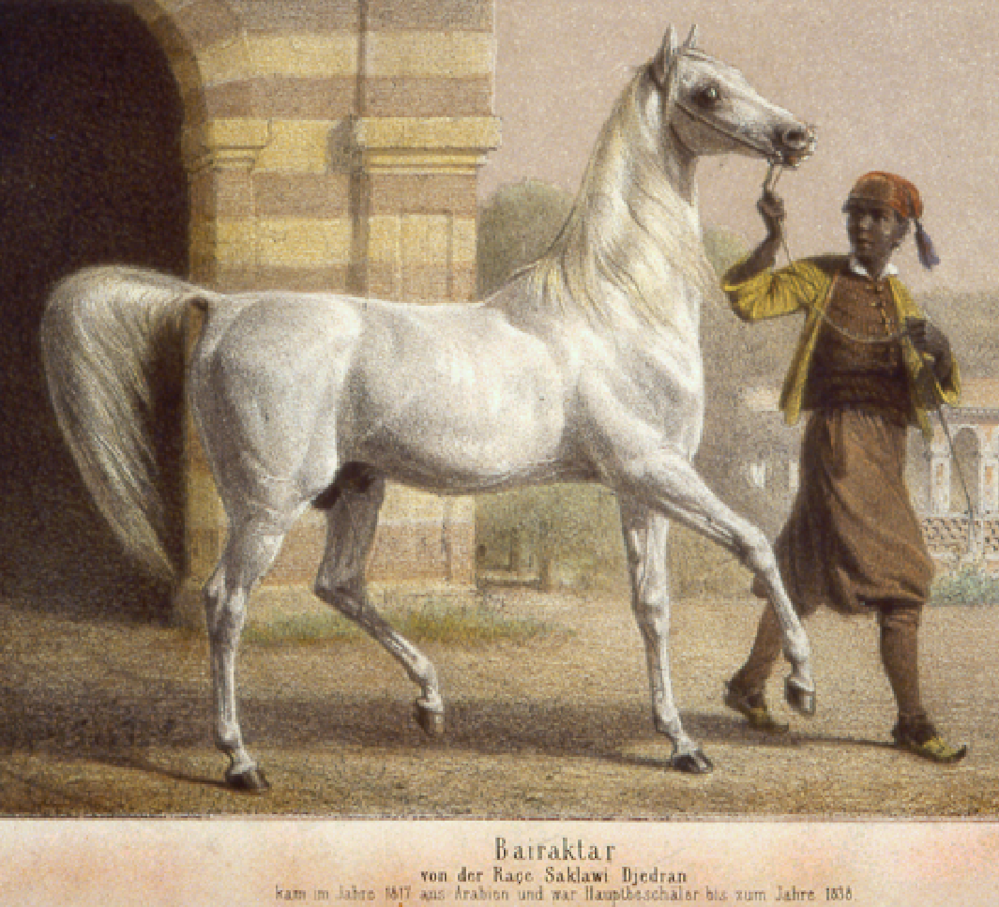
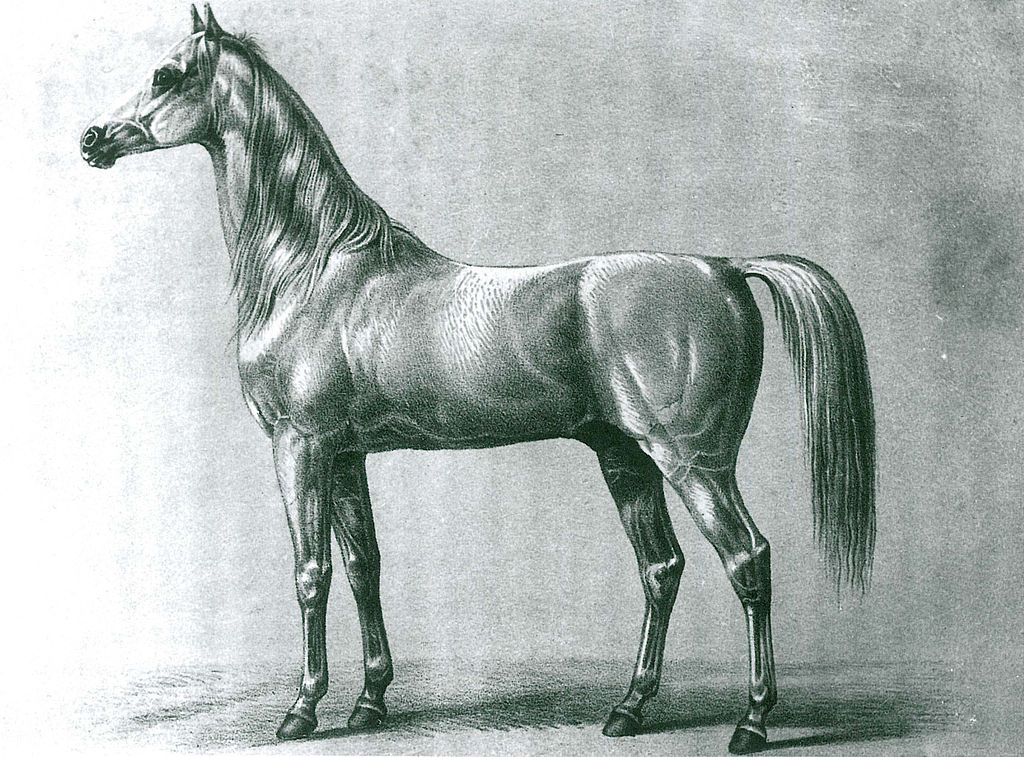
long time ago there was a famous Arabian horse sire - stallion Bairaktar written also as Bairactar.
Supposedly his name Bairaktar was a Turkish word for standard bearer. Born in the desert (Syrian?) circa 1813, he was imported to Europe after the Napoleonic Wars and would become one of the most influential sires in the history of the American and European Arabian horse breeding history.


And there was a German king, Wilhelm I of Wurttemberg, who bought this stallion in 1817, rode him  and also had him used as a sire for this studs , including Weil, where our Bairaktar died in 1838 or 39AD. 


Nota bene, supposedly the oldest existing German stud is the Marbach Stud, near Gomadingen, in Baden-Wurttemberg, established more than 540 years ago by  Eberhard I of Wurttemberg as a private stud, elevated during the reign of Christoph of Wurttember to the official state stud.   
Below two monuments to Wilhelm I of Wurttemberg and of Bairaktar.


His skeleton still exists today. 


Incidentally, there is military aerial vehicle (UCAV) alias combat drone produced by the Turkish military, and this unmanned aerial vehicle is called Bayraktar. 


Valete

Tuesday, May 31, 2016

Mr. Baucher - on seat p.2

Salve,
continuing with Mr. Baucher on seat nad exercise
Just let us use a chart from Mr. Littauer:

ad rem, the exercies as advocated by Mr. Baucher


Flexion of the legs.
The instructor will watch that the knees always preserve their perfect adherence to the saddle. The legs will be swung backward and forward like the pendulum of a clock ; that is, the pupil will raise them so as to touch the cantle of the saddle with his heels. The repetition of these flexions will soon render the legs supple, pliable, and independent of the thighs.
The flexions of the legs and thighs will be continued for four days (eight lessons). To make each of these movements more correct and easy, eight days (or sixteen lessons) will be devoted to them. The fifteen days (thirty lessons), which remain to complete the month, will continue to be occupied by the exercise of stationary supplings; but, in order that the pupil may learn to combine the strength of his arms, and that of his loins, he will be made to hold at arm s length, progressively, weights of from ten to forty pounds. This exercise will be commenced in the least fatiguing position, the arm being bent, and the hand near the shoulder, and this flexion will be continued to the full extent of the arm. The chest should not be affected by this exercise, but be kept steady in the same position. 

Of the knees.
The strength of pressure of the knees will be judged of, and even obtained, by the aid of the following method : this, which at first sight will perhaps appear of slight importance, will, nevertheless, bring about great results. The instructor will take a narrow piece of leather about twenty inches long; he will place one end of this strap between the pupil s knee and the side of the saddle. The pupil will make use of the force of his knees to prevent its slipping, while the instructor will draw it towards him slowly and progress lively. This process will serve as a dynamometer to judge of the increase of power. The strictest watch must be kept that each force which acts separately does not put other forces in action, that is to say, that the movement of the arms does not influence the shoulders ; it should be the same with the thighs, with respect to the body ; the legs, with respect to the thighs, etc . The displacement and suppling of each part separately being obtained, the chest and seat will be temporarily displaced, in order to teach the rider to recover his proper position without assistance. This will be done as follows : the instructor, being placed on one side, will push the pupil s hip, so that his seat will be moved out of the seat of the saddle. The instructor will then allow him to get back into the saddle, being careful to watch that, in regaining his seat, he makes use of his hips and knees only, in order to make him use only those parts nearest to his seat. In fact, the aid of the shoulders would soon affect the hand, and this the horse ; the assistance of the legs would have still worse results. In a word, in ail the displacements, the pupil must be taught not to have recourse, in order to direct the horse, to the means which keep him in his seat, and vice versa, not to employ, in order to keep his seat, those means which direct the horse.

Here but a month has elapsed, and these equestrian gymnastics have made a rider of a person, who at first may have appeared the most unfit for it. Having mastered the preliminary trials, he will impatiently await the first movements of the horse, to give himself up to them with the ease of an experienced rider.


enjoy
ps
Baucher belongs to the period of the 2nd Empire - when Napoleon III ruled France and her dominions, and I included two paintings from the famous war when the French gave the final push for the Italian freedom and liberation of the Peninsula from the Austrian Empire and thus allowed the creation of the modern Italian state... right, 'Italy' is only 157 years old - :) while Germany even younger (135 years old)..

Mr. Baucher - on seat p.1

Salve,
the month of May will end today - what a pity, but then all the wonders of the summer fruits are upon us - strawberries, wild strawberries, blueberries, cherries and other berry fruits...
ad rem, it has been a while since the last visit to the glorious world of the XIX century horsemanship - and present Mr Baucher. part of the French school of horsemanship.

before I turn to this ecuyer I should quote, again, the passage from Xenophon's horsemanship work (this time in Morris H. Morgan translation) on rider's seat-

''When the rider takes his seat, whether bareback or on the cloth, I do not approve of a seat which is as though the man were on a chair, but rather as though he were standing upright with his legs apart. Thus he would get a better grip with his thighs on the horse, and, being upright, he could hurl his javelin more vigorously and strike a better blow from on horseback, if need be. His foot and leg from the knee down should hang loosely, for if he keeps his leg stiff and should strike it against something, he might get it broken; but a supple leg would yield, if it struck against anything, without at all disturbing the thigh. Then, too, the rider should accustom himself to keep his body above the hips as supple as possible; for this would give him greater power of action, and he would be less liable to a fall if somebody should try to pull or push him off.''

Mr. Francois Baucher has never 'visited' this blog hence the time is ripe to rectify this omission and kill two birds with one stone. - from
 
''A METHOD OF HORSEMANSHIP, FOUNDED UPON NEW PRINCIPLES: INCLUDING THE BREAKING AND TRAINING OF HORSES WITH INSTRUCTIONS FOR OBTAINING A GOOD SEAT.'' (2nd American edition)

The seat of the rider. The rider will expand his chest as much as possible, so that each part of his body rests upon that next below it, for the purpose of increasing the adhesion of his buttocks to the saddle; the arms will fall easily by the sides. The thighs and legs must, by their own strength, find as many points of contact as possible with the saddle and the horse s sides; the feet will naturally follow the motion of the legs. You see by these few lines how simple is the rider s seat.
now the lessons on how to obtain a good seat -

PREPARATORY LESSON
This course will make the rider expert, and consequently intelligent. One month will not elapse without the most stupid and awkward recruit being able to seat himself properly without the aid of the word of command. Preparatory lesson (the lesson to last an hour, two lessons daily for a month). The horse is led upon the ground, saddled and bridled. The instructor must take two pupils; one will hold the horse by the bridle, and observe what the other does, that he may be able to perform in his turn. The pupil will approach the horse s shoulder and prepare to mount ; for this purpose he will lay hold of and separate with the right hand, a handful of mane, and pass it into the left hand, taking hold as near the roots as possible, without twisting them ; he will seize the pommel of the saddle with the right hand, the four fingers inside, and the thumb outside; then springing lightly, he will raise himself upon his wrists. As soon as his middle reaches the height of the horse s withers, he will pass the right leg over the croup, without touching it, and place himself lightly in the saddle. This vaulting will tend to make the man active; and he should be made to repeat it eight or ten times, before letting him finally seat him self. The repetition of this exercise will soon teach him the use of his arms and loins.
... 


...
Exercise in the saddle. (This is a stationary exercise on horseback ; an old, quiet horse to be chosen in preference ; the reins to be knotted, and to hang on his neck.) The pupil being on horseback, the instructor will examine his natural position, in order to exercise more frequently those parts which have a tendency to give way or stiffen. The lesson will commence with the chest. He must expand the chest, and hold himself in this position for some time, without regard to the stiffness which it will occasion
at first. It is by the exertion of force that the pupil will become supple, and not by the abandon so much and so uselessly recommended. A movement at first obtained by great effort, will not require so much force after a while, for he will then have gained skill, and skill, in this case, is but the result of exertions properly combined and employed. What is first done with twenty pounds of force reduces itself afterwards to fourteen, to ten, to four. Skill will be the exertion reduced to four pounds. If we commenced by a less, we would not attain this result. The flexions of the loins will be repeated, allowing the pupil often to let himself down into his natural relaxed position, in order to accustom him to throw his chest quickly into a good position. The body being well placed, the instructor will pass : 1st. To the lesson of the arm, which consists in moving it in every direction, first bent, and afterwards extended ;
2d. To that of the head ; this must be turned right and left without its motions reacting on the shoulders. When the lessons of the chest, arms, and head give a satisfactory result, which ought to be at the end of four days (eight lessons), we will then pass to the pupil s legs.
He will remove one of his thighs as far as possible from the quarters of the saddle; and afterwards replace it with a rotatory movement from without inwards, in order to make it adhere to the saddle by as many points of contact as possible. The instructor will watch that the thigh does not fall back heavily; it should resume its position by a slowly progressive motion, and with out a jerk. He ought, moreover, during the first lesson, to take hold of the pupil's leg, and direct it, to make him understand the proper way of performing this displacement. He will thus save him fatigue, and obtain the result more quickly.
This kind of exercise, very fatiguing at first, requires frequent rests ; it would be wrong to prolong the exercise beyond the powers of the pupil. The motions of drawing in (adduction, which makes the thigh adhere to the saddle), and putting out (abduction, which separates it from the saddle), becoming more easy, the thighs will have acquired a suppleness which will admit of their adhesion to the saddle in a good position. 
Then comes the flexion of the legs. 
 end of part 1
Enjoy