Showing posts with label Peri Hippikes. Show all posts

Monday, November 28, 2022

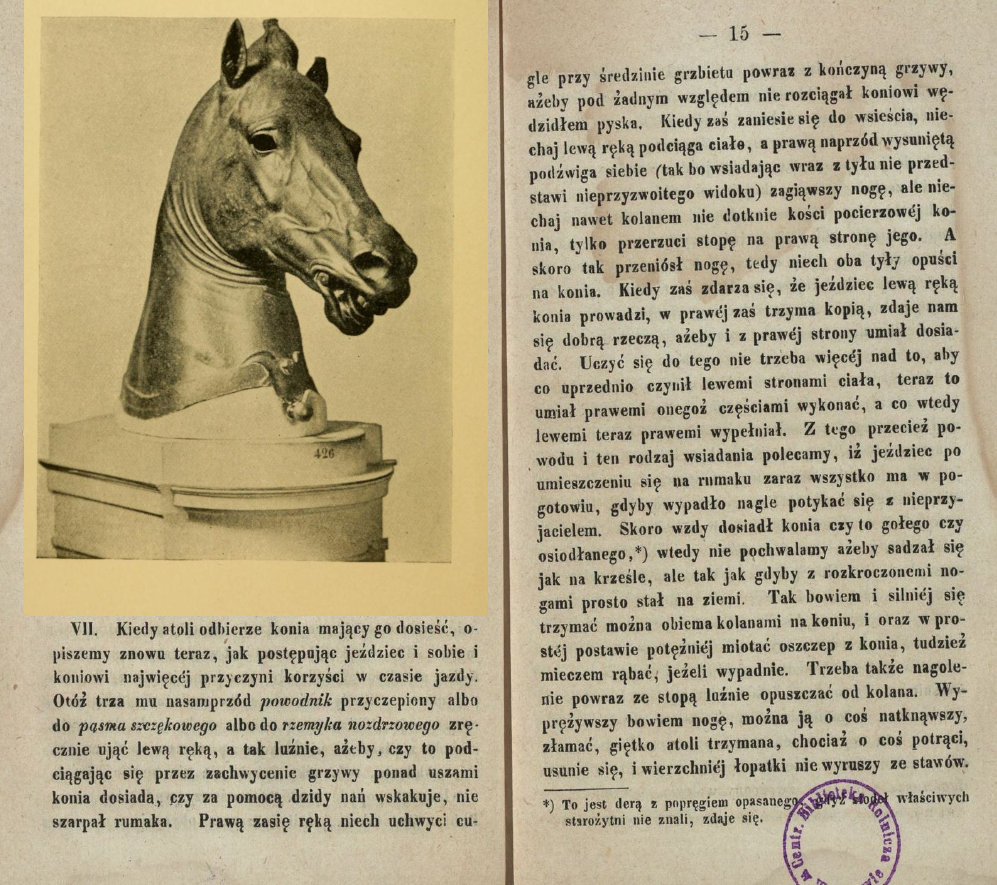
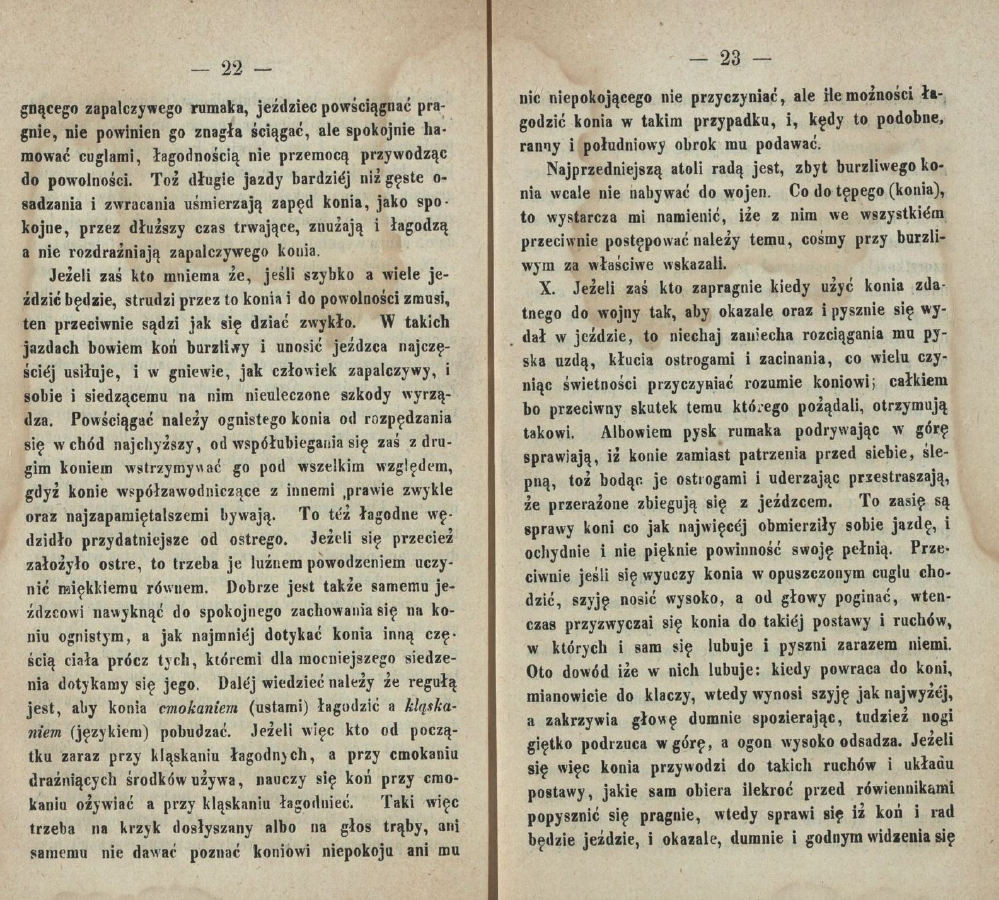
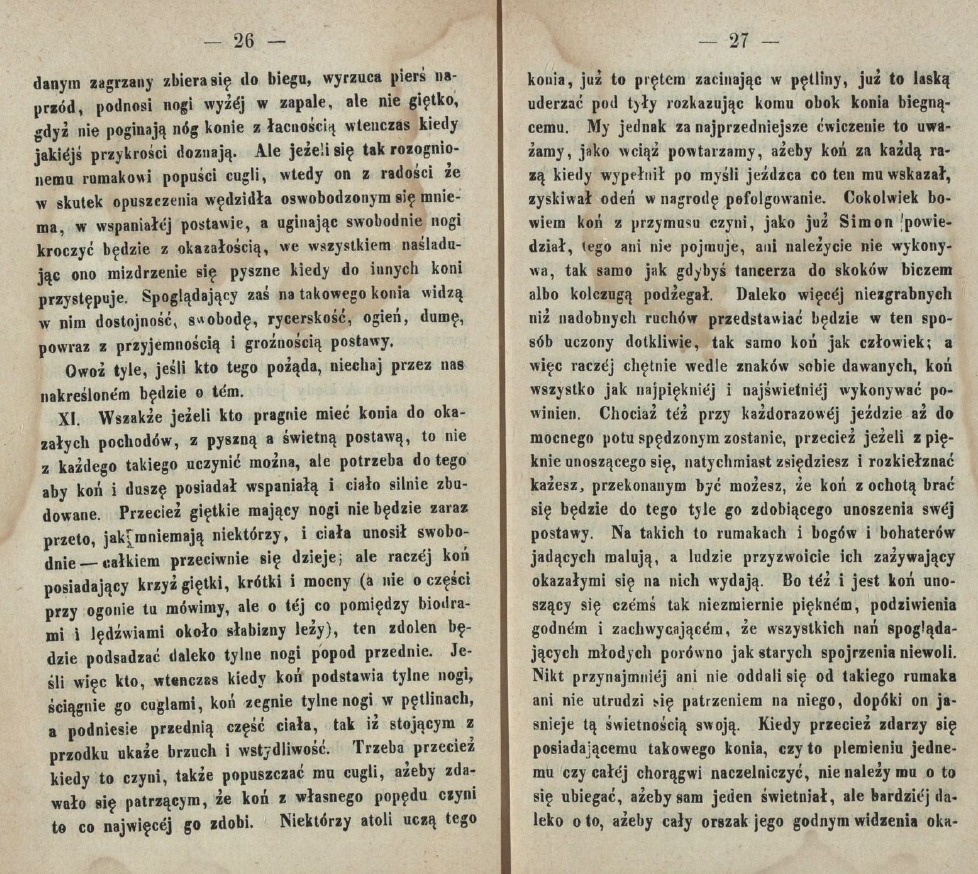
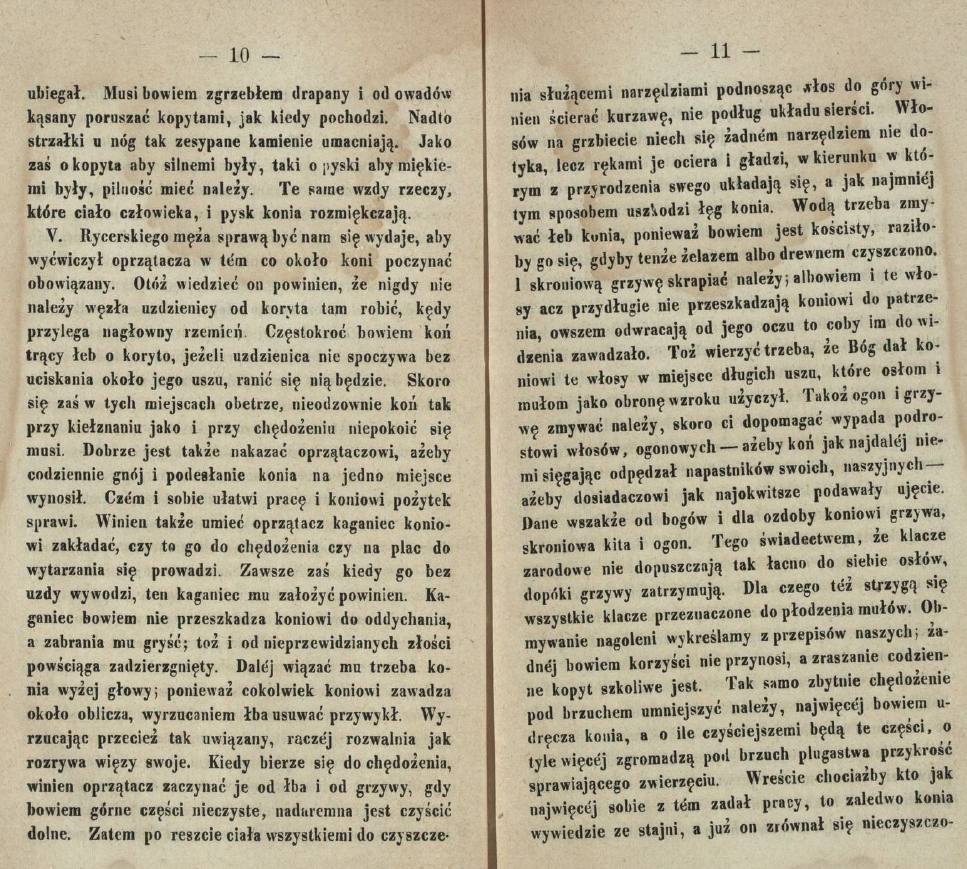
Hippika Ksenofonta w tlumaczeniu Antoniego Bronikowskiego II

 Salvete Omnes,

[in Polish]


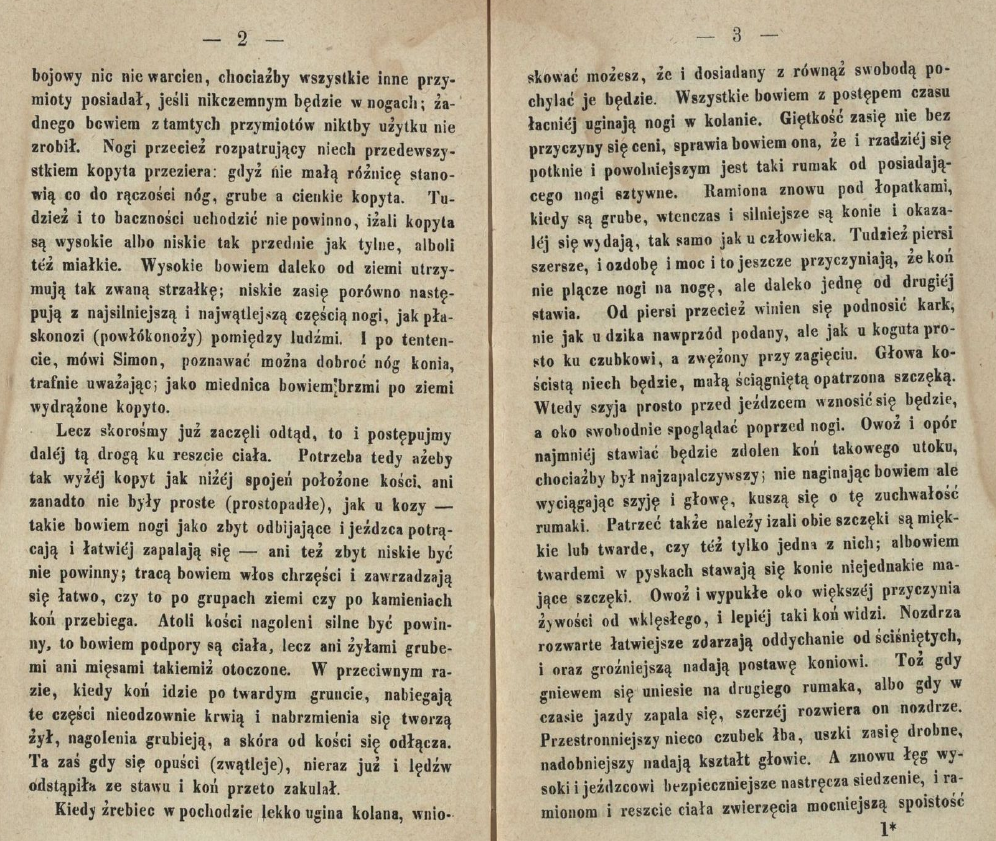
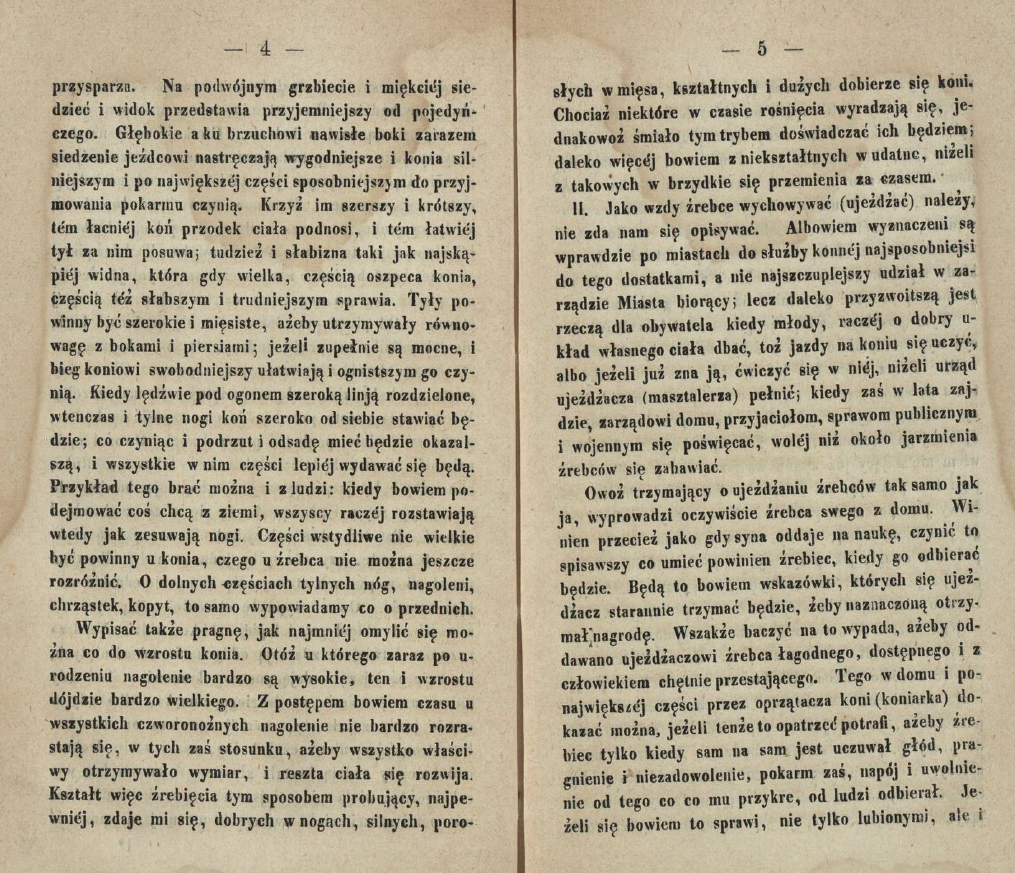
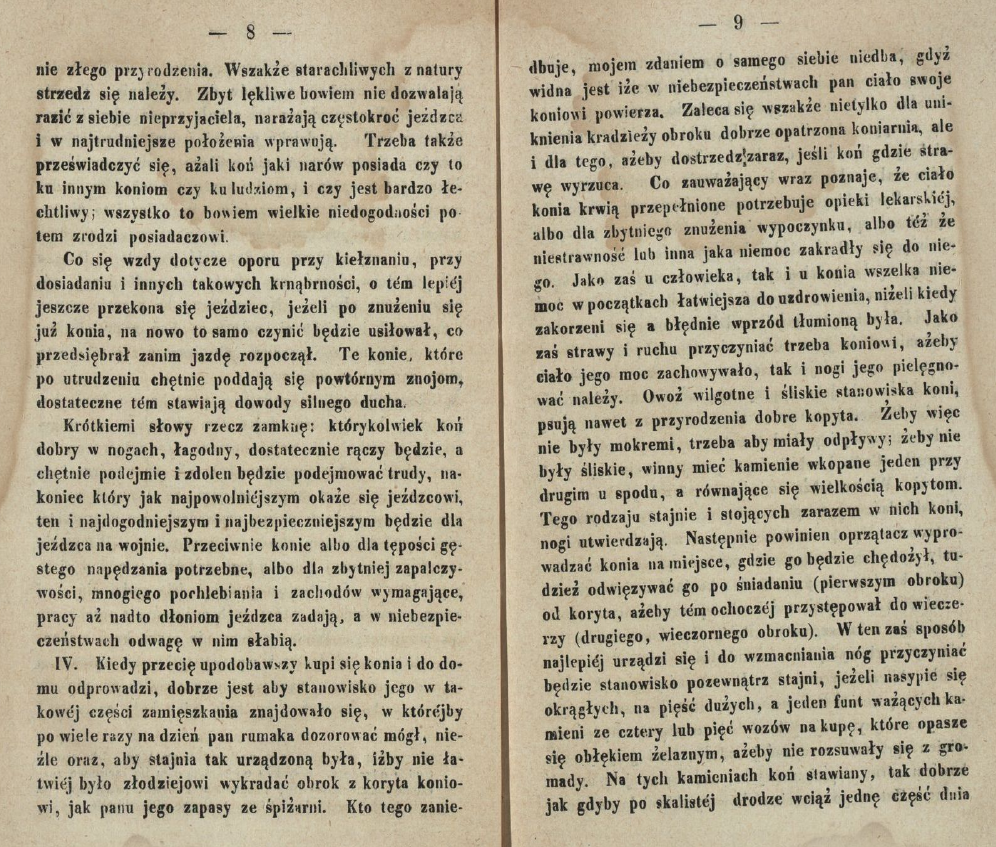
Peri Hippikes mistrza Ksenofonta - czyli ciąg dalszy tłumaczenia pana Antoniego Bronikowskiego  z 1860tego roku-


Valete

Hippika Ksenofonta w tlumaczeniu Antoniego Bronikowskiego I

 Salvete Omnes, 


 [in Polish]


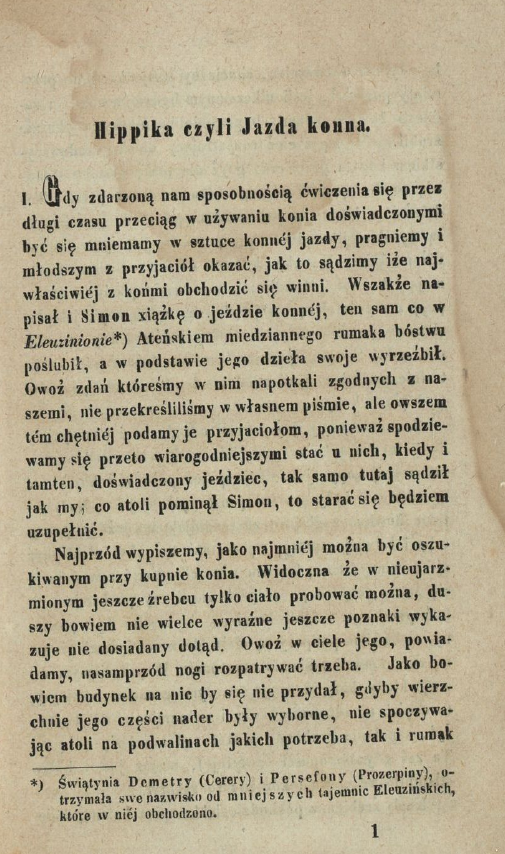
dzieło Hippika czyli 'Jazda Konna' 'rylca' Ksenofonta, helleńskiego żołnierza i filozofa, jest podstawą do studiowania traktatów hipologicznych per se.
Tłumaczenie Antoniego Bronikowskiego (1817-1884-  właściwie pełne nazwisko rodowe to Oppeln-Bronikowski, herbu własnego)  na język polski  ukazało się w Ostrowie [Wielkopolskim] w 1860tym roku, gdzie tłumacz był profesorem gimnazjum królewskiego. 


tedy piękno staropolskiego języka, w tym  języka hipologicznego, przed Wami, drodzy czytelnicy:


cdn

Valete


Sunday, August 14, 2022

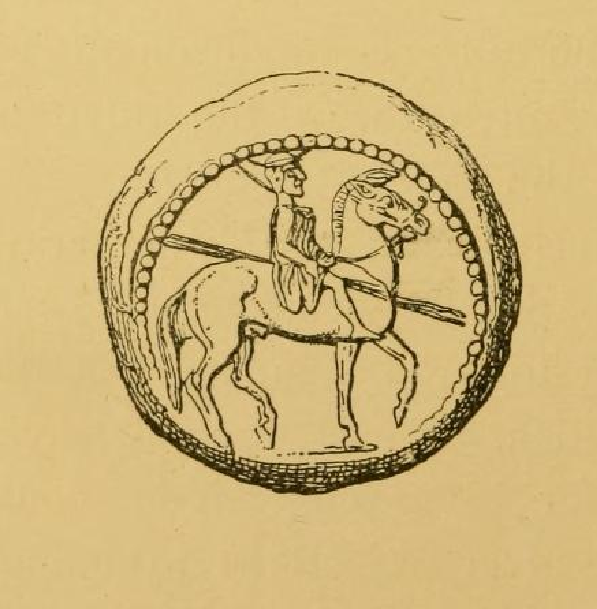
Petasos - Thessalian horseman hat continued

 Salvete Omnes,


dog days of the summer (but there are wars and conflicts all over the Planet: Ukraine vs Rus. Federation and their respective allies, Horn of Africa, Syria, Palestine etc) - so let us continue with the petasos, their wide brimmed horseman hat.


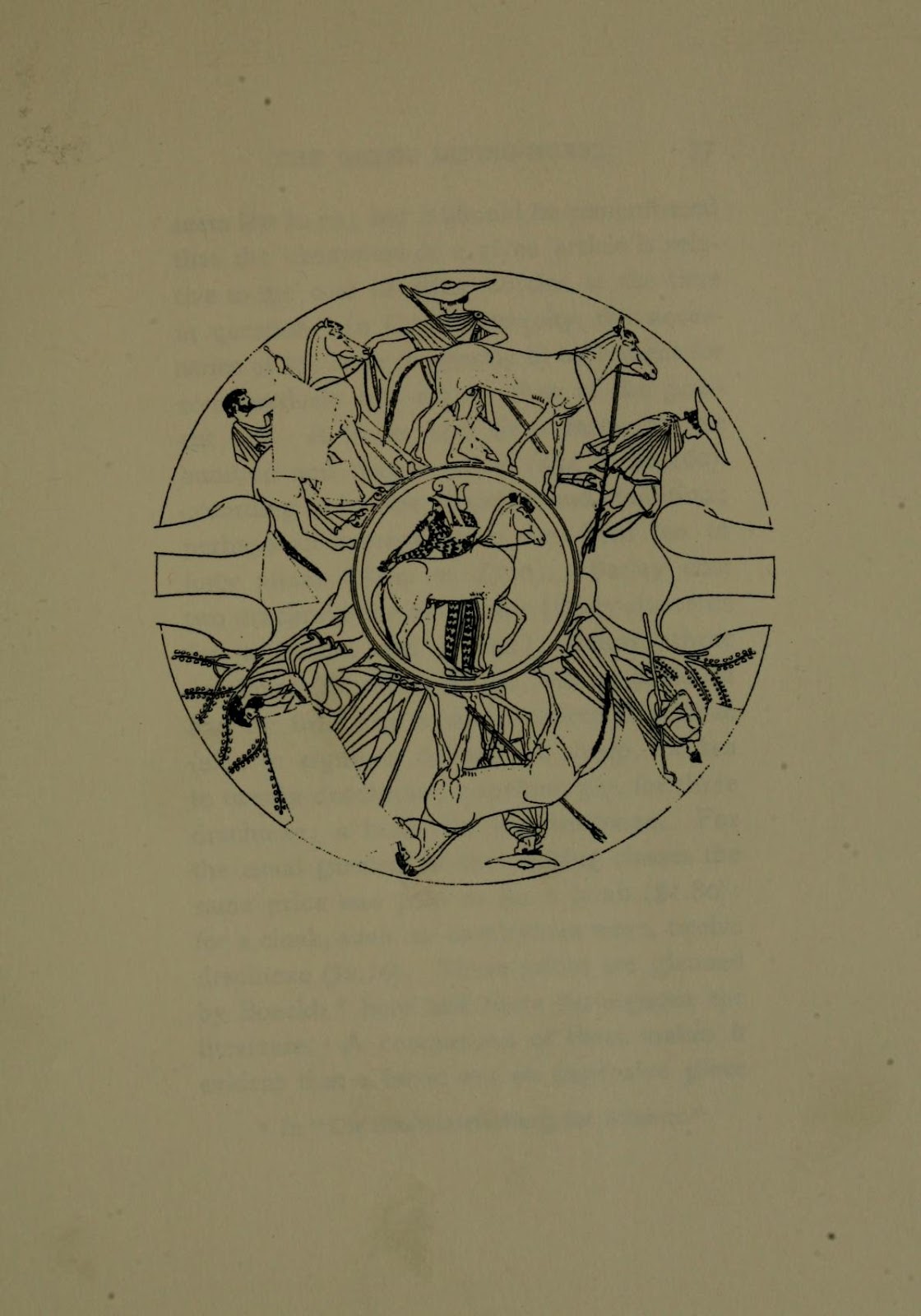
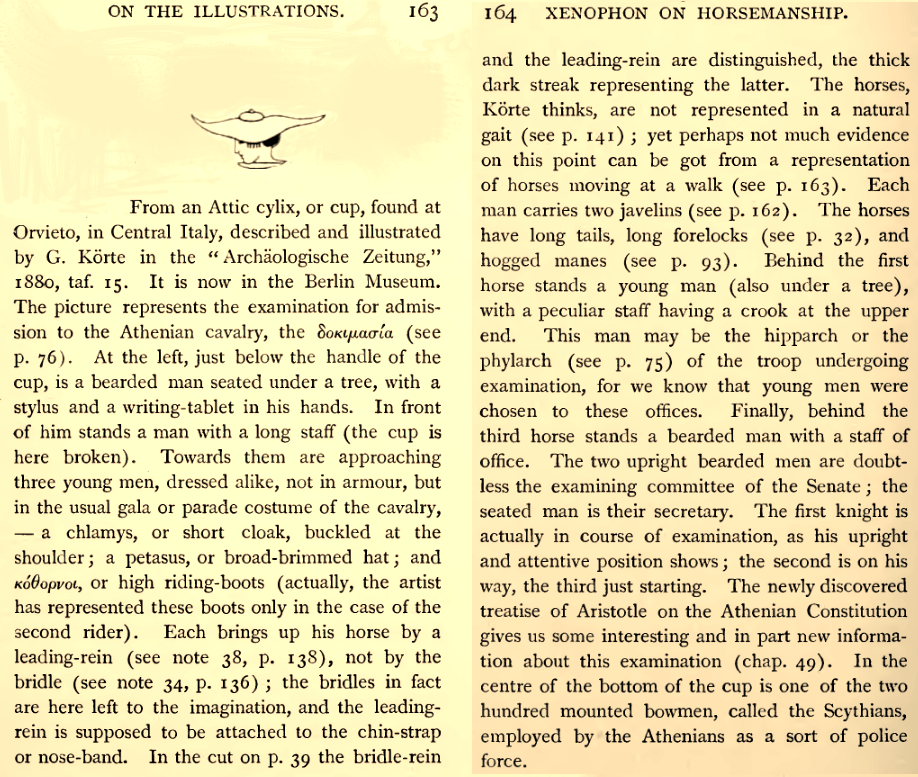
From Xenophon's Art of Horsemanship comes this description to this pottery painting -


enjoy 


Valete

Saturday, August 13, 2022

Petasos and horsemen

 Salvete Omnes.

 summer weekend  - and more ancient Thessalian horseman hat aka petasos imagery

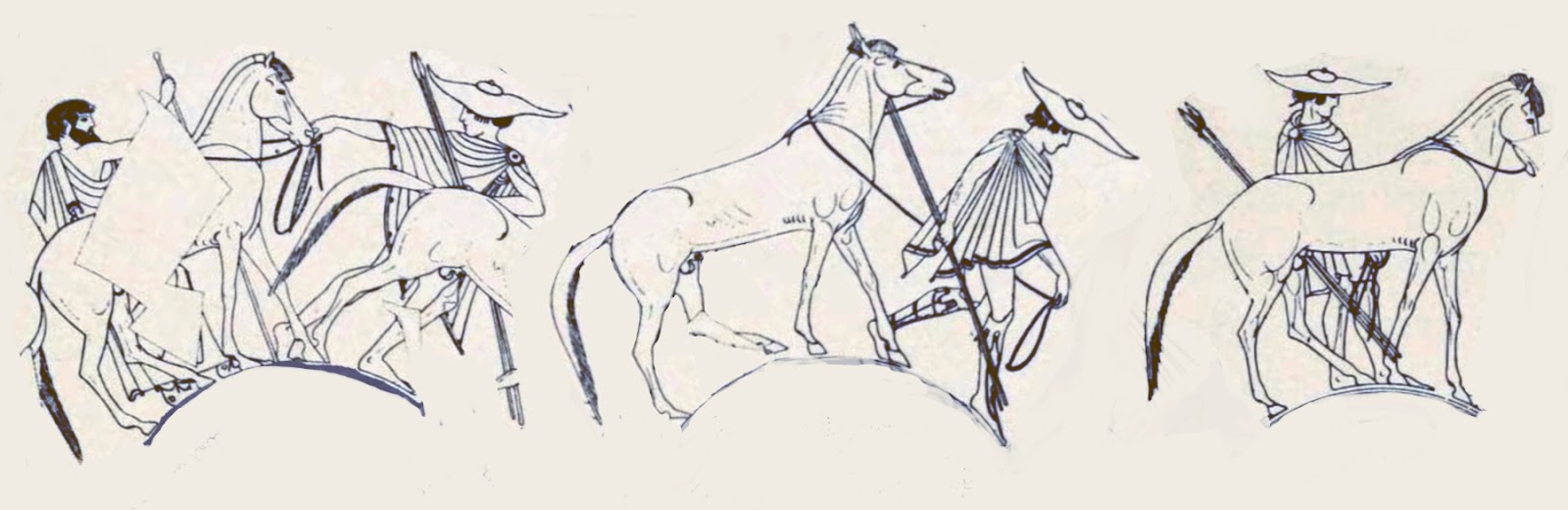
 from the famous book  Art of Horsemanship by ancient horseman Xenophon of Athens come these  beautiful images of ancient  Athenian cavalrymen wearing petasos- a Thessalian hat. This American edition of Xenophon's work was translated by Morris H. Morgan, PhD, and published in Boston, MA, 1893AD.  Available on Archive to read, download and peruse.


I 'separated' these horsemen a bit for clarity sake, so if you want to use them as they are now, for your pleasure or whatever, do feel free to use it, as I used the original image from the book 

cheers

Valete

Monday, September 27, 2010

Xenophon Peri Hippikes - arms and armor for the rider, rider's posture

 Salve,
finishing this Xenophon's horsemanship work with a fragment of a mural (Alexandrovo) painting of Thracian horseman hunting wild boar and a vase painting of Odysseus stealing horses  at the bottom

Continuing from Chapter XI:

CHAPTER XII.

Of a horseman's armour and arms.

l. We wish also to show how he should be armed who prepares to encounter danger on horseback.

In the first place, then, we say that his coat of mail should be made to suit his body ; because the whole of the body supports one that fits well, but the shoulders only support one that is too loose; and one that is too tight is a prison, and not a coat of defence.
2. Since the neck, too, is one of the vital parts, we think that a covering should be made for it of the same shape with the neck, rising from the coat of mail; for it will not only be an ornament, but, if it be made as it ought to be, will cover the face of the rider, if he wishes, up to the nose.

3. As for the helmet, we consider that which is of Boeotian manufacture to be the best; for it protects most effectually all the parts above the corslet, and yet does not prevent the wearer from seeing.

The coat of mail, again, should be made in such a way that it may not prevent the horseman from sitting or stooping.

4. About the abdomen, too, and the parts below and around, there should be skirts of such a description and size as to protect the limbs.

5. Since, also, if the left hand should be hurt, it disables the rider, we recommend the armour which has been invented for it, and which is called the hand; for it protects the shoulder, the upper part of the arm, the elbow, and the portion of the arm next to the bridle, and can be either expanded or contracted ; and it also covers the part under the arm which is left unguarded by the coat of mail.

6. The right hand a rider must raise, when he wishes either to hurl a weapon or to strike a blow. Whatever portion of the coat of mail, therefore, would obstruct it, must be removed ; and if in its place a sort of flaps with joints be put, they will, when the arm is raised, unfold at the same time, and, when it is let down, will close.

7. As to the right arm, that sort of defence which is put on it like greaves on the leg appears to us to be better adapted for protecting it than that which is attached to the coat of mail; and the part of the arm which is exposed when the right hand is lifted up must be defended near the coat of mail, with a covering made of calf's skin or of brass; otherwise it will be left unguarded in a most dangerous place.

8. Since, too, if the horse is disabled, the rider will be in extreme peril, it is necessary to arm the horse also with defences for his head, his breast, and his shoulders ; for these assist likewise in guarding the rider's thighs. But of all parts of the horse we take most care to protect his belly, for it is at once a most vital and a most defenceless part; but it is possible to protect it by something connected with the housings.'

9. It is necessary, too, that that which covers the horse's back should be put together in such a way that the rider may have a firmer seat,'' and that the back of the horse may not be galled. As to other parts, also, both horse and horseman should be armed with the same precaution.3

10. The legs and feet will naturally hang down below the covering of the thighs; but these parts may be sufficiently protected, if a sort of boots be constructed for them of the leather of which sandals are made ; for such boots may be at once armour for the legs and shoes for the feet.

11. Such is the armour that may prove, if the gods be propitious, a defence against harm. But to inflict injury on an enemy, we recommend the short curved sword rather than the long straight one; for from a horseman, seated aloft, a blow from a curved sword will be more effective than one from a straight sword.

12. Instead of a reed-like spear, as it is weak and inconvenient to carry, we rather approve of two javelins of cornel wood; for a skillful thrower may hurl one of these, and use the other against assailants either in front, or flank, or rear. They are at once stronger than a spear, and more easily carried.

13. We approve of the hurling of a javelin from a great distance; for by that means more time is allowed for throwing it and for taking another weapon. We shall intimate in a few words how the javelin may be hurled with the greatest effect. If the rider advance his left side, at the same time drawing back his right, and rising on his thighs, and launch his weapon with its point directed a little upwards, he will thus send it with the greatest force and to the greatest distance ; and he will send it with the truest aim, if the point, as it is discharged, is directed steadily to the mark.

14. Let these admonitions, and instructions, and exercises be considered sufficient to be prescribed for a private individual. What it is proper for a commander of cavalry to know and to do, is set forth in another treatise.

Xenophon of horseridding - paces


Continuing from Chapter X:

CHAPTER XI.

Of teaching a horse his paces. How to make him assume showy attitudes.

1. But if a person wishes to possess a horse that is fit for processions, and of lofty and magnificent bearing, such qualities are not to be found in every horse, for he must be one that is of a noble spirit and strong frame.

2. But what some suppose, that a horse which has suppleness of leg will also be able to rear his body high, is not the case; the truth rather is, that it must be a horse which has flexible, short, and strong loins (we do not mean the part by the tail, but that which is between the ribs and the haunches, at the belly), for such a horse will be able to extend his hinder legs far forward under him. 3. If a rider, then, when the horse has his hind legs thus under him, should pull him up with the bridle, he rests his hinder parts on his heels, and rears up the fore part of his body, so that his belly is seen by those in front of him. But when he does this, it is proper to give him the bridle, that he may assume of his own accord the attitudes most graceful in a horse, and appear to the spectators to do so.

4. There are people who teach horses thus to rise, some by striking them on the fetlocks with a stick, some by directing a man, who runs at the side for that purpose, to hit them on the upper part of the legs.

5.We however consider it the best mode of instruction, as we are perpetually saying, that when ever a horse acts agreeably to the wishes of his rider, it should follow that he receive some indulgence from him.

6. For what a horse does under compulsion, as Simon also observes, he does without understanding, and with no more grace than a dancer would display if a person should whip and spur him during his performance; since both horse and man, when suffering such treatment, would exhibit more ungraceful than graceful gestures. But the rider ought to teach a horse by signs to assume of his own accord all his most beautiful and showy attitudes.

7. If, then, when he is exercised, he be ridden till he is quite in a perspiration, and the rider, as soon as he raises himself gracefully, dismounts and unbridles him, he may feel assured that the horse will always be ready to rear himself of his own accord.

8. It is upon horses of this kind that gods and heroes are painted riding, and men who are able to manage them skilfully are regarded as deserving of admiration.

9.So extremely beautiful, and admirable, and noble a sight is a horse that bears himself superbly, that he fixes the gaze of all who see him, both young and old; no one, indeed, leaves him, or is tired of contemplating him, as long as he continues to display his magnificent attitudes.

10. If it should ever happen to the possessor of such a horse to be a phylarch or hipparch, he ought not to make it his study that he alone may enjoy distinction, but rather that all the cavalry under his command may be deserving of admiration,

11. Should such a horse precede the rest, [as people esteem such horses most,] one that, as he advances, rears himself very high and very frequently, it is plain that the other horses would follow him at a slow pace ; but what striking attraction could there be in such a spectacle ?

12. If, however, while you animate your steed, you lead neither with too great quickness nor with too great slowness, but just as horses appear most lively and formidable, and best adapted for exertion, if, I say, you precede the other horses in this manner, the march of the whole troop will be uniform, and even the very neighing and snorting of the horses will be n concert, so that not only the commander himself, but the whole troop, will present an admirable spectacle.

13. If a person be fortunate in purchasing horses, and bring them up to be able to endure fatigue, and train them properly, not only in exercises for war, but in manoeuvres for parade, and in service in the field, what can prevent him, unless some god be adverse to his endeavours, from rendering his horses of far greater value than they were when he took them under his care, or from having not only estimable horses, but being himself greatly admired for his skill in the art of horsemanship.

Xenophon of horse ridding - bit, briddle and hand


Continuing the Horsemanship Chapter IX :

CHAPTER X.

Of the proper management of the bit and bridle.

l. But whoever would desire to have a horse serviceable for war, and at the same time of a stately and striking figure to ride, must abstain from pulling his mouth with the bit, and from spurring and whipping him ; practices which some people adopt in the notion that they are setting their horses off; but they produce a quite contrary effect from that which they intend.

2. For by drawing the mouths of their horses up, they blind them when they ought to see clearly before them, and they frighten them so much by spurring and striking them, that they are confused and run headlong into danger ; acts which distinguish such horses as are most averse to being ridden, and as conduct themselves improperly and unbecomingly.

3. But if a rider teach his horse to go with the bridle loose, to carry his neck high, and to arch it from the head onwards, he would thus lead him to do everything in which the animal himself takes pleasure and pride.

4. That he does take pleasure in such actions, we see sufficient proof; for whenever he approaches other horses, and especially when he comes to mares, he rears his neck aloft, bends his head gallantly, throws out his legs with nimbleness, and carries his tail erect.

5. When a rider, therefore, can prompt him to assume that figure which he himself assumes when he wishes to set off his beauty, he will thus exhibit his steed as taking pride in being ridden, and having a magnificent, noble, and distinguished appearance.

By what means we consider that such results maybe attained, we will now endeavour to show.

6. First of all, then, it is necessary for a rider to have not less than two bits ; and of these let one be smooth, and have rings of a moderate size;' and let the other have rings that are heavy, and hang lower down, with sharp points;2 in order that, when the horse takes the latter into his mouth, he may be offended with its roughness, and consequently let it go, but when he finds it exchanged for the other, he may be pleased with its smoothness ; and that whatever he has been trained to do with the rough bit, he may do also with the smooth.

7. But if, from making light of it for its smoothness, he press upon it frequently with his teeth,1 we in that case add large rings to the smooth bit, that, being compelled by them to open his mouth, he may let go the bit. But it is possible to vary the rough bit in every way, by relaxing or tightening it.

8. But whatever sorts of bits are used, let them all be yielding ; for as to a stiff bit, wherever a horse seizes it, he has the whole of it fast between his teeth, as a person, when he takes up a spit, wherever he lays hold of it, raises up the whole.

9. But the other sort of bit is similar to a chain ; for of whatever part of it a person takes hold, that part alone remains unbent, but the rest hangs down. But as the horse is always catching at the part which escapes him in his mouth, he drops the bit out of his jaws ; and to remedy this inconvenience rings2 are suspended by the middle from the two parts of the bit,3 that while he catches at these with his tongue and his teeth, he may omit to seize the bit between his jaws.4

10. In case any one should be ignorant what flexibility, and rigidity, in a bit are, we will explain the terms ; for a bit is flexible when the two pnrts of it have broad and smooth joints, so as to be easily bent; and everything that is applied about these two parts, if it fit loosely, and not with a close grasp, conduces to flexibility; but if every part of the bit opens and closes with difficulty, it is to be called hard.

11. But whatever sort of bit is used, the rider must do everything with it in the manner which I have stated, if he wishes to make his horse such as has been described.

12. He must pull up the mouth of the horse neither too severely, so as to provoke him to shake himself free from it, nor too gently, so that he may be insensible to it. But when, on pulling him up, lie raises his neck, the rider must immediately give him the bridle. In other respects, too, as we do not cease to repeat, he must, whenever the horse has acquitted himself well, show him some indulgence.

13. When he perceives that the horse is pleased with carrying his head aloft, and with the looseness of the rein, he should then put him to nothing disagreeable, as if he would force him to exert himself, but should coax him, as if he wished him to be at ease; for thus he will feel greatly encouraged, and will advance of his own accord at a swift pace.

14. That a horse delights in going fast, there is sufficient proof; for no horse, on getting loose, goes off at a slow pace, but runs. With this speed he is naturally delighted, provided we do not compel him to run longer than is reasonable; for nothing whatever, immoderately protracted, is agreeable to either horse or man.

15. When the horse was brought to perform his exercise with grace, he was trained by us,1 we know, in the early part of his practice, to advance at full speed after sundry turns. But if any rider, when his horse has learned to do this, should rein him in, and give him at the same time a signal to hasten forward, the horse, being at once checked by the bridle, and incited to speed by the signal, will advance his chest, and lift his legs higher in anger, but not with ease; for horses, when they are annoyed, will assuredly not use their legs with greater agility and grace.

16. But if when he is thus animated, the rider gives him the bridle, he will then, from delight at supposing himself, on account of the looseness of the bit, freed from its restraint, bound forward with exultation, in a noble attitude, and with an easy motion of his limbs, and expressing in every gesture the grace with which he approaches other horses,

17. Persons who view such a horse pronounce him noble-spirited, prompt for action, fit for military exercise, high-mettled, superb, and at once pleasing and formidable to contemplate.

If any one desires such qualities in a horse, let what we have so far written serve as instructions for him.
ps

Greek cavalry Ancient Riding Hellas

Xenophon o horse ridding -fierce and diffcult warhorse


Xenophon - Continuing from chapter VIII:

CHAPTER IX.

How fierce and high-mettled horses are to be managed.

l. The directions which I have given show how a person may best avoid being deceived in purchasing a colt or a fullgrown horse; how he is least likely to spoil him in putting him to use, more especially if he would produce a horse having all the qualities that a horseman requires for war. But perhaps it is now proper to state how a rider, if he ever happen to have a horse excessively fiery, or excessively sluggish, may treat either of them with the most success.

2. In the first place, then, he ought to know that spirit in a horse is what anger is in a man ; and as a person who should neither say nor do anything annoying to a man would be least likely to anger him, so the rider that does nothing to vex a high-spirited horse will be least likely to provoke him.

3. Accordingly he must be careful, even from the very time that he mounts such a horse, not to discompose him as he takes his seat; and when he is fairly seated, he should allow him to stand quiet for a longer time than a horse of ordinary spirit,1 and then direct him to go forward with the gentlest possible intimations. Beginning to proceed, too, at the slowest pace, he should bring him into a quicker one, in such a manner, that the horse may be as little sensible as possible that he is accelerating his course.

4. But whatever a rider requires a spirited horse to do suddenly, the unexpected sights, or sounds, or sensations, consequent upon it, annoy him, as they would annoy a passionate man ; and it is necessary to bear in mind that everything sudden produces perplexity in a horse.

5. If therefore you wish to rein in a spirited horse when he is going faster than is necessary, you must not check him suddenly, but pull him in with the bridle gently, coaxing, and not forcing him, to slacken his pace.

6. Long rides in a direct course, too, soothe horses more than frequent short turnings ; and long gentle rides also soften and tame, and do not exasperate, the high-mettled horse.

7. But if any one imagines that if he rides at a hard pace for a long distance, he will render his horse gentle by fatiguing him, he supposes what is quite contrary to experience ; for a highspirited horse, in such circumstances, uses his utmost endeavours to get the better by force and with anger, like an angry man, and often does irreparable mischief both to himself and to his rider.

s. It is proper also to check a high-mettled horse from galloping at full speed, and to abstain altogether from matching him with other horses ; for horses that grow fond of contending against others become also the most refractory.

9. Smooth bits are more eligible for such a horse than rough. If a rough bit be used, we ought to assimilate it tc a smooth one by keeping it slack.1 It is well, too, for the rider to accustom himself to sit quiet on a fiery-spirited horse, and to touch him as little as possible with anything else2 besides those parts of the body with which we necessarily touch him in order to sit secure.

10. A rider should know, also, that it is a rule to moderate a horse's pace with a sort of whistle, and to urge him forward with a clucking sound; yet that if a person should from the first move him to gentle exertions with a clucking sound, and to more difficult efforts with a whistle, he would learn to quicken his pace at the whistle, and to moderate it at the cluck.

U. Likewise, when a shout is raised, or a trumpet sounded, a person should not appear to a horse to be at all disturbed, or approach him with anything that may alarm him, but should, under such circumstances, use his utmost efforts to pacify him, and, if convenient, should bring him his morning or evening feed.

12. It is a very judicious piece of advice, too, not to purchase a very high-mettled horse for service in war. As to a sluggish horse, it appears to me sufficient to observe, that a rider must treat him in a manner quite contrary to that in which we recommend him to treat a horse of high spirit.

* This observation is most just. It is from the manner of managing them alone that bits are easy or severe to the mouth of the horse; other wise, as the Duke of Newcastle says, the bit-makers would be the best horsemen. Berenger.

' We should not touch him, for instance, with the spear or javelin.

Xenopon on horse ridding - making a warhorse


Xenophon Peri Hippikes - continuing from chapter VI:


CHAPTER VIII.

How a horse is to be taught to leap. How he is to be prepared for military service.

1. Since there will be occasions when the horse will have to run up and down sloping and hilly grounds, and along the sides of hills, when he will have to leap over obstacles., and to spring up and down, the rider must train and exercise both himself and his horse completely in all these maneuvers; for thus they will be likely to contribute more to the safety and advantage of each other. 2. If any one thinks that we are merely repeating ourselves, because we now make mention of the same things that we mentioned before,1 let him understand that this is not a repetition ; for we then exhorted H. horseman, when he purchased a horse, to try whether the animal could perform such exercises ; but now we say that he must teach his own horse, and are going to prescribe how he must teach him.

3. He that has got a horse utterly inexperienced in leaping over ditches must, after slackening the leading-rein, go over the ditch first, and must then pull him on with the rein, that he may take the leap. 4. If he will not leap, another person must take a whip or a switch, and apply it on him smartly, when he will not only leap over the required space, but much further than is necessary; and afterwards there will be no need to strike him, for if he only sees some one coming behind him, he will leap.

5. When he has thus been trained to leap, let the rider mount him, and take him first to small, and then to larger ditches. Just as he is going to leap, let the rider touch him with the spur. Let him spur him, too, when he is teaching him to leap up and down from any height; for if the horse does all these things with an impulse2 of his whole body, he will do them with more safety to himself and his rider than if his hinder parts lag either in leaping over an object or in springing up or down.

6. To make him go down steep places, we must begin to train him on soft ground; and at length, when he is accustomed to this, he will run much more readily down a slope than up it. As to what some people fear, that horses will dislocate their shoulders in being ridden down steep places, let them be under no apprehension, when they are told that the Persians and the Odrysae (Thracians) all ride as fast as they can down steep hills, and yet have horses not less sound than those of the Greeks.

7. Nor will we omit to mention how the rider must accommodate himself to each of these particular circumstances ; for he ought, when his horse suddenly raises himself for a leap, to lean forward (since by that means the horse will feel less pressure on his hinder parts,1 and will be less likely to shake the rider), and, as he pulls in the reins when the horse alights, he must throw himself back, for he will thus be less jolted.

8. As the horse is leaping over a ditch, or stretching up an ascent, it is well for the rider to take hold of the mane that the horse may not be oppressed by the difficulty of the ground and by the bit at the same time ; but in going down a declivity, he should hold himself back, and support the horse with the bridle, that himself and his horse may not be carried headlong down the slope.

9. It is right, also, to exercise the horse sometimes in one place and sometimes in another, sometimes for a longer and sometimes for a shorter period; for this will be less disagreeable to the horse than to be always exercised in the same place and for the same length of time.

10. Since it is necessary, too, for him who rides his horse at full speed over all sorts of ground to be able to sit firmly on him, and to know how to use his arms on horseback dexterously, the practice of horsemanship in hunting is to be commended, where the country is favourable, and wild beasts to be found; but where these conveniences do not offer themselves, it is a good sort of exercise for two horsemen to make such an arrangement as this: that the one is to retreat over ground of a varied character, and, as he flees, is to turn about from time to time and present his spear, while the other is to pursue, carrying javelins blunted with balls, and a spear prepared in the same manner ; and whenever the pursuer comes within a javelin's throw of the pursued, he is to discharge his blunted javelins at him, and, whenever he gets within the stroke of a spear, to strike him as he is overtaken.

11. It is well for a horseman, also, if he close with an enemy, to pull his enemy towards him, and then suddenly push him away ; for this treatment is likely to unhorse him. On the other hand, it is well for him who is thus dragged to urge his horse forward; for by this means he is more likely to throw off his antagonist than to fall off himself.

12. If, on any occasion, when two camps are pitched opposite, the cavalry ride out against one another, and one party pursue their adversaries close up to their main body, and then retreat to their own, it is good for a rider to know that in such circumstances, as long as he is near his friends, it is right and safe to wheel about among the foremost, and charge the enemy at full speed; but he must take care, as he comes close upon them, to have his horse under control; -for, by acting with such caution, he will be in the best condition, as is probable, to injure the enemy and to escape injury from them.

13. The gods have enabled men to teach other men by speech what they ought to do. As for a horse, it is certain that you can teach him nothing by speech; but if, when he does what you wish, you gratify him in some way in return, and, when he is disobedient, make him feel punishment, he will thus effectually learn to obey you in what is required of him. u. This we may express, indeed, in a few words, but it should influence us throughout all our treatment of horses; for a horse will more readily take the bit, if, when he has taken it, something pleasant results to himself ; and he will leap across ditches, and jump over obstacles, and comply with our wishes in all other respects, if he looks forward, when he has done what is required of him, to some indulgence.

' As they wheel round, it will be proper for him to be among the foremost to charge the enemy. It will be proper for him to be in the rear when his party is retreating, and to be consequently foremost when they turn about to make a charge.

Tuesday, August 24, 2010

Xenophon on horse ridding - continuation of Peri Hippikes


Salveos,
today continuing from the Xenophon's book Peri Hippikes
http://dariocaballeros.blogspot.com/2010/08/xenophon-on-colt-young-stallion-male.html
Xenophon states:
CHAPTER VII.
Of the proper mode of mounting and riding a horse. Of exercising a horse.
1. We shall now show how a rider must act, when he has received his horse for the purpose of mounting him, so In the first place, then, he must take the rein,1 which is fastened to the lower part of the bit, or to the chain that goes under the chin, in his left hand, in a convenient manner, and so loosely, that he may not, either as he raises himself by grasping the mane near the ears, or jumps on the horse's back with the assistance of his spear, pull the animal back. Then, with his right hand, let him take hold of the bridle  at the point of the shoulder, and of the mane at the same time, that he may not in any way, as he mounts, twist the horse's mouth with the bit.
2. When he has set himself at ease for mounting, let him draw up his body with his left hand, and, stretching forth his right, let him lift himself with that also (for, mounting in this way, he will not present an ungraceful appearance behind), and let him do this with his leg bent, and not rest his knees on the back of the horse, but throw his leg across at once to the right side ; and when he has passed his foot clean over, let him then seat himself on the horse's back.
3. It seems to us also very proper, in case a rider should happen to be leading his horse with his left hand, and to be holding his lance in his right, to practise mounting on the right side ;1 but for this he has nothing more to learn, than to perform those movements with his left hand and foot which he had previously performed with his right. 4. We commend such readiness in mounting for this reason, that the rider, as soon as he is seated on the horse, is in every way prepared for action, if it should be necessary to encounter an enemy on a sudden.
5. When he has taken his seat, whether on the horse's bare back or on the cloth, we do not like that he should sit as if he were on a carriage seat, but as if he were standing upright with his legs somewhat apart ; for thus he will cling more firmly to the horse with his thighs, and, keeping himself erect, he will be able to throw a javelin or to strike a blow on horseback, if it be necessary, with greater force.
6. But it is necessary to allow the leg, as well as the foot, to hang loose from the knee ; for if a rider keep his leg stiff, and strike it against anything, it may be broken ; but if the leg hangs easy, and anything strikes against it, it will yield, and yet not move the thigh from its position.
7. A rider should also accustom himself to keep the parts of his body above the hips as flexible as possible ; for he will by this means be better able to exert himself, and if any person should drag or push him, he will be less likely to be thrown off.
   8. Let it be observed, too, that when he is seated on the horse's back, he must first teach the horse to stand quiet, until he has drawn up his mantle, if necessary, and adjusted the reins, and taken hold of his lance in such a way as it may most conveniently be carried. Then let him keep his left arm close to his side, for in such an attitude a rider appears most graceful, and his hand has the greatest power.
9. As to reins, we approve of such as are equally balanced, and not weak, or slippery, or too thick, so that the hand which holds them may be able also to hold the spear when it is necessary.
   10. When the rider gives the signal to the horse to start, let him begin to advance at a walking pace, as this pace is least likely to disturb the horse. Let him hold the reins, if the horse is inclined to hold down his head, rather high ; but if he is more disposed to carry it erect, let him keep them lower, for thus he will best set off the horse's figure. After a little, if he trots at his natural pace, he will find his limbs become pliant without inconvenience, and will come with the greatest readiness to obey the whip. Since too, it is the most approved practice to set off towards the left side, the horse will most readily start on that side,1 if, when he lifts, as he is trotting, his right foot, the rider then give him the signal to gallop. 
    12. For, being then about to raise the left foot, he will thus start with that foot; and just at the moment that the rider turns him to the left, he will make the first spring  in his gallop; for a horse, when he is turned to the right, naturally leads off with the right foot, and when turned to the left, with the left foot.
13. As to the mode of exercising a horse, we approve of that which is called the 'pede' (Volte according to G. Hermann), for it accustoms a horse to be turned by both sides of his mouth ; and it is good to change the direction of his course, that both sides may receive equal stress in the different directions.
14. We approve, too, of a place of exercise of an oblong form, in preference to the round; for in the oblong the horse may be turned with the greater ease, when tired of going straight forward, and he will be exercised at once in running in a direct course and in turning.
   15. It is proper also to pull in the reins as the horse turns ; for it is not easy for a horse, nor safe, when going fast, to turn in a small space,1 especially if the ground be rough or slippery.
16. But at the time that the rider pulls him in, he ought to sway the horse as little as possible with the bit, and to sway himself also as little as possible; for if he sways himself much, he may be well assured that a very small impulse will be sufficient to stretch both him and his horse on the ground.
17. When the horse, after having turned, looks straight before him, the rider should then excite him to greater speed; for it is plain that turnings are made in war either for pursuing or retreating, and hence it is good to accustom a horse, after he has turned, to increase his speed.
18. Also, when the horse appears to have been sufficiently exercised, it is useful, after having let him rest a while, to excite him on a sudden to his utmost speed, as well away from the other horses as towards them; and, after he has been put to his speed, to let him rest somewhere as near as possible, and, when he has stood still awhile, to wheel him about and urge him again to a gallop; for it is certain that occasions will offer when he will have need to practise both.
19. But when it is time to dismount, the rider should never alight either among other horses, or amidst a concourse of people, or beyond the exercise ground; but in the place where the horse is obliged to exert himself, there let him also begin to rest.

ps
 a little sketch o mine on top of this page

Friday, August 20, 2010

Xenophon's threatise 'On Horsemanship' continued


Salveos,
today we're going to continue with the most famous equestrian treatise,  Xenophon's "On Horsemanship,"  already started several days ago on my blog : http://dariocaballeros.blogspot.com/2010/08/xenophon-on-colt-young-stallion-male.html

 Xenophon on  buying a horse and caring for the steed:

When buying a horse
1. When a person would buy a horse that has been already ridden, we shall subjoin some admonitions which he ought to bear in mind, if he would not be cheated in his purchase. In the first place, then, let it not escape his notice what the age is; for a horse that has no longer the marks in his teeth neither delights the buyer with hope, nor is so easy to be exchanged.
2. When his youth is ascertained, it must also be noticed how he takes the bit into his mouth, and the head-piece over his ears; and this cannot fail to be observed, if the bridle is put on in sight of the purchaser, and taken off in his sight.
3. It is also necessary to see how he takes the rider on his back ; for many horses reluctantly receive on them anything which it is plain to them that they cannot receive without being compelled to work. It must likewise be observed whether, when he is mounted, he wishes to separate himself from other horses, or whether, if he is ridden near horses standing by, he carries off his rider towards them. There are some horses too, that, from bad training, run off from the places of exercise to their stalls' at home.
5. As for horses whose jaws are not alike, that sort of riding which is called the pede3 exposes them, and, still more, a change in the direction in which they are ridden; * for many horses will not attempt to run away with their riders, unless a hard jaw, and their course directed homewards, concur to stimulate them. We ought to ascertain, also, -whether the horse, being put to his speed, is readily pulled up, and whether he submits to be turned about.
6. It is good for a purchaser not to be ignorant, moreover, whether a horse is equally willing to obey when he is roused with a blow; for a servant and an army, if disobedient, are useless, but a disobedient horse is not only useless, but ofter: plays the traitor.
7. But when we take upon ourselves to purchase a warhorse, we must make trial of him in all things in which war will make trial of him; and these are, leaping across ditches, springing over walls, jumping on to mounds, and jumping down from them; and we must try him in riding up and down to steep places and along them; for all such efforts show his spirit, whether it is bold, and whether his body is sound. 8. Yet we must not at once reject a horse that does not accomplish all these feats perfectly ; for many fail, not from being unable, but from want of training ; and if they are taught, and used, and exercised in such performances, they will execute them all well, provided they are sound in other respects, and not wanting in spirit.
9. We must however be cautious of having anything to do with horses that are naturally shy ; for horses that are excessively timorous will not only not allow the rider on their back to harm the enemy, but will often take him by surprise, and expose him to great danger,
10. We must also learn whether the horse has anything of vice either towards other horses, or towards men, and whether he is averse to being handled ; for all such defects are troublesome to his owner.
11. As to any reluctance to being bridled and mounted, and other tricks, a person will much sooner discover them, if, when the horse has been thoroughly exercised, he attempt to do to him what he did before he began to ride him; since horses that, after having been exercised, are ready to submit to exercise again, give sufficient proofs of a mettlesome spirit.
12.- To sum up all in a few words, whatever horse has good feet, is mild-tempered, sufficiently swift, is willing and able to endure fatigue, and is in the highest degree obedient, will probably give least trouble to his rider, and contribute most to his safety in military occupations. But horses that from sluggishness require a great deal of driving, or, from excess of mettle, much coaxing and care, afford plenty of employment to the rider, as well as much apprehension in time of danger.


CHAPTER IV.
Attention necessary to be paid to a horse by its owner.
1. When a man has purchased a horse that he admires, and taken him home, it is proper that his stable should be in some part of the premises where the master may see him most frequently ; and it will be right for him to construct the stall in such a way that it may no more be possible for the horse's food to be stolen from the manger than the master's from his cellar. He that is neglectful of such precaution appears to me to be neglectful of himself; for it is evident that in danger the master trusts his personal safety to his horse.
2. A secure manger is not only serviceable to prevent the food from being stolen, but to let it be seen when the horse scatters his food out of the manger ;l and if a person perceives that such is the case, he may be sure, either that the horse, having too much blood in his body, requires veterinary attention, or that, from fatigue having affected him, he needs rest, or that indigestion or some other malady is coming upon him ; and it is with horses as with men, that all diseases are more easily cured at the commencement than after they have acquired strength, and mistakes have been made in the treatment of them.
3. As attention must be paid to a horse's food and exercise, that his body may be vigorous, so must care be likewise taken of his feet. Damp and smooth stable floors injure even naturally good hoofs; and to prevent them from being damp, they ought to be sloping; to prevent them from being smooth, they should have stones inserted in the ground close to one another, similar to a horse's hoofs in size; for such stable floors give firmness to the feet of horses that stand on them.
4. The groom must also lead the horse out of the stable to the place where he is to comb him ; and he should be tied away from the manger after his morning's feed, that he may come to his evening meal with the greater appetite. The ground outside the stable may be put into excellent condition, and serve to strengthen the horse's feet, if a person throws clown in it here and there four or five loads of round stones, large enough to fill the two hands, and about a pound in weight, surrounding them with an iron rim, so that they may not be scattered ; for, as the horse stands on these, he will be in much the same condition as if he were to travel part of every day on a stony road.
5. A horse must also move his hoofs when he is rubbed down, or when he is annoyed with flies, as much as when he is walking; and the stones which are thus spread about strengthen the frogs of the feet. And as we must take care of the hoofs, that they may be hard, so we must take care of the mouth, that it may be soft; and the same treatment softens the flesh of a man and the mouth of a horse.

Saturday, August 14, 2010

Xenophon on colt- young stallion conformation


Salve,
let us return for a moment to that time  less than 2,400 years ago, of the IV century BC,  when Athenian hippeis, adventurer, philosopher and writer Xenophon (Ξενοφῶν ) wrote his famous On Horsemanship ( Peri hippikés) treatise, and I am going to 'publish' here the most relevant parts of that ancient work since this work seems to sum up the ancient  Indo-European (North Iranian, Thracian, Greek, Persian and Median) knowledge  on horses in war and parade.

Xenophon (Ksenofont, Ксенофонт,) :


   1.In regard to a colt not yet broken, it is plain that we must examine his body ; for of his temper a horse that has never been mounted can give no certain indications.
2. In respect to his body, then, we assert that we must first examine the feet; for as there would be no use in a house, though the upper parts were extremely beautiful, if the foundations were not laid as they ought to be, so there would be no profit in a war-horse, even if he had all his other parts excellent, but was unsound in the feet; for he would be unable to render any of his other good qualities effective.
   3. A person may form his opinion of the feet by first examining the hoofs ; for thick hoofs are much more conducive to firmness of tread than thin ones ; and it must also not escape his notice whether the hoofs are high or low, as well before as behind ; for high hoofs raise what is called the frog ' far above the ground; and low ones tread equally on the strongest and softest part of the foot, like in-kneed men. Simon says that horses which have good feet may be known by the sound; and he says this with great justice, for a hollow hoof rings against the ground like a cymbal.
4. Since we have commenced with this part, we shall ascend from it to the rest of the body. The bones immediately above the hoofs, then, and below the fetlocks, must be neither too upright, like those of a goat (for then, being too unyielding, they shake the rider, and such legs are more subject to inflammation), nor ought those bones to be too sloping; for the fetlocks will in that case be denuded of hair and galled, if the horse be ridden either among clods or over stones.
5. Of the legs the bones ought to be thick ; for they are the supports of the body ; but it is not in veins or flesh that their thickness should consist, since, should this be the case, they must, when the horse is ridden over hard ground, be filled with blood, when hard tumours will arise, and while the whole leg is swollen, the skin will widen ; and when the skin is loose, the small bone of the leg4 often gives way, and renders the horse lame.
6. If the colt, as he walks, bends his knees freely, you may conjecture that he will have supple legs when he is ridden; for all colts in the course of time acquire greater freedom of motion in their knees ; and supple joints are justly commended, for they render a horse less likely to stumble and grow tired than stiff joints.
7. The forearms under the shoulders, if they are stout, appear stronger and more graceful, as is the case with those of men. The chest, if somewhat broad, is better adapted both for beauty and strength, as well as for keeping the legs, not so as to touch, but wide apart.
8. The neck, as it proceeds from the chest, should not fall forwards, like that of a boar, but should grow upwards like that of a cock, and should have an easy motion  at the parts about the arch. The head should be bony, and have a small cheek. Thus the neck will be directly in front of the rider,' and the eye of the animal will see what is before his feet. A horse of such a shape would be less able to do mischief, even though he be extremely vicious ; for it is not by bending, but by stretching out the neck and head, that horses attempt to be mischievous.
9. It is necessary to observe, however, whether both the fates * (On account of the smallness of the jaw, which will not obstruct his sight. Weiske ) be soft or hard, or only one of them, for horses which have not both the jaws alike are generally obstinate. To have the eye prominent gives an air of greater vigilance to a horse than to have it sunk, and a horse with such an eye can see much further than another.
10. Wide nostrils are not only better adapted for breathing than those which are contracted, but make a horse appeal more terrible; for when one horse is angry at another, or is excited in being ridden, he dilates his nostrils.
11. When the top of the head is somewhat large, and the ears rather small, they render a horse's head more like what it ought to be. The point of the shoulder being high renders the seat of the rider more secure, and makes the shoulder appear more firmly attached to the body. A double spine is both much softer to sit upon, and more pleasing to the eye, than a single one.
12. The sides being somewhat deep, and swelling towards tin belly, render a horse in general more easy to ride, and stronger, and make him appear better profited by his food. The broader and shorter the loins are, the more easily the horse raises his fore parts, and brings forward his hinder ones; and in so doing, his belly will appear smaller, which, if large, partly disfigures a horse, and renders him also weaker and less able to carry weight.
13. The haunches should be broad and well covered with flesh, that they may correspond to the sides and the chest; and if these parts are compact, they will be lighter for running, and render the horse much swifter.
14. If a horse has the thighs under the tail broad and not distorted, he will then set his hind legs well apart, and will by that means have a quicker  and firmer step, a better seat for a rider, and will be better in every respect. We may see a proof of this in men ; for when they wish to take lip anything from the ground, they try to raise it by setting their legs apart rather than by bringing them together.
15. A horse should not have large testicles; but it is impossible to tell what will be the size of them in a colt. With regard to the pasterns of the hind legs, or shins, as well as the fetlocks and hoofs, we may make the same remarks as we made concerning the fore-legs.
16. I wish also to show by what means \ person will be least likely to be deceived in regard to the probable size; for any colt that has very long legs when it is foaled will become a very large horse, since in all quadrupeds the shank-bones do not grow much as time advances, but the rest of the body, that it may be symmetrical, grows in proportion to them.
17. Those who judge in this way of the shape of a colt seem to us most likely to get a horse that has good feet, and is strong, fleshy, and of a good figure and size. Even though some horses change as they grow up, yet we may still have sufficient confidence in these observations to form a judgment; for far more horses, from being ill-shaped, become well proportioned, than grow deformed after having once been well-shaped.
 The above translation is by Rev. J. S. Watson, published in 1891
link to a Spanish language scholarly article (from Gladius magazine) on the Ancient Greek riders and their 'echo' amongst the Iberians http://gladius.revistas.csic.es/index.php/gladius/article/download/29/30
ps
 at the top my own little sketch of a warhorse, I hope :) and a photo of a  Hellenistic spirited war horse covered with a leopard 'schabraque' (sort of like Alexander the Great before and Hungarian, Polish and Ottoman Turkish riders during the XVI-XVIII centuries)