Showing posts with label Khotyn 1621. Show all posts

Monday, June 12, 2023

Jerzy Rudomina and 8 winged hussar companions cenotaph

 Salvete Omnes,


this topic is closely related to the battle-siege of Khotyn and the great Polish-Ottoman war 1620-21AD, two years ago I published the Polish version of this article - so as the saying goes-  better late than never I am 'publishing' the English version here today.                                                                                        


 ***

One of the heroes and and also one of the chroniclers of this war with the Ottoman sultan Osman II and his imperial army was Polish-Lithuanian cavalry rotomistrz/rotameister (captain) Jan Rudomina Dusiacki (1581-1648AD). 

This Jan Rudomina, later a castellan of Nowogrodek (an ancient city of Belarus and GDL, now in Belarus), was a son of another Jan, a tribunus of Braslaw, who was admitted to the Radziwill coat of arms Traby by Grand Lithuanian Hetman Mikolaj Radziwill Rudy ( Red) in 1575AD.  

Younger Jan Rudomina brought his winged hussar banner, in which his brother Jerzy and other citizens of property and means from the Grand Duchy of Lithuania served among this cavalry company. 

The Rudomina banner, without their kopia lances,  participated in the famous cavalry charge against the huge Ottoman attacking force of September 7, 1621AD. The Rudomina's winged hussar banner was combined within a ‘pulk’ or the crack mounted unit of 4 winged hussar companies, rapidly formed for this purpose under the leadership and orders of Grand Lithuanian hetman Jan Karol Chodkiewicz, against the Ottoman army attacks on the evening of that September 7.

In the course of the fighting, the Rudomina banner, fighting like reiter cavalry using pistols, broadswords and sabers,  suffered significantly higher  losses  among the 4 banners in this engagement (described in the poetry of the era, in diaries, and eventually in modern historical studies, e.g. by researcher Radosław Sikora). Among the killed companions and retainers of Rudomina banner was Jerzy Rudomina, Jan's brother. Jan took the bodies of the fallen companions back to Grand Duchy of Lithuania, and he had  his brother  Jerzy buried in Vilnus, while the companions were buried in Nowogrodek. 

Jan himself was wounded and wrote an epic diary of the Khotyn battle – published in print in 1640AD and nowadays available in digital form on the website of the Jagiellonian Digital Library. 

In 1643, Rotmistrz Jan funded a cenotaph commemorating the valiant death of his brother and his 8 companions on that Khotyn battlefield on September 7. The cenotaph was installed inside the Transfiguration of Christ church in Nowogrodek.
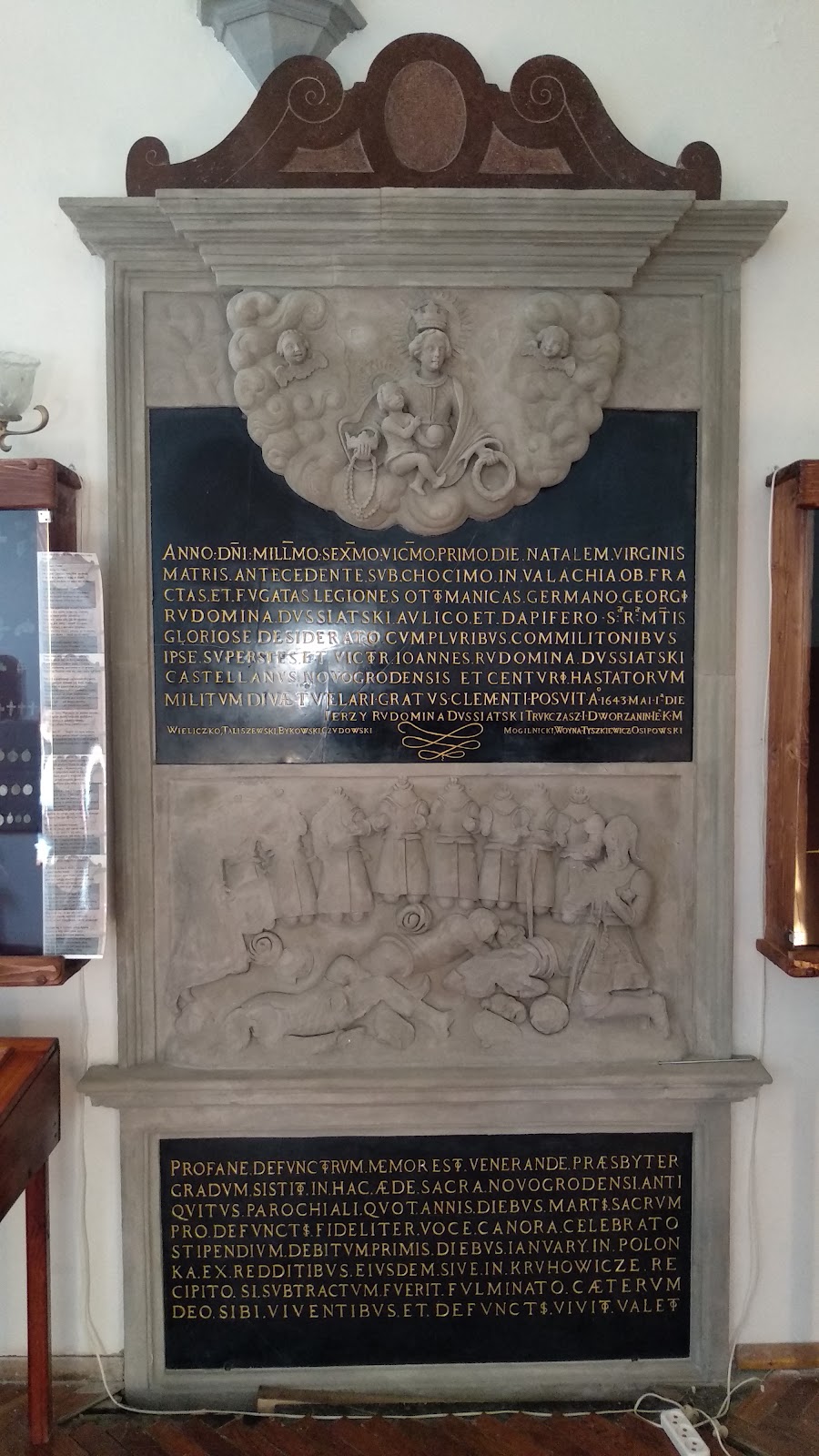


And although the current church was re-built in the XVIII century, the cenotaph survived the storms of history (Soviet hordes 1919-20AD, then the invasion and occupation by the German Nazi bestial savages 1941-44AD, and finally the rule of the only ‘just’ Red system (1944-90AD), and although mightily damaged, it can be admired in the said church of the Transfiguration of Christ in the old ducal city.


 Fortunately and happily, during the XIX century, some unknown artist drew a cenotaph and then the drawing was copied in the form of a lithograph printed by the Lemercier company in Paris, France, the so-called Vilnius Album, edited by (?) J.K. Wilczyński, published in Paris 1845-1856, volume 2, and the publication itself was financed by a descendant of the Rudomina family.  


Finally, on academia page of dr Katarzyna Kolendo-Korczak, you can read her article about the very cenotaph (in Polish) still located in the ToC church in Nowogrodek.


Valete

Friday, October 15, 2021

Rudomina eques polonus - rotmistrz & jego brat

 Salvete Omnes,

[in Polish]

wokół Chocimia i wielkiej wojny 1621AD - 

jednym z bohaterów i zarazem kronikarzy wojny z Osmanem II był rotmistrz Jan Rudomina Dusiacki i jego chorągiew, w której wśród towarzystwa służył jego brat Jerzy i inni obywatele a posesjonaci z Wielkiego Księstwa Litewskiego. 

Chorągiew ta brała udział w słynnym natarciu kawleryjskim, tj walkach  'pułku' husarskiego wprędce stworzonego pod wodzą samego hetmana wielkiego litewskiego Jana Karola Chodkiewicza na wojska osmańskie wieczorem 7 września, 1621AD.
W toku walk chorągiew Rudominy poniosła znaczne straty (opisane w poezji z epoki, w diariuszach, i w opracowaniach np Radosława Sikory), min. poległ brat rotmistrza Jerzy. Sam pan Jan napisał diariusz ekspedycji chocimskiej - wydany drukiem w 1640 roku i dostępny na stronie Jagiellońskiej Biblioteki Cyfrowej

W 1643 rotmistrz Jan ufundował bratu swemu i jego 8 towarzyszom poległym pod Chocimiem cenotaf w kościele w Nowogródku(mieście starożytnym Białorusi i WKL), który to pomnik przetrwał burze dziejowe (hordy sowieckie1919-20, panowanie jedynego sprawiedliwego ustroju(1944-90) i najazd  germańskiej dziczy hitlerowskiej 1941-44), i choć uszkodzony może być podziwianym w farze Przemieniania Pańskiego w wielkoksiążęcym mieście. 

fragment z Polona


Szczęśliwie  XIX wieku nieznany artysta narysował cenotaf i następnie rysunek został skopiowany w formie litografii  wydrukowanej  przez firmę Lemercier w Paryżu, Francja, jako część tzw Album Wileńskie,  pod redakcja(?) J.K. Wilczyńskiego, ser. 2, Paryż 1845-1856, poszyt 2, a sama publikacja sfinansowana przez potomka rodu Rudominów.

A na stronie mości pani Katarzyny Kolendo-Korczak można przeczytać artykuł o cenotafie, który wystawił swojemu poległemu bratu Jan  Rudomina w farze w Nowogródku.

[in English]

soon to follow

Valete

Sunday, October 3, 2021

Batle of Khotyn 1621 - video released!

 Salvete Omnes,

I have just started watching this SandRhoman History video production - don't know if it is any good - here the link to this YouTube presentation

screenshot with my 14 figures


Perhaps it will be all right...so enjoy this production of the Battle of Khotyn Project ..


Valete

Friday, October 1, 2021

Battle of Khotyn 1621 Project

 Salvete Omnes,

I had been involved in this project - Battle of Khotyn 1621 Project -  and painted a number of soldiers for it - it was fun albeit kind of late effort - I hope they will work .
this project is  a collaboration between our Polish 'afficionados' and SandRhoman History YT channel - 

So, I just have got this notice that there is a trailer and that a full video will follow on October 3, 2021 - 


Cheers.. -:)

Valete

Wednesday, September 29, 2021

Chocim aka Khotyn 1621 order of battle - Polish-Lithuanian army

 Salvete Omnes,

One of the most important battles in Polish history, the one of Chocim (Khotyn) 1621,  is not really celebrated in Poland and other former lands of the Polish-Lithuanian Commonwealth. But for these celebrations that took part last Saturday in Rzeszow, Poland.


This epic armed conflict  between  Polish-Lithuanian Commonwealth and  Ottoman Turkey, the culmination of about 20 years of border conflicts, incursions, raids and etc, armed invasions eg Cecora 1620AD.  this year has its 400th anniversary.  And not a small role in  instigating this conflict, apart from the huge role of the Polish  border magnates, Zaporozhian Cossacks and Crimean Tatars,  was played by the enemies fighting during the early stages the 30 Years War -prince Gabor Bethlen on one side and the Hapsburg Empire. Perhaps Gabor Bethlen was instrumental in instigating the Ottoman attack on Polish-Lithuanian Commonwealth, as he was the enemy of our Respublica. Luckily for the Polish side the victorious Ottoman  commander Iskander Pasha had died before the fighting at Chocim took place.

so I would like to add some info about the Polish-Lithuanian Commonwealth army that mustered in the defensible war  laager around the medieval Chocim castle  on September 2nd, 1621 AD or at the beginning of a month long   'battle' between the hostile parties. It should be followed by another post about the Ottoman host.

the commander in chief :

Lithuanian grand hetman  Jan Karol Chodkiewicz

three major components of the army:

-mercenary soldiers and their retinues, where appropriate

-the Zaporozhain Cossacks

-magnate and lesser lords private banners and companies with appropriate retinue and warmed camp followers.

Polish-Lithuanian Commonwealth army at Chocim had also several separate commands -

 -Crown

-Lithuanian  grand duchy,

these former armies were untied under one register.

 -Zaporozhian Cossack

Now, as far as the total number of soldier there are two troop lists aka registers, that differ slightly as to the number of units and horses/portions(infantry),  of the Crown and Lithuanian army divided into different types of units:


Register one                                                                                              Register Two 

1. Winged hussars :

  -53 banners or 8520 horses (paid for soldiers on paper)          or             - 70 banners       or 8600 horses

2.  Pancerny kozak calvary and lisowczyk banners                     

  -66 or 8450 horses                                                                    or    -75 kozak cavalry or 7700 horse and 10 lisowczyk/1300horse

3.  German  reiter cavalry 

- 10 companies/ 2160 horses                                                       or - 12 companies 1300 horse

4.  regiments of German infantry

-5 regiments / 6450 portions                                                          or  -6 regiments  6100 portions

5.  Polish and Hungarian hajduk infantry

-29 companies/ 7600 portions                                                         or -30 regiments /8000 portions

all together 

33180 horses and portions.                                                             or- 33000 horses and portions

 Crown and Lithuanian army also included the camp followers, and some historians count to add about 30 to 35,000 armed camp followers from the hussar, kozak pancerny, reiter and  infantry commanders' retinues to the total number of armed combatants. The actual numbers of paid soldiers were at least 10% smaller in fact or so it this thought.

 The second important component consisted of the Zaporozhian Cossacks commanded by hetman Petro Konaszewicz-Sahajdaczny and it consisted of about 25-30,000 soldiers or portions(?)

 So for the purpose of operational and tactical combat application this Commonwealth army was divided into 'pulk' or temporary divisions of various sizes -
1.prince Władysław Vasa - 10,180 horses and portions

2. Grand hetman Chodkiewicz - 4,600 horses and portions

3.voivode Lubomirski -  3,350 horses and portions

4.Maciej Lesniowski - 1,000 horses and portions

5.Jana Mikolaj  Boratynski  - 859 horses and portions 

6.Mikolaj Zienowicz - 1,750 horses and portions

7.Aleksander Sapieha - 2,000 horses and portions

8.Piotr Opalinski - 1,600 horses and portions

9.Mikolaj  Kossakowski - 1,300 horses and portions

10.Mikolaj & Prokop Sieniawski, 1,200 horses and portions

11.Stanislaw Rusinowski - 1,200 lisowski horse

in addition there were 2,650 horses and portions that were not included in these 'pulks', as they arrived separately into the war laager  and thus not assigned to any division.

The army had circa  30 pieces of field artillery, only few of them heavier guns.  


Zaporozhian Cossacks, with their separate camp extended along the river constituted a self-operating rather huge division ( we do not know how they might have been divided and operated other than they did have a 'pulk'  organization too) -  like I said experienced fighter, scholar and commander hetman Petro Konaszewicz-Sahajdaczny commanding.   


From the very first day the Commonwealth army was not sufficiently provisioned with foodstuffs, horse fodder, munitions and especially gun powder. For some reason  the river Dniester was not used to ship food and war supplies into this war laager. Which is interesting in itself since all Commonwealth large rivers were used as the  shipping and trading highways, yet Dniester was no used to provide supplies to the fighting army.

to be continued

Valete


Tuesday, August 24, 2021

Chocim 1621-2021 - via YT

 Salvete Omnes,

[in Polish]


zbliża się szybkimi krokami wrzesień i rocznica rozpoczęcia oblężenia albo bitwy obronnej wokół zamku w Chocimu nad Dniestrem połączonych armii Rzeczpospolitej Obojga Narodów dowodzonych przez hetmana wielkiego litewskiego J. K.Chodkiewicza(po jego śmierci przez Stanisława Lubomirskiego (herbu Szreniawa bez Krzyża) przy obecności królewicza Władysława, a kozacy zaporoscy przez swego hetmana Piotra Konaszewicz Sahajdacznego),  z armia Imperium Osmańskiego sułtana Osmana, młodzieńca wspomaganego przez swych doradców i dowódców.


Na YT pojawiły się wywiady i prezentacje związane z sama bitwa, kampania, wojną1618-1621, z wojskowością polska tamtej epoki i innymi podobnymi  tematami (filmików jest więcej - należy tylko wpisać szukaj w przeglądarkę YT, eg na Bitewnym szlaku)

Dr Przybył gości u Sebastiana Pitonia, gdzie opowiada wokół wojny z Porta Ottomańską i problemie kozactwa zaporoskiego, tak źle rozegranego przez włodarzy ówczesnej Rzeczpospolitej, przy koncertowej grze naszych ówczesnych wrogów.


Imć pan Jacek Komuda, Stadnicki wciąż was/nas potrzebuje, gości w swym dworze imć Jacka Bartosiaka, gdzie sobie gaworzą o wojskowości szlacheckiej epoki (bardziej rozrywkowo niż naukowo, ale momentami bardzo zgrabnie)

I finałowy film to wywiad a może prawie monolog mego druha dr Radosława Sikory, który opowiada o potrzebie chocimskiej AD 1621 w kontekście militarnym


miłego słuchania i/lub oglądania.

Valete