Salve,
a day after the great feast of Thanksgiving calls for something special in the history of horse art and war horse, so perhaps the grand work by master
François Gérard who witnessed the Age of Napoleon would give us this 'grandeur.' (notwithstanding the fact that the Emperor was one of the great destroyers of war horses in history).
The French victory at
Austerlitz was painted by many an artist, but the rendering of this moment of cavalry glorious return from their victorious charge as depicted by monsieur Gerard allows us to do a little viewing of the period tack and horse, and horse soldiers of the
Imperial Guard, Their their famous charge that 'let the ladies of Saint Petersburg weep ' left for the other
artists to paint.
Naturally the Emperor of the French first :)
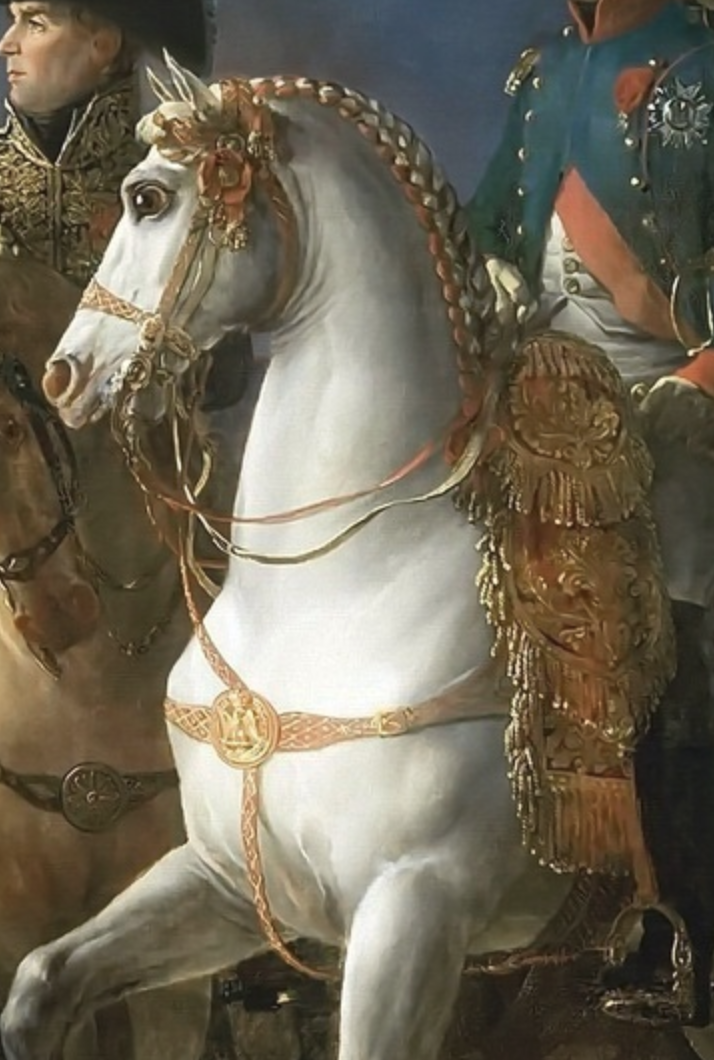
In the center of the canvass we see the commander of the famous charge, Napoleon's ADC general
Jean Rapp reporting the victory to the Emperor and his staff (nota bene Marechal
Jean-Baptiste Bessieres also charged in this cavalry action)
Napoleon on his splendid stallion:
staff:
heroic Jean Rapp is a bit wounded, hatless and rides a splendid grey that could make many a stable proud
but there is this anecdote about the artist and the general's horse -
La France Hippique
relates the following anecdote :
“ Gerard, the
celebrated painter, was charged by the Emperor Napoleon I.
to paint the battle
of Austerlitz. In his composition of that great feat of arms,
General Rapp was to
be represented coming up at full gallop to announce the
gain of the battle.
Every thing was prepared on the canvass, and there only
remained to place
Rapp on horseback, but Gerard could not find a charger
which suited his
ideas.
The Emperor had
placed at his disposal, not only all the horses of his own stables,
but ordered that
those of all the cavalry regiments should be open to him.
The animals were
made to gallop, rear, and perform all kinds of movements, but none of
them pleased the painter, and Rapp still remained unmounted.
One day while
walking along the Boulevard, the painter, in passing
before a toy-shop,
uttered an exclamation of delight on observing a small
pasteboard horse,
painted grey and with a black head, which, from its position looked
as if it was about to leap out of the window.
“Ah!' cried
Gerard, 'that is the horse for Rapp;' and entering , he asked the
price for it – 'Twenty -five sous,' was the replay; and the artist,
paying the money, carried off the horse under his arm.
It is this animal
which, it is said, figures, in the famous picture of the Museum at
Versaillers,
carrying Rapp to the emperor, the General, in his haste having lost
his hat.
(printed 'Dwight's
Journal of Music:' Boston 1861, p 175)
General Rapp described this action in his memoirs - can be read at
archive library, as usual :)
Chasseur a cheval - including the chasseur who mortally wounded still brought the captured flag to his commander - (The
Memoirs of Baron de Marbot, vol I p. 199)
Mamelukes - famous Mustapha (Mustafa) who wanted to catch Archduke Constantine, who escaped by shooting mameluke's horse. Baron de Marbot, p 198-99
Grenadiers a cheval - famous bearskins - perhaps a little about their horse tack - their horse tack consisted of a natural leather saddle with a white leather seat (over a blue saddle cloth with wide stripe of 'gold' lace). Gold grenades were embroidered in the rear corners of the the saddle cloth. The bridle with reins, breastplate, and crupper were of black leather with the metal buckles et al of brass where required. Cinch was of a grey cloth. Pistol holders were of brown leather, blackened iron stirrups hung on the Hungarian leather straps. The horse head harness consisted of the cavalry bridle (curb-bit of steel with a brass boss stamped with a grenade and snaffle etc) and double reins and scarlet rosettes and ribbons.
enjoy
ps
Patrice Courcelle painted several Osprey's titles where very detailed plates with uniforms, horse tack etc can be studied and enjoyed along with the text. Two plates in the 'Mounted Chasseurs of the Guard' depict the Rapp & Guard's charge at Austerlitz in monsier Courcelle' fine style.
Ps'
2014
reenactment - at
Slavkov u Brna, in Czech Republic, of course.