Showing posts with label reiters. Show all posts

Wednesday, July 29, 2026

Wallahusen - Jacobi's Kriegkunst & Kavallerie

 Salvete Omnes,


almost a decade ago I wrote this post about the Gdansk citizen and military theoretician Johann von Wallhausen.


Today just some plates from his book published by Paul Jacobi and scans available from Deutsche Fotothek. 

Horse & rider training - including war horse desensitizing with fire, noise and obstacles


emjoy

Valete

Tuesday, April 7, 2026

Warka on the Pilica River 1656-2026

Salvete Omnes, 


On April 7, 1656 near town of Warka on the Pilica River Polish Crown forces consisting of cavalry and dragoons defeated the invading Swedish forces during the so called Deluge or Polish-Swedish war 1655-60 AD.


Polish Crown forces that crossed the flooded Pilica River consisted of some 6,500 men and horses (Crown cavalry banners) whereas  some 5 to 6,000 men and horses stayed on the other side of the river,

The Crown army divided into several pulk commands, the main ones being two:


 1. The Crown marshal Sebastian Lubomirski - crica 1,500 horses and men including 1 banner of his own winged hussars and 2 other winged hussar banners, pulk of  kozak pancerni banners, pulk of   light cavalry, and 2 companies of dragoons . His forces attacked the Swedish main army


.


2. voivode of Kijow Stefan Czarniecki - perhaps 3,000 plus division -  who had under his command 1 winged hussar banner and many companies of dragoons, light cavalry, kozak pancerni etc.
Also, about 1000 strong voivodeship of Sandomierz noble militia.

Swedish forces were commanded by Frederic VI, Margrave of Baden-Durlach with 'colonel' (Oberstleutnant)  Ritter consisted of cavalry and dragoons - circa 2,500-3,000 men and  horses, plus huge wagon train - some sources say 2,000 wagons and carriages. 

Magrave's forces were also cavalry and dragoons - the  Reiter Cavalry Regiments of Ahlefeld, Waldeck, Siegel, 3 companies from Adolf Johann reiter regiment, and companies  & freicompanies of dragoons. Ritter (who died in action), commander of Radom, led circa 1000 strong dragoon force protecting the huge wagon train, and in the battle he commanded the rearguard. Poles attacked this rearguard as the prelude to the main engagement of two main armies.


Upon destroying of the Ritter's rearguard, Crown Marshal Lubomirski personally led 3 winged hussars banners (500 strong?)  assault on the Swedish cavalry and dragoons. The charge did not break the Swedish companies, but gave time for the other Polish cavalry banners to provide support to the winged hussars and then Czarniecki  sent the Zamoyski winged hussar banner aided by the Wasowicz dragoon regiment to charge the Swedes. Next the winged hussar banners withdrew and upon reforming their ranks and file charged as one lance hedgehog-like 4 banner strong unit. They broke Swedish regiment and companies.. 

Within two hours from the beginning of the battle it was over, our Polish Crown cavalry secured a tactical victory of the Swedish army.  Margrave with many high ranking officers and under the escort of a Finnish company escaped to the Czersk Castle (well, the ruins of it), where they were able to have survived 'till the following morning and only after the Polish Crown cavalry withdrew to the main body of the Crown army, the Swedish commander adnd his stragglers made it to Swedes-held Warsaw. 

enjoy

Valete 

Tuesday, October 14, 2025

Young Pasek at Parkany & Juliusz Kossak painting

 Salvete Omnes

the painting above, a watercolor painted by famous artist Juliusz Kossak in the late XIX century, depicts a particular event that took place during the aftermath of  the 2nd battle of Parkany.

Polish XVII century memoirist Jan Ch. Pasek wrote down the description of the 1683 campaign based on conversations with the actual participants. One of them was his brother's son (hence synowiec) or nephew  Stanislaw Pasek.
The painting describes Stanislaw's tale about what happened after the battle:

'My nephew Stanislaw Pasek [captured] a certain  important-looking Turk, because of his fine costume and  of a beautiful steed he was mounted upon; he had already disarmed [his prisoner] and rode with him by leading the [Turkish] horse by its reins, with the Turk mounted upon it, until a German [horseman] rode up, and when [the German] was parallel to the Turk , he run  [the Turk] through with his sword. The Turk just only groaned, so when [my] nephew turned to see [he saw] that the [Turk] opened his mouth  in last gasps and was falling off the horse. The German rode quickly to the side. My nephew berated the [German] -
-"Oh scoundrel, such and son of the bitch! you killed my prisoner, is that honorable?"
The German just laughed and said [in broken Polish]:
-"I am [your] Pan/Sir / Brother , Pan/Sir/ Pole, I am astonished that you want to feed this devil/pagan."
My Nephew continued to scold him:
-"You are a knave, not a chivalrous man, when you kill a prisoner in my custody (in my hands)."
The German kept on laughing and riding, thus slipped away [unpunished].                                                     What was the nephew to do? The German harbored [then] great hatred towards the Turks [...] and because the German were cruel by nature and when in victory don't know how to show noble moderation.''

in Polish from one of the versions that survived, devoid of Latin phrases and curses) -


..


enjoy

Valete

Monday, September 22, 2025

Polish-Russian war 1609-11AD - advance on Smolensk

 Salvete Omnes,

Yesterday, i.e., the 21st of September,  but in 1609AD,  Polish-Lithuanian army crossed the border the Commonwealth-Muscovy border and advanced onto Smolensk, the most important fortress of the western Muscovy, guarding the so called Smolensk Gate. 


Since 1582 Polish-Lithuanian Commonwealth and Muscovy had been under the truce, although our Polish-Lithuanian magnates supported Dmitry, the alleged son of Ivan IV,  who even married and crowned a tsarina Maryna Mniszech, Polish noblewoman. 


Since 1605AD Muscovite realm, Grand Duchy of Muscovy, was in the throes of the civil war  known as the Dimitriads, where various factions of the Muscovite aristocrats aided by Polish-Lithuanian magnates, foreign mercenary armies and foreign powers, like Sweden etc, were meddling within the Russian realm. Technically, upon the murder of tsar Dmitry I in 1606,  there was a tsar or grand duke Vasili IV Shuisky in Kremlin, but his fraction had to face Dmitri II, known as false Dmitry II, whose armies and popularity with the population allowed for control of rather vast areas of the huge Muscovite realm since 1608AD.

Since 1600AD Polish-Lithuanian Commonwealth already had been in a war, this was a dynastic war  against the usurper Karl IX of the kingdom of Sweden, where  the war was  mostly carried by Lithuanian  army with many private banners and companies. Ducal  forces were under the commanded of Jan Karol Chodkiewicz, victor of Kircholm 1605. 

King Sigismund III,  the scion of the Swedish Vasa dynasty elected by the noble host  to sit on the Polish-Lithuanian Commonwealth throne in 1587, and his councilors decided to breach the 1582 AD truce and to attack Smolensk, taken by the Muscovite armies in 1514AD. The ship had sailed- Mars ruled.


Smolensk on the Dniepr/Dnieper River 1609-11


Royal Polish army was divided into various divisions, the advance party was led by  Lew Sapieha, a chancellor of Lithuanian, and Stanislaw Stadnicki, castellan of Przemysl - reached Smolensk on September 28. 
Then came hetman Stanislaw Zolkiewski division, with the artillery park = reached the camps on September 29.
And finally the king's division and court with the rest of the army and thousands of wagon trains filled with ammunition, powder, food, fodder and other supplies and necessities, but also thousands of servants, traders, and camp followers. 

King and his contingent  crossed the border, via a bridge over the river Iwala or Iwata,  on the 21 of September, 1609 and reached Smolensk camps on  October 1, 1609.

The anonymous diary of this campaign tells that  in vanguard 800 Hungarian infantry marched first, then the 200 [infantry] of starost of Sacz [Stanislaw Lubomirski], 100 [infantry] of lord of Krakow[Janusz Ostrogski], then 100 strong  horse banner of  Old Polish Kozak cavalry of starost of Sacz,   then lord of Krakow also  a 100strong  Kozak cavalry. Thena very fine 200 winged hussars banner of starost of Sacz. Just before the His Majesty person and  retinue(70 strong) a very well equipped   100-lancer strong winged hussar banner  of lord of Krakow. After the king [marched] the court banner of 600 lancers, after them a 150 horse [reiter] banner made out of Prussians, Pomeranians and 'Inflanteers'  under pan Nowodworski*, each rider with two carbines. After them a 100 strong Kozak cavalry royal banner. Then 1400 German infantry under [Ludwik] Weiher [marched across the bridge]. The weather was fine, no clouds in the sky and this fine weather lasted until the evening. The king arrived in Wasylov where he joined hetman [Zolkiewski] already in the camp there. This day a finely equipped banner of prince Porycki, 150 horse strong, came[to our side].  (page 65 of the diary).


According the Polish archives,   during the quarter of the 5th of July through Ocbober 5, 1609 the cavalry arm of the army consisted of:

- 2,300 winged hussars or lancers

- 800 Polish kozak cavalry

- 300 "German' reiters.

By the next quarter - October through January 1610, the number of winged hussars would grow to 4000 lancers, Polish Kozaks to 900 horsemen, while reiters would fall to 269. Again in 2 quarters- January to July  1610AD the winged hussar would drop to 2205 lancers, Polish Kozaks to 400, and the reiters would grow again to 300 horsemen (after Kazimierz Gorski, 1895). 


Infantry - German, Hungarian hajduk, Polish hajduk and royal guards -  and artillery - cannon masters, gunsmiths, gun crews and craftsmen  -   also waved in numbers during the first year of the siege - started with 4213 officers and soldiers, went down to 2513 (June) and to 1698 in July 1610.  Gunmasters 


The siege continued during the summer of 1610,  the following winter and spring of 1611. During this period hetman Zolkiewski defeated the allied army at Klushino, July 1610, and consequently  the Muscovite Shuisky regime collapsed and victorious and Sun Tsu-like hetman Zolkiewski entered Moscow and new era, our Poles in Moscow, ensued.

King Sigismund III victorious at Smolensk


 Finally  our king ended victorious in June 1611AD,  when on the 13th  the Polish army stormed and captured the fortress, king  had medals made for the happy occasion. During the final assault knight of Order of Malta pan Bartlomiej Nowodworski *,  Nalecz coat of arms,  sallied to blow the gate and having succeeded became a hero. Winged Hussar Samuel Maskiewicz wrote his diaries describing the war. Hetman Stanislaw Zolkiewski wrote his famous work about his war -  Poczatek i progres wojny moskiewskiej. Another warrior ,Mikolaj Scibor Marchocki also wrote his history of the war.


Meantime, since 1605 many thousands of Cossacks, Zaporozhian and Don, roamed the Muscovite lands siding with this or that party or power But perhaps more importantly it was during this period that the  new Polish light cavalry was born:  the Lisowczycy (Lisowski' kozacy [singular Lisowczyk, kozak lisowski] cossacks), one could say also to the detriment of the civilian populations in Muscovy and in Polish-Lithuanian Commonwealth, and further west in the Holy Roman Epire and Hungaries.
For the project about Khotyn 1621 I did draw two Lisowski kozaks.

Valete

Thursday, July 31, 2025

Warsaw 1656 - Swedish-Brandeburg-Prussian armies and Dahlberg's day one print

 Salvete Omnes

Battle of Warsaw - day 1 - 

Swedish-Brandeburg-Prussia armies come from Nowy Dwor - the map comes from collection at Polona, Polish National Library, and was based on the drawings by Erik Dahlberg


. Swedish army under Karl X Gustavus*


.


.Brandenburg-Prussian army under  Friedrich Wilhelm, de jure Polish vassal in mutiny against his Polish sovereign. *


.


total - 


.


*according to Riese' work (1870) - now, the modern Polish historians (Herbst, Wimmer,, Nagielski etc) give the number at 18,000 soldiers. Swedish historians, based on Carlbom (1906) who worked from Pufendorf's book and Swedish army archives, provide a slightly smaller number - 17,000 plus 50 to 60 cannons.  
the cavalry (including dragoons) was more numerous than the infantry in this allied army.

Valete

Thursday, February 1, 2024

De Ruiterschool - de Gheyn - part I

 Salvete Omnes,

a new month and new challengers - farmers around the world unite while world needs more peace, no war and mayhem. 

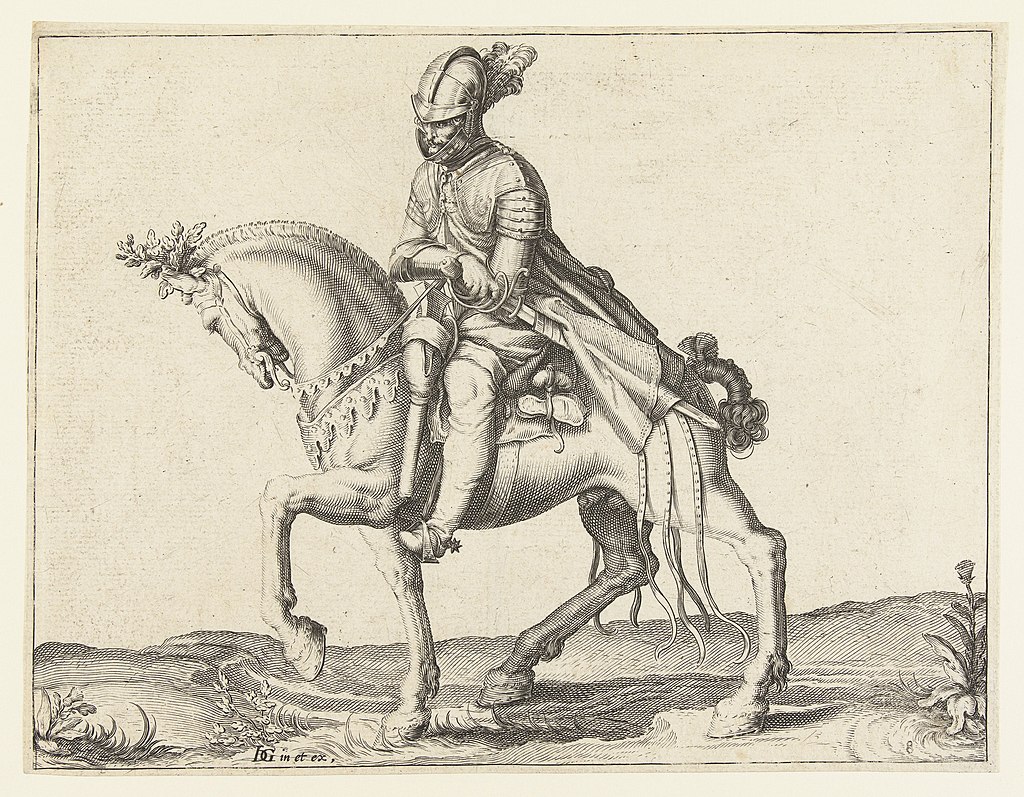
ad rem, my first posting of the month - the 'modern' cavalry of the late XVI century, when Western European  lancers were giving way to the 'modern' firearms blazing reiter cavalry


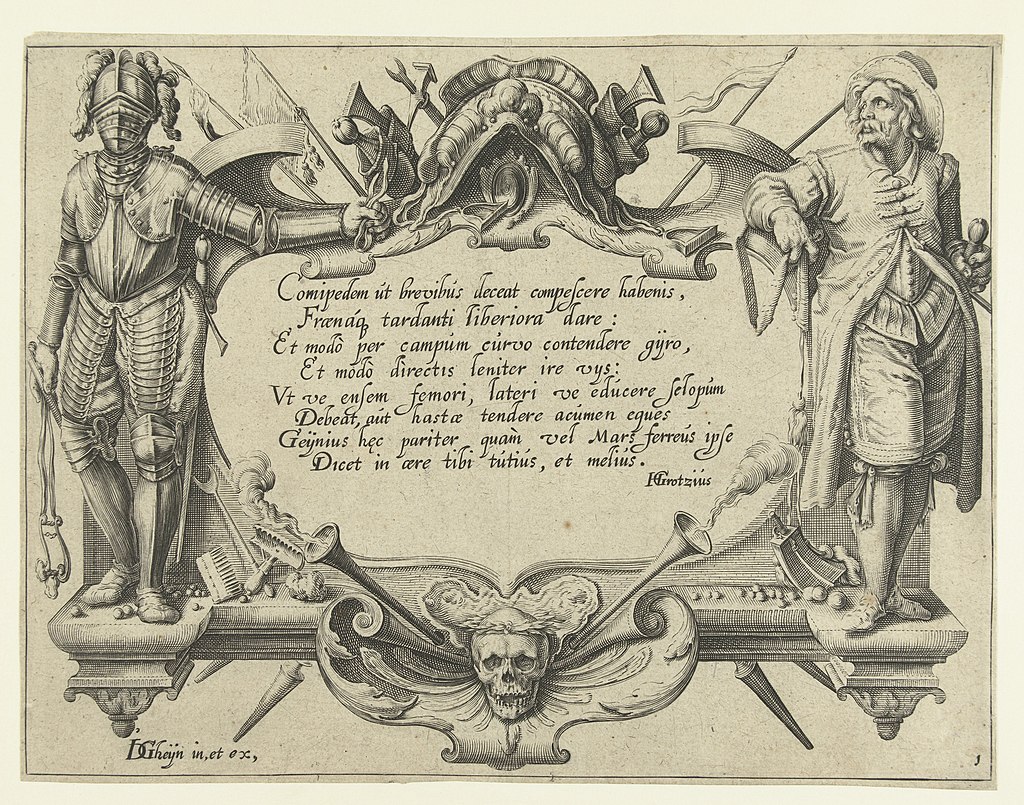
Here a collection of miltiary horsemanship prints by Jacob de Gheyn from Rijksmuseum in Amsterdam, Netherlands - done in 1599 AD.

part one - 'pistoliers' (reiter cavalry)  and arquebusiers of the late XVI century


 for your study and enjoyment 

Valete