Showing posts with label Hucul horse. Show all posts

Monday, March 27, 2023

Zygmnut Ajdukiewicz - a painter

 Salvete Omnes,

To the market with geese


*
May peace return to the people of Ukraine while my Moslem friends shall diligently celebrate the month of Ramadan until sundown April 20.

Easter is coming  - may peace come to the people of Ukraine


 alas,today we should take a quick look at the available works of Zygmunt Ajdukiewicz (1861-1917), the cousin of Tadeusz Ajdukiewicz.


first, this series of works that where illustrating the life of Tadeusz Kosciuszko, hero of Poland and USA, published in a book and can be had from the Polish national library site  Polona.

Kosciuszko's 'dworek - Mereszowszczyzna according to our illustrator

Kosciuszko and George Washington - American Revolutionary War

battle of Dubienka


Kosciuszko thanking his troops

Raclawice battle

Maciejowice battle and capture of Kosciuszko


and the genre paintings, including two from the National Museum in Warsaw


and a historical illustration - a knightly tournament


Valete

Tuesday, December 13, 2022

Juliusz Holzmuller and his watercolors

 Salvete Omnes,

today a short entry with yet another Polish horse painter. 


Juliusz Holzmuller was a Polish watercolor, gouache, and ink painter active during the first part of the XX century.
Maestro Juliusz was born in Bolechow (now in Ukraine) in 1876, the year George Custer and his command died at Little Big Horn in Montana.


He went to school in Lwow (about 90 km from his hometown), known then as the C.K. State Industrial School, where he studied decorative painting with  professors and artists like Roman  Bratkowski, Stanisław Józef  Rejchan , and Tadeusz  Rybkowski. Then in 1898 he became a student at the Krakow's Fine Art Academy with Florian Cynk,  Józef  Mehoffer  i Teodor  Axentowicz etc where he studied until finishing his academic studies in 1906. In 1903 through 1904 he took one year leave or 'sabbatical'  from his Krakow studies and went on to study at the Munich Art Academy.
Upon terminating his studies he settled in Stanislawow (now Ivano-Frankivsk in Ukraine), where he worked a teacher of drawing at the town's middle and high schools etc. He showed his work at Krakow Society of Friends of Fine Arts and other venues throughout  partitioned Poland. He eventually moved to Lwow, here he became a drawing teacher at the Nikolaus Copernicus' 1st State (c.k.) High School. He painted large size watercolors, and one of them, showing Japanese Imperial cavalry, was purchased for the officer club in Tokyo, where it may still be surviving.
Also he painted portraits  of the famous Taurow Polish Arabian stud farm* horses at the request of Longin Łobos, nephew of the founder, Dionizy Trzeciak. Pan Juliusz passed away in 1932 in Lwow, 7 years before his world become no more (Soviet, Germand and Ukrainain UPA eradication of the Poles in this beautiful land of Red Ruthenia aka eastern LittlePoland.


He painted horses, horse people, Huculs and local topics like markets or hunting, also landscapes and many other topics.


You can explore - via your browser's search engine - his watercolors and other works in various galleries and auction houses around the Internet.


Hucul wedding party

Hucul wedding party with musicians


Valete

*Taurow stud farm and estate was located in the vicinity of Taurow village in present day Ukraine, 28 km north-west of Brzezany,  Tarnopol oblast,

Saturday, December 10, 2022

Polish peasant horse in Aleksander Kotsis paintings

 Salvete Omnes,


finally a little entry about Aleksander Kotsis (1836-77), citizen of then town of Podgorze (complicated story of Krakow and towns and villages in the vicinity during 1795-1914- nowadays a district of Krakow) who was of mixed Polish and Slovak heritage, his father Jan perhaps of the Slovak ancestry from Lewocza/Levoca in Spis while his mother came from  village of  Ludwinow  , now part of Krakow, and was of a peasant origin.
Kotsis was one the XIX century growing community of Polish masters of brush and paint, pen and ink, and charcoal. This artist grew up, lived and worked mostly in Little Poland, while doing academic and artistic studies at  Krakow Academy of Fine Arts  and at  Vienna's k.k. vereinigten Akademie der bildenden Künste (Imperial and Royal Unified Academy of Fine Arts). 

Luszczykiewicz' gorals or highlanders


While in Krakow  he  studied under two influential  professors   Władysław Łuszczkiewicz & Wojciech Stattler, 


friends of Artur Grottger, including Kotsis and Matejko Ad 1865, Krakow

  Among his fellow students there were many great artists-in-training, like  Jan Matejko and Artur Grottger to name a few.


 He was forced to stop working in 1875 and  died prematurely in 1877.


Kotsis painted lots of country and farm characters, including the gorals aka Highlanders and other Carpathians Mountains  mountaineers.
Became a painter of Polish peasants and their lives in the second half of the XIX century.  And the peasant farmer and highlander used faithful koniks and Hucul horses in their work, draft and in other transposition needs and pleasures, including riding.


in the picture below there is a Gypsy family with a captive bear.


here we have a typical sturdy konik, the workhorse of the Polish peasantry of those past centuries

noble horses in this canvass - horse market

Kotsis traveled across Europe, including the Alps,hence this alpine looking canvas

Cracovian farmer and a Jewish trader


Valete

Tuesday, September 13, 2022

Tadeusz Rybkowski - genre painter

 Salvete Omnes,


today, I would like to corral some artwork from the brushes and pencil by yet another Polish painter blossomed during the Partition Era - Tadeusz Rybkowski (1848-1926), disciple of Wladyslaw Luszczkiewicz, Leopold Loffler and Hansk Makart. He settled in Austrian held city of Lwow (then much bigger center of Polish culture than Krakow) where he taught and prospered through War World I and Polish Independence wars etc. 


Dorotheum page on maestro Rybkowski


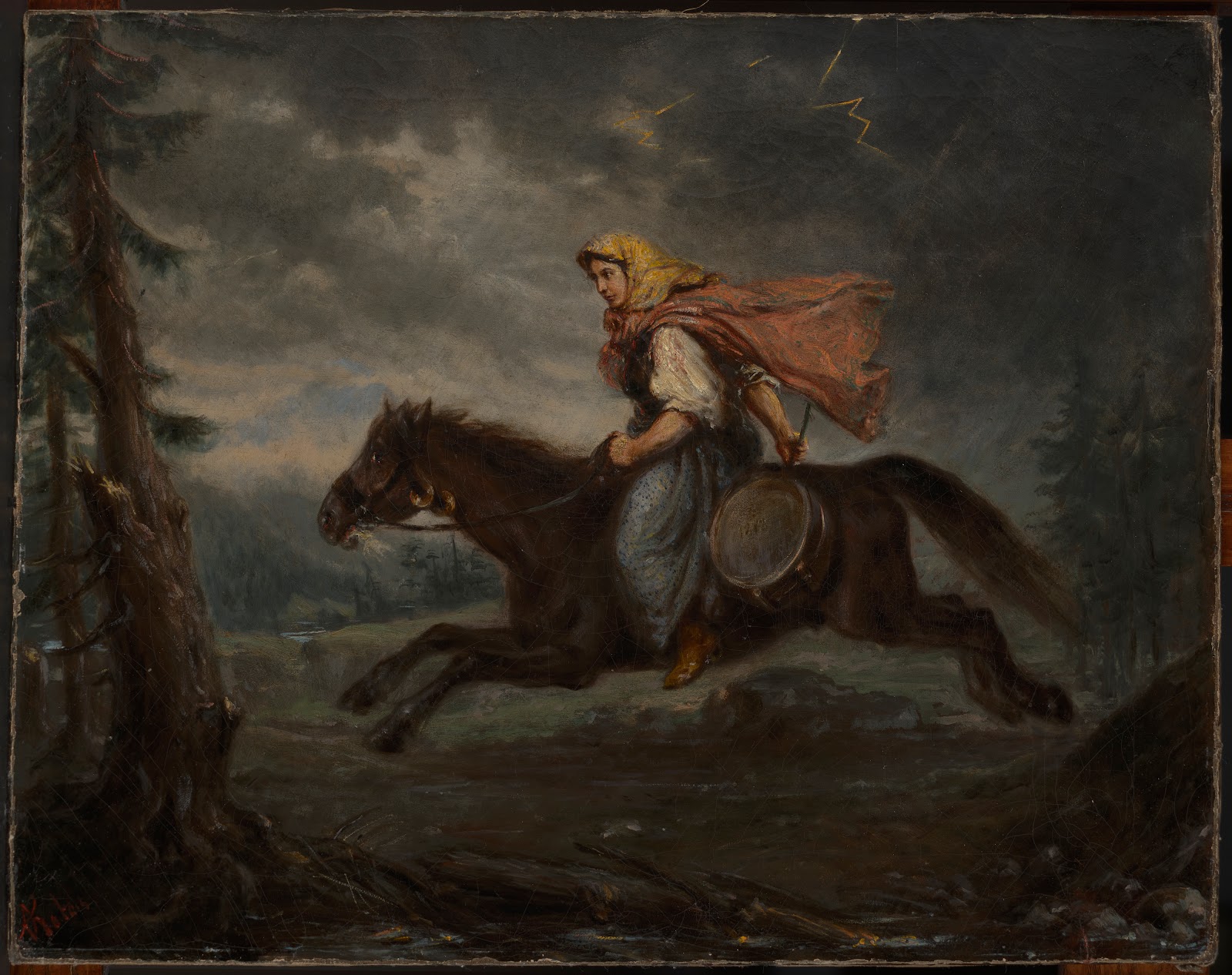
so some of his works (minus the market scenes, as I will make a separate entry about them) - historical paintings, genre paintings, landscapes, horses and Hucul peasants of Carpathian mountains


Valete