Showing posts with label digital painting. Show all posts

Friday, February 10, 2023

David Deevad Revoy - new 2023 bundle of brushes for Krita

 Salvete Omnes,


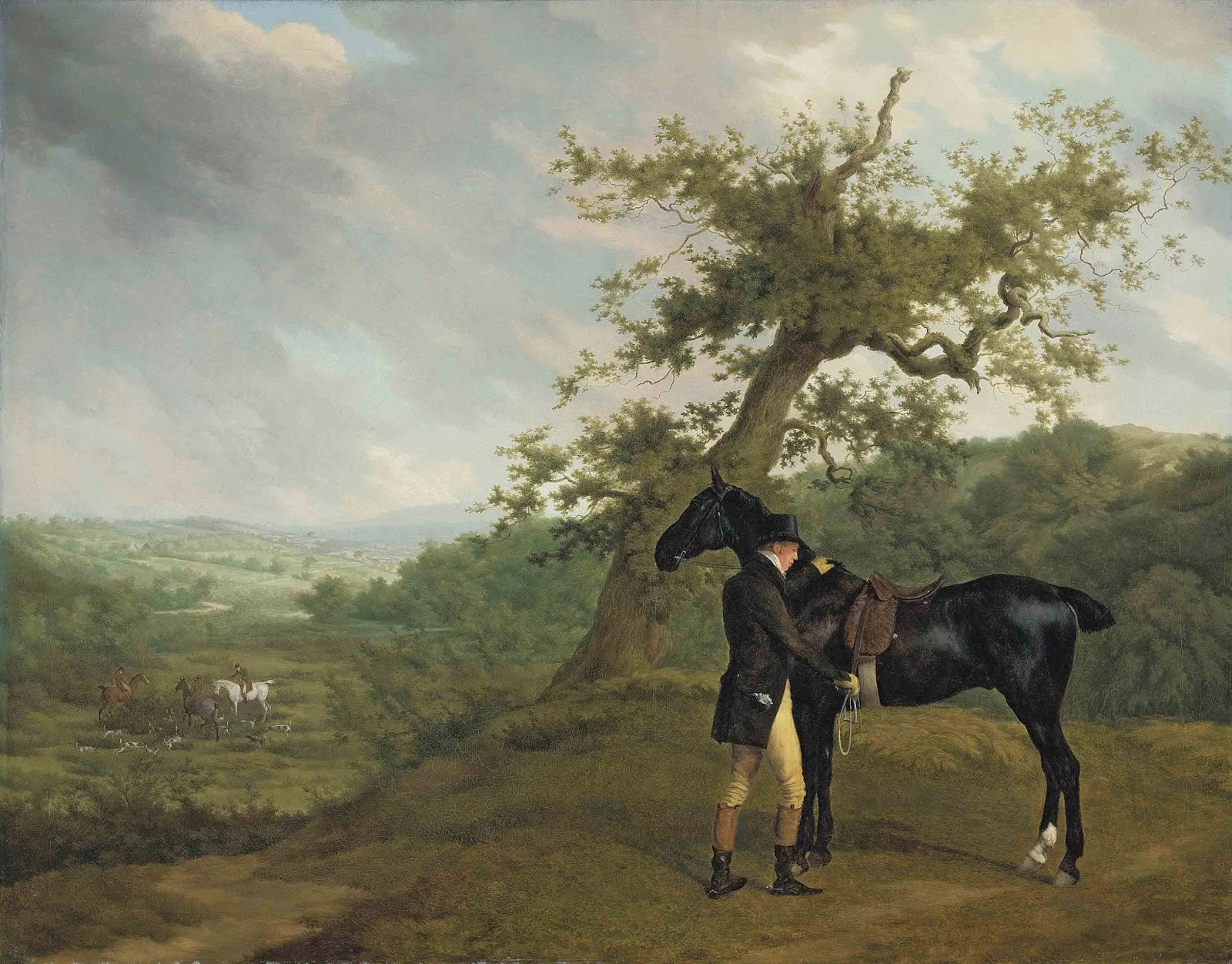
Jacques-Laurent Agasse - George Irving with his black hunter


perhaps my very shortest entry this far - namely,
I use Krita and enjoy this software digital painting program a lot.
French master of digital brushes monsieur David Revoy aka Deevad came up his newest digital brushes creation - first bundle for this 2023.

You can get it at David's website - merci David! 
On David's YT channel you can watch and practice along with David.

Enjoy and paint away -


Valete

Saturday, August 25, 2018

French infantry - my new illustration

Salvete Omnes,
last month I 'painted,' on my computer, a plate showing two French soldiers from late period known as the wars of Louis XIV. 
OD EISENBIRN DO HÖCHSTÄDT. Kampania w Górnej Austrii 1703 roku (1) (the first battle of Hochstadt etc) by Damian Plowy has been published by Infort Editions from Poland.
Infantry in general and early XVIII century Western European soldateska are not my favorite subjects.
It was a venture into the new world of uniformology, as part of doing research I did some questioning around and would like to thank  Tomasz Karpinski and Sergey Shamenkov (both gentlemen are reenactors and historians of the XVIII century soldiers, Sergey also is a very fine historical illustrator and sculptor) for their helpful comments.
All mistakes are mine - here you may find the cover of the new Infort Editions book.
I used Krita, MyPaint and GIMP, and my Wacom tablet.
Valete!
ps
 the next illustration I am going to paint for Infort Editions will be the King Philip War and the Algonquian woodland warriors etc - book will be published next month.

Monday, December 17, 2012

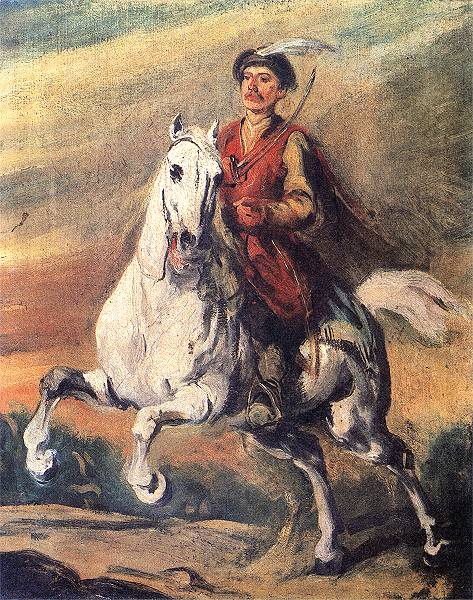
A rider - MyPaint and Gimp manipulated image

Salve,
let me share with you a drawing/digital/ I did this month with MyPaint and manipulated with GIMP a bit.
The image - well, perhaps he is a schwartz character from some remote corner of the vast Polish Commonwealth borderlands (in 1620s A.D. the Respublica Poloniae was approximately 1 million kilometres in area) or perhaps a Registered Cossack (Polish Cossacks or Zaporozhian Cossacks) on a lookout for the Crimean Tatars.

 I may add several items to this image, perhaps a skull or some bones..., add some items on the horse tack list etc... After the New Year.

For, now I hope you will find it interesting :)
ps
Polish painter Józef Brandt was famous for showing these lookout (czaty) parties and our Cossacks eg:

many here and a nice one  here 


Saturday, July 2, 2011

Winged Hussar Chorąży quick sketch

Salve,
a quick sketch of a hussar standard bearer aka Chorąży - MyPaint and Gimp
I should add the white knightly cross in the middle of the standard...

Thursday, February 10, 2011

Some Sketches

Salve,
we had some cold days and nights in Colorado - and lovely views of Pike's Peak snowed-in.
I am attaching here some sketches that I have been working on, in different stages of 'undress' :) - common theme - Polish-Lithuanian Commonwealth
hasta la vista

Friday, January 21, 2011

! Vivat Kielbasa !

Salve,
 'The Saveur'  www.saveur.com/article/kitchen/The-SAVEUR-100-Chefs-Edition?cmpid=teaser magazine en.wikipedia.org/wiki/Saveur  announced that 'kielbasa' en.wikipedia.org/wiki/Kielbasa  is the most delicious of 100  foods selected and thus NUMERO UNO- vivat kielbasa!
My friend Waldi made us some fine Polish kielbasas and  other smoked meats* this season -see the delicious traditional foods :)
on the plate:

 and freshly from the smoke house:


*
made from the best organic Canadian (Quebecoise ) pork  - :), with organic casing etc.
ps
would like to welcome new followers :)

...and an little quick sketch oil-like digital painting in MyPaint (thanks to all these MyPaint developers, especially Ramon Miranda ramonmirandavisualart.blogspot.com/http://ramonmirandavisualart.blogspot.com/, tanda  http://blog.lodetanda.com.ar/, and David  Revoy fine blog and website ) http://www.davidrevoy.com/blog.php

and give links to some fine equine (horse) photography blogs:
equinepainterschallenge.blogspot.com/
lechevalthehorse.blogspot.com/

Thursday, December 23, 2010

A little sketch with a new software

Salve,
 I've got this new painting program - Sketchbook Pro 2011 (merci Maarcin for pointing it to me  -:) ) and decided to draw this sketch, this is quasi-Swedish/German cavalryman (been reading about these pesky Swedish, Finnish, Latvia and German horsemen-enemies of the Polish horsemen during the Deluge, they were quite great warriors and riders in their own right) .
As I am looking at this 'digital painting' I am thinking that perhaps he will need his horse or a saddle at least at his feet when he is done - :)
1 more day to Christmas or as we call it - Świąt  et Wigilii

Sunday, November 28, 2010

a sketch in progress - Lisowczyk

Salve,
a sketch in progress - working over an old watercolor -  I am using GIMP and MyPaint

This time the subject is loosely based on the Lisowczyk - lisowczycy (plural) or Liswoski kozaks theme -
wiki/Lisowczycy
 Juliusz Kossak's Lisowczyk 
Kossak's lisowczyk2
Michalowsk Jezdziec Lisowczyk
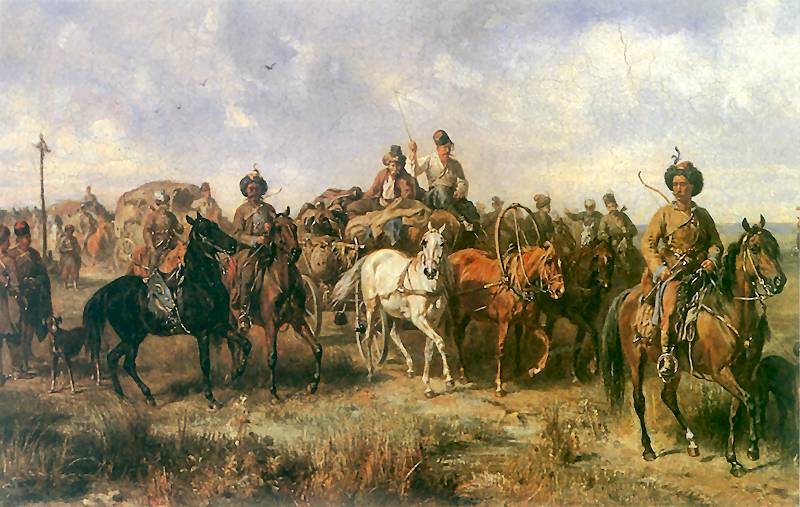
  Brandt Pochod_Lisowczykow.jpg
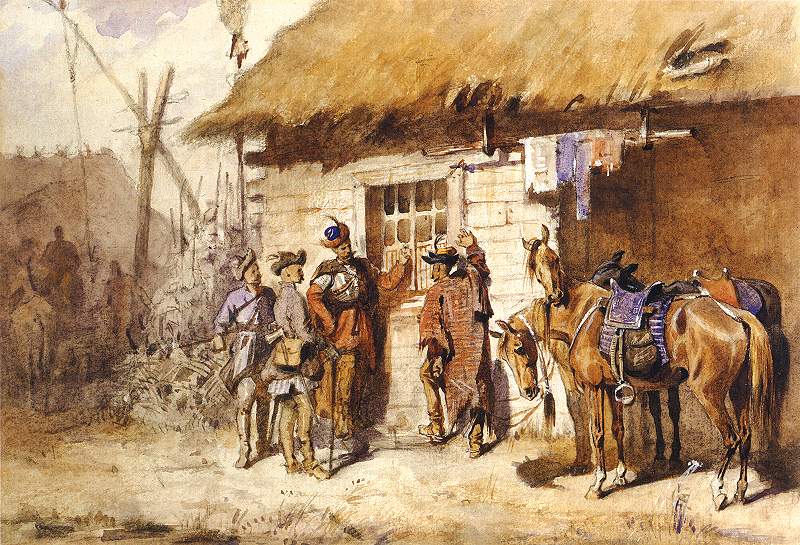
Brandt Lisowczycy_przed_gospoda
  Brandt Lisowczycy Strzelanie z luku 
in the last painting please note the Moldavian border fortress of Khotin (Chocim) in the background  wiki/Khotyn  .
The Polish-Lithuanian  Commonwealth army is pictured in the foreground, the gathered banners and regiments and Cossacks are already getting a horsearchery show by the lisowczycy while the Polish forces have been preparing to fight to death at  this southwestern border of Commonwealth, being entrenched within their much fortified camps around the Khotyn fortress, they know the Ottoman Turkish army augmented by the Tatars would come soon, it is AD 1621.


I will post progress of this one too, later next month, I hope..

ps
  interesting blog (in Polish)  by painter Jarek Glod who is copying/painting great Kossak and other masters' works and showing his own works' progress  http://nabial.blogspot.com/2008_11_01_archive.html

Tuesday, November 23, 2010

Muscovite Reitar 1660s - update I

Salve,
a bit of an update on my Muscovite Reitar started here muscovite-reitar-1660s


I added double reins and a curb-bit (Polish. munsztunk) on a horse, made horse's neck a bit longer;  on the officer - a longer beard (hope you like it better, Kadrinazi),  and then some other little equipment parts that make this soldier appear more 'historic'
pa ka

Saturday, November 20, 2010

Royal City of Lwow Banner 1410 sketch

Salve,
 this past July there was 600 anniversary of the battle of Grunwald (Tannenberg) and Polish-Lithuanian-Ruthenian victory over the Western European knights and Teutonic Kinghts.
I started working on this piece a while ago - it is far from finished, perhaps too far. It purports to show a Lwow banner 'ensign' mounted on his faithful 'dextrarius' aka English language  'destrier' - I am not going to refer here to the Wikipedia page on the subject as it is not a good entry.

Friday, November 19, 2010

Polish light Rider sketch in progress

Salve,
I am working on this little animated one, this time i cannot decide what kind of weapons to give to this fellow - a kozak cavalryman (not a Cossack) or Polish-Lithuanian light rider. Wearing a zupan, bare-headed, with his bow and arrow, and faithful sabre... the rest it is still to be seen

Sunday, May 16, 2010

another Gallic horseman

Salve,
I just 'cartoonized' another of my Gallic horsemen. Time frame is around  the Wars of the Second Triumvirate  ( 43 BC – 33 BC ), with the great battle of Philippi  http://en.wikipedia.org/wiki/Battle_of_Philippi  as the largest land battle of the Second Triumvirate (eg the life of one of the principal actors -Brutus by Plutarch here Plutarch Brutus   ).  HBO series 'Rome' season 2 did attempt to show the battle, but it was not the greatest reconstruction I daresay.

Polish readers can find a nice book on the battle of Philippi authored by Maciej Milczanowski titled 'Filippi 23 X 42 p.n.e.'  published bye Wydawnictwo Inforteditions from Zabrze  in 2006.


English readers can read Osprey's book by Si Sheppard amply  titled 'Philippi - 42 BC' osprey Philippi-42-BC 
 Reviewed on Amazon.com by R. Forczyk  - the entire review here:
amazon.com Forczyk Philippi

The great podcast (actaully just one great history of Rome in lectures) on the subject is here:  historyofrome the-second-triumvirate

Sunday, April 18, 2010

Wounded Gaul

Salve,
 Several years ago I did a number of illustrations for a book on the battle of Philippi http://en.wikipedia.org/wiki/Battle_of_Philippi
Amongst many drawings and paintings I  did this particular of a  one wounded Celtic warrior on his equally grievously wounded horse.
I did it somewhat in a comics(cartoon, bande dessinée) style.
 Next shall be a horseman of Iberia of the same battle - :)

Monday, February 1, 2010

Husaria and poetry I


czolem,
as mentioned husaria of the Old Poland appeared often in her poets written work, from Mikolaj Rey (Rej) od Naglowice  http://en.wikipedia.org/wiki/Miko%C5%82aj_Rej to  Waclaw Potocki  http://en.wikipedia.org/wiki/Wac%C5%82aw_Potocki and mentioned already poet and soldier Wespazjan Kochowski.
Often these references were not direct,  for especially in the second half of 16th century ( XVII ) a noble knight ('rycerz') would serve mounted  with a lance ('drzewko' or 'kopia')  and need not be called a 'husarz' (winged hussar) for the audience to see him as one (even our best poet of this period Jan Kochanowski http://pl.wikipedia.org/wiki/Jan_Kochanowski was described when welcoming king Henry in Cracow, dressed as winged hussar) ,  so for example one of the prolific writers  Marcin Bielski  http://en.wikipedia.org/wiki/Bielski,_Marcin  wrote  in one of his satires 'kto chce w potkaniu pozyc dobrze Moskwicina, przytrzy nam predko z drzewem jak na Tatarzyna' ( one that wants to press hard a Muscovy soldier in a fight, needs to attack him quickly  with a lance in the same manner [one would do]  against a Tatar) ' Sen Maiowy' (Dream of a Hermit, 1586).  It was understood that one attacking with a 'drzewo' (lit. wood,  actually a lance) was a winged hussar. 
Often our poets would talk about hussar appearance and interesting information can be had from these verse as in Wacław Potocki poem where poet (who very often was a great satirist and comedian in his work) only recognizes a winged hussar by his costume details - 'karwasze' (warmbraces or forearms protectors )  and one wing (poem 'Pogonia Litewska', from  a compilation titled 'Ogrod Fraszek' written between 1675-90 but published in its entirety in 1907).
Potocki, having often written about war and politics in his poems, will often be revisited here (God willing), as many of his works have to do with fine horses and riders, their adventures and misadventures as well  - :)

Thursday, December 24, 2009

Wesolych Swiat!

Hello again,
we, Polish people, celebrate Christmas with 3 days of eating and bonding,  especially reestablishing family and friendship bonds, and it is a very joyous time of the year.


However, in today's little entry I would like to  return for a moment to the time of the other great Jewish (and a bit Arabian) king of Judea  known to us a  Herod the Great , whose dynasty ruled, solely with Rome's nod and approval,  the last independent Jewish kingdom in the Holy Land (ending with the death of  Agrippa II circa 100 AD) The other independent Jewish state was the  khanate of  nomadic Chazars of the Pontic-Caspian steppes, but  more than a millennium after the last Herodian ruler.
I just received, as a Christmas gift, this little Heracles (so much good info0 of a book published by British Osprey, titled 'The Army of Herod the Great,' written by Samuel Rocca and nicely illustrated by Christa Hook.  It is a book about the military of the Jewish-Hellenic client-state  existing on the borders of the Roman Empire.
There are many interesting figures in this book,  especially Hatrene warriors,  or the Thracians and Galatians in Herod's service.  But my first 'love' is another cavalryman mentioned in the book and painted there along with his commander. It is the 'Babylonian. '

I sketched this horseman out off the plate F in the book, sort of coping it and changing some.
He is a member of  this so called Babylonian light horse archers unit, created by one Jewish nobleman named Zamaris and hired by Herod. Zamaris  at some point of his adult life moved from the Parthian kingdom, where Jews had lived and prospered for centuries,  to the Herod's realm and entered Herod's army as commander. Mr Rocca, after Shutzman, says that from Mesopotamia our Zamaris emigrated along  with his entire retinue and  initially must have created this 'Babylonian' unit of horse archers for  the Herod's army out of his retainers. Jospehus Flavius, the Jewish_Roman ancient historian, wrote about Zamaris and his riders (AJ XVII , 24).

He wears Parthian ridding coat with fur trimming (slit from the hem to hips to allow easy mounting and ridding horses), quilted tunic, quilted hat,  Leather belt covered with gilt-metal plates,  and tied with laces. His weapons are the two unstrung composite bows, with a tubular quiver (unseen as covered by his coat), and long sword (unseen), suspended from the second belt, and his horsewhip, quite a weapon itself - eg just read the Tyrant novels by Mr Cameron.
Horse has a typical horned and stuffed leather saddle, secured with broad breast and croup straps, adorned with bronze pahalerae (medallions),  while his saddle is covered with a cloth...  His horse' snaffle bit has long psalion bars for stability etc. I drew  his horse's tail tied as the Iranians used to do, and its forelock is also tied up with leather thong, in the same Iranian  martial fashion ( this sketch and info  pertaining to the cavalryman are based mostly on the Mr Rocca's book).

I did my sketch entirely on my Linux computer, using GIMP and MyPaint drawing with the Wacom tablet.

Merry Christmas...
ps
I found more info on the Babylonian horsearchers unit - according to Jonathan P.  Roth, Zamaris came to Judea around 20 BC, possibly having defected from the Parthian service. He and his followers (500 soldiers and 100 relatives) were taken by Herod into his service as horsearchers, and settled in town called Bathrya, in Batanea. This military colony under Zamaris was organized in such a way that Zamaris' unit performed military service in exchange for freedom from taxation (what a great king Herod was!  the next tulers tired to change this approach).  The unit survived Herod's and Zamaris' deaths, and was commanded, according to Flavius Josephus,  first by Zamaris' son  Jacimus or Jakimus (who trained soldiers in arts of horsemanship and horse archery, and provided king's bodyguards)  and then his grandson Philip Ben Jakimus, who was of strong hands and friend of Agrippa.   The Babylonian archers unit size also increased over time, from 500 to several thousands, again according to F. Jospehus who claimed that this 'Babylonian' unit was as large as the rest of king Herod Agrippa forces. Most likely Philip as strategos  was the commander of the 2000 cavalry that king Agrippa II sent to quell the budding Great Uprising in Jerusalem  (66AD )which failed but they were allowed to retire from the city. Then they fought alongside the Roman army during this long and difficult war, with Philip fighting and surviving the large Roman defeat at Beth Horon, later being most likely the commander of the entire Herodian army   (Roth,  Jewish Forces in Roman Service p.  6 - 23,  Flavius Josephus  on Zamaris and his unit  p.210-11 here  http://books.google.com/books?id=II5DAAAAYAAJ&pg=PA209&lpg=PA209&dq=zamaris+flavius+josephus&source=bl&ots=H9JP4VC6Tm&sig=t8tGSt48OOOvIQUf-0HJrY6MNy4&hl=en&ei=ZmI2S7eLJ861lAfB4dzdBg&sa=X&oi=book_result&ct=result&resnum=1&ved=0CAoQ6AEwAA#v=onepage&q=&f=false )

Wednesday, October 21, 2009

Saka and Skuda in one steppe dwelt


Sketches of the 1st millienium BC steppe horse masters - I know the ladies are missing, they should come shortly :) patientia virtutem est, amici mei.

working.. the Parthians of sorts


...some sketches of proverbial Parthians, in various stages of 'undress' :)

Wednesday, April 1, 2009

Serbian Hussars


Salve,
the very beginning of Polish Hussaria   belongs entirely to the  Balkan Serbian warriors already known as hussars (for almost a hundred years prior to their coming to Poland).
They came to the Polish  Kingdom, at the end of the 15th century,   in search of military employment and probably somewhat of a easier life,  and our Polish Kingdom did  offer these noble refugees from the Turkish-Hungarian-Habsburg wars of the 15th century plenty of  religious freedom  and economic  prosperity...
They carried 3 meters long, light lances with small pennons, Balkan shields, oriental and Hungarian sabres, and presumably war axes and 'klevets' or war hammers. They used light Balkan, Turkish and Hungarian saddles,  peculiar round stirrups, curb bits and long 'czaprak'  (large and often richly decorated  textile horse blanket or 'shabraque') to cover their horse back, sides, and  hindquarters.
 Polish-Serbian hussars can be seen in action  circa AD 1514  in this  very large 1530s painting from the Polish National Museum in Warsaw, you can take at look at the painting here http://en.wikipedia.org/wiki/File:Battle_of_Orsha_(1514-09-08).jpg 
The painting depicts the first Polish-Lithuanian victory over a huge Muscovite army near Orsha on the Dniepr River (now Bielarus), one of three battles that took place at Orsha  in the first half of the 16th century.
During the next 50-70 years hussars acquired  full armor, larger horses, longer and heavier lances, shishak (Turkish style) helmets,  leopard, bear, wolf and lion pelts to cover themselves and their horses, and plenty of eagle, ostrich, falcon etc  feathers.