Showing posts with label tok. Show all posts

Thursday, February 28, 2019

Husaria - sketches -on Paczki Day

Salvete Omnes,
today is Fat Thursday and in Polish culture today one must eat pączki ( Polish doughnuts ) - :) more the better - like those in this picture.

... and also today the good month of Luty  (February) ends so to finish off this not a bad month I am sharing several reworked sketches or sketches in process of being reworked.
 
the theme is the famous Pastorius engraving showing a winged hussar with his lance lowered to strike and the end of his lance rests in the tok (lance boot) attached to the pommel of the saddle with a leather strap.


Nota bene my friend Radoslaw Sikora's book on husaria is selling well throughout Poland - being a bestseller.

Valete

Wednesday, January 23, 2019

Recenzja Husarii potrzebna


Salvete Omnes,
[in Polish]
[zaznaczam a priori to nie reklama!]
Wydawnictwo Znak wydało właśnie imć Radkowi Sikorze książkę o naszej najsłynniejszej jeździe, owych strasznych wrogom kopijnikach epoki staropolskiej czyli o husarii.
O samym wydaniu książki pisałem na blogu parę dni temu.
                                                     *
Jak już pisałem zrobiłem do tej książki rekonstrukcję-grafikę z pocztem 3konnym plus wydawnictwo wzięło ode mnie pewną liczbę  już wykonanych starszych moich rysunków a grafik, co jest kroplą w morzu ikonografii tego dzieła, jako że praca jest bardzo bogato ilustrowana, choć głownie zdjęciami rekonstruktorów, obrazów, rycin i obiektów etc autorstwa Marka Kalisinskiego i Radoslawa Szleszynskiego. Tutaj z smutkiem dodam, że   książce nie ma spisu ilustracji[sic!].
                                                   *
Ciekawi mnie czy ktoś z badaczy et fascynatów wojskowości staropolskiej dokona czy planuje dokonać recenzji tej pracy?

 Dlaczego pytam?
Pytam o recenzje dlatego, że IMHO jest to książka, która w swym zamyśle i wykonaniu a sposobie prezentacji tematyki historii et splendorów husarii celuje w zajęcie czołowego miejsca wśród już wydanych publikacji typu 'całościowego'  lub 'przekrojowego' o naszej husarii, być może pozostawiając w tyle takie dzieła jak ospreyowy 'Husarz' imć Brzezińskiego, 'nieśmiertelna' ''Husaria'' mości panów Cichowskiego i Szulczyńskiego, czy śliczna 'Husaria polska' prof. Żygulskiego jr. etc.

ps
dodam ze smutkiem, ze nie znam zaprawdę dobrych recenzji poprzednich książek mości Radka, znacie waszmość państwo jakieś?

Valete & Khoda Hafez.

Sunday, February 25, 2018

Maurice de Saxe - winged hussar-like lancer continued

Salvete Omnes,
I am going to continue from the last post, hence below pleas find ( in French for now and the English translation omits the heavy horse charge underlined in read) more of the Maurycy Saski (Maurice de Saxe) winged hussar-like lancers from his work Reveries or Memories Concerning the Art of War.
This time about charging the enemy:
how to carry out a successful knee-to-knee charge
the role of a cavalry banners in keeping the espirit de squadron
the importance of training as a squadron and as a regiment

lancer at ready
[French]
 continued here
 and the last remark

lancer charging
to be continued
ps
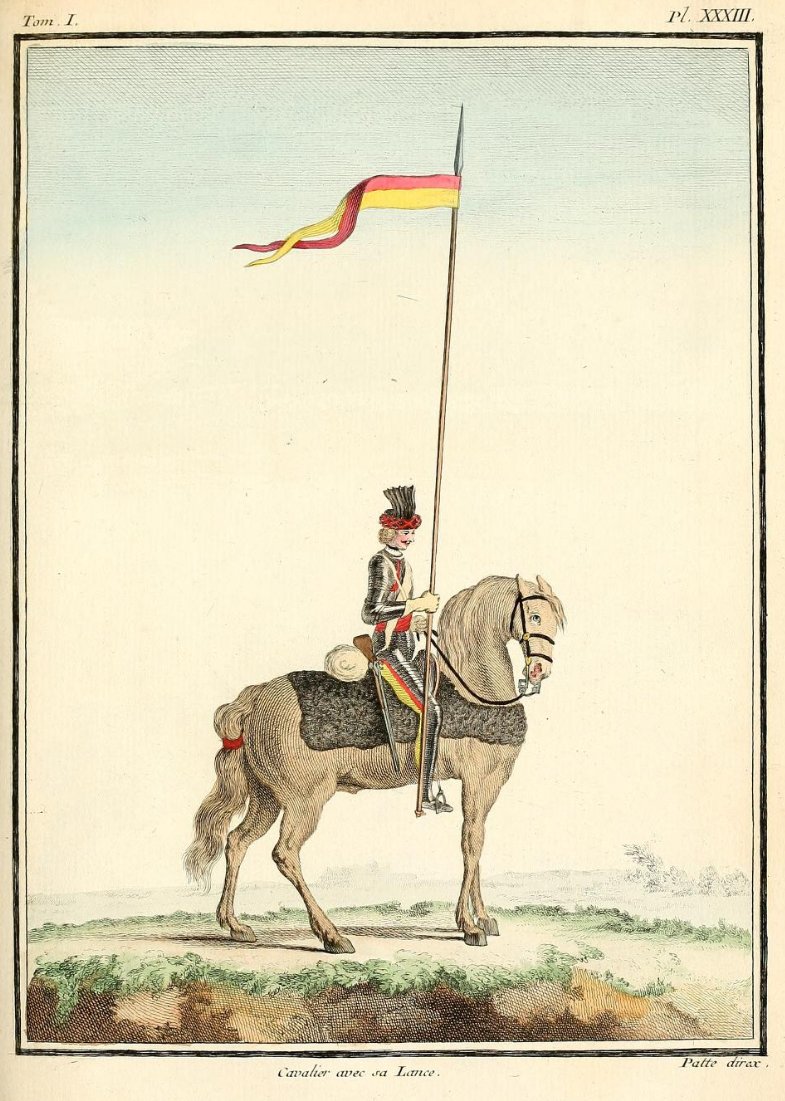
note the lancer's lance penon a la Polonoise 
enjoy

Monday, June 21, 2010

in the spirit of Kluszyn 2010 (Klushino)

salve,
 today's little drawing of a charging winged hussar (true,  I'll have to add the wings later on)  - I hope I am showing here  the process of lowering his lance  the  while his rumak (war steed) is in full gallop... seconds before hitting the target.

Wednesday, January 27, 2010

Usarz in training ...

     Hussaria or our winged hussar  ( польский гусар)  had to train their horses a lot, until their horses were so well trained and  fiery that,  as one of our  Polish poets from the 17th (XVII) century Waclaw Potocki wrote in one of  his poems,   when trumpets called hussars to battle such  horse  would beat the ground with his hooves, would raise his head high and neighing announced his readiness to serve his rider.  I use masculine  gender when talking about their horses for according to the sources usually stallions  ('drygant'/'ogier') or   geldings ('walach') were used exclusively as war horses.  Mares were used for breeding and non-military transportation.
      After all, according to another Polish poet of the mid-17th century Wespazyan Kochowski  http://en.wikipedia.org/wiki/Wespazjan_Kochowski , a winged hussar was a giant of martial prowess when had a brave horse, strong breastplate,  saddle (presumably hussar saddle or 'husarskie siodlo')  with a 'koncerz' (tuck, estock).


In my sketch our noble towarzysz (companion), mid 1640s, is dressed in his undershirt, loose pants of steppe Turkish-Tatar style, yellow leather boots with hussar spurs and Hungarian-style magierka (hat).  Let's say he is in his  'majdan' (another Persian via Turco-Tatar word in our language) paddock gentling his future warhorse.
     His saddle is of that already mentioned  hussar type, as exemplified by surviving  winged hussar saddles in Moscow and Stockholm, with Polish-Tatar iron stirrups, and with a simple 'potnik'(sweat pad) or 'mituk' (blanket) under the saddle. He has his 'kopia' (lance) in the 'tok' (leather container) hung from the saddle's 'kula' (horn) - nota bene  similar to the Mexican and Western saddles' horn.  And he is training his young horse ('munsztuk' or curb bit in his mouth) to turn while distracted by the presence of his kopia. Most likely he has his 'szabla' (saber) on his left side and a 'koncerz' under his left thigh.

Imci Wespazjan Kochowski poems can be read via google books: http://books.google.com/books?id=-mhbAAAAQAAJ&pg=PP6&dq=Wespazyan+Kochowski&as_brr=1&ei=NItgS7X9FY-0NOXwzO8E&client=firefox-a&cd=2#v=onepage&q=&f=false