Showing posts with label Napoleonic cavalry bridle. Show all posts

Wednesday, June 18, 2025

Wexy - a brave Irish horse at Waterloo 1815

 Salvete Omnes,

210 years ago French, Dutch-Belgian, Prussian and British armies met at Waterloo (I am going to do a separate posting about the battle of Wavre). 

10 years ago I posted about the grand reenactment festival that took place at Waterloo. 
This past decade has not been the best for us, human beings, in the Western world. And new wars are taking place, in addition to the Ukraine-Russian Federation catastrophic war, as of past week - the Israeli attack on Islamic Republic of Iran (the site of my beloved ancient Persian  civilization). God have mercy on all of us. 

the saddle is placed too much forward or high on the withers in this display, perhaps indicating museum curators ignorance of principles of saddling and riding with a saddle on 


Ad rem,

At Waterllo  Commander of the 1st Corps of the  Allied army William, Prince of Orange ( future William II of the Netherlands ), had a horse, presumably among many mounts his royal highness had to posses in his staff, that was called Wexy.  


Wexy was an Irish hunter(?) or half English Thoroughbred, perhaps a light bay? Hard to tell from the photos.

 According to the linked article it is unknown how and when this horse came into prince's possession. Perhaps during the campaigning in the Iberian Peninsula from 1811-1813, where Prince was part of the Duke Wellington's staff. Prince of Orange was popular with the British and they called him 'Slender Billy.' In Spain prince William took part in the siege of Badajoz and the battle of Salamanca.  


Prince of Orange and his mount were hit by a bullet half past seven (7:30 PM) during the battle of Waterloo.

.

This warhorse lived to a tender old age, dying in 1839 or 40, having been foaled circa 1801 in Ireland.

here the saddle was placed correctly on Wexy's back, without impacting the scapula/shoulders and without restricting the movement


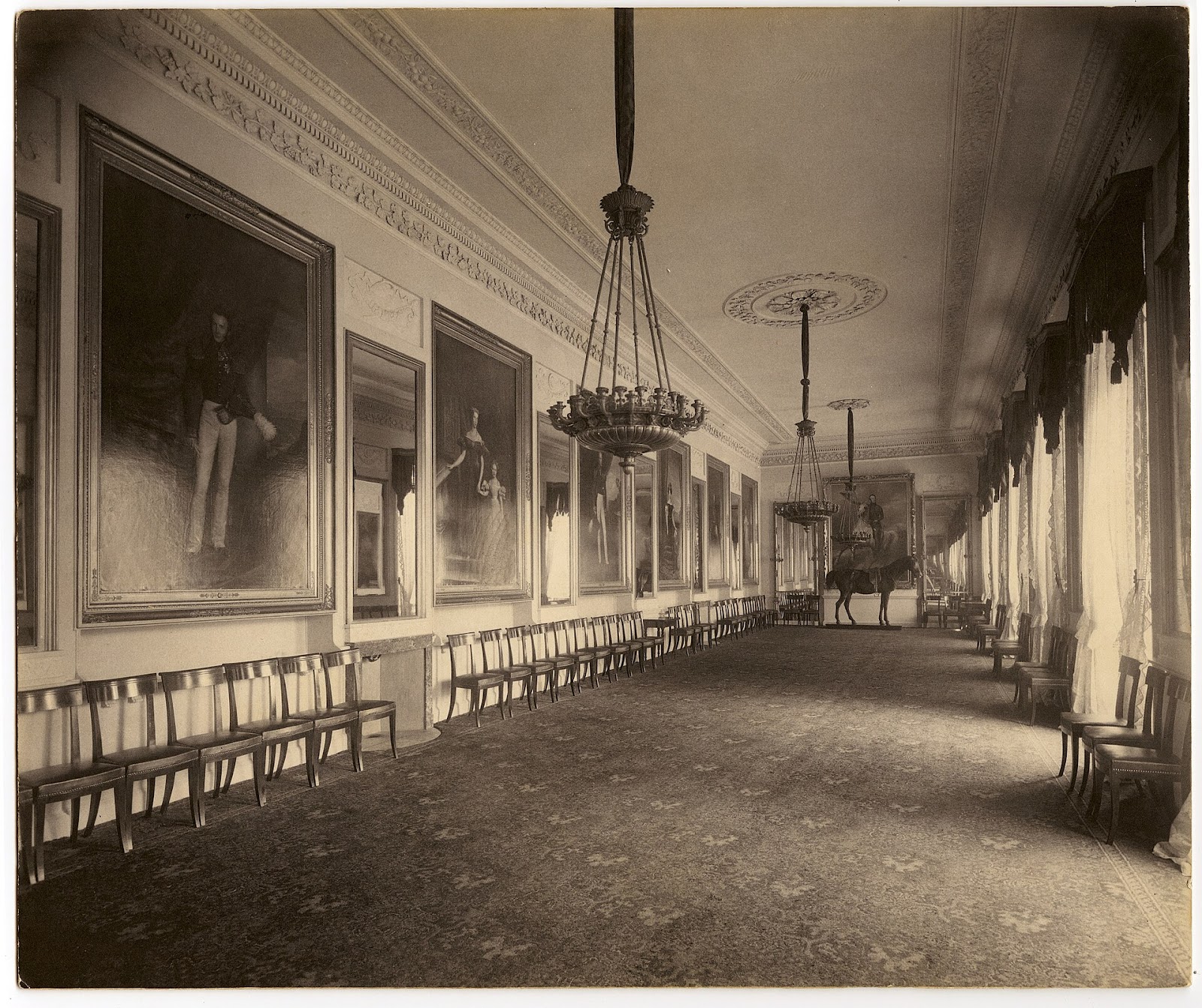
 The horse was stuffed and mounted on display in Gothic Hall at Kneuterdijk Palace, and since 1900 at the Royal Stables. Daily Mail article erroneously claimed that Wexy was killed during the battle of Waterloo.

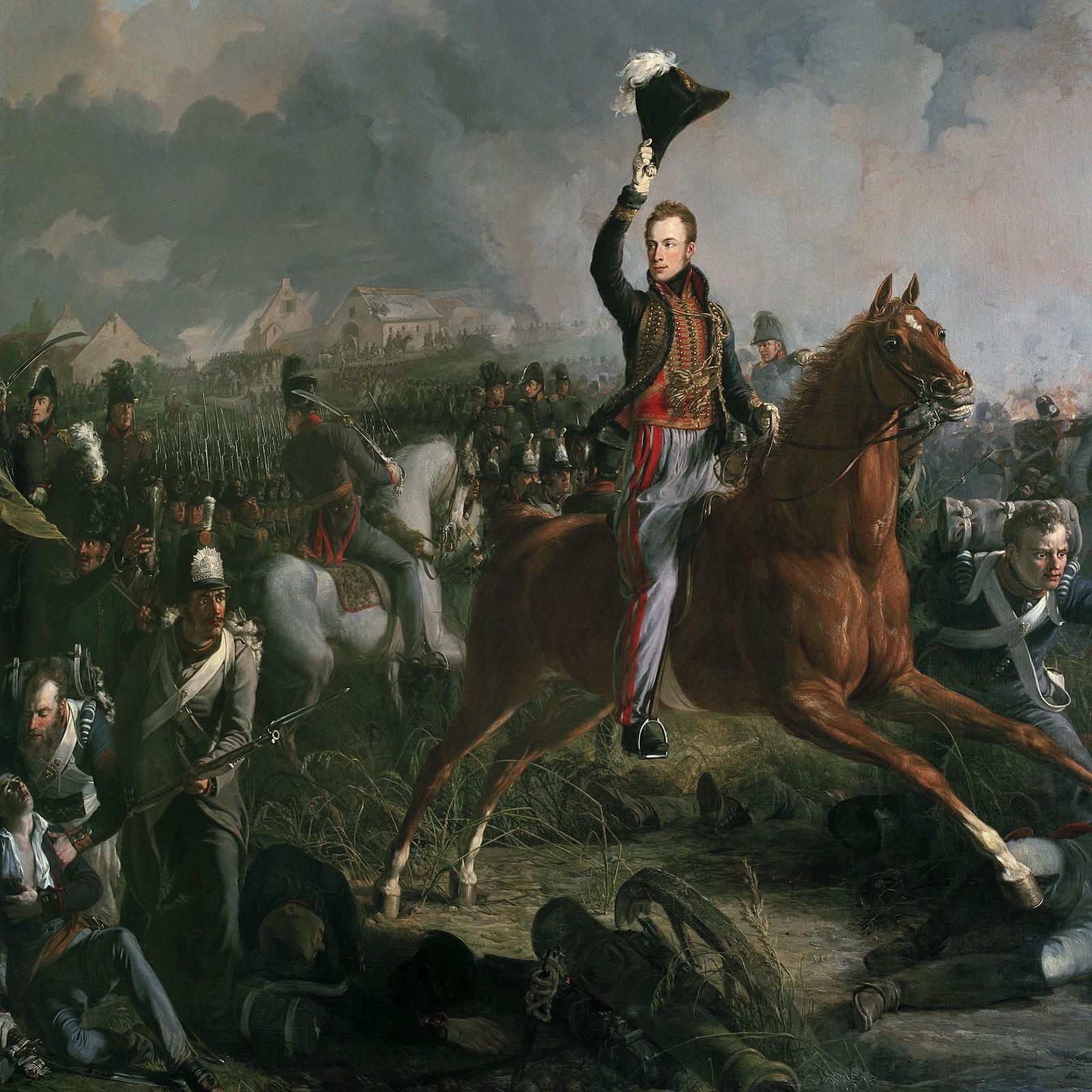

the painting showing prince William at Quatre Bras seems to be showing a different, chestnut horse, since Wexy had no socks.


I wonder if the horse in this equestrian monument of William II was modeled after Wexy.

Valete

Wednesday, March 26, 2025

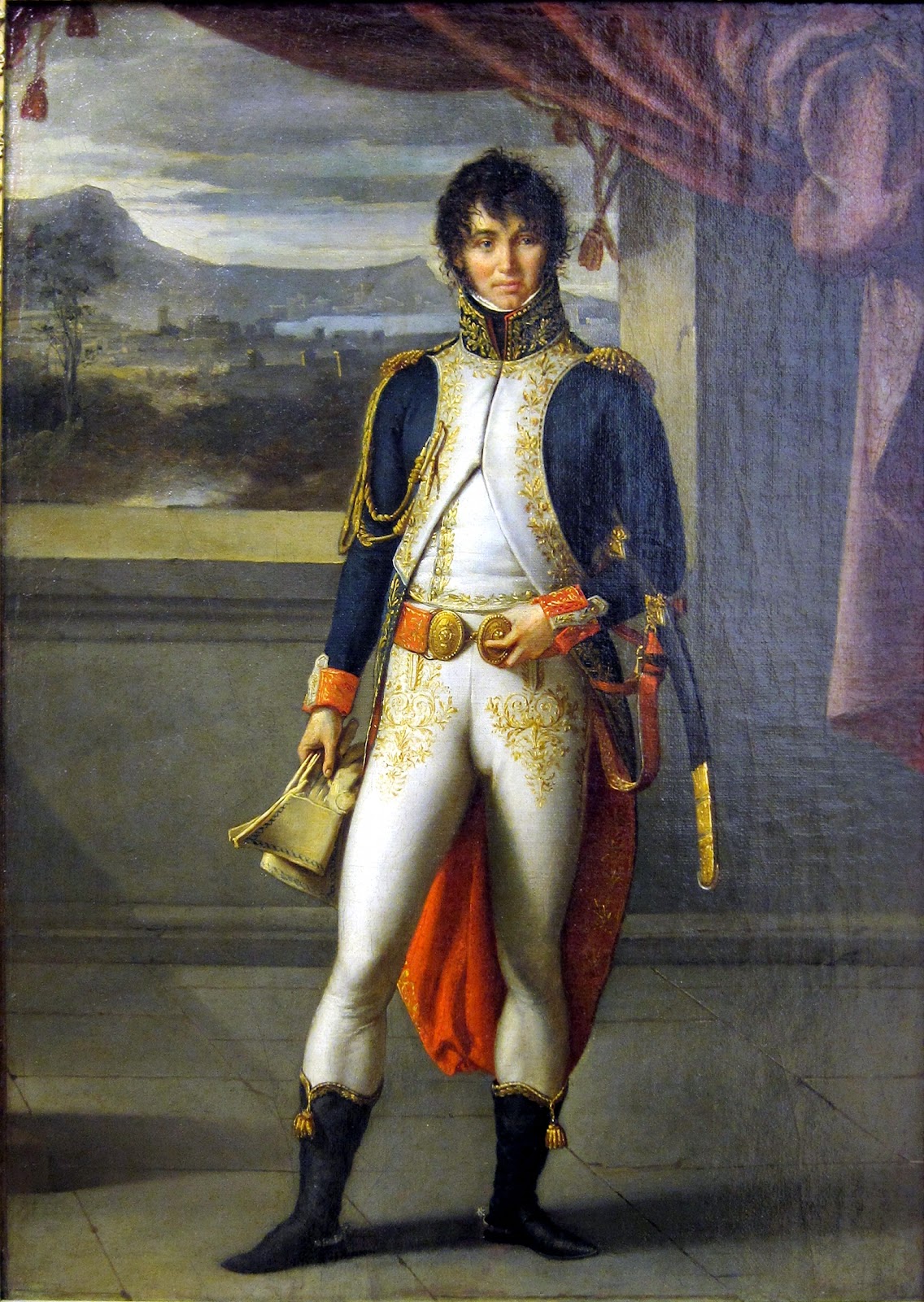
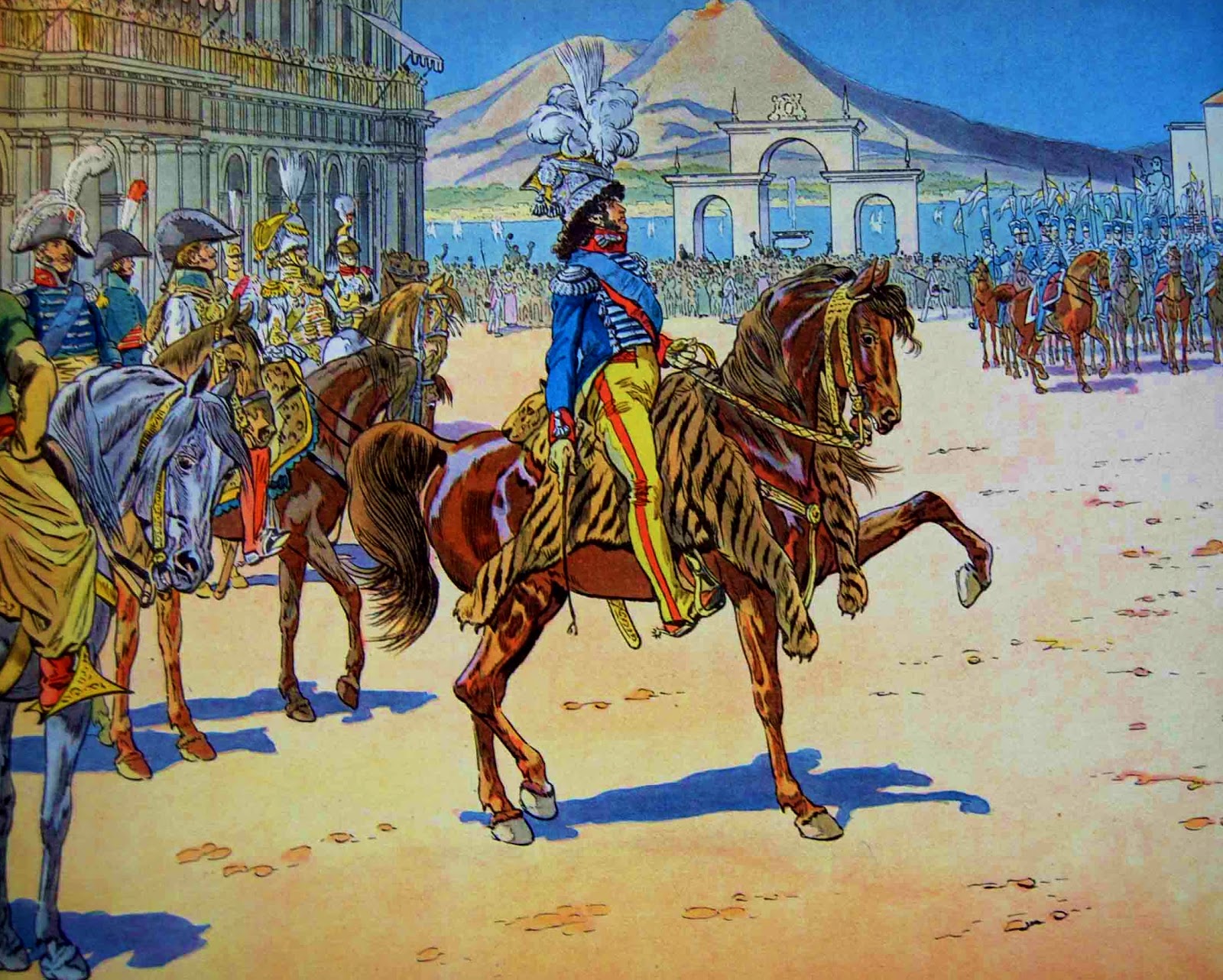
Joachim Murat - happy birthday

 Salvete Omnes,


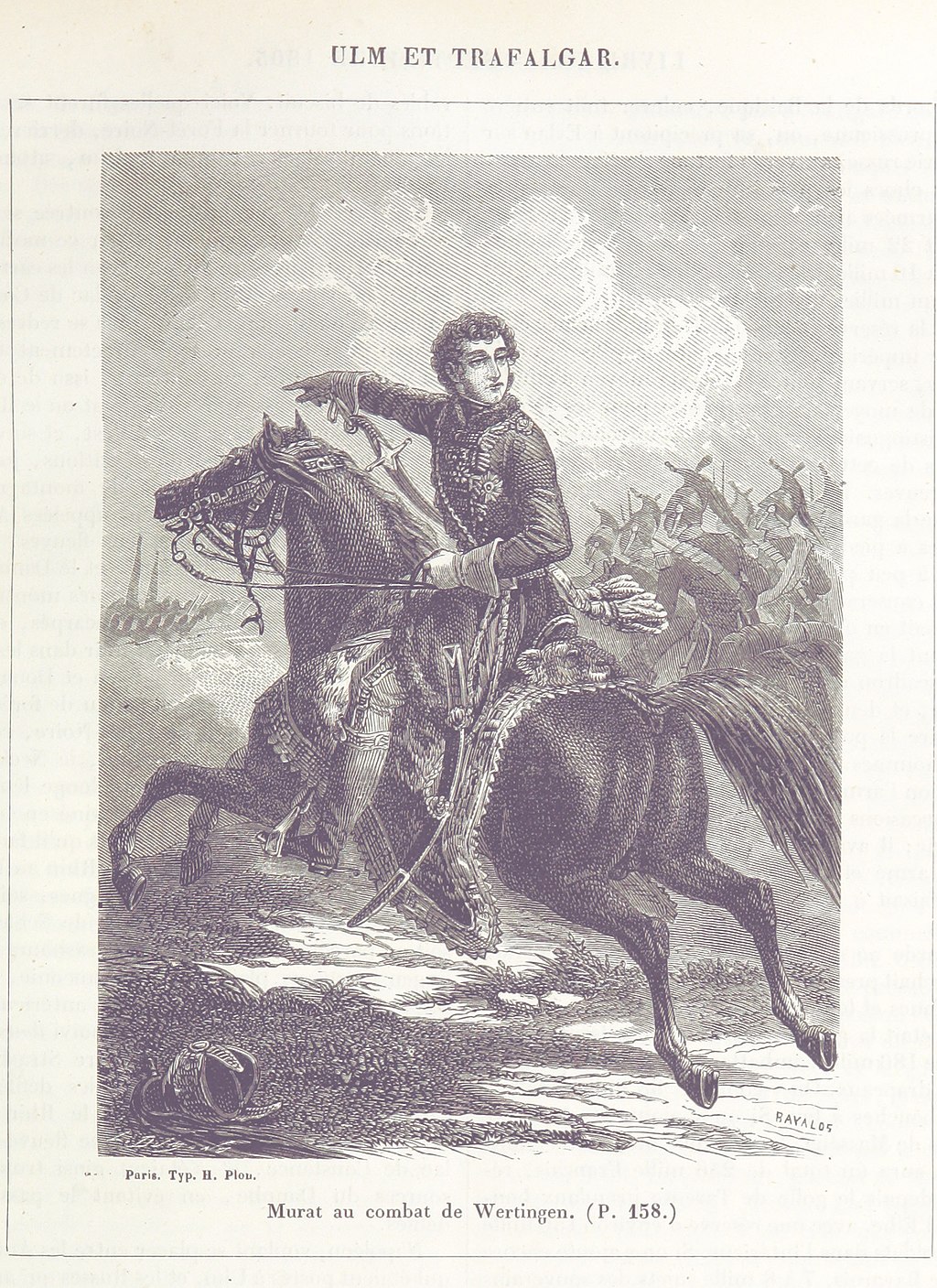
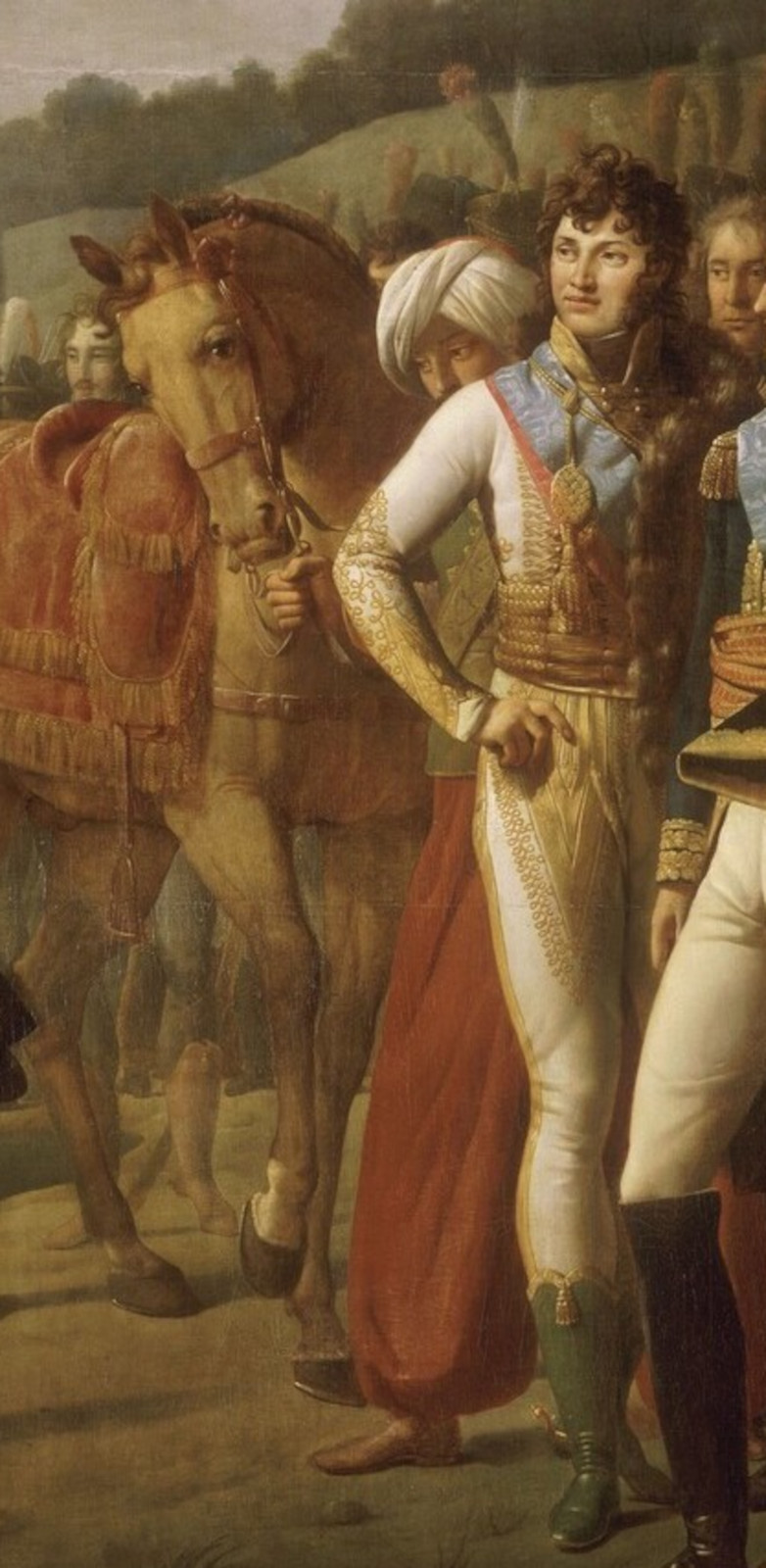
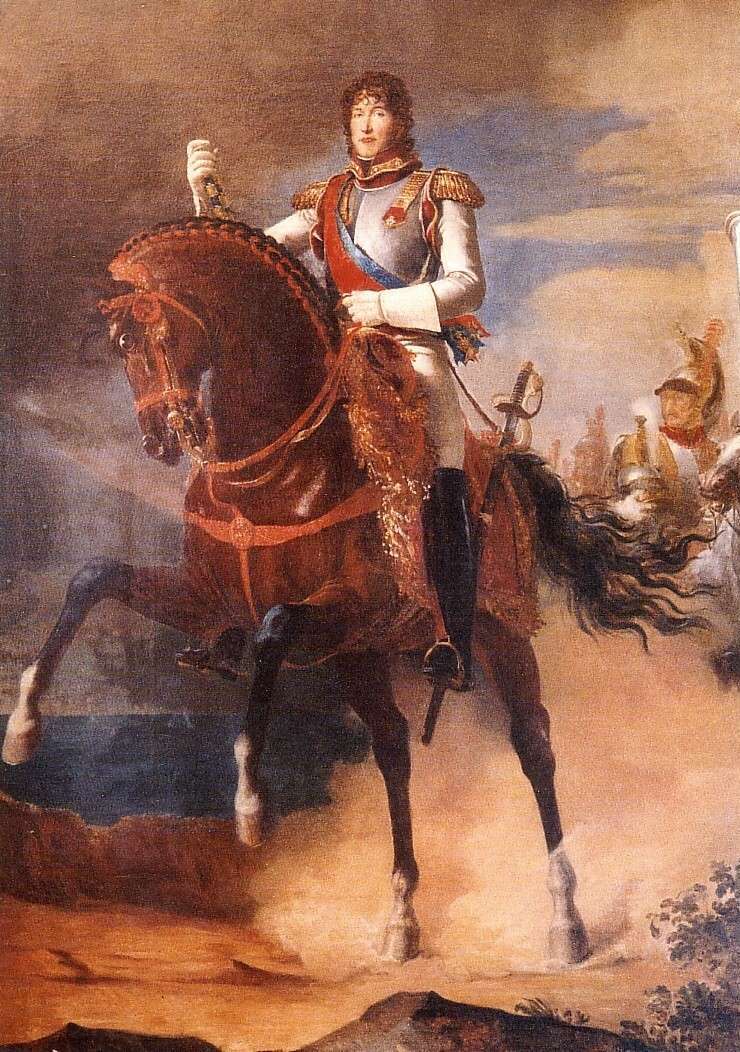
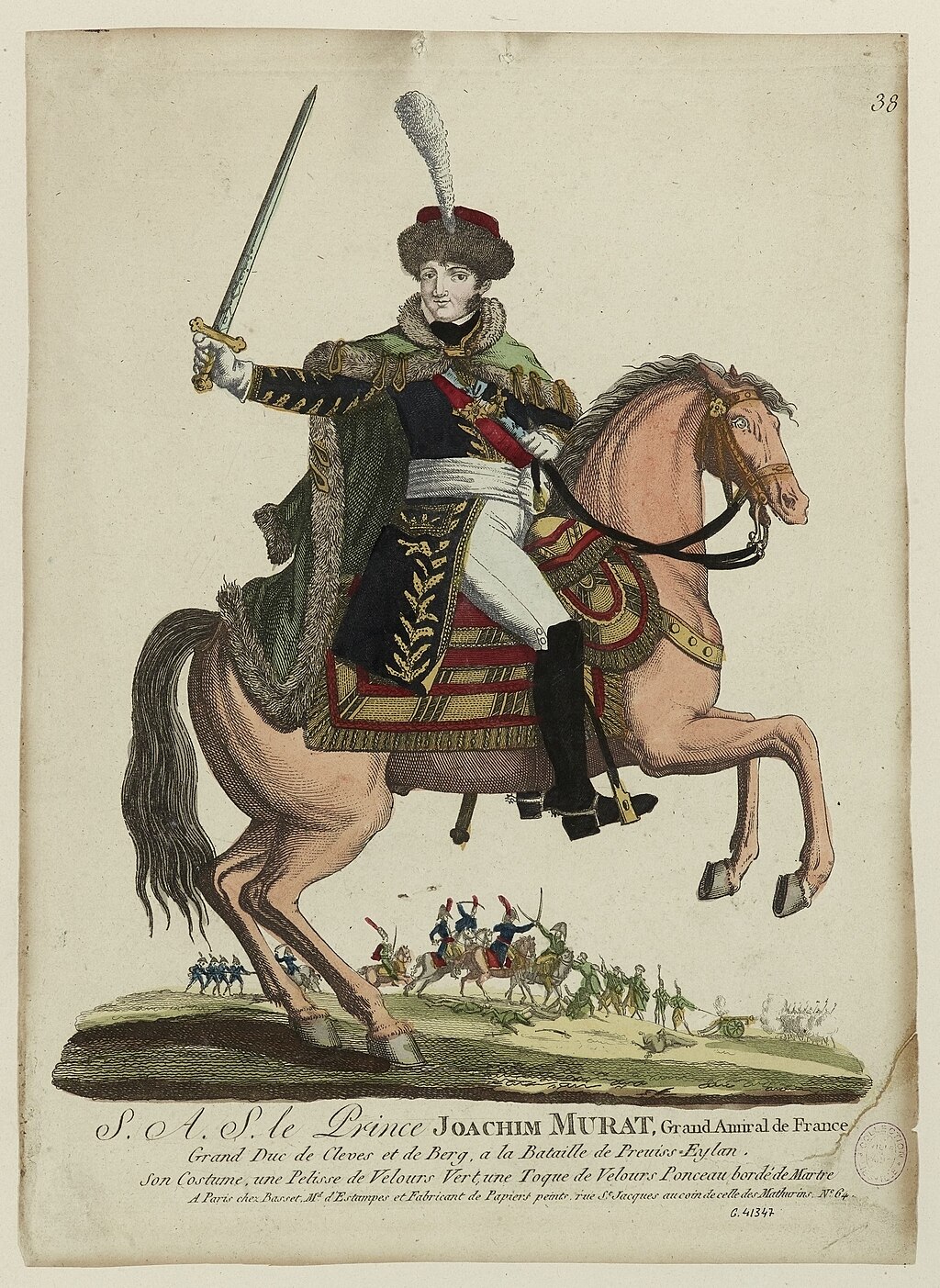
yesterday but in 1767AD France's most dashing cavalry commander Joachim Murat, marshal of France and king of Naples, was born in France to his parents, Pierre and Jeanne nee Loubières. From one dashing raid or charge to another had gone the years of his own Napoleonic epic.
Trying to carve his own realm he had abandoned Napoleon and eventually Joachim Murat was shot by a firing squad in Calabria, Kingdom of Naples, in 1815AD.

I gathered some period and later historic imagery to recall  this dashing and flamboyant horseman's life and deeds. 

Ave, Murat.

battle at Abukir, 1799


.


Murat was married to Caroline Bonaparte, also born on March 25,  and they had 4 children, and their family line still lives on in France and the US. His descendants included a horseman and  cavalry general Louis Napoléon Achille Charles Murat (his great-grandson, born to a Mingrelian princess and French father in 1872 and died 1943), who was an officer in the Russian Imperial army and fought against the Germans in World War I and later on the side of the White Russians against the Bolsheviks etc.


Valete

Saturday, March 15, 2025

Battle of Reims 1814

 Salvete Omnes,

on the 13th of this month it passed another anniversary of the battle of Reims, one of the battles during the 1814 campaign of France.

we can see here the splendor of the Hungarian-style uniform of the Guards of Honour


Briefly, as you can read in many books and on many webpages, Emperor Napoleon I brought crica 10,000 strong army against a combined Prussian-Russian command (15,000 strong) under the command of general Emmanuel Saint-Priest.
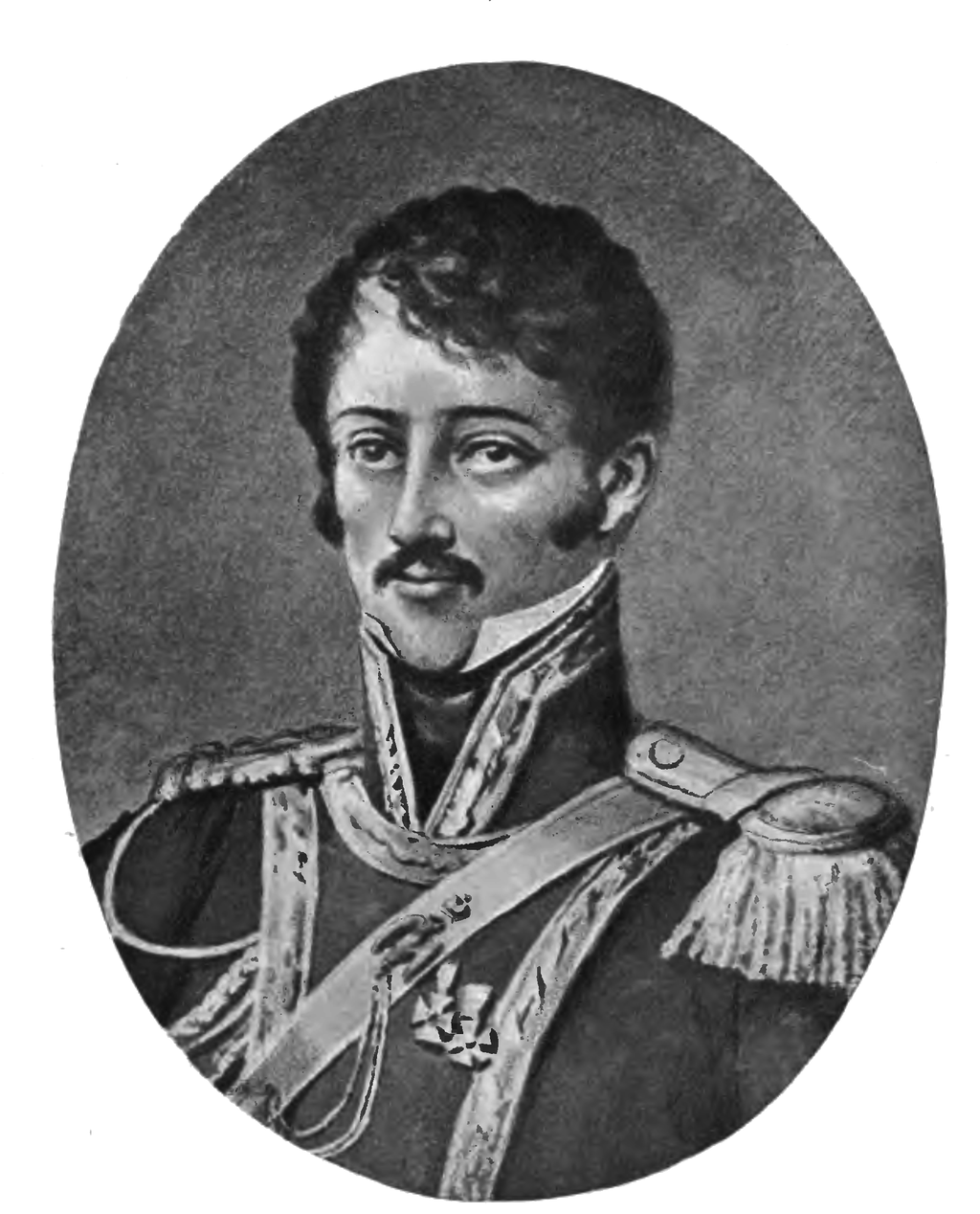
Polish cavalrymen of the 1st Chevaulegrs Lanciers  Polonais (Polish Lancers of the Guard) commanded by general Wincenty Krasinski  charged across the streets of Reims and breaking Prussian-Russian defences and capturing hundreds of enemy soldiers.


During this battle a cavalry regiment known as the Eclaireurs-Lanciers (3e Regiment d'Eclaireurs de la Garde Imperiale or 3rd Scouts) also distinguished themselves. This cavalry unit was  a regiment organized based on the reorganization of the Polish lancers by the emperor in December 1813. They were attached to our Polish lancers and with mostly Polish officers and sergeants within their ranks. But curiously all the regimental farriers were German by birth, while all 14 trumpeters were all French.  On March 8, 1814 they had 66 officers and 794 men.

Per uniforms they wore a czapka lancer cap (rogatywka) dark-blue kurtka jacker and trousers, armed with lances and sabres & pistols. 


During this battle of Reims Polish officer  captain Wincenty Szeptycki commanded the duty squadron of the 3rd and they attacked with their valiant captain at the head and captured an entire Prussian infantry battalion. 


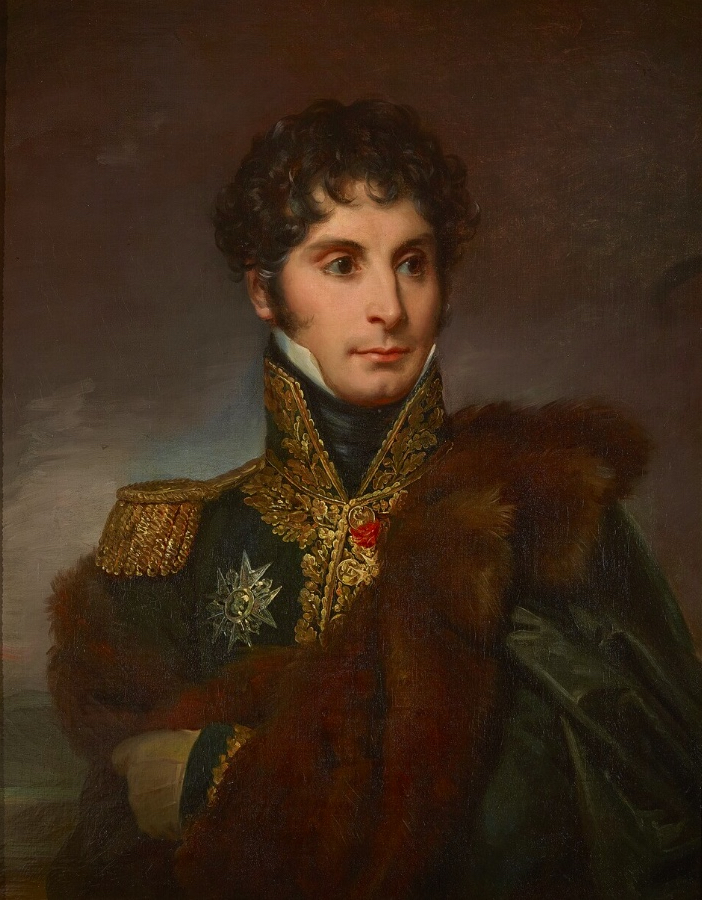
Imperial French cavalry also had another late comer to the Grand Army there , the  3rd Regiment of Guards of Honour, it was organized in Tulouse in 1813 - you see and study their uniforms below. And the 3rd took part in the 1813 and 1814 campaigns. , during this campaign  it was commanded by general Philippe-Paul de Segur,  a seasoned cavalry officer, who commanded personally in front of his horse soldiers, engaging in hand to hand combat with the enemy dragoons and Cossacks. 


 During the battle  the 3rd along with elements of the 1st Regiment of Guards of Honour charged the Russian dragoons at the Soissons-Epernay crossroads, and went through them all the way to the gates and walls of the city. After many deed of valour, facing the artillery fire from the walls and a canister shot form two cannons of the Russian artillery unit and musket fire from the Riazanski , Russian, Regiment, the Honour cavalrymen persisted but many officers and soldiers and their horses sustained many wounds, including mortal ones. 

The colonel-major (2nd in command) Count Cesar Vachon de Belmont-Briancon was killed. The officers of the regiment tasked Horace Vernet to paint a posthumous portrait of the colonel-major as he appeared on the morning of the 13th of March.

light cavalry saddle under the ornate green and silver lace shabraque


 He was dressed in his Hungarian hussar-like campaign dress: dark green pants with silver buttoned side-stripes, dark green pelisse with silver braid and sleeve rank stripes, and a red shako with one narrow and one wide rank stripes at the top and the white plume of a regimental staff officer.  He has a red leather sabretache on his left hip.

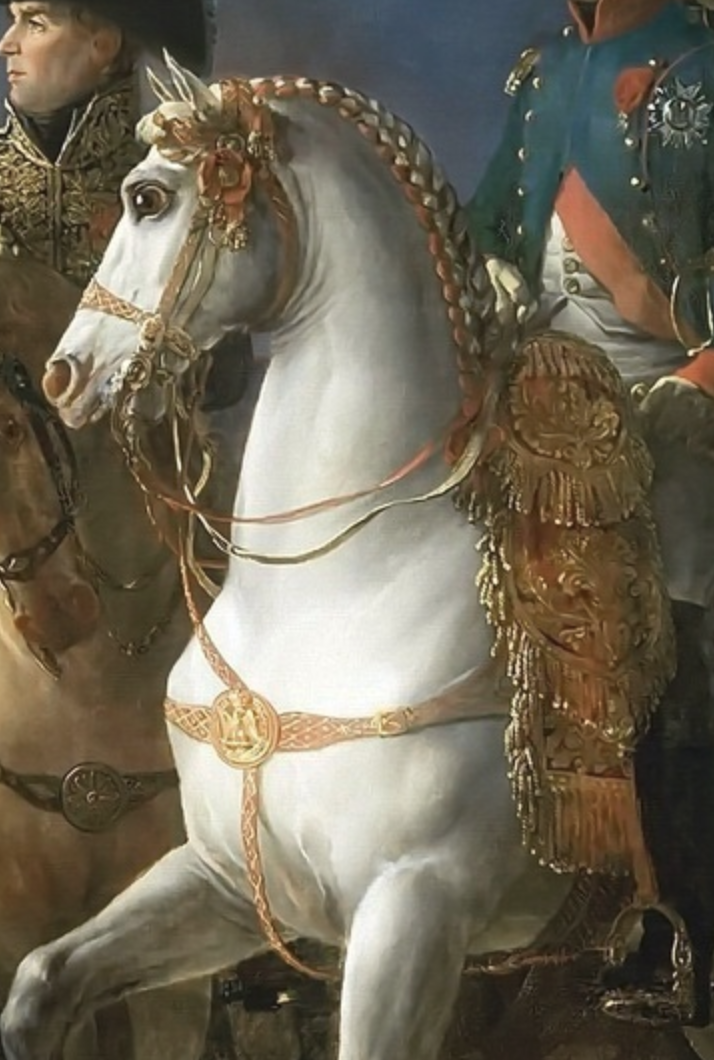
light cavalry bridle, in the Hungarian of Old Polish fashion

horses and cavalrymen of the 3rd regiment of the Guards od Honour on campaign  


enjoy

Valete
Sunday, January 21, 2024

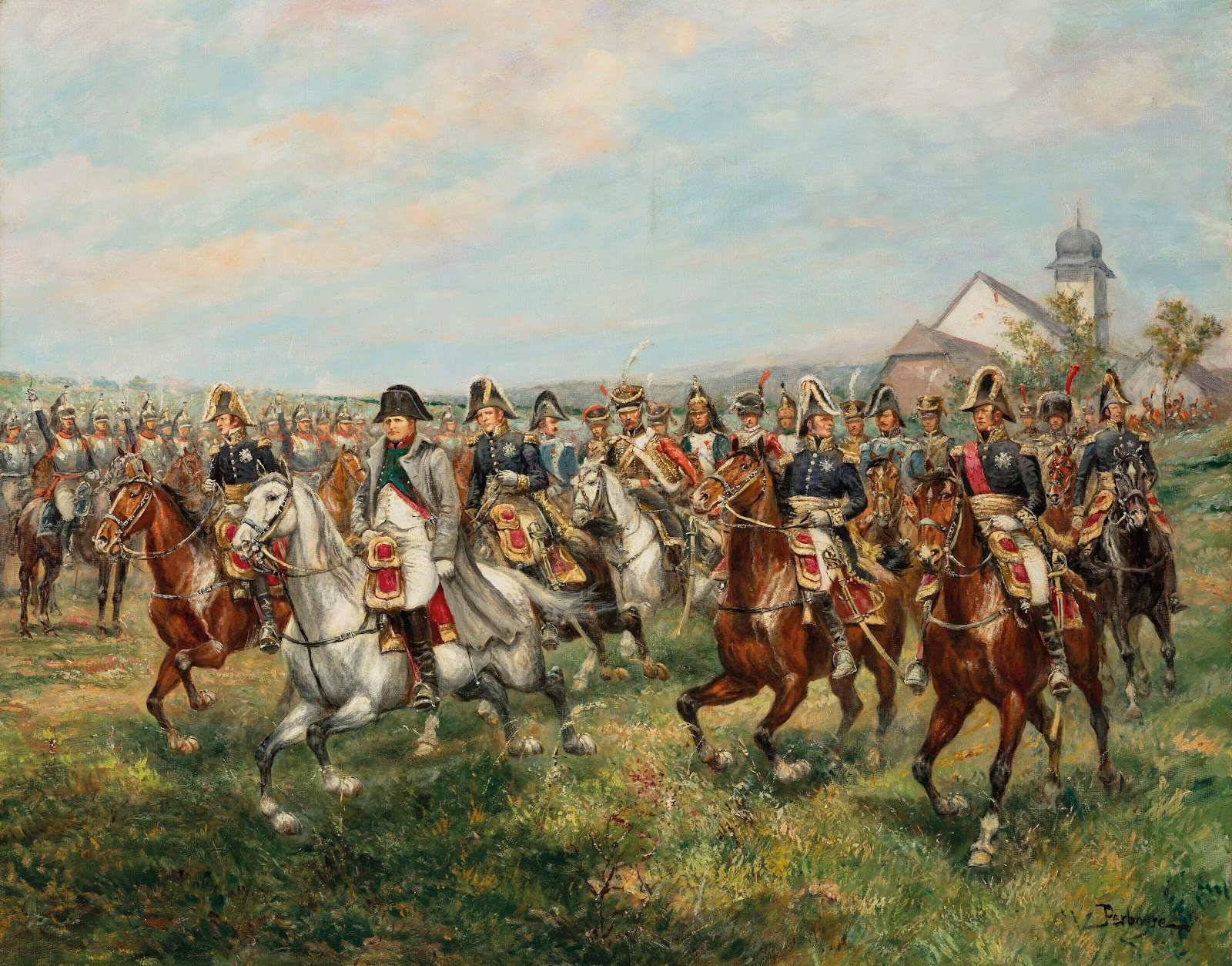
Napoleon during 1812 Russia campaign in Albrecht Adam's brushes

 Salvete Omnes,

taking of Smolensk 1812


we, the Napoleonic Age aficionados,  are still reeling from the 'fracaso' or failure of the latest Hollywood take on the great European aka Napoleon by a British director R. Scott.


So today some images of mounted Napoleon by maestro Albrecht Adam, who himself, when very young, was 'an honorable visual corespondent' during the epic 1812 campaign in Russia.  

detail from a larger painting
burning Moscow in 1812


detail from the Berezyna/Berezina crossing


nota bene gorgeously painted horse 


Valete

Monday, October 30, 2023

Napoleonic guard cavalry bridle - general Walther in Levebre's portrait

 Salvete Omnes,

number 13 is considered unlucky so I am  going to post another little thing this days -

and staying within the Napoleonic spirit why not to share this portrait by master portraitist of the era Robert Levebre. 


general Frédéric-Louis-Henri Walther (20 June 1761 - 24 November 1813) was a cavalryman  during the late Ancient Regime and later Revolutionary & Napoleonic wars, one of the most famous Napoleonic commanders and cavalry leaders of the era.

he enlisted in the Bercheny hussars in 1781, became officer in 1792, fought in the wars of the First and Second Coalition, and subsequently in the war of Third Coalition, Ulm campaign, and battle  of Hohenlindenm, 

Under the emperor he commanded 2nd  dragoon division at the battle of Austerlitz and was wounded there,  made commander of the Guards' grenadiers a Cheval(mounted grenadiers of the Imperial Guard)  in 1806, in the subsequent campaign of 1806-7 was in the forefront of the action, his command and he were among those 10,000 horsemen  that charged under Murat at Eylau. 


and so on, commanded and fought as cavalryman at many engagements, below as a colonel of the Guard grenadiers a Cheval regiment at Essling 1809 - painted by Victor Huen.  Commanded the guard cavalry at Wagram. Commanded the Guard's light cavalry during the tragic and epic  1812 campaign, During the 1813 campaigning general Walther was the commander of the Guard cavalry seeing action at all the major battles:  Lutzen, Dresden, 2nd Kulm, and Leipzig.   His last battle was to be Hanau in October 1813.  Thus Frederic-Louis  Walther served in the cavalry  more than 32 years as  cavalryman.  How many horses he could have had and ridden to their untimely end, God only knows, how many he loved and how many he cherished and treasured, we'll never know, unless we obtain a Time machine.   


and the bridle detail in this Robert Levebre's painting - horse appears to be of the high caste, noble breeding, Arabian perhaps? 


valete

Saturday, October 28, 2023

Paul-Emile Leon Perboyre - Napoleonic soldiers in art

 Salvete Omnes,


the film director Ridley Scott, of UK, directed and produced a brand new epic movie about Napoleon -  see the wiki entry. It is worth noting that Ridley Scott started his big movie career with a fine cavalry-themed Napoleonic epic - The Duelists in 1977.

I still thing his movie Kingdom of Heaven sucked and was full of ahistorical nonsense and propaganda, but many were fine works of entertainment. I hope this Napoleon will be rather finer that not, but we will not see that until end of November  2023.

So in the spirit of Napoleonic wars soon to be seen again on the screen, I would like to bring your attention to the works of this one Frenchman.

general Drouot at Wagram

Paul-Emile LeonPreboyre (1851-192) - a Frenchman who was born near Colmar, Alsace region of France (Alsace taken from France by newly created German Empire in 1871, returned in 1919, taken again in 1940 and returned in 1945 'till present), a disciple of finest portrait painter of the era Leon Bonnat, and specialized in military themes. Preboyre began to exhibit at the Paris Salon in 1881, and in 1909 became the member of the prestigious Society of French Artists. He also exhibited in UK and presumably other continental galleries etc. 

Augereau at Castiglione 

Augereau at Jena

Napoleon orders advance at Jena - horse artillery moving with the chasseurs a cheval screening the Emperor

Napoleon with his cavalry - cuirassiers, chasseur a cheval, hussars  etc 

inspection before the battle - cuirassiers in the foreground

cuirassiers at Essling 

enjoy ,

ps
and in the link under Preboyre name there is a Artnet gallery of more than 200 works of this artist

Valate

Friday, November 28, 2014

Napoleonic bridles and horse soldiers as seen by François Gérard

Salve,
a day after the great feast of Thanksgiving calls for something special in the history of horse art and war horse, so perhaps the grand work by master François Gérard who witnessed the Age of Napoleon would give us this 'grandeur.' (notwithstanding the fact that the Emperor was one of the great destroyers of war horses in history).
The French victory at Austerlitz was painted by many an artist, but the rendering of this moment of cavalry glorious return from their victorious charge as depicted by monsieur Gerard allows us to do a little viewing of the period tack and horse, and horse soldiers of the Imperial Guard,  Their their famous charge that 'let the ladies of Saint Petersburg weep ' left for the other artists to paint.
Naturally the Emperor of the French first :)  
In the center of the canvass we see  the commander of the famous charge, Napoleon's  ADC general Jean Rapp reporting the victory to the Emperor and his staff (nota bene Marechal Jean-Baptiste Bessieres also charged in this cavalry action)
Napoleon on his splendid stallion:
staff:


 heroic Jean Rapp is a bit wounded, hatless and rides a splendid grey that could make many a stable proud

but there is this anecdote about the artist and the general's horse - 
La France Hippique relates the following anecdote :

“ Gerard, the celebrated painter, was charged by the Emperor Napoleon I.

to paint the battle of Austerlitz. In his composition of that great feat of arms,

General Rapp was to be represented coming up at full gallop to announce the

gain of the battle. Every thing was prepared on the canvass, and there only

remained to place Rapp on horseback, but Gerard could not find a charger

which suited his ideas.

The Emperor had placed at his disposal, not only all the horses of his own stables,

but ordered that those of all the cavalry regiments should be open to him.

The animals were made to gallop, rear, and perform all kinds of movements, but none of them pleased the painter, and Rapp still remained unmounted.

One day while walking along the Boulevard, the painter, in passing

before a toy-shop, uttered an exclamation of delight on observing a small

pasteboard horse, painted grey and with a black head, which, from its position looked as if it was about to leap out of the window.

“Ah!' cried Gerard, 'that is the horse for Rapp;' and entering , he asked the price for it – 'Twenty -five sous,' was the replay; and the artist, paying the money, carried off the horse under his arm.

It is this animal which, it is said, figures, in the famous picture of the Museum at

Versaillers, carrying Rapp to the emperor, the General, in his haste having lost his hat.
(printed 'Dwight's Journal of Music:' Boston 1861, p 175)
 General Rapp described this action in his memoirs - can be read at archive library, as usual :)

Chasseur a cheval -  including the chasseur who mortally wounded still brought the captured flag to his commander - (The Memoirs of Baron de Marbot, vol I p. 199)


Mamelukes -  famous Mustapha (Mustafa) who wanted to catch Archduke Constantine, who escaped by shooting mameluke's horse. Baron de Marbot, p 198-99


  Grenadiers a cheval -  famous bearskins - perhaps a little about their horse tack - their horse tack consisted of a natural leather saddle  with a white leather seat (over a blue saddle cloth with  wide stripe of 'gold' lace).  Gold grenades were embroidered in the rear corners of the the saddle cloth. The bridle with reins, breastplate, and crupper  were of black leather with the metal buckles et al of brass where required. Cinch was of a grey cloth. Pistol holders were of brown leather, blackened iron stirrups hung on the Hungarian leather straps.  The horse head harness consisted of the cavalry bridle (curb-bit of steel with a brass boss stamped with a grenade and snaffle etc) and double reins and scarlet rosettes and ribbons. 

enjoy
ps
Patrice Courcelle painted several Osprey's titles where very detailed plates with uniforms, horse tack etc can be studied and enjoyed along with the text.  Two plates in the 'Mounted Chasseurs of the Guard' depict  the Rapp & Guard's charge at Austerlitz in monsier Courcelle' fine style.
Ps'
2014 reenactment - at  Slavkov u Brna, in Czech Republic, of course.