Showing posts with label Ottoman Turkish saddle. Show all posts

Thursday, January 23, 2020

Ottoman horse market miniature et al

Salvete Omnes,
I think that perusing Wiki Commons is always a good thing, for one may find many an interesting image.
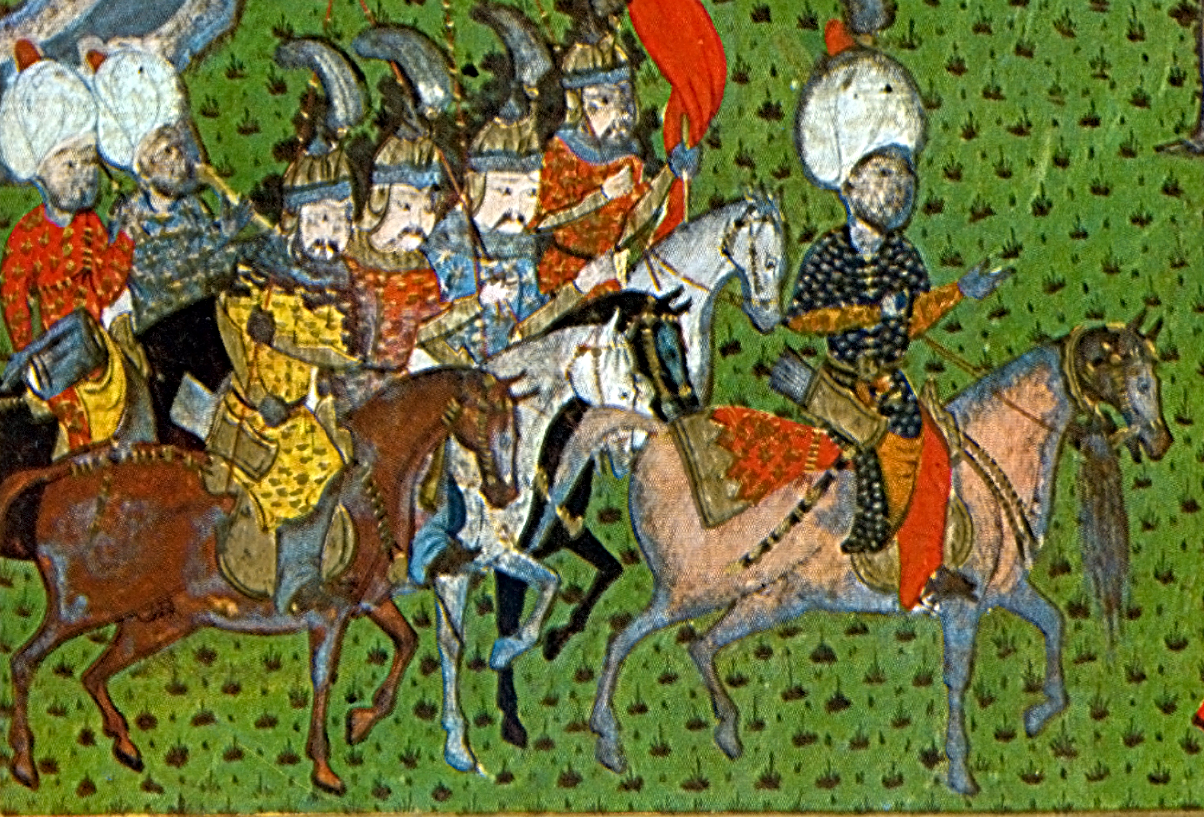
For example in this this collection of the Ottoman miniatures there are these interesting images showing among other, the horse market -


..


Valete

Wednesday, November 13, 2019

Turkenbeute from Karlsruhe

Salvete Omnes,
today a little entry -  Ottoman horse-related treasures to be found within the Federal Republic of Germany, the federal state of Baden-Württemberg, in the city of Karlsruhe. 

 Imperial commanders (field marshals ) and Baden-Baden princes Ludwig Wilhelm von Baden-Baden(Turkenlouis)  - below dressed as a Ottoman warrior
 
participated at the battle of Vienna (AD 1683), victor of  Battle of Niš (AD1689) and Slankamen (AD 1691) where the grand visir Fazıl Mustafa Köprülü perished with his army;  prince Ludwig Wilhelm participated as sub-commander at the battle of Zenta ( AD1697) .
 
and his uncle Hermann von Baden
 
fought the Ottoman Turks during the war 1683-99. They brought many captured trophies from the battles  and this collection known as Der Turkenbeute constitutes the large part the fabulous art collections at the Karlsruhe Palace Musuem.
Schloss Rastatt , a nother of the Badenian palaces - build by and for Turkenlouis
 
Some of the images taken from Wiki Commons. - the exhibit and some of the Ottoman horse tack and weaponry, including the most fabulous carpets etc


 they also have many more saddles, including Polish XVII  c saddle, and lost of horse tack - like the woven Ottoman cinches and bridles etc.
Valete

ps
 the very  palace-museum also contains some fabulous examples of the ancient art from Europe, Western Asia and North Africa . The medieval period is very well represented - eg great representation of Saint Martin.

Monday, May 22, 2017

Ottoman Turkish horse stabling and tack from L. Marsigli

Salvete omnes,
in 1682 Habsburg officer and gentleman Luigi Ferdinando Marsigli was taken prisoner during the war with the Ottoman Turks that his employers, Holy Roman Empire, fought against.He spent several years in captivity and being a military man he observed the Ottomans with care and consideration.
Eventually he wrote and illustrated a book aptly titled L'État militaire de l'empire ottoman or Stato militare dell'Imperio Ottomanno  that was published in Amsterdam in 1732.

Let me share with you the following details of his plate on the Turkish cavalry campsite, where horse are kept separated by boards from their food, while they are picketed by their hind leg


where B is a wooden wall constructed from wooden boards, its function to prevent horses getting to their food to quickly and perhaps to prevent horses from fouling their fodder
and E is the picketed horse

also horse tack and aids according to Marsigli

enjoy
ps
there is one more interesting plate, showing the Tatars crossing a river but we will save it for another day
ps'
I have just read that Zbigniew Wodecki, a famous singer-musician from Poland -my favorite of all times is his theme song to Pszczółka Maja , passed away today - pacem aeternam, panie Zbigniewie!

Sunday, August 21, 2016

Wilanow Museum - saddles, bridle, and a cavalry drum

Salvete omnes,
when I went to the Polish Army parade in Warsaw I took the opportunity to visit several museums in the capital of Poland.
I wrote about my trip to the Wilanow Palace Museum already, but today i would like to share with you several pictures, taken with my phone - sorry for the poor quality, of historic saddles displayed there.
First saddle was displayed with a bridle with a curb-bit and textile reins (wrapped around the saddle's pommel).


second saddle


also a Polish cavalry drum

all presumably late XVII -first half of XVIII centuries - the textiles displayed with the saddles are most likely of the Ottoman Turkish manufacture. The saddles also show Turkish influence on the Polish horse tack. Both saddles are incomplete - without seat pillows, stirrups, cinches and matching bridles, breastplates and croupers. 

Enjoy

Saturday, January 4, 2014

Ottoman Turkish saddle - Certamen equestre

Salve,
continuing from subject of saddles shown in the Swedish Certamen Equestre -
today my choice of Ottoman Turkish (and they are also Crimean Tatar, although not named in the collection) saddles from the engravings - then, prior to 1683, the greatest empire in western Eurasia, the centre for ancient horse cultures of Antiquity and Eurasian nomadic traditions. The empire's heyday was XVI century epitomised by the great sultan Suleiman, when empire's splendours, military, arts and generally culture flourished. The miniatures from mid XVI century show this clearly:


Below sultan or padishah Osman II, on horseback, he died over his failure to conquer Poland at Khotyn 1621, and whose  horse furniture can be used as a example  of calculated and dazzling beauty of their horse tack and ... fine skills of the Ottoman painters.


King Charles XI's Certamen Equestre took place during the reign of the sultan Mehmed IV, who saw revival of Ottoman might and then a collapse, following the defeat at Vienna et al., perhaps beginning of the end of Ottoman empire.

The saddles - nota bene you can see how much Polish saddles were influenced by the Ottoman and Crimean Tatar traditions - of jarczak type and lancer war saddle type.


enjoy

ps
next the Western European saddles from the same collection.

Friday, November 19, 2010

Turkish rider sketch

Salve,
this one is reworking of an old sketch into a new image, this time he is going to be a Ottoman Turkish cavalryman  or .. well, whether an akinci, delier or sipahi I do not know yet. Time period XVI century CE.
V.