Showing posts with label Gericault. Show all posts

Sunday, September 27, 2026

Portraits of equine expressions in eighteenth- and nineteenth-century paintings

 Slavete Omnes,

University of Michigan Digital Collections 


 from the Journal of Veterinary Behavior come this libre article -Portraits of equine expressions in eighteenth- and nineteenth-century paintings by Denise Pereira Leme.


.


It is free and about horse paintings, so why not to peruse it?  -   as the the proverbs go:

-don't look a gift horse in the mouth

-darowanemu koniowi w zęby się nie zagląda

-a caballo regalado, no le mires el diente

-Даровому коню в зубы не смотрят 

And what a joyous opportunity to share some great equestrian art on this blog 


.


.


.


enjoy

Valete


Sunday, August 13, 2023

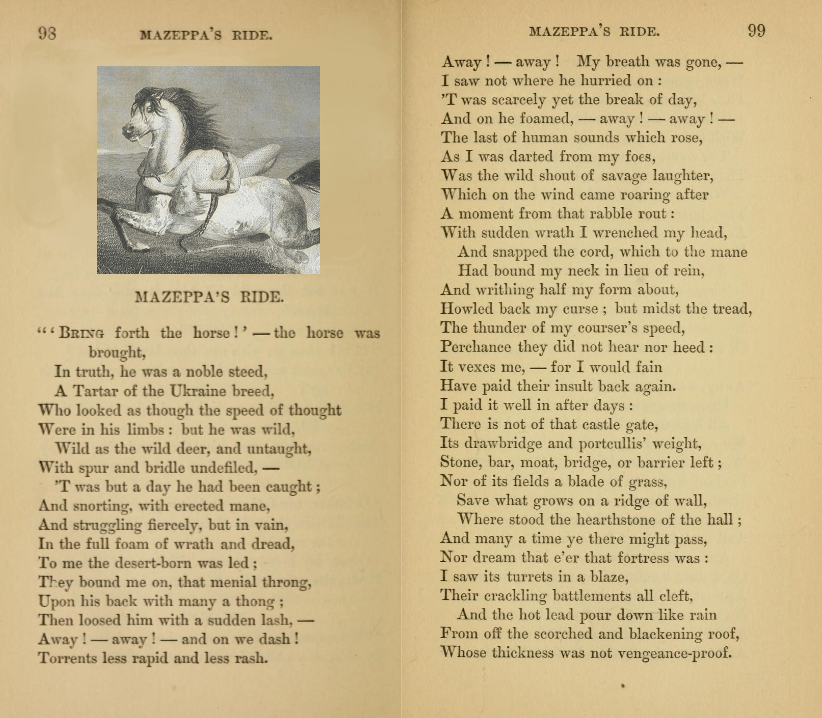
Mazeppa's Ride - Byron

 Salvete Omnes,


While in college I took an advance class in English late XVIII and XIX century literature - from William Blake to Kipling et al. 

Among many poems, novels, and other works of literature we studied there were poems of  George  Gordon, Lord Byron.

Byron wrote a long poem somewhat based on the life of  Ivan (John) Mazepa-Kolodynski, a nobleman of Kurcz coat of arms, and a real political leader, a hetman, of the Zaporozhian Cossacks of the so called 'Left-Bank Ukraine(semi-independent Russian territory on the left bank of the Dnieper River taken from Polish-Lithuanian Commonwealth during the long war of 1653-1667). At first strong ally of the Russian tsar and Polish-Saxon king Augustus hetman Mazepa and his Cossacks switched sides, from Russian-Saxon to  Charles XII, King of Sweden,  during the Great Northern War. But upon the defeat of the Swedish-allied forces at Poltava (allied - Swedish-Polish-Cossack army was defeated  by tsar Piotr  I(Peter) of Russia) he withdrew his remaining Cossack forces into the Ottoman territory, where being a refugee from his land Cossack hetman Mazepa died at Bendery in the fall of 1709.
Byron took the story of the ride from some French publications, perhaps from Voltaire's History of Charles XII, King of Sweden, while Voltaire must have taken it from perhaps some French courtier who had been a courtier or soldier of our king John III Sobieski, and via Polish court had been acquainted with the Mazepa's tragic amorous story. The original story seem to have been  first described by Polish memoirist Jan Ch. Pasek in his memoir. 
The important aspect of the epic poem is the famous Mazeppa's ride -  on the back of the 'Tatar noble steed.' - as we call it a bachmat.


  the Mazepp'a Ride via Byron's own verse and artwork that came after the publication of the poem


one day soon we may read about the historic Mazepa's  ride as our XVII century Polish memoirist Jan Ch. Pasek described it.

Valete

Friday, January 10, 2014

Horses of Gericault - adendum

Salve,
in December I made this entry on the wonderful equestrian art of Monsieur Gericault, and today I am going to add several images from his 'stables.'

 I especially like the watercolour sketches and the drawings done on tinted paper with sepia and white gauche.
All of these images again and again shows us the beauty of the horse and amazing skill of Master Gericault.
..


.
also, I made a sketch, a few weeks back, of a horseman based on his famous horseman of the Napoleon's guard. I am going to make this horseman into a Polish or Hungarian rider from the 1600s or 1700s, I am not sure just yet.  Perhaps more than one horseman since digital painting allows us to do create multiple images  :)
In any event, studying the Old Masters and using their compositions etc to draw and paint that is the time honoured tradition, and a great learning tool.

Enjoy

Monday, December 30, 2013

Horses of Gericault


Salve,
2013 is closing fast on us, i must admit I do not like that the New Year starts in the dead of the winter, I rather take the Persian New Year tradition of Nowruz that falls around the Spring Equinox in the Northern Hemisphere, but things are as they are :)
Ad rem, Jean-Louis André Théodore Géricault aka Theodore Gericault was a marvellous Romantic painter from  early XIX century France, whose works are admired all over the world.
I do like his brushwork as shown in portraits or period scenes, but I find his horses and riders even more appealing and worth studying, for they are wonderfully drawn and painted, with so much spirit and love for the subject that I never cease to marvel.
About his studies Jean-Louis Andre Theodore wrote himself:
''To draw and paint after the great Old masters. -Read and compose - Anatomy. Antiques -Music -Italian. -Take courses  in ancient art, on Tuesdays and Saturdays, at two o'clock... draw after the antique ... go yo M. Guerin's in order to paint after nature ... Concern myself with the style of the Old Masters and compose, without going out and always alone.'' ( in Nina Athanassoglou-Kallymer, 'Theodore Gericault' 2010,  p 20)
We should note that he first studied with a famous French horse painter Carle Vernet (1758-1833)

and became a lifelong friend of his son, Horace Vernet, also a great painter of horses and military, teacher of Polish painters eg January Suchodolski and Juliusz Kossak.

About his horses a cousin of his Henri Moulin said in 1865 -
Horses, as he himself confessed, just made him crazy, and perhaps no other painter better than himself felt so vividly the beauty of this proud and fiery animal ... so much was his passion for the horse akin to madness ... An excellent rider, his greatest pleasure was to gallop wildly through the countryside, preferably mounting pure-blood horses and always selecting the wildest ones. (  Nina Athanassoglou-Kallymer, p 14)


.
Love the Chasseur a Cheval of the Imperial Guard (Napoleon I )
Cuirassiers & Carabiniers


Barb horses racing in Papal Rome - part of the old Carnival of Rome


the studies of horses,  done in oil or watercolour


 Napoleon


cavalrymen  -  like this Wincenty Krasiński

above, the three trumpeters of the Polish lanciers


and many others


.


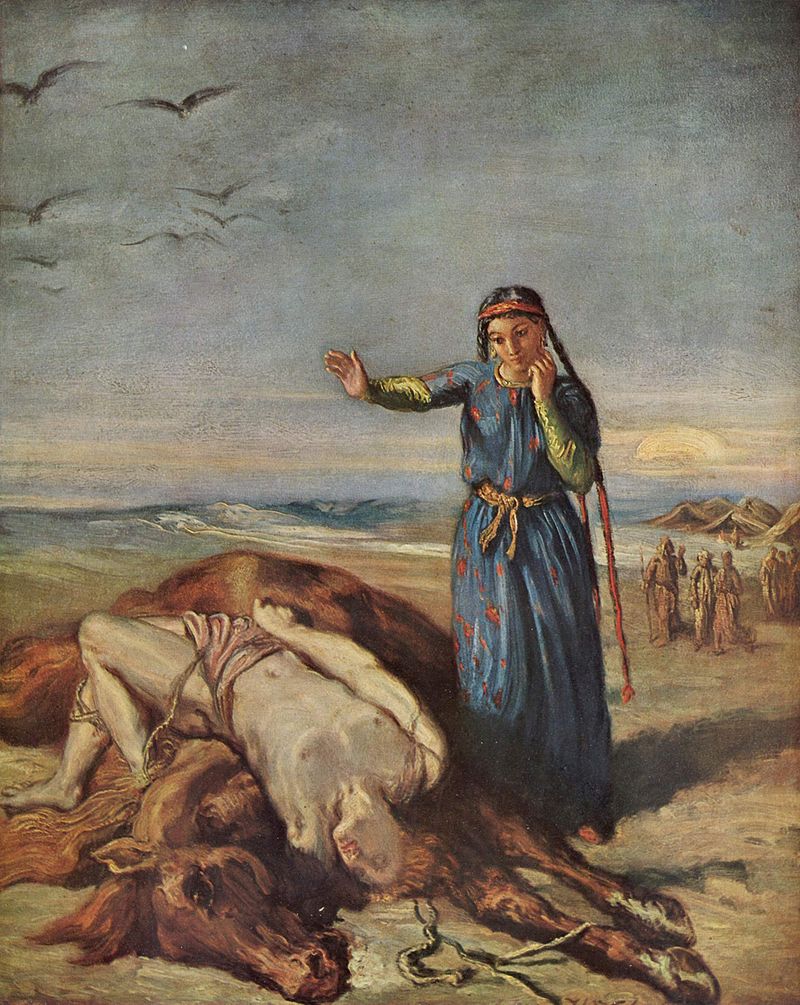
 and Mazeppa -

as the Russians say - pa ka - :)

there are prints available on the British Museum research website, and I find this one interesting - shows a Spanish horse between the pillars, with a cavesson etc, and the stallion's trainer?
ps
images come form Wikimedia Commons and wikigallery.org