Showing posts with label George Bird Grinnell. Show all posts

Friday, December 29, 2023

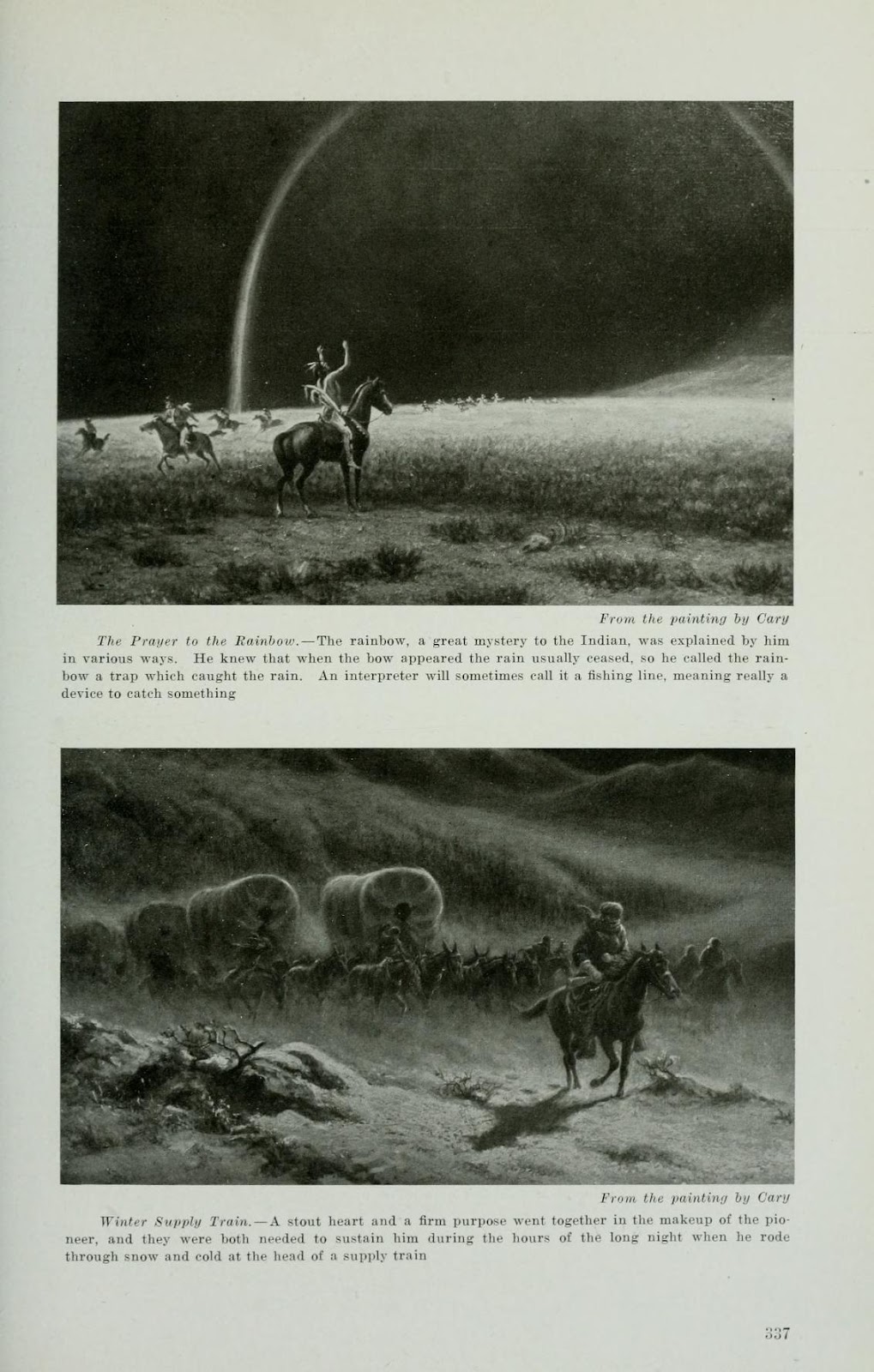
William de la Montagne Cary - Grinnell's article with Cary's art

 Salvete Omnes, 


another post about William de la Montagne Cary, before year's end 

this time a fine article, from American Museum of Natural History Journal,  written by one of the more preeminent historians and students of the Great Plains people - the Cheyennes, Pawnees etc.
The article deals with the 1861 and 1874 trips to the West made by maestro Cary. 


the last page also includes a comprehensive  editorial note on the voyages and experiences with the Plains nomads by dr. Grinnell himself.

enjoy

Valete

Monday, November 29, 2021

W. T. Hamilton & C.M. Russell

 Salvete Omnes,

from wiki commons


as always you can count on the world library - archive.org. So a quick entry of book that can be found (several scans of the same volume) at the site.
The book - My Sixty years on the plains, trapping, trading, and Indian fighting - was written by William Thomas Hamilton.

In the old days  this esteemed Western historian George Bird Grinnell wrote a little biographical information in the entry to his book - Beyond the Old Frontier - published in 1913.


The 1905 book by Hamilton was published with a number of excellent illustrations painted by one of the most popular artist of the Old American West - Charles Marion Russell.

I 'corralled' them for you all :


we may return to this book in the future...

Valete

Thursday, December 22, 2016

Fetterman Fight - Cheyenne Account 2

Salve,
returning to the battle known as Fetterman Fight - and the Cheyenne account of this day, unfortunately and sadly I could not publish this on the day of the struggle.

Cheyenne account reported by G.B. Grinnell & G. Bent:

After a little time a single shot was heard. Later it was said that when the young men who had been sent to the fort had charged the post they had killed a
sentry. This was the shot. A long period of silence followed, during which they waited and listened; then a number of shots were heard, but the firing lasted for a few minutes only. It was afterward said that some troops came out from the fort as if to attack the decoy Indians and then turned back and went into
the fort and that someone who was with the soldiers made motions to the young Indians to go away, that the soldiers were going to eat. This was the Indian understanding of the signs, whatever they may have been.

The Sioux signed back to them that to-day they would get a full stomach of fighting. The soldiers re-entered the post and the young Indians remained in sight riding about.

After a time a number of bugle-calls were heard and soon after a troop of cavalry marched out of the post toward these young men, and after them a company of infantry. At a bugle-call the cavalry charged and fired at the Indians who, of course, ran away. This was the distant shooting heard.

It was some time before the watchers heard any more shooting. The cavalry after firing had stopped, and would follow no longer, and the Indians were obliged to return and attack again, be shot at, and followed a little farther. In this way the infantry kept well closed up with the cavalry, which was perhaps the reason the cavalry followed slowly.


After the third and fourth volleys the shooting came closer, and before long some of the Indians came riding down the ridge and a little later another man, Big Nose, the Cheyenne, mounted on a black horse, was seen riding back and forth across the ridge before the soldiers, seeming to fight them and they were shooting at him as hard as they could. It looked as if Big Nose was trying to fight and hold back the soldiers in order to help someone ahead of him to get away. From the place where the Indians were waiting Big Nose seemed almost against the soldiers. The great body of Indians bidden along the ridge kept themselves well concealed. Not a move was made nor a sound heard.

After Big Nose, followed slowly by the soldiers, had come down off the steep ridge the troops stopped, and Big Nose charged back and seemed to go in among the soldiers so that he was lost to sight. He went into the troop from the right and came out on the left, wheeled his horse, rode into them again and came out, and turned as if to go back.

The troops kept following, coming down the old Bozeman Road which runs down the crest of the ridge. The Sioux on foot were hidden in the grass on the flat beyond the end of the ridge, perhaps one and a half miles distant from the place where the troops came to it at its upper end. The mounted Sioux were
hidden behind two rocky ridges on the east side of this ridge, while the Cheyennes were on the west side of it. It had been announced that a certain Cheyenne, Little Horse, who was a Contrary*, should give his people the word to charge, and when the proper time came this word was to be passed on from one to another until all were notified and then all should spring up and charge.

The cavalry, who had been following the ridge down nearly to the flat by the stream, were now pretty close to the Sioux footmen, and the infantry were well within the Indians' lines. When the decoys had forded the stream beyond the end of the ridge and the cavalry had nearly come to it the decoys separated
into two parties, riding away from each other, and then, turning, came back and crossed each other. This was very likely a signal, and the Indians charged. 

Little Horse, following the law of the Contraries, held his contrary lance in his left hand. The Cheyennes watched him, and when they saw him pass his left
hand behind his neck and grasp the contrary lance with his right hand they knew that he was about to charge, and all sprang up.

When the charge was made the sound of many hoofs made a noise like thunder and the soldiers began to fall back. On the ridge near the place where it leaves the hill are many large loose flat stones. The infantry took a position behind these. The cavalry moved back up the hill and stopped.

On the infantry hidden among the rocks a a Sioux came charging down the old road  and the infantry stood up in sight as if about to leave the shelter. They did not do so, but let the Sioux pass through them and after he had passed fired at and killed him.
Soon after this another man came down the road on foot and began to shoot at the infantry and -what they rose up to shoot at him the other Indians shot at them. This young man was killed.

White Elk— at that time named Wandering Buffalo Bull—was with those fighting the infantry. Soon after the second Sioux was killed the try was given to charge and the Sioux and Cheyennes charged and got to the infantry about the same time, and for a little while Indiana and soldiers were mixed up together in hand-to-hand fighting. Just before and in this charge a Sioux was killed and another wounded by arrows shot by their own people. The one killed was struck in the forehead just over the root of the nose, and the arrow-point pierced his brain.  The arrow was shot from the other side of the ridge and had passed
through or over the crowd of troops.

The cavalry, who had followed the decoying party of Indians down nearly to the level of the river bottom, when they saw the Sioux charging them from the northeast turned and retreated up to the top of a high hill toward the end of the ridge. There they halted and waited in line until the infantry were all killed
at the rocks about a hundred yards north of the line of cavalry.
Then the cavalry began to fall back, but slowly and in order. Some were even on foot leading the horses.

After the infantrymen had been killed the Indians rushed up toward the cavalry, but the ground was slippery with ice and snow and in many places the hill was too steep for them to charge up it. Still many people crept up toward the place, and Little Horse is reported to have approached behind the rocks within forty feet of the soldiers, and fought there, yet he was not hurt in the fight. While this was going on White Elk was a little behind, where he could see the Indians shooting at the cavalry with arrows, and the arrows flew so thickly above the troops that to him they seemed like a lot of grasshoppers flying across each other.
On the hill an officer was killed and when he fell the troops seemed to give up and to begin to fight their way up the ridge. The weather now grew very cold, so that blood running from wounds soon froze. After the soldiers had reached the end of the ridge they began to let go their horses and the Indians, eager to capture the horses, began to lessen their shooting.

Up to this time Big Nose had not been hurt. Someone called out: "There are two good horses left there." Big Nose enlarged up toward the horses, struck them with his whip, thus taking possession of them, and then rode back and turned again, hut here his horse stopped, exhausted. He could not get it to move,
and here Big Nose was shot off his horse. This was the only wound he had and his horse was untouched.

White Elk went to where his friend lay. He spoke to White Elk and said: "Lift my head up the hill and place me where I can breathe the fresh air." This was all he said. He breathed for a day or two after this. Big Nose was killed on the ridge in the first sag northwest of the monument, near some large rocks west of the crest of the ridge. His horse stopped as he was crossing the ridge and began to back toward the soldiers, who were west of where the monument is. While White Elk was helping Big Nose the soldiers were shooting at them constantly.

The cavalry kept moving back to some great rocks, perhaps four hundred yards from where the infantry had been killed. On the other fade of the rocks there was a fiat with no cover behind which the Indians could approach, and they could not get near to the soldiers. The Indians kept calling to one another to keep hidden, but to continue to creep up. They did so, and every now and then an Indian would show himself and seem to be about to charge, and when the soldiers rose to their feet to shoot all the Indians would shoot. In this way they killed some of the soldiers. They kept calling to each other: "Be ready. Are you
ready?" And others would call back: "We are ready." They were preparing for the charge — a hand-to-hand fight.

When at last the order was given to charge they rushed in among the soldiers and a number of Sioux were killed among the soldiers. Here they killed every one. 
After all were dead a dog was seen running away, barking, and someone called out: "All are dead but the dog; let him carry the news to the fort," but someone else cried out: " No, do not let even a dog get away " and a young man shot at it with his arrow and killed it. The last of the cavalry was killed just where the monument now stands.
Charles M Russell's drawing

The fight began when the sun was quite high in the heavens and ended about noon. Little Horse led the Cheyennes in the charge which had been ordered. All watched him and when he went forward they followed. Only two Cheyennes were killed.
The Sioux were laid out side by side and made two long rows, perhaps fifty or sixty men. The number of Indians was very great. Of Arapahoes and Cheyennes there were a good many hundred, and there were three times as many Sioux. White Elk believes that in the Fetterman fight there were more men than in the Custer Fight. Most of the Indians were armed with bows. The few who had guns had old smooth-bore flintlocks. Only six of the eighty-one white men bore gunshot wounds, and of these Colonel Fetterman and Captain Brown are supposed to have killed themselves with their own revolvers.''


...
* Contrary Society

Saturday, November 19, 2016

Fetterman Fight - Cheyenne account 1

Salve,
back to bloggin' I hope
I do like primary accounts of historic events and I decided to reopen this blog with a story about the Fetterman Fight, a famous victory of the Teton Sioux and their allies and equally infamous defeat suffered by the US Army elements, 2nd Cavalry and 18th Infantry, at the hands of the Lakota, Arapaho and Cheyenne warriors during the Powder River War. The fight took place 3 days before Christmas  December 21, 1866, but since it is already late Fall this 2016 I decided to start today and finish the story on the day of the battle.
This battle is famous for the deeds of the Oglala Lakota warrior Crazy Horse but also for the heroic death of Adolph Metzger(nice blog and a very detailed entry on our bugler) who was a veteran cavalryman and the bugler (the name means 'butcher' in German). When you read book you can learn about the soldiers who perished in this violent encounter.

Let me start with this endorsement ..several years ago I read this book by the western Us history scholar Shannon Smith  on this fight (Massacre)/Battle of the Hundred Slain (review here ). It is an eye opening book on many levels, and if you are interested in this battle, the Indian Wars, Army wives, or just the American history of the XIX century this book is definitely for you.
Here, you can read prof. Smith's article on the new perspectives on the Fetterman Fight, sort of the book in a nutshell article.
The battle was primary the Lakota Sioux battle, due to their numbers and importance, however I have always enjoyed the Cheyenne people and their stories, thus I am quoting here excerpts from their history book titled Fighting Cheyennes, and the accounts have the Cheyenne heroes of this battle too.

So please find below  part I from the Cheyennes account of the battle, describing mostly their preparation for the battle and placement of the ambuscade with warriors and women hiding from view - as reported by George Bird Grinnell who was guided and helped by George Bent, his Cheyenne interpreter and confidante:

I [Grinnell and George Bent] have talked of this fight with a number of the Cheyennes who took part in it, and from several of these have had the detailed story. One of them — White Elk — accompanied me over the battle-ground and pointed out the route of the troops, the hiding-places of the Indians, and the spots where different groups of the soldiers fell.

This is the history of the events of that day as White Elk saw them, and as he recalls them forty-eight years after the event. He was then a young man sixteen or eighteen years of age:

It was at the beginning of cold weather. The Cheyennes were camped on Muddy Creek, and Crazy Mule was exhibiting to them his power. Different people were shooting at him, but the bullets and the arrows did not enter his flesh.

Soon after these ceremonies were over White Elk, Plenty Camps, and Rolling Bull began to talk together about making an excursion to war, and at last determined to go, and set out toward the mountains. After leaving the camp they be^an to discuss the route they should follow to reach the country of the Shoshoni. They determined to go in below Fort Phil Kearny to the head of Powder River.

As they were marching along. Just getting out of Tongue River Canyon, they met four Cheyennes returning to the camp, who asked: "Where are you going?" The young men said they were going to war against the Shoshoni. The four men warned them, saying: "Be careful how you go about the fort. Up to this time we have always been friendly with those people, but now they have been shooting at us. They are on the watch; so be careful" The three kept on their way and stopped at Big Springs on Tongue River. After they had reached camp. Rolling Bull asked: "What do you think of this that has been said to us? Shall we go back?" Plenty Camps said: "Let us go on a little farther and see what will happen." Both these men were older than White Elk. The message given by the four Cheyennes, of course, threatened some danger. From the post, and besides this to be warned in this way just as they were starting out on a journey was a bad omen.

Plenty Camps, who seemed to be thinking, at length spoke, saying: "I believe that those four men we passed must have done some mischief up there by the fort. Let us stay here overnight and to-morrow return to the camp."

At Fort Phil Kearny something like this had perhaps happened : The Sioux had been attacking the wood-trains and already had killed some people. They had thus shown their hostility. The four Cheyennes may have ventured near the fort, been recognized as Indians, and so have been fired on by the troops. To these soldiers an Indian was an Indian and so an enemy.

Next morning the three young men remained in this camp till late in the day, when Plenty Camps said: "We will not go in to-night; let us sleep here again." Next morning early Rolling Bull said to White Elk: "Friend, get up and go down to the river and get some water." White Elk got the water, and had come half-way back to the camp when he thought he heard some one utter a yelp, and stopped to listen. As he listened closely he heard far off a number of people singing. He carried his water to their shelter and said to the others: "I think I heard a number of people singing." As they stood there listening on a sudden four Sioux rode in sight. They rode up to the camp and spoke to Rolling Bull, who could talk their language. He turned and said to his companions: "These men tell me that many people are coming, some on foot and some on horseback. Women are coming with the men. They are coming up Tongue River on their way to the Cheyenne camp."

The Sioux told them that this was a war party brought together for the sole purpose of fighting the soldiers who were at Fort Phil Kearny. The Indians had laid a plan to try to get the soldiers into the open. They intended to send a small party to make an attack on the post to see if they could not induce the soldiers to come out from the fort " If we cannot get the soldiers to come out as we want them to," they said, "then we will attack the post."

The four Sioux stayed there talking with the Cheyennes, and presently the whole Sioux party came in sight. Some of the older Sioux shook hands with the Cheyennes and asked them to return with the Sioux to the Cheyenne camp. The Cheyennes went with them and that night they camped at the Big Springs near the head of the canyon.

At dark an old crier went about the circle of the camp and called to all the companies of soldiers to get together, for a council was to be held. The Sioux men formed in a big circle about the camp and the chiefs and the soldier chiefs gathered in the centre, where the Cheyennes too were taken. There was much talking, all of it in Sioux and so comprehended only by Rolling Bull.

After they had finished talking the Sioux came over to the Cheyennes and said to them: "Now to-night we have made our plans as to what we shall do, and we intend to ask the Cheyennes to join us. We have chosen four men to go on ahead and notify the Cheyenne and Arapaho camp of our plans." These two camps were close together. The four men selected had got their horses and saddled them and now rode up, and the Sioux chief spoke to than and at length they rode off.

The next day near sundown the four Sioux messengers returned to the war party and told the chiefs that they had reported to the Cheyennes just what the chiefs had ordered, but that the Cheyennes had said that they must have time to get ready. Nevertheless, the Cheyennes must have left their camp in the night and come part way toward the Sioux camp, for the next morning — not very early — the Cheyennes and Arapahoes charged the Sioux camp — a friendly act. Then, after the charge, the Cheyenne chiefs gathered by themselves and told their young men that the Sioux had sent for them to help fight the soldiers. They must not weaken, but every man must stand his ground and do his best. After that all the Cheyennes fell in single file and rode all around the Sioux camp and stopped on the river below the camp and dismounted. They remained there all night.

Next morning they went as far as Crow Standing Off Creek — Prairie Dog Creek — and camped. After leaving this camp they went up Crow Standing Off Creek beyond where it forks, keeping up the right-hand fork. Soon they came to a flat prairie and the Sioux were directed to form a line with a wide front — abreast. There were many of them. A Cheyenne chief called out to his people, saying: "Men, do not fall in line with the Sioux. We are not carrying on this war party." The Arapahoes did not form abreast like the Sioux, but stood to one side.

Soon a person, half man and half woman — He e man eh — with a black cloth over his head, riding a sorrel horse, pushed out from among the Sioux and passed over a hill, zigzagging one way and another as he went. He had a whistle, and as he rode off he kept sounding it. While he was riding over the hill some of the Cheyennes were told by the Sioux that he was looking for the enemy — soldiers. Presently be rode back, and came to where the chiefs were gathered and said; "I have ten men, five in each hand; do you want them?" The Sioux chiefs said to him: "No, we do not wish them. Look at all these people here. Do you think ten men are enough to go around" The He e man eh " turned his horse and rode away again, riding in the same way as before. Soon he came back, riding a little faster than before and swaying from one side to the other on his horse. Now he said: "I have ten men in each hand, twenty in all. Do you wish them?" The same man replied: saying, "No, I do not wish them; here are too many people here and too few enemies." Without a word the half-man-half-woman turned his horse and rode off.
The third time he returned he said: "I have twenty in one hand and thirty in the other. He thirty are in the hand on the side toward which I am leaning."
"No," said the Sioux, "there are too many people here. It is not worth while to go on for so small a number." The He e man eh rode away.
On the fourth return he rode up fast and as his horse stopped he fell off and both hands struck the ground. "Answer me quickly," he said, "I have a hundred or more," and when the Sioux and Cheyennes heard this they all yelled. This was what they wanted. While he was on the ground some men struck the ground near his hands, counting the coup. 
Then they all went back and camped on Tongue River, at the mouth of the little creek they were going to follow up.

That night the names of ten young men were called out, and those called were ordered to start that night and to be ready the next morning to attack the post. There were two Cheyennes, two Arapahoes, and two from each of the three tribes of Sioux who were present. 


The two Cheyennes were Little Wolf and Wolf Left Hand. After he had been chosen Little Wolf rode over to the fire at which his brother. Big Nose, was sitting. A few days before the two brothers had quarreled with one another, Little Wolf said to his brother: "Brother, I have been called to go and attack the post; take my horse and do you go."
Big Nose was still angry and said: "Take back your horse; I do not want him." Bull Hump, who wished to make the brothers friends again, said to Big Nose: "My friend, here are my moccasins and my war clothes. If you have any bad feeling you may have those clothes to lie in" (i. e., to be killed in). Big Nose accepted the clothes and agreed to go. Little Wolf and his brother Big Nose were both good men in a fight — one as good as the other.

Some time after the young men sent to the fort had gone — just as day was about to break — all the men were called and ordered to saddle their horses, and when this had been done they moved out. They followed the stream up to the forks and there stopped. The Cheyennes kept by themselves and did not mingle with the Sioux. At the forks they stopped and a Sioux cried out, haranguing the Cheyennes, and asking them to choose which side of the ridge they wished to be on, the upper or the lower side. The Indiana hoped to draw the soldiers down this ridge between their two forces hidden on other side.

One of the Cheyenne chiefs said that bis people would take the upper side of the ridge, and presently the order was cried out for the Cheyennes and Arapahoes to take the upper — west —side. In going up to the place selected, the people who were on foot stopped near the lower end of the ridge, not far from the stream, while those on horseback, who had the longest distance to go, went on up above. All the Cheyennes and Arapahoes were mounted. Some Sioux women who were along stayed below with the Sioux men who were on foot.

After the different parties had gone to their places and hidden themselves everyone kept very still. All were waiting, listening for what might be heard.
.... 
 to be continued
enjoy
ps
I could not resist to include this interesting and unusual ledger drawing* of the Cheyenne warriors fighting the Mexican lancers.

...*from Wikipedia

Thursday, July 21, 2016

Fighting Cheyennes - libre


Salvete omnes,
today we will ride to the country of the Great Plains horse people, where winds will never stop blowing.
   in the past I pointed to the so called ledger drawings as the best source for the Plains Indians history, imagery and fine example of graphic storytelling done by the horse warriors themselves. My favorite Great Plains tribe, the Cheyennes,  had some very fine artists skilled in telling the stories of their exploits.

The Plains Indian Ledger Art website has digitalized 15 Cheyenne ledgers (11 Northern Cheyenne and 4 Southern Cheyenne) and one ledger of the Southern Cheyenne/Arapaho origin.

I would like to point your horse - :) - towards this still great book - ''The Fighting Cheyennes'' by George Bird Grinnell.
First published in 1915, after many years of work with the Cheyenne through George Bent (I would like to point you to his fine biography by his contemporary and fine Plains people historian George E. Hyde,  titled  'Life of George Bent: Written from his Letters' (1967)  or this one, that is not very trustworthy - David Fridtjof Halaas, and Andrew E. Masich,  'Halfbreed: The Remarkable True Story Of George Bent.')
Bellow find  three  reviews written and published in respectable research journals already in 1915-16,
this one by Ralph Linton: (The Mississippi Valley Historical Review, Vol. 3, No. 3 (Dec., 1916) ).  
''[417-18]
No student of American history can fail to have been struck with the partisanship of the sources available for the study of the Indian wars of the United States. The Indian histories of the past century were usually written with feeling, and therefore interest, ran high ; while their authors, if they had not been actively engaged in fighting the subjects of their books, were usually densely ignorant of Indian life and psychology. In all cases they looked upon the Indians as enemies whose victories had to be accounted for in some way which would save the reputation of the whites, while their defeats must be correspondingly magnified. It is refreshing therefore, to encounter such a work as The fighting Cheyennes which, in setting forth the wars of that tribe, draws its material from both white and Indian sources, and which, while scarcely impartial, does not attempt to suppress any of the facts. The author numbers among his friends many army officers who took part in the later Cheyenne wars, while his long association with that tribe has enabled him to gather information at first hand from old men who participated in their stubborn resistance. The book is thus in large part compiled from the narratives of eye witnesses; while in the frequent cases where the white and Indian accounts disagree, or where the partisans of either side disagree among themselves, the conflicting narratives are given and
the reader is allowed to make his own choice. In conflicts of the former sort, the author 's decision is uniformly in favor of the Indians, for whom his book is avowedly a plea; but his partisanship does not detract from the value of the work, and is perhaps needed to counterbalance that of the earlier white authors. Indeed, it would be hard to read the details of the various massacres and outrages perpetrated by the white troops, as gleaned from their own official reports, without becoming a partisan and acquiescing to the decision of the committee of 1865 that, "In a large majority of cases, Indian wars are to be traced to the aggression of lawless white men." (Committee appointed by resolution of Congress, March 3, 1865. Report, of 1867.)

In the various Indian accounts of raids and battles, the book offers the specialist in the history of the Indians of the plains a wealth of material not hitherto available, while its correlation of the white accounts now extant would also prove useful ; but from an ethnological point of view it leaves much to be desired. There is no attempt to describe concretely the culture of the tribe, nor to explain its organization and religious concepts, factors which played a very important part in determining the actions of the group, as well as those of the individual. At the same time there are many references, to the various soldier societies for in- stance, which would be unintelligible to any one who had not some slight knowledge of the social organization of tribes of the plains. The book contains many concrete instances of the working of various beliefs and institutions, but these are unintelligible to the historian or layman, to whom they appear as strange customs without context or background ; at
the same time these accounts lack the accuracy and detail necessary to make them of value in comparitive* ethnological study. Viewed from this direction, the book appears as another of those hybrids, neither scientific or truly popular, upon which so much time and energy have been wasted. To the person whose interests are neither ethnological or historical, the book should appeal as an excellent account of frontier adventure, seen from a new angle. It contains plenty of brave deeds and hair-breadth escapes, the actuality of which makes them doubly interesting.''

James Mooney - The American Historical Review, Vol XXI, Oct 1915-July 1916
  ''[612-614]
Of some twenty wild tribes formerly ranging the great Plains from Canada to the Mexican border, one of the most important, owing chiefly to their central position adjoining the overland trails, was that of the Cheyenne, or as they call themselves Dzitsistas, nearly equivalent to "kinsmen". Formerly of eastern Minnesota, they drifted across the Missouri; and for eighty years past have lived in two divisions, widely separated but keeping up a friendly intercourse, viz., the northern, ranging chiefly along the North Platte in company with the Sioux and Northern Arapaho, and now gathered upon a reservation in Montana, and the southern, much the larger division, ranging south from the Arkansas, in company with the Kiowa, Comanche, and Southern Arapaho, and now residing with them in western Oklahoma. The whole tribe at its best may have numbered 3500 souls or perhaps 800 warriors. The latest census gives 1420 for the northern and i860 for the southern division.

The author of this latest contribution to tribal history has a long and intimate acquaintance with the Northern Cheyenne, but his knowledge of the Southern and more important' division is comparatively limited, and the difference is at once apparent as soon as he leads his readers south of the Arkansas. The bias of the work is indicated in its title. From frequent listening to their own narratives of old-time warlike deeds the visitor may unconsciously imbibe their own idea of
their superior valor, but while the Cheyenne are truculent and hot-headed, and correspondingly hard to deal with, there is nothing in their history to show that they were better fighters than their neighbors. In 1837, matched against Indians, they were completely routed by the Kiowa, a smaller tribe, with the loss of every man of their best warrior company, 48 in all. In 1868, on Arikaree Fork in Colorado, Colonel Forsyth with 53 plainsmen, fighting on foot in the open, successfully held off some 500 picked and mounted warriors for eight days, inflicting considerable loss, until relieved. The Cheyenne speak of this engagement as a fairly even encounter. In the outbreak of 1874-1875 the Comanche took the initiative and were the last to surrender. In the Fort Kearney and Custer massacres the Sioux were the principals and the Indians outnumbered the soldiers fifteen to one.

The principal events in Cheyenne history for the last hundred years are sketched in interesting fashion, chiefly from Indian reminiscence, with occasional reference to other sources of information. All of these events are a part of the general history of the plains and have been repeatedly written up by Bourke, Mooney, Robinson, and others, as well as in published official reports. We get few new facts, but we get the Indian viewpoint and incidentally much valuable light upon Indian belief and custom. The story is simply told, with none of the exaggerated statement and impossible happenings common to Indian " bestsellers". Of all these, probably the Forsyth fight has been most sensationalized, although the plain fact of 50 men against 500 would seem to be sufficiently heroic. The Chivington massacre byColorado volunteers comes in again for deserved condemnation, and the Fort Robinson
tragedy closes the story of resistance to inevitable fate.

In many places, particularly in the chapters dealing with events in the south, there is a looseness and vagueness of statement inseparable from a work based largely on the recollections of illiterate informants, but which could easily have been corrected from official and other published sources. Thus the Lone Wolf of 1837 is confused with his grandson of the outbreak of 1874, and it is stated that he died "not long ago ", the actual date being 1879. It is stated that " a Comanche " brought the pipe, i. e., the invitation for a general rising, to the Cheyenne, the author being apparently not aware that this was Quana* Parker, half-breed chief of the Comanche, and the ablest and most famous character in the history of the confederated tribes. He commanded in person at Adobe Walls, where, as he stated to the reviewer, he led 700 warriors, but — with a smile — " no use Indians fight adobe ".
In his account of the disposition of the Cheyenne prisoners after the surrender the author says that " about 25 " were selected and sent to Florida, " where they were held five years ". The official statement is 33, and they were held exactly three years. Of the DullKnife flight from Fort Reno he says, " of the 300 Indians 60 or 70 were fighting men ". The official Record of Engagements says 335 Indians, including 89 men.

The most notable instance of this defect is in the account of the great Medicine Lodgetreaty of 1867, by which the southern tribes were assigned their final reservations. Speaking of the slowness of the Cheyenne, he adds, " apparently the Cheyennes did come in and sign, though definite information as to this is lacking ". The Cheyenne, as one of the principal tribes concerned, certainly did come in and affix their signatures, and their coming, as described to the present reviewer by Senator Henderson, one of the commission, and Major Stouch, in charge of the escort of Seventh Infantry (not Seventh Cavalry) troops, was the dramatic event of the gathering. They came on full charge, several hundred naked painted warriors, yelling and firing their guns as they rode, every man with a belt of cartridges around his waist and a smaller bunch fastened at his wrist. " I confess ", said the senator, " I thought we were in peril ".
As a compendium of Indian reminiscence from the Indian stand-point, obtained directly from the actors concerned, the work has a peculiar interest, and it is of value for the sidelight it throws upon tribal belief and custom. As history it is lacking in exactness.'

Clark Wissler -  available in pdf format at American Anthropologist 
..
enjoy