Showing posts with label shabraq. Show all posts

Wednesday, August 26, 2026

Polish Saddle from Livrustkammaren

 Salvete Omnes,

long time (10 years) ago I posted these photos of saddles from the Swedish museal collections.
Now, the Statens Historiska Museer has more information, along with a color photo, about this beautifully ornamented saddle and a horse shabraq that went with this horse outfit(suit). 


.

.


enjoy

Valete

Wednesday, November 26, 2025

Polish Cavalry Saddle of 1925

 Salvete Omnes,


  finally we have arrived in 1925, when the Polish cavalry was to received the new Polish-designed military saddle. 

saddle with leather covering, seat and saddle skirts 

saddle tree

leather saddle and skirts & linen cinch
sweat-pad /horse blanket aka potnik 

shabraque

The 1925 saddle tree bars was made from one piece of wood each, and the pommel and cantle were made out of iron metal. In the 1927 design the saddle tree bars were made from a 5 layers of birch & poplar plywood.  The straining parchment leather attached to the pommel and cantle and secured to the seat with parchment thong webbing , the whole tree covered with leather seat and leather flaps or saddle skirts. Leather saddle bags, leather shabraq, sweat-pad/horse blanket and cinch composed the remainder of the whole saddle arrangement. Finally, the Polish sabre was attached by straps under the saddle skirts, laying on the leather shabraq, 

They made four versions of this saddle for smaller and larger horses, and for officers too. 

The saddle was subject to many a discussions in the cavalry and military periodicals of the era. And these discussions would lead to a new patented saddle for Polish military, so called 1936 saddle. 


 This saddle would serve the Polish cavalry in the  1939 September campaign and was used by the Polish partisans during the war. 


valete

Friday, July 19, 2024

Turkish Horses - J.G. Pforr

 Salvete Omnes,


it seems to me that we have one lazy Friday of the dog days of this summer, save for the attempted assassination of the former POTUS in Pennsylvania last Saturday, a d here we are continuing with the horses of brushes and pencils by Johann Georg Pforr. 
today we will look at the Turkish horse - or the horse of the Ottoman Empire, the multiethnic and multireligious imperial realm, in the second half of the XVIII century in a serious eclipse, both militarily and economically. 

Two horses, of which the grey is saddled with a type of saddle known as jarczak(Jarcak)

.


.


.


.

details of the legs and hooves
.

Jarczak saddle, with an obergurt (ober-sattelgurt) or ryngort (leather straps with cinch arrangement holding the saddle with a shabraq on horse's back) 


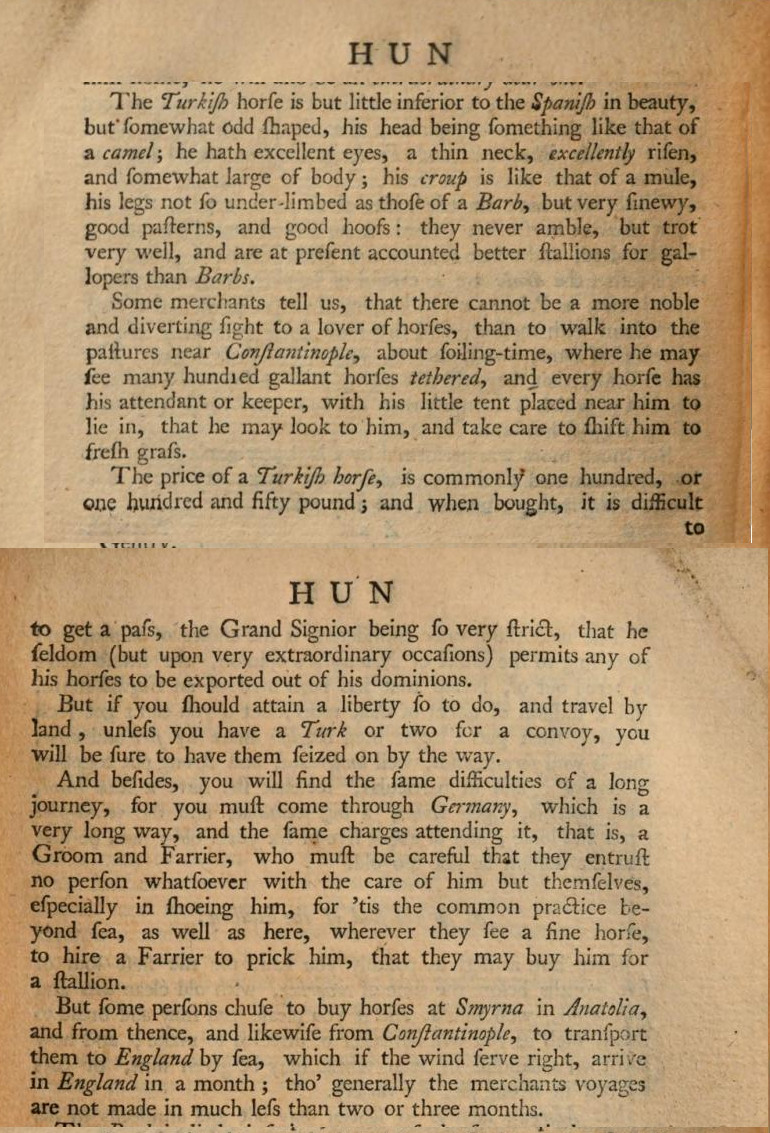
and finally, what our good friend The Sportsman's Dictionary had to say about the Turkish horse circa 1770AD- 


Valete

Wednesday, October 18, 2023

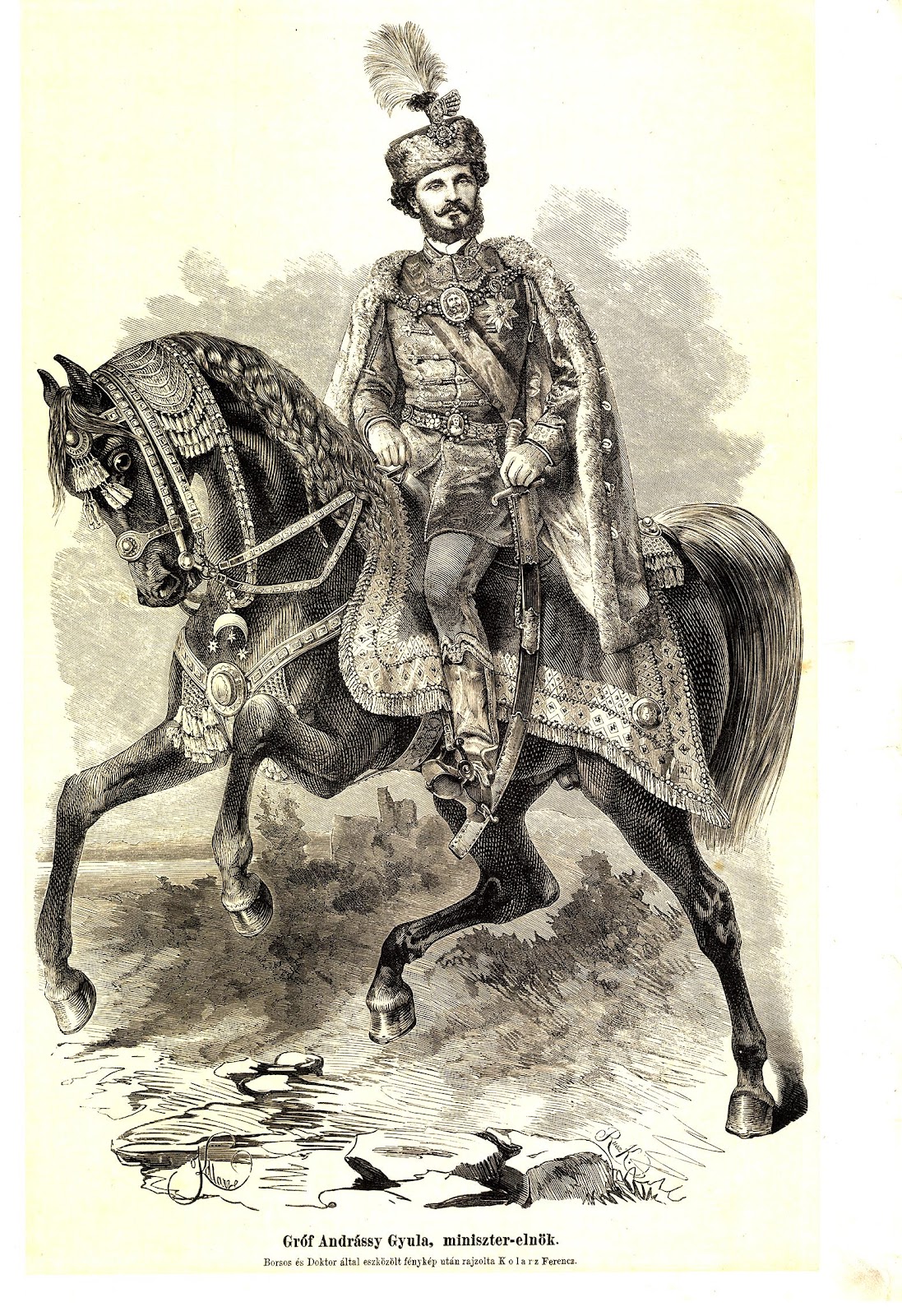
Gyula Andrassy equestrian monument in Budapest

 Salvete Omnes,

Halzbant at the throat of Andrassy horse


we have not seen equestrian monuments for a while.
If you ever visit Budapest there is a number of beautiful equestrian monuments in the Hungarian capital.

Old national Hungarian costume and Hungarian horse tack


One of them is the monumental equestrian composition to count Guyla Andrassy,  one of the most important Hungarian leaders of last 200 years.
 Count Andrassy, born in 1823,  served as a military officer  during the Hungarian Revolution 1848-49, but did not participate in the battle and capitulation of the  Vilagos (August 13, 1849) and the capitulation of the Hungarian army commanded by general Gorgey ( general Klapka  commanded the last serious Hungarian army elements that surrendered at the fortress of Komarom on October 7, 1849). Andrassy had been sent as an envoy to the Ottoman court at  Constantinople (today Istanbul). Thus he avoided being executed by the Hapsburgs, for he was sentenced in absentia to death and his portrait-effigy was hung in 1851.
Upon the amnesty to all participants of the Revolution and due to the political winds of change in the Hapsburg Empire he returned to Hungary and became a politician within the realm. Upon the creation of the Austro-Hungarian Empire in 1867, Andrassy became the Prime Minister of Hungary within the dual-state. His later political life, since 1871 when be became the foreign minister of the empire, was full of political upheavals and diplomatic 'warfare' eg -  he changed the course of the Austrian politics from friendly towards Russian Empire to openly courting the newly established German empire and hostility against Russian politics in the Balkans and Austro-Hungarian Slavic provinces (former &present day Poland, western present day Ukraine, and present day Slovakia and Czechia)  He died in 1893.

In 1904 Hungarian capital saw the unveiling in front of the Parliament  the equestrian monument to Andrassy by then famous sculptor Gorgey Zala. 


After 1945 and the occupation of Hungary by the Red Army, the Communists had the monument removed and melted. In 2016 Hungarian capital once again saw the monumental sculpture recasted and erected in the Parliament.  


a very large shabraq
perhaps a Shagya Arabian steed 


all images Wiki Commons 

Valete

Monday, January 2, 2023

Portrait of a boy and his rocking horse - Stanislaw Seweryn Potocki

 Salvete Omnes,

New Year has started - lets pray it will be not worse than the 2022 - fingers crossed - :)

ad rem,
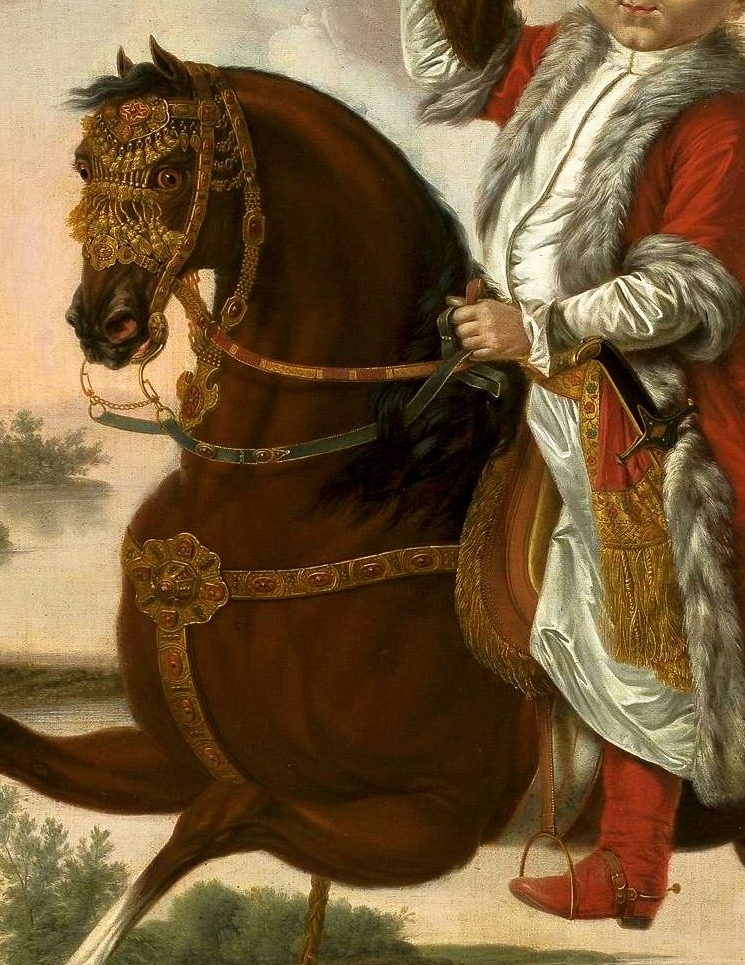
Polish National Museum in Warsaw has among his collections this painting -


and a closeup of this splendid equestrian figure


According to the Museum information it was painted circa 1788, our boy (most likely this boy, whose father was Stanislaw Szczesny Potocki ) in the most splendid daily costume of the Sarmatians (Polish patriotic nobility of those times and also of the conservatives- so to speak) - zupan, kontusz sash, sabre, a kolpak, red riding boots.
His rocking horse - looking very much like an  Oriental- Eastern- stallion or even the Old  Polish one - has a splendid bridle made in the fashion of old Polish with Ottoman styles of the previous 200 years, give it or take - eg Beliotto's Stanislaw Poniatowski Wola Election 1776 - two versions:  Warsaw NM & Poznan NM.

This was the swan song of the Old Polish horse tack as the army regulation soon forbade the ornate bridles and shabraques/czaprak for the officer's horse 1789 and 1791. And then in 1795 Poland was partitioned by Prussia, Austria and Russian empire, and thus ceased to exist until 1806, when our state resurfaced as Napoleonic Duchy of Warsaw etc, in the wake of Napoleonic armies crushing victories over the  Prussians.
ps
A presentation of children fashion as evidenced  in the National Museum collection - a file for download (in Polish)
Last year my friend Radoslaw Sikora authored  three articles about children games and plays in Old Poland - 1, 2, and 3.

Valete