Showing posts with label Comanche. Show all posts

Wednesday, January 26, 2022

Lances and bows... and shields

 Salete Omnes,

I am having problems with my regular PC tower, so trying to use my other old horse PC, hope it will keep on working .

ad rem, 

I am re-looking at the works by George Catlin regarding his visual recording of warriors's weapons and manner of carrying them while on horseback, in the context  of Plains people horse/equestrian horizon. Especially the shield, lance and bow with bowcase - this post


Maestro Catlin made two excursion in to the Indian Country west of the American control, i.e, the Great Plains in the early 1830s; his very first one was the trip  into the Upper Missouri country, where among various Plains tribes he observed the Sioux (Lakota) and then with the US Dragoons he went over to the edges of the Comanche country - I did a post about his meeting (when with the Dragoon command) with the Comanche warriors and their horsemanship.

Many of his painting have plenty of peculiar information on the 1830s Plains warriors that are absent in the other visual sources from the American West.
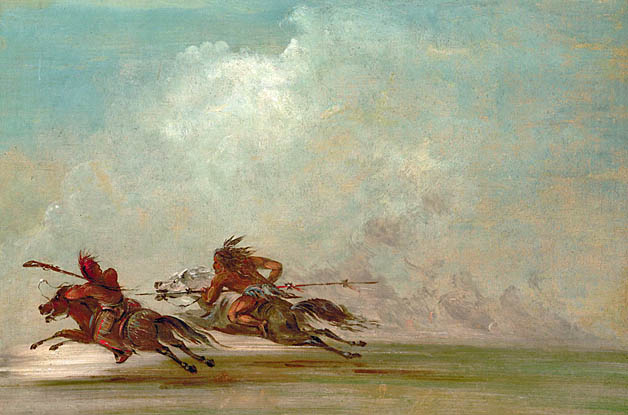
 So as per my interests in weapons, lances, bows and horses I have got interested in their manner of carrying their lances as evidenced by this painting.

Sham Fight of the Camanchees[Comanches]-   (the museum site has the story behind this oil on canvass painting - see the link below)


this painting is in the National Gallery of Art collection - and it is to depict the special display of horsemanship and martial skill of the Comanche warriors. This feat of equestrian prowess was a special presentation for the benefit of our artist. The whole scene reminds me of the hippika gymnasia of the ancient Roman cavalry, as in Arrian's writings.


For the intriguing part of this visual narrative, it is the manner in Catlin recorded the arangement of spear/bow and shield  in mounted combat, in which the warrior's  spear/lance is secured under his right thigh, when using the bow to shoot at the adversary. nota bene, there is another painting titled Sham Fight of the Comanchees [Comanches]- from the 1850s - and very different  much different.

valete

Friday, July 29, 2016

Cremony's Comanche chief Janamata

Salve,
still grazing horses in the prairies - :)
John Cremony, soldier, explorer, traveler and interpreter, wrote a book titled ''Life Among the Apaches '' in 1868. This book is quite extraordinary and full of exquisite detail on the life of the Apache and other tribes during the period of 1847-60s. The Long Riders Guild has an article on his ride across the Jornada de Muerto pursued by the Sierra Blanca Apaches in 1851 (perhaps I will attach the excerps from this fantastic feat ).
Today I will share with you another part of the book, this one a short description of an encounter with a Comanche war party during the Mexican-American War of 1846-48.

My first business acquaintance with "Lo" occurred in the year 1847. A band of about one hundred Comanche warriors, led by a chief named Janamata. or the
"Red Buffalo," taking advantage of the subdued and defenceless condition of the Mexicans, crossed the Rio Grande, about seventy miles below Old Reynosa (Reynosa Viejo, the older settlement 9? miles west from Reynosa), and
commenced a series of depredations. 


Information was immediately given to the American officer commanding at that post, and the writer was detailed, with a force of fifty men, to drive off the invaders, with orders not to engage in hostilities, unless the Indians proved refractory and deaf to all other appeals.


After marching fifty miles, which was accomplished in two days, we arrived at the scene of operations, meeting the Comanches on the highway. Our force was immediately disposed to the best advantage, and placing a white handkerchief on the point of my sabre, I advanced alone toward the chief, who, leaving his warriors, rode forward to meet me. He spoke Spanish fluently, having evidently acquired it in his many marauding excursions into Mexico.
[...]
     Janamata was a good type of his tribe, in point of physical development. He was about five feet ten inches in height, with well proportioned shoulders, very deep chest, and long, thin, but muscular arms. His forehead, was very broad and moderately high, his mouth enormous, and garnished with strong white teeth. His nose was of the Roman order, broad and with much expanded nostrils, which appeared to pulsate with every emotion; but his countenance was rigid and immovable as bronze. 
His arms consisted of a bow and quiver full of arrows, a long lance, a long sharp knife, worn in the top of his moccasin boot, and a very good Colt's  Paterson revolver. A strong shield of triple buffalo bide, ornamented with brass studs, hung from his saddle bow, and his dress was composed of buckskin and buffalo hide well tanned and flexible, but wholly free from ornament. 


Lino Sanchez y Tapia watercolor
''I afterwards learned from a Texas Ranger that he was called Janamata, or the "Red Buffalo," from a desperate encounter he once had with one of those animals, which had ripped up his horse, and attacked him on foot. 


In this encounter Janamata had only his knife to depend on, as he had lost lance and bow when unhorsed. It is related that as the buffalo charged upon him, he sprang over the animal's lowered front, and landing on his back, plunged his knife several times into its body; then, as suddenly jumping off behind, he seized it by the tail and with one cut severed the ham-string. These details made an impression upon me at the time which has never been effaced or weakened.''
(story not dissimilar to this Minneconjou Sioux more tragic story about the chief called La Corne Suelle who using only a knife was killed by a bison bull/tatanka - see Edwin Thompson Denig, Five Indian Tribes of the Upper Missouri: Sioux, Arickaras, Assiniboines..,p.23-24).
Unfortunately John Cremony did not remember anything about the Comanche horses during this encounter.
enjoy

Tuesday, December 30, 2014

Comanches - equestrian warlike feats - by James Hobbs

Salve,
let us gallop over to the Great Plains of North America, and the XIX century writings of various military men, trappers, mountainmen and just travellers.


In this instance I would like to bring to your attention Captain James Hobbs of California(portrait taken from his opus magnum) who wrote the grand recollections of the Far West adventures aptly titled ''Wild Life in the Far West: Personal Adventures of a Border Mountain Man'' (1873).

Dear author, on pages 458-9, describes the Comanche mode of mounted fighting (not unlike Mr Catlin quoted already on this blog 12), he mentions a separate mount for war (war pony)or chase(hunting of buffalo/bison) also known famously as a buffalo runner :
 

COMANCHES AND THEIR HORSES. (p. 458-59)*
There is one warlike feat in which all the Comanche warriors are trained from their infancy. As the man is dashing along with his horse at full speed, he will suddenly drop over the side of his horse, leaving no part of his person visible, except the sole of one foot, which is fastened over the horse’s back, as a purchase 'by' which he can pull himself to an upright position. 
In this attitude he can ride for any distance, and, moreover, can use with deadly effect either his bow or fourteen-foot lance. 

One of their favorite modes of attack is to gallop towards the enemy at full speed, and then, just before they come within range, they drop upon the opposite side of their horses, dash past the foe, and' pour upon him a shower of arrows directed under their horses’ necks, and sometimes even thrown under their bellies. All the time it is nearly useless for the enemy to return the shots, as the whole body of the Comanche is hidden behind the horse, and there is nothing to aim at save the foot just projecting over the animal’s back. 
Sometimes the Comanches try to steal upon their enemies by leaving their lances behind them, slinging themselves along the sides of their steeds, and approaching carelessly, as though they were nothing but a troop of wild horses without riders. A quick eye is needed to detect this ruse, which is generally betrayed by the fact that the horses always keep the same side towards the spectator, which would very seldom be the case were they wild and unrestrained in their movements.


Every Comanche has one favorite horse, which he never mounts, except for war or the chase, using an inferior animal upon ordinary occasions. Swiftness is the chief quality for which the charger is selected, and for no price would the owner part with his favorite steed. Like all uncivilized people, he treats his horse with a strange mixture of cruelty and kindness. While engaged in the chase, for example, he spurs and whips the animal most ruthlessly; but as soon as he returns, he carefully hands over his valued animal to his women, who are waiting to receive it, and who treats it as if it were a cherished member of the family.

enjoy
ps
the images enclosed are some of the rather fanciful engravings from the very book, some taken after George Catlin's paintings
*original spelling

Thursday, June 21, 2012

Little Spaniard and other Comanche warriors in Catlin's art

Salve,
with the shields, horses and Plains warrior ethos in mind we will explore the paintings by George Catlin showing Comanche warriors.


    Maestro George Catlin painted Comanches in their village during the 1834 excursion onto the Great Plains, amongst them the noted warrior Little Spaniard. Here are his words describing this warrior:
 “A gallant little fellow [. . .] represented to us as one of the leading warriors of the tribe; and no doubt [. . .] one of the most extraordinary men at present living in these regions. He is half Spanish, and being a half-breed, for whom they generally have the most contemptuous feelings, he has been all his life thrown into the front of battle and danger; at which posts he has signalized himself, and commanded the highest admiration and respect of the tribe for his daring and adventurous career. This is the man  who dashed out so boldly from the war-party, and came to us with the white flag raised on the point of his lance  I have here represented him as he stood for me, with his shield on his arm, with his quiver slung, and his lance of fourteen feet in length in his right hand. This extraordinary little man, whose figure was light, seemed to be all bone and muscle, and exhibited immense power, by the curve of the bones in his legs and his arms. We had many exhibitions of his extraordinary strength, as well as agility; and of his gentlemanly politeness and friendship we had as frequent evidences.”

Here is the painting showing Little Soldier meeting with the US Dragoons under colonel Henry Dodge - the first US newly organized cavalry expedition onto the Plains.
Catlin described Little Spaniard in the moment of the meeting between the forces:
''He rode a fine and spirited wild horse, which was as white as the drifted snow, with an exuberant mane, and its long and bushy tail sweeping the ground. In his hand he tightly drew the reins upon a heavy Spanish bit, and at every jump, plunged into the animal's sides, till they were in a gore of blood, a huge pair of spurs, plundered, no doubt, from the Spaniards in their border wars, which are continually waged on the Mexican frontiers. The eyes of this noble little steed seemed to be squeezed out of its head ; and its fright, and its agitation had brought out upon its skin a perspiration that was fretted into a white foam and lather. The warrior's quiver was slung on the warrior's back, and his bow grasped in his left hand, ready for instant use, if called for. His shield was on his arm, and across his thigh, in a beautiful cover of buckskin, his gun was slung—and in his right hand his lance of fourteen feet in length. Thus armed and equipped was this dashing cavalier; and nearly in the same manner, all the rest of the party ; and very many of them leading an extra horse, which we soon learned was the favourite war-horse''    (  both the Eurasian and Americas  warrior practice of leading the war horse along, saving it for  the battle or chase only  )


On the Comanche horses:
No sooner were we encamped here (or, in other words, as soon as our things were thrown upon the ground), Major Mason, Lieutenant Wheelock, Captain Brown, Captain Duncan, my friend Chadwick and myself, galloped off to the village, and through it in the greatest impatience to the prairies, where there were at least three thousand horses and mules grazing; all of us eager and impatient to see and to appropriate the splendid Arabian horses, which we had so often heard were owned by the Camanchee warriors We galloped around busily, and glanced our eyes rapidly over them; and all soon returned to the' camp, quite "crest-fallen" and satisfied, that, although there were some tolerable nags amongst this medley group of all colours and all shapes, the beautiful Arabian we had so often heard of at the East, as belonging to the Camanchees, must either be a great way farther South than this, or else it must be a horse of the imagination.
The Camauchee horses are generally small, all of them being of the wild breed, and a very tough and serviceable animal; and from what I can learn here of the chiefs, there are yet, farther South, and nearer the Mexican borders, some of tho noblest animals in use of the chiefs, yet I do not know that we have any more reason to rely upon this information, than that which had made our horse-jockeys that we have with us, to run almost crazy for the possession of those we were to find at this place. Amongst the immense herds we found grazing here, one third perhaps are mules, which are much more valuable than the horses.
Of the horses, the officers and men have purchased a number of the best, by giving a very inferior blanket and butcher's knife, costing in all about four dollars! These horses in our cities at the East, independent of the name, putting them upon their merits alone, would be worth from eighty to one hundred dollars each, and not more.
(Interestingly, this is another piece of evidence to show that the Comanches were principally horse trades on the Plains, selling and exchanging their capture, mustangs and Spanish horses, to the other Plains tribes and Anglo-Americans)

In my post Comanche war bridle I gave Catlin's description of the Comanche horsemanship and further he states: 
  these people have several other feats of horsemanship, which they are continually showing off; which are pleasing and extraordinary, and of which they seem very proud. A people who spend so very great a part of their lives, actually on their horses' backs, must needs become exceedingly expert in everything that pertains to riding—to war, or to the chase; and I am ready, without hesitation, to pronounce the Camanchees the most extraordinary horsemen that I have seen yet in all my travels, and I doubt very much whether any people in the world can surpass them. The Camanchees are in stature, rather low, and in person, often approaching to corpulency. In their movements, they are heavy and ungraceful; and on their feet, one of the most unattractive and slovenly-looking races of Indians that I have ever seen[...]

 Here, a bison hunts:
with bows


with lances


War Party 
seeing the enemy

fully armed

Comanche and Osage warrior duel

scouting 


Warriors  
 Mountain of Rocks  -“the largest and fattest Indian I ever saw [..] A perfect personation of Jack Falstaff, in size and in figure, with an African face, and a beard on his chin of two or three inches in length. His name, he tells me, he got from having conducted a large party of Camanchees through a secret and subterraneous passage, entirely through the mountain of granite rocks, which lies back of their village; thereby saving their lives from their more powerful enemy"
 Corpulency is a thing exceedingly rare to be found in any of the tribes, amongst the men, owing, probably, to the exposed and active sort of lives they lead; and that in the absence of all the species of life, many of which have their effect in producing this disgusting, as well as unhandy and awkward extravagance in civilised society.

Dragoon NCO officerHugh Evans was a Sergeant, Company G, United States Dragoon Regiment ) gave a brief description of Mountain of Rocks - '' the old chief come riding on a, verry[sic] fine horse he was a verry[sic] large man corpulent and muscular in appearance he inquired where our great Captain was and repaired thither immediately he imbraced[sic] Col Dodge and called him his great white brother.''

 Beaver - “a warrior of terrible aspect, and also of considerable distinction.”

He Who Carries a Wolf - a distinguished brave; so called from the circumstance of his carrying a medicine-bag made of the skin of a wolf; ho holds a whip in his hand. This man piloted the dragoons to the Camanchee.


 Hair of the Bull’s Neck


Bow and Quiver  - “pleasant looking [..] without anything striking or peculiar in his looks; dressed in a very humble manner [...] his hair carelessly falling about his face, and over his shoulders,”[..]“the only ornaments to be seen about him were a couple of beautiful shells worn in his ears, and a boar’s tusk attached to his neck, and worn on his breast.”

Wolf Tied with Hair 
 James Hildreth, describing the US Dragoon expedition to the Plains in 1834 said this about the Comanches:

''The Camnnches are a very numerous tribe, and extend themselves over that vast extent of country extending between the Red River and the north fork of the Washita, which you may easily point out upon the map. They have no established villages, but wander about from place to place, living chiefly upon game and wild fruit. They are armed with bows and arrows, and spears, and clothe themselves in the skins of the buffalo, elk, and deer. They are of a bright copper color, their faces broad and large; they are generally muscular men, and differ only in appearance from their squaws in the manner of wearing the hair, the latter having their heads cropt very short, whilst the former wear their hair in long tufts. They are the allies of the Pawnees, Kioways, and Arripahoes [Arapahoes]  and together, when prepared for battle, form a host not easily conquered. Among the Camanche women we discovered several Spanish females who had probably spent the greater portion of their lives among the Indians, and had assimilated their manners to their wild habits.
The Camanche, when mounted, presents a fine classic appearance; with his covering of variegated hide, his broad shining face, his spear and target, he is apt to remind one of the more chivalrous days of ancient Britain, when the tilt and tourney claimed no less the prowess of the bold than the plaudits of the fair; when the knight templars laid lance in rest, and sovereigns marshalled their followers on the plains of Palestine.''
 

and time to say - until the next time:
 ...a sketch of one of these extraordinary scenes, which I have had the good luck to witness; where several thousands were on the march, and furnishing one of those laughable scenes which daily happen, where so many dogs, and so many squaws, are travelling in such a confused mass; with so many conflicting interests, and so many local and individual rights to be pertinaciously claimed and protected. Each horse drags his load, and each dog, i.e. each dog that will do it (and there are many that will not), also dragging his wallet on a couple of poles; and each squaw with her load, and all together (notwithstanding their burthens) cherishing their pugnacious feelings, which often bring them into general conflict, commencing usually amongst the dogs, and sure to result in fisticuffs of the women; whilst the men, riding leisurely on the right or the left, take infinite pleasure in overlooking these desperate conflicts, at which they are sure to have a laugh, and in which, as sure never to lend a hand.


* all Italicized text by Catlin himself  from George Catlin, ''Letters and Notes,'' vol. 2,  1841


Monday, June 4, 2012

Plains Indians sketches - shield and armour

Salve,
some sketches of the Plains Indians and ways of carrying the shield:  work-in-progress

horse armor in concept
idea of the Plains Indian horse armour of XVIII century, especially Comanches, Plains Apaches (then Lipan, Mescalero, Jicarilla etc) and Shoshones
Comanche shield of the mid-XIX century, and some sketches showing ways of carrying the shield

Crow warrior, horse with a pad saddle and long shabraque - old sketch

Cheyenne mounted on a horse with a bison hide horse mask, early 1800s

Lakota warrior

late XIX century generic war chief mounted on a horse with a leather mask and breastplate


Saturday, August 28, 2010

Comanche war bridle

How kola (Lakota greeting),
 my little sketch of what various horse trainers of the XIX century perceived as  the 'Comanche war bridle'   ( the Lords of Southern Plains texasindians.com/comanche   ), just a rope  and nothing else...


1830s, Texas still in Mexico, Comanche warriors Comanches de Texas Occidental
 Catlin's (   georgecatlin.org/  ) Comanche Osage duel -  Comanche_Osage
Greeting the Anglo-Americans ( George Catlin did this scene in 1834, when he went with the United States Dragoons to Indian Territory ) catlin's comanche chief horsemanship
and in  Catlin's words:  ....one of their party galloped out in advance of the war-party, on a milk white horse (look at the rope trailing behind him, this was a typical arrangement, in case of falling off), carrying a piece of white buffalo skin on the point of his long lance in reply to our flag  (and a large buffalo hide shield on his back, and a rifle in a beaded holster hanging from the horn of his saddle, horned saddle with stirrups ). This moment was the commencement of one of the most thrilling and beautiful scenes I ever witnessed. All eyes, both from his own party and ours, were fixed upon the manoeuvres of this gallant little fellow, and he well knew it .  The distance between the two parties was perhaps half a mile, and that a beautiful and gently sloping prairie; over which he was for the space of a quarter of an hour, reining and spurring his maddened horse and gradually approaching us by tacking to the right and the left, like a vessel beating against the windHe at length came prancing and leaping along till he met the flag of the regiment, when he leaned his spear (my note, look at the length of it, Catlin gives more details below)  for a moment against it, looking the bearer full in the face, when he wheeled his horse, and dashed up to Col. Dodge with his extended hand, which was instantly grasped and shaken...my eyes were fixed upon the gallant and wonderful appearance of the little fellow who bore us the white flag on the point of his lance. He rode a fine and spirited wild horse, which was as white as the drifted snow, with an exuberant mane, and its long and bushy tail sweeping the ground. In his hand he tightly drew the reins upon a heavy Spanish bit, and at every jump, plunged into the animal's sides, till they were in a gore of blood, a huge pair of spurs, plundered, no doubt, from the Spaniards in their border wars, which are continually waged on the Mexican frontiers. The eyes of this noble little steed seemed to be squeezed out of its head ; and its fright, and its agitation had brought out upon its skin a perspiration that was fretted into a white foam and lather. The warrior's quiver was slung on the warrior's back, and his bow grasped in his left hand, ready for instant use, if called for. His shield was on his arm, and across his thigh, in a beautiful cover of buckskin, his gun was slung—and in his right hand his lance of fourteen feet in length. Thus armed and equipped was this dashing cavalier; and nearly in the same manner, all the rest of the party ; and very many of them leading an extra horse, which we soon learned was the favourite war-horse (the practice of leading the war horse along, saving it for  the battle or chase only  ); and from which circumstances altogether, we soon understood that they were a war-party in search of their enemy..

Catlin -  Comanches'  horsemanship

  1. and little original description by the  artist :   ...amongst their feats of riding, there is one that has astonished me more than anything of the kind I have ever seen, or expect to see, in my life: a stratagem of war, learned and practiced by every young man in the tribe; by which he is able to drop his body upon the side of his horse at the instant he is passing, effectually screened from his enemies’ weapons as he lays in a horizontal position behind the body of his horse, with his heel hanging over the horses' back; by which he has the power of throwing himself up again, and changing to the other side of the horse if necessary. In this wonderful condition, he will hang whilst his horse is at fullest speed, carrying with him his bow and his shield, and also his long lance of fourteen feet in length, all or either of which he will wield upon his enemy as he passes; rising and throwing his arrows over the horse's back, or with equal ease and equal success under the horse's neck. ....  I was continually frustrated, until one day I coaxed a young fellow up within a little distance of me, by offering him a few plugs of tobacco, and he in a moment solved the difficulty, so far as to render it apparently more feasible than before ; yet leaving it one of the most extraordinary results of practice and persevering endeavours. I found on examination, that a shorthair halter was passed around under the neck of the horse, and both ends tightly braided into the mane, on the withers, leaving a loop to hang under the neck, and against the breast, which, being caught up in the hand, makes a sling into which the elbow falls, taking the weight of the body on the middle of the upper arm. Into this loop the rider drops suddenly and fearlessly, leaving his heel to hang over the back of the horse, to steady him, and also to restore him whau he wishes to regain his upright position on the horse's back. fragments form Catlin Letters and Notes vol. 2)
    Comanche war party http://americanart.si.edu/images/1985/1985.66.596_1a.jpg
    Some good books I have read and own on the pre-Anglo invasion Comanches and their society
    G. Betty, Comanche Society:  Before Reservation
    D. Weber, Barbaros, Spaniards and their 'Savages'
    J. Barr et al, Peace came in the form of a woman
     P. Hämäläinen, Comanche empire
    B. De Lay, War of the thousand deserts
    more on the Comanche warriors and horses in the near future