Showing posts with label Napoleonic wars. Show all posts

Wednesday, June 17, 2026

Goldsworthy on the Napoleonic period mounted troops aka cavalry

 Salvete Omnes,


a short entry - dr Adrian Goldsworthy, historian & novelist (his Roman period novels are good entertainment ).


So dr Goldsworthy, in a rather typical British fashion of not knowing about Polish cavalry or history (like the Polish and Red army cavalries 1917-45), delivers a lecture on the Napoleonic era mounted troops and use of horses by the armies. - this is the video on Yt. 

And some of my old Napoleonic ulan (uhlan -lancer) and cheavulegers art.


.


enjoy

Valete

Monday, November 24, 2025

Spanish Lance manual - 1814 AD

 Salvete Omnes,


November - Somossiera etc, so the lancers on my mind, And I would like to invite you to  this interesting material from Spain dating back to the last year of the War of Independence, 1814AD.

Laminas del ataque y la defensa del arma de la lanza. 

Created by the officers of the Legion de la Extremadura, a unit famous  also for a Scottish officer John Downie.


.


this manual was the second manual after the work of general Wincenty Krasinski et al., of the 1st Lancers of the Guard [Napoleonic].
enjoy 

Valete

Tuesday, August 26, 2025

The Mir Castle - returned from Valhalla

 Salvete Omnes,


a quick late summer entry -  a little posting on the Mir Castle (Zamek w Mirze,  Мірскі замак, Mirski zamak) in the Grodno District.


XV-XVI century Lithuanian Duchy court marshal and starost of Brzesc (Brest) and Kowno (Kaunas) Jerzy Iwanowicz Ilinicz (?-1527) had a Gothic castle with 5 imposing towers built in his manor of Mir. His grandson Jerzy, who was a son of  Zofia nee Radziwill, was the sole heir to the fortune, and having been brought up by Mikolaj Radziwill the Black, he unfortunately died without issue, and thus Jerzy made a testamentary bequest to his cousin Mikolaj Radziwill Sierotka (the Orphan), last will passed the castle and estates  to the Radziwill family. They rebuilt the castle in the Renaissance style, adding a palazzo to the castle complex. 


Unfortunately, the wars - starting with 1655 (the Deluge) through  the Great Northern War, Polish-Russian war of 1792, and Kosciuszko Insurrection of 1794, the Napoleon invasion of Russia 1812 - caused multiple damage to the castle complex.


In 1895 the Swietopelk-Mirski family bought the castle from the descendants of the  Radziwill clan and zu Sayn-Wittgenstein-Berleburg, and started some rebuilding of  the castle ruins. Bolsheviks murdered local Polish patriots in the castle ruins in 1919.


Michal Swiatopelk-Mirski started restoration of the castle in 1923, based on the plans of Teodor Bursche (Bursze). 


Unfortunately the communists, as the Soviet Union, returned in September 1939 (killing and deporting to Siberia our Polish inhabitants of Mir), and the the Nazi Germans in 1941 through 1944 (murdering the Jewish inhabitants of the town of Mir). Stalin's Soviet Union took final possession of the castle until the end of the Soviet Union, in 1991. 


Finally, the castle has returned from Valhalla -  during the early decade of the XXI century the miracle took place, the ruins were rebuilt - below the beautifully rebuilt castle of Mir, by the taxpayers of  Belarus.  They say a fine museum too.

Vivat! 


Enjoy

Valete

Thursday, June 19, 2025

Battle of Wavre 1815 - la bataille est gagnee?

 Salvete Omnes,


the French Army of the North Right Wing's operation   in pursuit of the Prussians army mauled at Ligny on the 16th of June, 1815 and the battle of Wavre (18th-19th June 1815) are  some of the mostly forgotten military operations in the history of the Napoleonic wars.


I am not going to study the battle itself but the more about the curious events surrounding the communications or lack of  between Napoleon's  army main body and its right wing under marshal Grouchy and the consequences of these that have led to the defeat of Napoleon at Waterloo and second abdication of the French ruler.


Grouchy, gallant cavalryman and then commanding Napoleon's Army of the North-Right Wing, perhaps 30-33 thousand officers and soldier - consisting of remnants of III, IV Corps infantry & 7th Cav. Division, and  1st (under general Pajol) & 2nd (general Exelmans) Cavalry Corps - was supposed to prevent the Prussians under Blucher from joining with Wellington's allied army and open the road onto Brussels, the English being pursued by Napoleon.


Astute and  skilled Prussian commander, marshal Blucher,  marched his 3 corps off to Waterloo, while his general Theilemann's Pussian III Corps ( 15-20 thousand officers and soldiers grouped in 3 infantry brigades and 2 cavalry brigades, including uhlans, landwehr, hussars) was to defend the fords and bridges in the Dyle River valley, concentrating the defense on the area of the town of Wavre.


 Grouchy's forces, lacking in artillery supremacy in the strong points, contacted the enemy outposts on the 18th morning and pursuant to the understanding of Napoleon's intentions French Right Wing advanced slowly on the Prussians in the late afternoon of June 18th.

The roads and ground were terribly soaked with the rains of storms of the 17th of June, making marching and advancing more difficult to the soldiers and horses.


Returning to the Napoleon's  headquarters at the Caillou farm, within his staff there was this veteran Polish officer in French service - Jerzy Zenowicz, Despot coat of arms (1782-1853) - who was attached to the staff and 'was ordered not to leave Napoleon's side for a moment.'

Sometimes after 9AM, June 18, 1813, Napoleon observed both armies concentrated on the future battlefield, and called our Zenowicz to deliver his message to Grouchy near Wavre.  They returned to the farm at 10 AM, and  due to certain indecision and tardiness in drafting the orders  by the staff scribes and the head of staff marshal Soult (whereas unfortunately the brain of the Grand Army the best chief of staff marshal Berthier was not part of this operation, having died on June 1, 1815)  our aide-de-camp Zenowicz left the headquarters on a rather inferior horse around noon, when the opposing armies joined the struggle.   
Since Napoleon insisted that Zenowicz would take the longer route via Gembloux. The difficult terrain, soaked by rain and full of debris. lack of maps and guidance caused this mounted messenger to travel for almost 4 hours until he was able to report to marshal Grouchy circa 4pm. 


Zenowicz gave marshal his dispatch - where Soult stated: ''[..] His Majesty is going to attack the English army [..] at Waterloo; also that His Majesty desires that you direct your movements on Wavre in order to approach us [Waterloo], come into our area of operations and tie in your communications, pushing before you the corps of the Prussian army which have taken this direction and which could stop at Wavre, where you are to arrive as soon as possible.  You are to follow the enemy columns which are on your right with some light troops in order to observe their movements and collect up their stragglers. Inform me immediately of your deployment and your march, as well as in the news you have of the enemy and do not hesitate in coming into communications with us. The emperor wants to receive your news often.' 
Grouchy, when explaining his moves after reading this dispatch in his writings years after the Waterloo campaign, stated that he read the dispatch - la bataille est gagnee (the  battle is won) whereas in fact the writing stated - la bataille est engagee (the battle has started). His army was 15km (lass than 10 miles) from Waterloo and his army could have changed the outcome of the Waterloo battle if started marching, especially his numerous cavalry, at 4PM towards His Majesty, the Emperor. But it was not to be.

Our Zenowicz witnessed the heated verbal fight between general Gerard and marshal Grouchy, where Gerard was mad at the indecision displayed by Grouchy accusing marshal of causing a potential defeat of the French.


Grouchy, instead of marching towards the cannonade at Waterloo, sent his men to attack Wavre and Limal crossing, mistaken in his understanding of the Napoleon's orders. Another French officer summarized these afternoon attacks - 'badly planned, feebly executed and the ground badly studied.' (Grouchy's Waterloo).


The battle continued until the morning  of June 19 when captain Dumonceau brought to Grouchy the news of the Waterloo defeat. 
Facing victorious enemies and threatened with encirclement and cut off from their French base, marshal Grouchy executed a skillful retread of his army to Paris, via Namur.

Despot coat of arms

enjoy

Valete

Wednesday, February 5, 2025

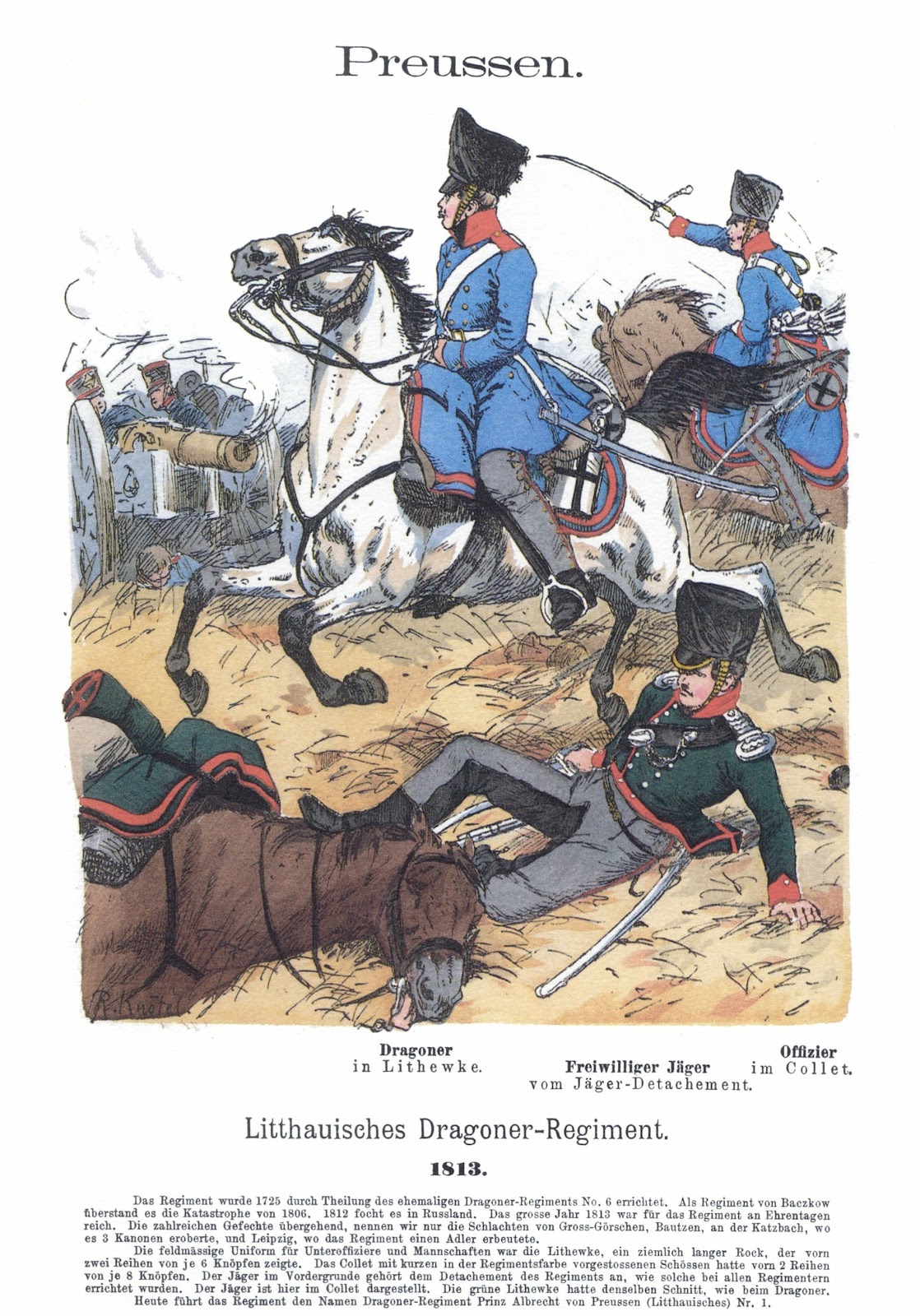
Pomeranian-Kashubian Yorck defeats Macdonald's cavalry - 1814

 Salvete Omnes,


several days ago there was 211th anniversary of the battle at La Chausse - Feb, 3rd 1814.
This battle took place during the 1814 defense of France conducted by Napoleon's Grande Armee corps and divisions commanded by his marshals.


In this instance Marshal Macdonald's forces, the XI Corps and II Cavalry Corps, were defending the Rhine River  line from Coblenz on the Rhine.  The French were facing huge numbers of Prussian - Army of Silesia-  and Austrian armies - Army of Bohemia - augmented by the Russian regiments and squadrons. 


General Yorck, a scion of the Pomeranian Kashubian lower nobility family of Jarka-Gostowski, commanded the Prussian 1st Corps f the Silesian Army.

Yorck as a fieldmarshal of Prussian army

the conditions for war during that winter were difficult, especially for the cavalry, with plenty of snow and cold, wind and poor & foggy visibility. 

French cavalry units at the village of la Chaussee were commanded by Dommanget (hussars, chasseur a cheval and lanciers cavalry)  and Marin Thiry  (2 cuirassier regiments), and their potions were constrained by the terrain. Also the French cavalry had poor morale and low spirit, 


while the Prussian horse, including militia horse regiment, was full of military vigor, animus and ardor. They were also disciplined and well trained as horsemen and as miltiary units. 

immobile French heavy cavalry receiving  the charging Prussians 


After the battle Yorck wrote to marshal Schwarzenberg  that the French sufffered loss of: seven guns, six caissons, one standard, several hundred men prisoners. Prussian suffered 150 causalities.  According to researchers at least 100 French were killed. 
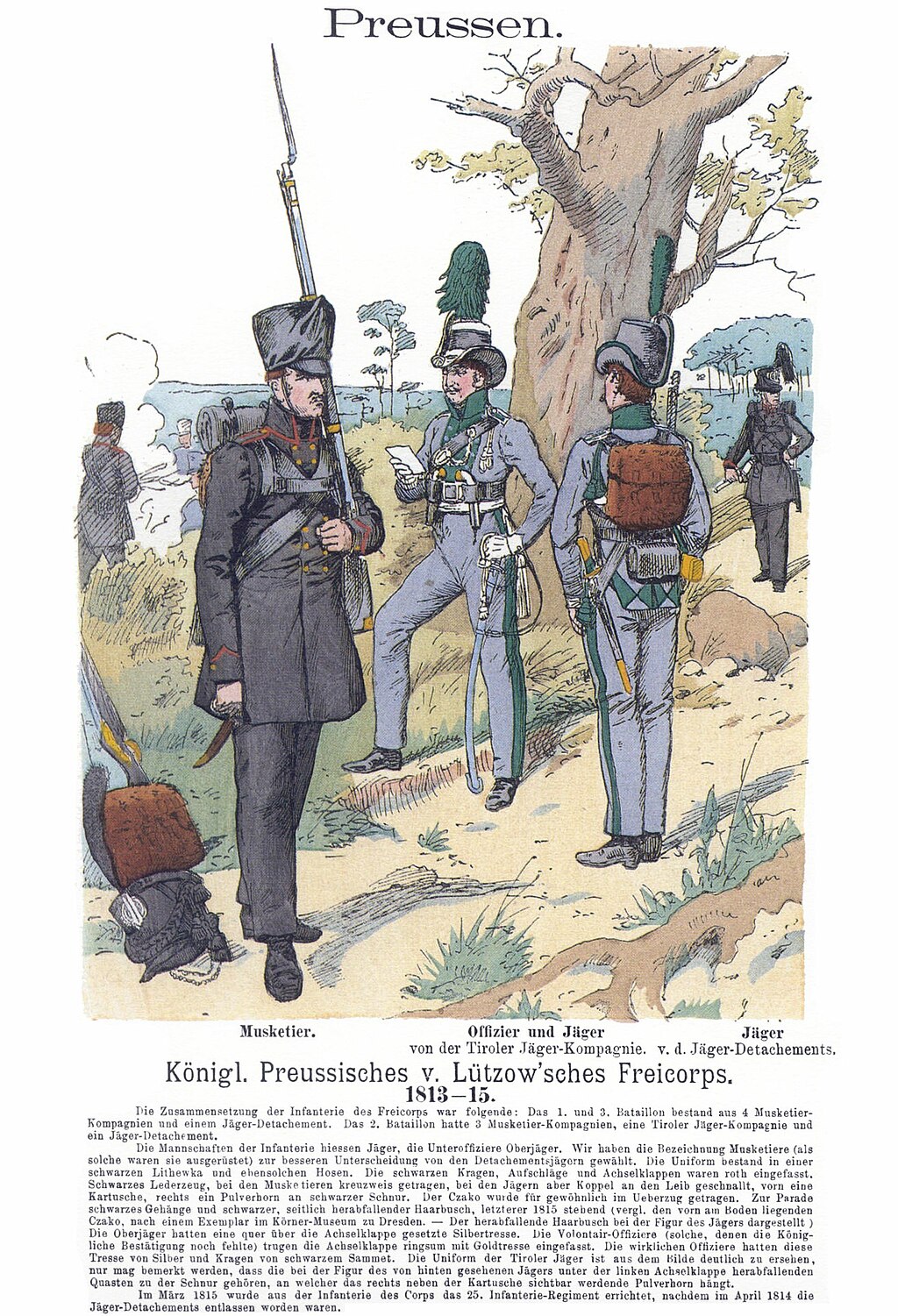


I came across this website - where the author, Andrew Field,  goes into the details concerning this cavalry battle, with a splendid use of primary sources and military studies. 


This is the orde de bataille (Order of Battle) acording to Andrew Field's research. 


It was a minor victory of the Prussian cavalry over the French one.
All ink and watercolor plates by Richard Knotel. 

Valete