Salve,
I have been interested in the life and works of the spirited German prince
Maurice de Saxe, son of our awful Polish king
Augustus II der Starke and beautiful
Aurora von Königsmarck.
Prince Maurycy Saski, as we call him in Polish, was a very brave and talented soldier who won many important victories, mostly against the enemies of the French Crown, amongst others he defeated
Duke of Cumberland at Fontenoy. He dictated his ideas about military, in the fashion of other famous military commanders, and these were published as ''Mes Reveries'' in 1757, almost 10 years after his untimely death. Had he lived perhaps the world would not have been celebrating that Prussian king Frederic the Great, soldier, philosopher, and thief. Why Frederic of Prussia was a thief? well, that is a story for another time, but perhaps for now it suffices to say he had the counterfeit Polish money minted in Prussia, but with much reduced amount of gold and silver in each respective coin, and then introduced that fake and injurious currency into the Polish market thus taking millions in gold and silver from Poland and then in 1772
he took our lands and people, building his military state.
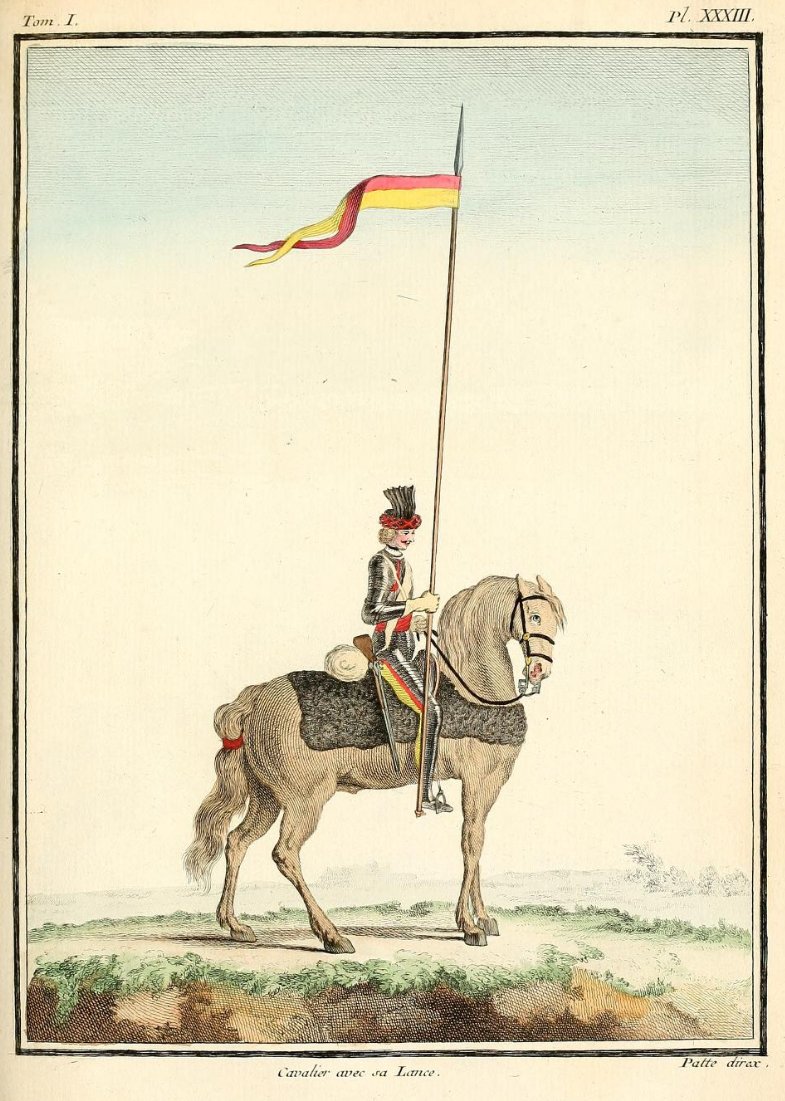
Ad rem, in volume I article III of''Mes Reveries'' prince Maurycy goes in detail about cavalry, its types and their equipment. Amongst the detailed description of the horse trappings we have a description of the bridle without a bit, looking like a curb-bit thus I naturally call it a 'mechanical hackamore'.
Well, ladies and gentlemen, there is prince Maurycy Saski's ''bride sans mors,''after the one invented by warrior-king of Sweden Charles XII while the Americans call
mechanical hackamore, awfully inaccurate name for this device I daresay, for it has little if nothing to do with the vaquero's hackamore aka jaquima. One set or reins and plenty of control needed in one-handed military riding.
'Je ne veux point de bride avec ùn mors. II faut qu'il ait une têtière avec deux branches droites, comme il y en a à nos brides, avec des bossèttes. De la place où est le mors ordinairement , il passe un cuir sur le nez du cheval; la gourmette venant à serrer, lorsque l'on tire les rênes, ramène parfaitement bien le cheval, & mieux qu'aucune bride : il n'y a point de cheval que l'on n'arrête avec cela, & que l'on ne manie bien; l'on ne sçauroit leur gâter la bouche, hi leur échauffer les barres.
II en résulte un autre avantage qui est trèsgrand; c'est que les chevaux peuvent tepaître sans que l'on soit obligé de débrider : dès que l'on lâche les rênes, ils peuvent ouvrir la bouche toute grande; & lorsqu'on les tient dans la main, ils ne sçauroient l'ouvrir, tirer la langue, & s'accoutumer à quantité de mauvaises habitudes qu'ils prennent avec la bride. D'ailleurs cela les relève plus, & fait fort bien. Cette invention est de Charles XII roi de Suède.' 
'' I do not see a point in having a curb-bit (bride avec un mors): instead of which, it should have a head-stall (une tetiere) having two straight shanks like those of our curb-bits, with small round ornaments (avec des bossettes); and from the spot where the bit is usually placed, a leather [strap] passes over the horse's nose, [while] a curb bit chain (la gourmette) comes to draw close [this bridle], in proportion as the rider tightens his reins, will govern a horse effectively, and better than any curb-bit: one may stop and manage the most headstrong horse at pleasure, without spoiling his mouth, or inflaming (echauffer) his jaws.
There is another advantage [to this bridle] that is very important, in that horses will be able to feed with it on, without obligation to take it off (debrider): for, by only slackening the reins, he is able to to open his mouth all the way, and again by gathering them in hand ('one hand' riding), he is not able to open his mount and will prevent lolling out his tongue, and put a stop to number of bad habits, that take hold with [use] of a bit. By the way, it will moreover make him raise and carry well [his head] ( elevating the front and lowering the hindquarters - better collection). This invention belongs to Charles XII, King of Sweden.''
I will bring more of prince Maurycy writings and inventions regarding cavalry, the next of his writing brought here should be the saddle prince Maurycy invented. By the way, when we get to the cavalry , he may shock some of you, enthusiasts of XVIII century warfare,, for he advocated using an armoured cavalryman with a 15 feet long lance a la Polish winged hussaria.