Salvete Omnes,
just a short entry on this British-American painter's equestrian works -
Arthur Fitzwilliam Tait was born in Liverpool, UK in 1819, 4 years after the Napoleonic Wars and the War of 1812 ended and the Latin America's wars for independence from Spain were about to start.
Mr Tait was self-trained in painting, lithography and drawing, having lived on a farm in teh Liverpool countryside, then working from his Manchester's studio and then back at Liverpool. He painted his first known oil-on-canvas
portrait of a thoroughbred horse in 1848. He might have met George Catlin in 1842, when Catlin opened his [American] Indian show at the Mechanic's Institute in Liverpool; later on his son claimed that Tait had joined Catlin's troupe of painted Englishmen dressed in Pains Indian costume during 1842-3 sojourn in that part of UK. In short he must have caught the bug of entertainment, wanderlust and perhaps plenty of curiosity about America, just one ocean away.
In 1850 Mr Tait emigrated to America and soon started painting hunting scenes - game stalking, bird shooting and deer hunting, as wild country was aplenty in upstate New York or New Jersy wilds.
He befriended one
William Ranney, who was working out of his Hoboken studio and exhibiting at the same art-supplies and prints business of Williams, Stevens and Williams in NY, NY. It was Bill Ranney, veteran of the Mexican War and Texas Indian wars, and wanderer in the West, who provided the necessary props and gear needed for Tait's Western genre paintings creation, and in 1851 our Arthur Fitzwilliam painted his first known Western genre painting -
On the Warpath. He submitted a number of paintings or the annual exhibit at the National Academy of Design and his career as a Western painter had sailed the 'port of his studio' so to speak.
 |
| Prairie hunter - a flying gallop of the period and enigmatic Indian riders in the background |
The Western painting and lithography period was not too long, but fruitful and helped maestro Arthur to establish himself within the NY art world.
 |
| this one clearly is due to Catlin's own images of the Comanche horsemanship |
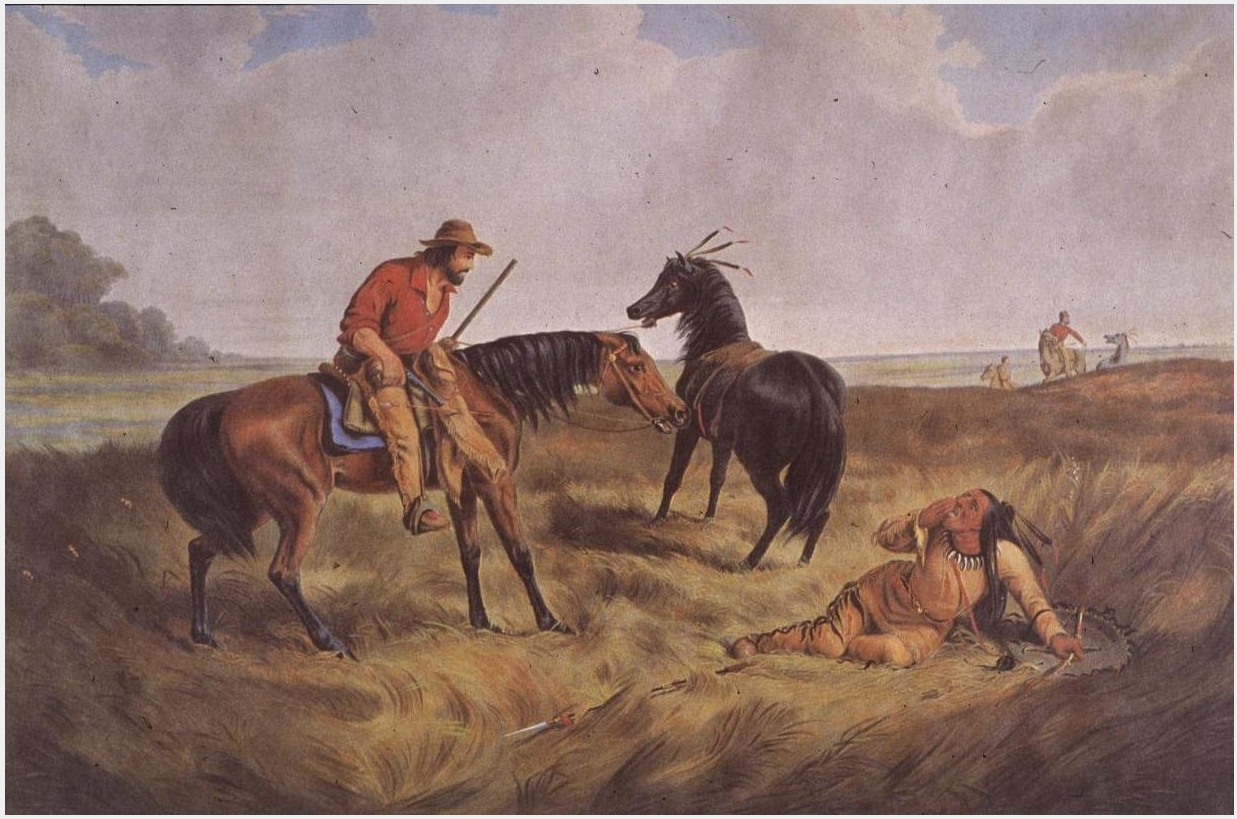
Mr Tait was creating his compositions out of other artists' work but in process created his own version of the dangerous Western life, the trappers and distant hostile native warriors or wild elements. We should note that this period coincided with the beginning of publication of many literary about the West written by trappers and travelers - like Rufus Sage's Scenes in the Rocky Mountains.
With the coming of the Civil War the scenes of Western life were not much in demand, but for two more years our maestro painted them (eg this
Amon Carter Museum piece), and thus slowly Arthur Tait turned to painting and producing lithographs of more tranquil hunting scenes from the mountains, marshes and lakes of the Old Northwest and eastern shores, aka Adirondacks Mountains and New Jersey Marshes, and in his later years painted simply bucolic images of farm animals and tranquil wildlife etc.
You can read the factual critique of Tait's western painting in Bernard de Voto's Across the Wide Missouri, or John Ewers' Fact and Fiction in Documentary Art of the American West (in this book) .
Valete