Showing posts with label horse trumpeter. Show all posts

Sunday, November 30, 2025

Kingdom of Poland cavalry - uhlans and chasseurs a cheval 1815-31

 Salvete Omnes,


The very end of November brings back the story of the November Uprising of 1831, when during the night of 29th to 30th of November, a 80-plus company of  cadets and second lieutenants marched out of their barracks in Warsaw and aided by their civilian co-conspirators attacked the Belvedere Palace( the seat of the king's representative) and the Arsenal of Warsaw. In process they murdered 6 Polish army generals (out of the 30-plus of the whole number of the Polish army generals at this time).  Numerous pubs and alcohol magazine had been broken in and the inhabitants of the Old Town Warsaw got drunk and for the next two days there was mayhem in the city center.  Instead of putting the rebellious cadets and young officers on trial the ruling Polish elites could not decide on any concrete course of action, and faced with the Russian armies marching onto Warsaw in the winter of 1831 had to fight the war against their king  (well, the parliament, in the act of mass formation psychosis,  deposed the king, cutting off any road to 'salvation') and his armies, which had to end in failure due to the lack of any international support and especially due to the Russian supremacy in the field and in logistics (eg the problem of horses for cavalry and artillery for the Polish army).  Thus ended the Army of the Kingdom of Poland established by the Congress of Vienna in 1815, and since 1832 the kingdom existed in the name only, without any special Polish army, laws nor Polish symbols until 1916, with the Russian direct rule and with the Russian army and police forces policing the territory.

Congress Poland or de jure Kingdom of Poland was a state established on the ruins of the Duchy of Warsaw (minus the Greater Poland, Kujawy, Torun, and Free City of Gdansk/Danizg that were re-attached to Prussia, and Free City of Krakow as a separate Polish entity) joined with the Russian Empire by the person of the king (personal union), first it was tsar Alexander I who was crowned the king of Poland in 1815 (nota bene, he discovered that the Prussian monarchy destroyed by melting historic Polish royal crowns and regalia in 1818-11) and then his brother tsar Nicholas II, crowned the king of Polish Kingdom in 1829. Grand Duke Constantine was king's representative and the commander-in-chief of the kingdom's army residing at the Belvedere Palace in Warsaw. 
Kingdom had its own army - colonel Bronislaw Gembarzewski wrote and illustrated a very nice monograph on the kingdom's army in 1900s-20s.

The army consisted of the regular regiment and  guard regiments, which included:


one guard regiment of the chasseurs  a cheval (strzelcy konni) (renamed to 5th reg of the chasseurs a cheval in January 1831)


one battery of horse artillery.


the Cavalry of the line or Cavalry Corps of Polish Kingdom, commanded by general Aleksander Rozniecki,  consisted of:


the chasseur a cheval division - four regiment of  chasseurs named: 1st, 2nd, 3rd, 4th .

from the left - 1,st, 2nd, 3rd, 4th regiment

3rd chasseur - stable uniform


1st reg. chasseurs  in their field  uniform


3rd chasseur regiment -field uniform
4th chasseur - horse trumpeter 


the Uhlan/lancer  division's regiments were  named:


1st uhlan, 


2nd uhlan, 


3rd uhlan, 


4th uhlan.


.

2n uhlan regiment - lancer in his stable uniform


Each cavalry division was divided into 2 brigade, each brigade consisted of one uhlan regiment and one chasseur a cheval regiment.

Each cavalry regiment was divided into two divizions, each divizion consisted of 2 full squadrons. A full squadron had 160 soldiers, 13 NCOs and 8 officers. Each squadron was divided into two half-squadrons, and each half-squadron was divided into 4 platoons, in turn platoons were divided into thirds, each third was divided into 3 'rotas.' The 1st and 4th platoon had the best men, then the 3rd could pick from the remainder of all men and the 2nd had to take whoever was left. There platoons were commanded by the platoon commanders and 3 officers 'ou-or-rota', who sort of were to oversee but did not interfere. Squadron formed in two lines, the first line had the best men and best looking horses. For the marching order, the squadron marched in threes (or like the Russians in 6-men abreast ).

The uhlans/lancers were armed with lances and sabres, each squadron had 1 carbine-armed platoon, or equally possible was the arrangement where there were 4 carbine-armed rotas in each platoon of the squadron. The flanking carabine-armed uhlans were supposed to form in two skirmish lines and even to dismount  and defend the squadron, when necessary. They were trained to do these tactics with the use of trumpeters and their signals.

The chasseur a cheval (szaserzy) regiments, beloved of grand duke Constantine,  were armed with a sabre, a cavalry carbine, and a pair of pistols. although they were taught infantry drills and fire drills of the infantry, they were horse-fighting 'dragoons,' using essentially the same tactics as the lancers.

Additionally , every regiment had one more reserve squadron of 100 men. NCOs and officers, where recruits were trained and schooled. (Tokarz, Armia Krolestwa Polskiego 1815-30).

In total 6788 officer, NCOs and soldiers and horses as of  the late 1830.

This was the most beautiful, led by the most experienced officer  and best trained army in the Polish history since the Jan III Sobieski's reign(1674-1699).  

Eagle on the uhlan 'czapka' according to Bronislaw Gembarzewski's research

Valete

Friday, September 12, 2025

Vienna 1683-2025 - horses

 Salvete Omnes,


today we commemorate the battle of Vienna 1683 -  I have written many posts on the battle, and I am sure will write many more, God willing. 

I would like to commemorate the struggle with the images of horses from the period paintings, mostly from this one - Anonym Entsatz Wien 1683 (painting in Vienna , Austria). 


Many thousands, perhaps a hundred thousand,  of horses participated in this battle. Horses on both sides suffered from lack of adequate feed. Days before the battle the Ottoman side had to take  their horses across the  Danube River to pasture and hay cutting parties roamed further and further from the besieged city and their own camps. During the battle some horses died from wounds but many more, especially of the Polish cavalry and wagon trains, died from malnutrition and near  starvation (the last couple days before the battle they ate tree leaves or nor food at all,  ). After the battle there was very little fodder  in and near Vienna, captured Ottoman camps had stores of fodder but they were wasted by the pillaging victorious soldiers,  while mostly Polish forces captured more than 20,000 animals in the Ottoman camps, including some very fine Turkish and Arabian noble horses.
Imperial bureaucracy was slow to deliver hay and grain to the encamped armies, while the armies  immediate supplies for men and horses. Only when the Polish royal army decamped away from Vienna and entered the country near Pressburg (present Bratislava) they had enough fodder for their horses - but then many Polish soldiers were sick with fever (bloody dysentery) and dying from this plague.
There was more fighting to be had in October against sultan's vizier Kara-Mustafa and his armies. 

Valete

Monday, July 28, 2025

Battle of Warsaw 1656, July 28-30th

 Salvete Omnes,


the famous battle in the fields of Warsaw's suburb Praga took place between July 28th to 31st, 1656AD.

King of Polish-Lithuanian Commonwealth and Swedish king saw their forces struggle for supremacy and glory, while soldier and their horses  fought the actual battle

Carolus X Gustavus
The events of July 29th, i.e., the maneuvers and epic fighting of  the second day are the most notoriously debated - it was the day of the Polish (actually the grand duchy) winged hussars banners famous charge[1] against the allied armies commanded  by the Swedish king.

This three day battle ended in a tactical victory of the Brandenburg-Swedish allies, but Swedish king Charles X Gustavus failed to destroy or even dent the main body of the Polish king's army, and in winning this battle the Swedish side faced again and again the guerilla-style warfare  waged by Stefan Czarniecki and other Polish commanders. On the other hand the withdrawal of the Polish forces from Warsaw led to another surrender of the city and the infamous pillages carried by the allied Swedes and Brandeburg-Prussian soldateska continued for another season..  
We are fortunate to have several prints made by Erik Dahlberg, who participated in the battle, of this momentous event in military history. And some primary sources writtten by this battle's participants, including Lithuanian magnate, Boguslaw Radziwill, who fought on the allied side against his king and country. 

Swedish-Prusian-Brandenburg forces come south from Nowy Dwor
the Polish king's army included an allied light cavalry Crimean Khanate Tatar contingent. Its size has been variously interpreted from the sources (like our Polish participant and poet Wespazjan Kochowski gave the size of the Tatar division at 6,000)  - see the XIX century German researcher August Riese's assessment from a German 1870 book on the battle.


Johan Philip Lemke painted the battle, here a detail from his painting showing winged Tatars with short cirit javelins and swords

I may write more about what the present Polish scholarship presents about the numbers of the king's army 28-30th July 1656.
..to be continued


ps

I could note here that we also have the memoirs or recollection of a westerner on the Polish side, namely, shortly after the battle a certain Scottish officer in Polish service (since March 1656) one Patrick Gordon was taken prisoner by the Brandenburgian soldiers, and general Douglas of the Swedish army came to his rescue, so to speak, hence Gordon went to serve his old masters, the Swedish king's army, but was to be taken prisoner several more times during the Deluge, and eventually ended up in the Muscovite army where he became one of the most strongest supporters of tsar Peter I. But this is for another day.
[1]My friend Radoslaw Sikora wrote a chapter in his dissertation on the winged hussar charge at Warsaw. I may do a little synopsis of his findings.

Valete

Monday, February 10, 2025

Waclaw Boratynski (1908-1939) and his Potop postcards

 Salvete Omnes,


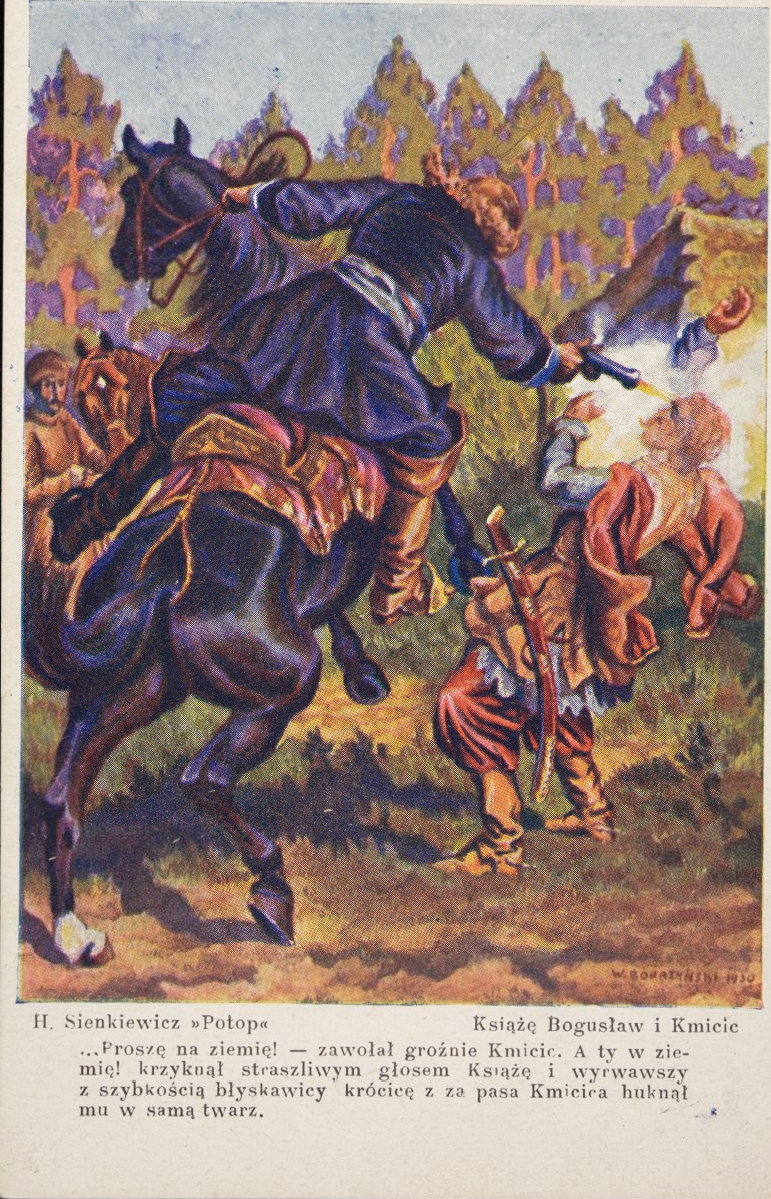
a quick post about an unusual  Polish illustrator and his artwork to illustrate the national epic , i..e., Sienkiewicz' Potop, 2nd novel in the 'Trylogia' ('The Trylogy') cycle.
Waclaw Boratynski (Pracowit z Ryglit)  was an illustrator  and painter, member of Stanislaw Szukalski's Szczep Rogate Serce (Horned Heart Band/Clan). 

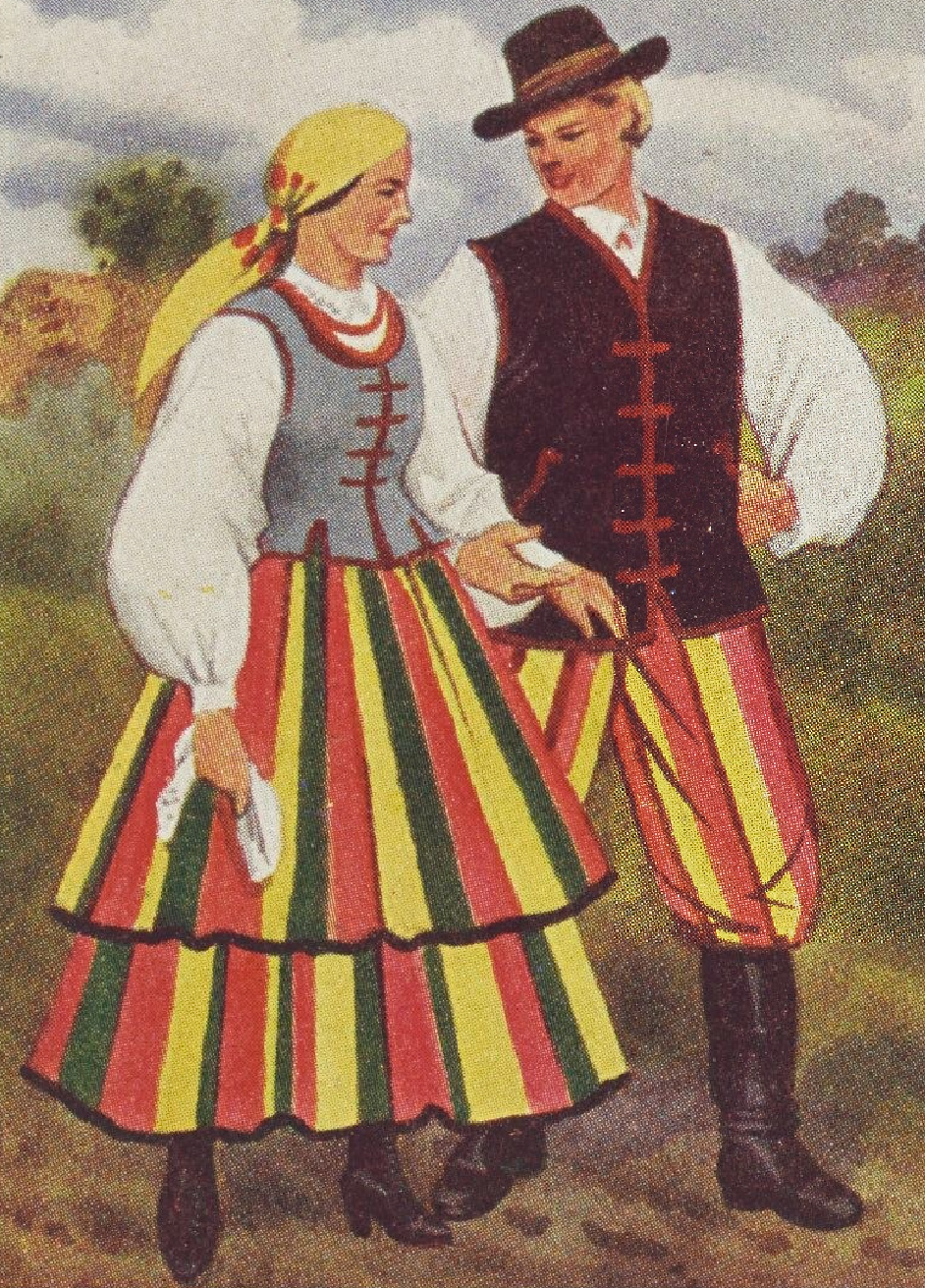
Lowicz peasant- male and female-  costume from 1930s


He was mobilized in as the infantry - 18th infantry regiment -  cadet officer (podchorazy) in 1939. He was part of the Polish army defending the city of Lwow against the German invasion, was wounded and died there on Septemebr 25, 1939, his body was buried there but it is said his grave did not survive the war, as Poles were ethnically cleansed (1939-47)  and deported from the Soviet Western Ukraine to the new Polish state. Boratynski's life was cut prematurely and Polish art was deprived of his talent.

perhaps the music platoon of the 1st 'szwolezerow' regiment 

In the 1937-38 he created a series of postcards - available for download at Polona website - based on  the national epic novel 'Potop' ('The Deluge'). Kmicic, Wolodyjowski, winged hussars, Tatars, Carpathian gorale, reiters, Swedish army, Luadanska company etc in these cards


enjoy

Valete