Showing posts with label Scythia. Show all posts

Wednesday, August 6, 2025

Prof. Gosciwit Malinowski - Scytowie DNA

 Salvete Omnes,

 [in Polish]


od pewnego juz czasu slucham podcastow na Yt profesora Gosciwita Malinowskiego - Interpretacja. Goraco polecam odwiedzanie strony na Yt gdzie profesor analizuje artykuly naukowe i ocenia, wyjasnia i tluamczy.


ad rem, dwa tygodnie temu napisalem post o artykule na temat DNA Scytow


Profesor opublikwoal podcast pt Scytowie i ich aDNA: pochodzenie, migracje, system społeczny,fenotyp, choroby genetyczne.

 Szczegolnie polecam cala ta audycje - bo jest dobra, choc moze temat Scithia Minor w Dobrudzy (218pne-167/110pne) w delcie Dunaju moglby profesor zglebic nieco dokladniej..


milego sluchania

Valete 

Sunday, June 4, 2023

Sauromatae virgin warriors by Hippocrates

 Salvete Omnes,


 The ancient Skuda, Skula, Skolotai, Saka (Skify,Σκολότοι, Skithian, Scythians, Skudra, Sogdian, Скифы, Скіфи, Саки, Scytowie, Sakowie ) or the Archers of the Eurasian Steppe were dreaded second wave of mounted horse-archers, after the Cimmerians, in the ancient Western Asia. 


But for the ancient writers the image of the armed and mounted young woman was especially or perhaps extremely untypical, intriguing, astonishing  and perhaps exiting.  So today we will quote an ancient writer about the virgin warriors of the steppes - the Sauromatae ha-mazan.

I have not quoted on these paged the so called father of medicine or Psuedo-Hippocrates (Hippocrates 2), a Kos/Cos-born Greek medical writer and doctor of the second half 400s BC and first quarter of the 300s BC. (460BC-375BC) who left some interesting observations or perhaps more like some tall tales about the ancient Skuda from beyond the Don River in the vastness of the Scythian Desert. 


In one  his medical treatises titled 'On Airs, Waters and Places' Hippocrates provided some curious glimpses into the world of the nomadic warriors and wanderers, whether he traveled there or read it somewhere and included it into his writing we simply don't konw. 

First in this quotation  the country of the nomads, in his Greek world view (part XVIII):

What is called the Scythian desert is a prairie, rich in meadows, high-lying, and well watered; for the rivers which carry off the water from the plains are large.
There live those Scythians which are called Nomads, because they have no houses, but live in wagons.The smallest of these wagons have four wheels, but some have six;
they are covered in with felt, and they are constructed in the manner of houses, some having but a single apartment, and some three; they are proof against rain, snow,
and winds. The wagons are drawn by yokes of oxen, some of two and others of three, and all without horns, for they have no horns, owing to the cold.
In these wagons the women live, but the men are carried about on horses, and the sheep, oxen, and horses accompany them;
and they remain on any spot as long as there is provender for their cattle, and when that fails they migrate to some other place.
They eat boiled meat, and drink the milk of mares, and also eat hippace, which is cheese prepared from the milk of the mare. Such is their mode of life and their customs.


Now, the Sauromatae virgin warriors of Palus Meotis (Meotis Swamp or the Don Delta):
Part XVII
In Europe there is a Scythian race, called Sauromatae, which inhabits the confines of the Palus Maeotis (for this is the boundary of Europe and Asia*), and is different from all other races. 


Their women mount on horseback, use the bow, and throw the javelin from their horses, and fight with their enemies as long as they are virgins; and they do not lay aside their virginity until they kill three of their enemies, nor have any connection with men until they perform the sacrifices according to law. Whoever takes to herself a husband, gives up riding on horseback unless the necessity of a general expedition obliges her. They have no right breast; for while still of a tender age their mothers heat strongly a copper instrument constructed for this very purpose, and apply it to the right breast, which is burnt up, and its development being arrested, all the strength and fullness are determined to the right shoulder and arm.


 A short but informative entry on the fabled Amazons or ha-mazan on Encyclopedia Iranica page.

It appears that Hippocrates had some very negative views on the horseback riding and its effects on the human body - and according to his writing  the  ancient nomadic Scythians were affected negatively by horseback riding up to causing them impotence, which is curious since in Thessaly , where Hippocrates eventually died according to sources, and in Macedonia the aristocratic warriors rode more than walked, and Thessalians were the fabled horsemen of the ancient Greece (no Osprey about their horse, but about the Italian Greek horse, sadly).

ps

Perhaps I should bring here the writings by Herodotus on the Sauromatae.


 all images come from Wiki Commons

 *part XIII


Valete


Sunday, May 21, 2023

Scythian Rhyton from the Louvre Museum

 Salvete Omnes,

a short entry today:
the Louvre Museum graciously made available on their website a collection  of photographs of one highly unusual silver rhyton
Allegedly this artwork comes from the Pontic steppe - Crimea and/or Kherson area etc - and was acquired by the museum in 1960s.
The vessel, shaped like a head of a wild boar, is decorated with some highly unusual art showing the Pontic Scythians and their horse in full tack. 
This work has never been seen by me and upon doing some research  I came upon some scholars who question its alleged origin  - the IV century BC. My friend and scholar dr Patryk Skupiniewicz, when asked, also was highly skeptical about this rhyton's origin. 
But the figures are quite splendid and beautiful, so let us enjoy this art for what it is prima facie  


the images are posted under the  Louvre  copyright as per their terms and conditions - 4.1.1 & 4.1.2.

Valete

Monday, November 30, 2020

Skithian and Greek


Salve,
ancient Athenian writer Thucydides said that there was no nation equal in military prowess to the Scythians/Skithians, and perhaps he was right issuing such opinion, eg the Achaemenid  Persians  and the Macedonians found this in a hard way.
So the Hellenes could have counted themselves lucky that such bellicose neighbours  preferred to stay in their great steppe and not to conquer the rest of the known world.


However, the ancient Greek writers also thought their immediate neighbours to the north, the Thracians, to have been another  nation with a huge conquering potential. In fact Macedonia felt the brunt of various Thracian 'razzias' until Philip V of Macedon put them to rest for good. Coming of the Celts a century later was another matter.
Back to the Skithians et al., during the long Hellenic colonization of the shores of the Pontic [Black] Sea there sprung many settlements in the Tauris [Crimean] Peninsula, mostly in the southern shores of this peninsula, including Pantikápaion [Panticapaeum] in the Cimmerian Bosporus [Kerch Peninsula], settled by the Milesian (Ionian Milethus- during the 'pre-Persian wars' period the greatest of all Greek cities).


 Herodotus, the famed grandfather of history - :) ,wrote plenty about slavery in the north and the role of trade between the north Pontic regions and Hellenes. 

Eventually a kingdom, called Bosporan Kingdom, arose in the Tauris and for 3 centuries one dynasty, Spartocids, had ruled the peninsula and its trade routes  - slaves, grain, honey, furs etc - with Graecia. Interestingly , in this kingdom the Thracians, Hellenes, and the ancient nomads came together, and the first  ruler of the late V century Bosporan Kingdom was a Thracian strongman named Spartocus/Spartokos, hence the Spartocid dynasty.

There had been many contacts between the Athenians and other Greeks and the Skithian world of Black Sea, some happy and many unhappy, i.e. the slave trade.

It has been more or less proved that the famous Athenian orator Demosthenes was of the Skithian descent, namely his maternal grandfather Gylon of Cerameis,  who was a warrior and soldier,  was a garrison commander  in the city of Nymphaion (Nymphaeum) on Cimmerian Bosporus in the late V century. When the city broke its alliance with Athens (for Athens quite like later Rome with Aegyptus  used the Pontic grain route to feed its population, and Nymphaion being positioned on the Chersonese sat on that grain route) and allied itself with the Spartocid Kingdom he was accused of treason by the Athenians.
He fled into the Scythian interior and there married a Skythian noblewoman. They had two daughters - Cleobule and Philia - probably while still in the Scythia. Now, Athens had some very prohibitive laws when came to descent, citizenry and full rights of citizenship.  Around  451BC Pericles, the good freedom defender  no doubt, had the Athenians pass a restriction  on the so called 'bastards' (nothoi) that required that both parents had to have been Athenian citizens in order for the kids to have been legitimate and to have possessed the full Athenian citizenship. Between 431 to 404BC the law was suspended - go figure, the Peloponnesian war  must have made these restrictions problematic when soldiers were needed.
Back to Gelon, eventually Gelon and his family  sailed to Athens, he was fined and paid this fine for his role in Nymphaion debacle, and was able to make his daughters Athenian citizens. Historians speculate that Gelon's unnamed Scythian wife must have been wealthy and the wealth was used to by their way back into Athens and to find husbands among the Athenian well-to-do citizens. Hence well-of Athenian citizen Demosthenes' father (named Demosthenes) married Cleobule and our famous orator was born. Philia married another well-to-do Athenian Demochares. But later on, when  Demosthenes was practicing as a layer and was active as a politician  he was often called a barbarian and Scythian by his legal and political opponents in Athens, his family  lineage being denigrated in public.

Greeks had Scythian archers and slaves in their service - here a nice article on the subject - and hence my quick sketch, it badly needs to be reworked and finished one day,  represents such 'policeman,' while a Greek mercenary soldier eyes him with a suspicion.

And if you are looking for some entertainment reading in this area, like a nice long historical fiction, I could point you the first 3 Tyrant cycle/saga novels by Christian Cameron - I truly like them - so a strong thumb  up.


 The Skithian topics to be continued..
enjoy

Tuesday, December 31, 2019

M. I. Artamonov - Sokrovishcha Skifskih Kurganov

Salvete Omnes,

the clock is ticking and perhaps this may next to the last post this 2019:
I watched the entire Netflix' Witcher series - for me it did not get better with each episode, so much money wasted; the hose tack in this production is horrid, mix of nonsense, pretensions and bad saddlery ideas. They should have hired some of the experienced European saddlers, like Joram van Essen et al or our Polish saddler Marcin Ruda ( Ruda Sadlery) to create some pleasing choices.

just a link (kronk site) to the color illustrations from prof. Mikhail Illarionovich Artamonov(Артамо́нов Михаи́л Илларио́нович) titled Сокровища скифских курганов в собрании Государственного Эрмитажа.-published as The splendor of Scythian art;: Treasures from Scythian tombs (1969).
The examples of the Scythian art from the Hermitage, just a few examples from the Kul-Oba kurgan 

Kul-Oba kurgan - a lancer

Kul-Oba kurgan - another lancer

 Scythian archers from the Kul-Oba kurgan
 

 Geremes kurgan - Геремесов курган ( Марьевка (Запорожский район) ),Ukraine - mounted lancer against an archer
 

Merdzhani or Merdzhana (Мерджаны) kurgan - late period - a horseman with a rython


  Elizavétinskaya stanitsa(Елизаветовская станица) kurgans -( Kuban Basin ) and one of my favorite animals - the wild boar detail from the sword scabbard discovered in the the kurgan number 16.


Valete
ps
the animal-style steppe art may be exemplified by the deer adornment for a shield that  comes from the Kostromskaya Stanitsa Kurgan numer 1, Kuban Basin.

Monday, December 30, 2019

Kurgan Solokha - Russian book & articles

Salvete Omnes,
a short entry on this last day before the last day of 2019.- :)

Academia has the entire Russian book dedicated to one of the most famous Pontic Scythian kurgans - The Solokha kurgan, the story of the collection by the Russian prolific researcher, academic Anastasia Petrovna Mantsevich ( А. П. Манцевич)- available for perusing or downloading for the future study.
Here you can seen a photo of the famous vessel with the hunting scenes from Solokha.
 
 Nikolai Ivanovich Veselovsky (Николай Иванович Веселовский) excavated the Solokha kurgan and the present site is located on the Dniepr River (ukr. Дніпро,   ros. Днепр, pol. Dniepr  ) not far the town of Nikopol in Ukraine.

Also, you may find of interest three separate articles by Mrs Anastasia P. Mantsevich on or about the objects from the Solokha kurgan-
-The Golden Comb from Solokha Kurgan - Золотой гребень из кургана Солоха (1949)  - from the kronk site.
the large photo of the comb comes from the article


 the second article on the Solokha comb(1962) - from the kronk site.


 another article on the comb and the phiale (patera) -  the kronk site. - it contains another photo of the hunting scenes vessel


- The Parade or Ceremonial Sword from the Solokha Kurgan (in Russian from the annales site, or with large scans of images from the kronk site , but can be translated by any internet translators)

 
Article by M.I. Artamonov about Solokha - the kronk site.

valete

Sunday, March 18, 2018

Sergey Yatsenko - ancient Iranian Costume


Salvete Omnes,
great news for all students of ancient Iranian peoples and their culture, especially the costume!
Russian scholar Sergey A. Yatsenko published, on his Academia page, all illustrations from  his  fantastic  study on the ancient Iranian costume.
These are large pdf files so they are divided in 5 parts:
List of illustrations
part 1
part 2
part 3
part 4
part 5

Thank you prof. Yatsenko
Valete!

Wednesday, October 25, 2017

Scythian saddle - articles


Salve,
long time ago I put some information and drawings regarding the Scythian pad saddle.

Recently I have been studying articles by Elena V. Stepanova, one fine Russian scholar from Sankt-Peterburg (Saint Petersburg) Russia, where she is the Hermitage Museum curator and scholar.
The articles deal with the saddles that have survived in Pazyryk, Ukok Plateau of Altai Russia, kurhans (kurgans), and other archaeological sites in Central Asia with references to other sites of Eurasian steppe. One article deals with the reconstruction and usage of such pad saddle from the Altai's Pazyryk kurgans discovered long time ago by the Soviet archaeologists led by Rudenko - English translation calls it a soft saddle, but I think this is the wrong terminology... :)

 The articles are very, very interesting and informative,and practical too. For me it means I have got to rethink and redo some of my drawings and comments on the said Scythian saddles,
so you can download the English translation from the Silk Road Foundation , volume 14. - on the reconstruction of one of the  Pazyryk (Barrow nr. 3) saddles, preserved at the Hermitage, and some interesting observations on the Bosporan saddles as visible on that kingdom funerary artwork.

Qin/Chin Shi Huang Di terracotta army of China - cavalry mount wearing a very Scythian saddle, late 3rd c. BC

or you could read the articles from Ms Stepanova's page on Academia, or you could register there and then download these articles one by one.

Getae Thracians - warriors  riding using saddles similar to the Scythian ones in this Letnitsa, Bulgaria find from IVc BC - note that the Thracian horsemen were allies of the Philip IV of Macedon and Alexander III of Macedon and took part in the conquest of Achaemenid Empire
enjoy

Sunday, July 13, 2014

Fallen warrior and galloping horse from Chertomlyk

salve,
Skudra/Skuda/Saka/Scythians or North Iranian nomads of the ancient Eurasian steppes are, as you the visitors to my blog know, some of my favorite subjects.

I want to share with you the academia.edu page of prof. Mikhail Treister, where you can read or download this fine scholar articles on the ancient nomads and their world.
Mikhail Treister's page
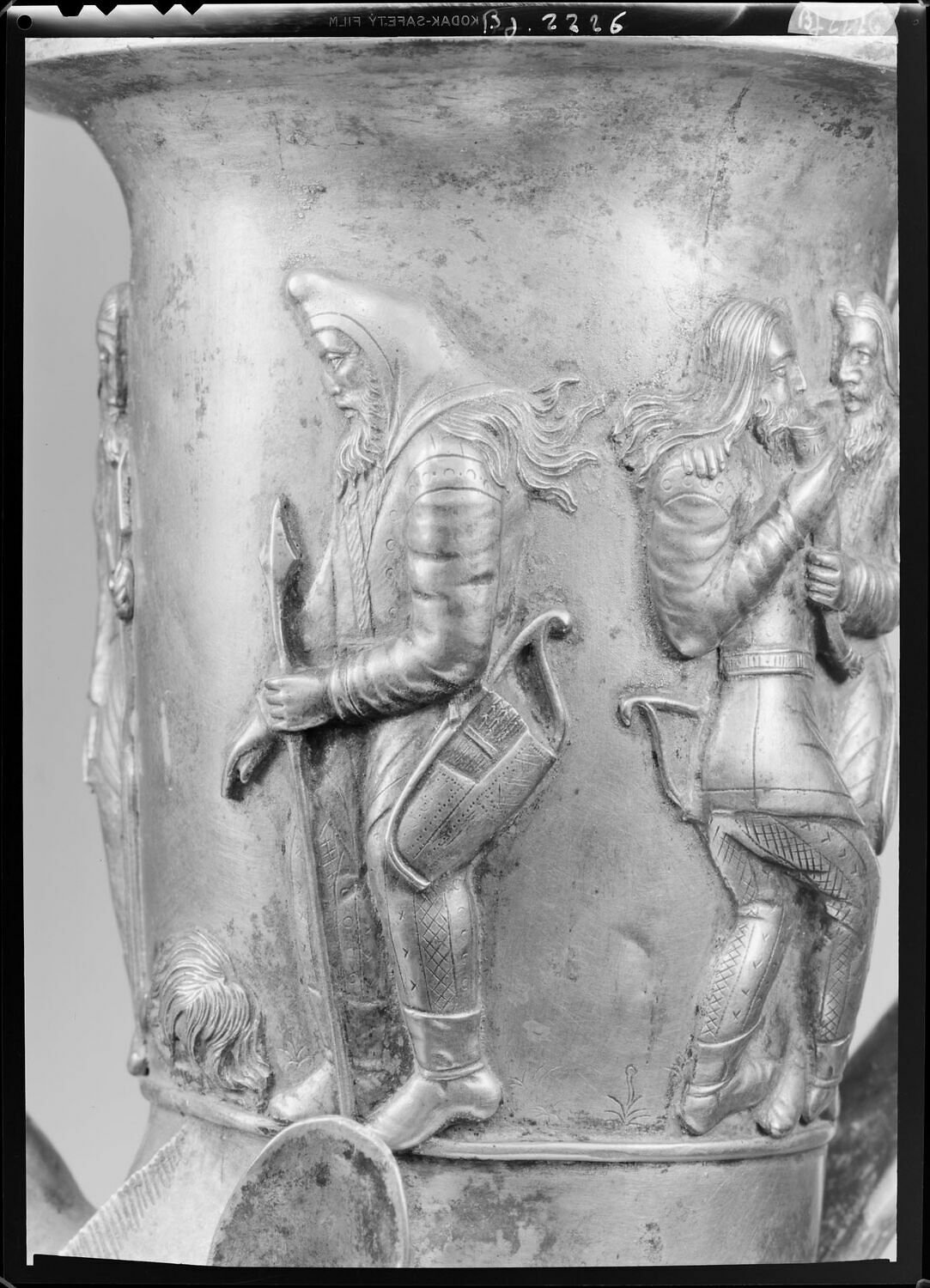
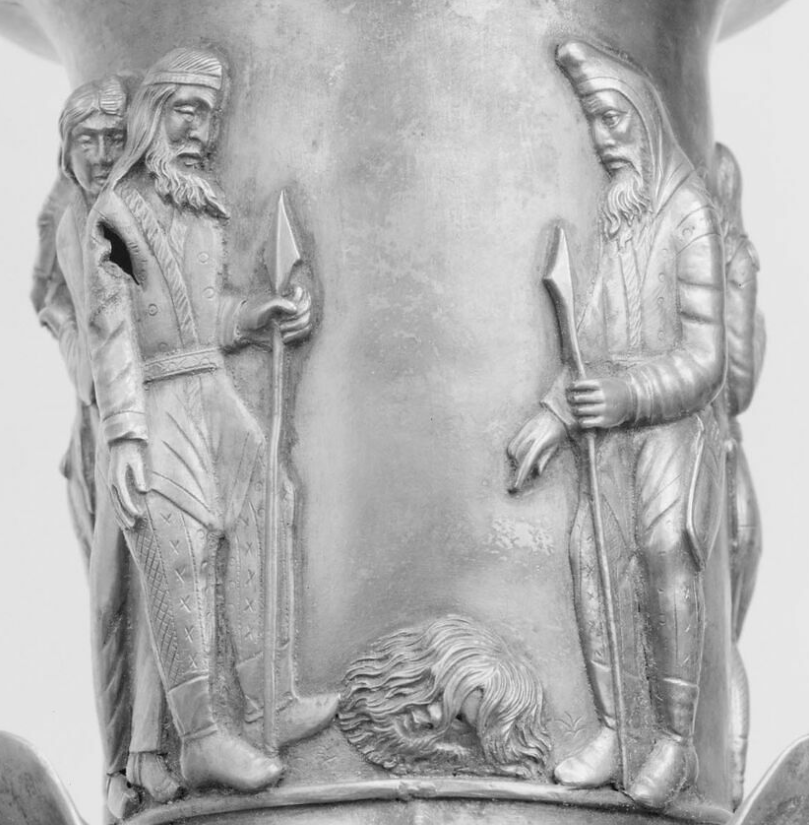
 I did copy a figure of a wounded rider and a galloping mount from the golden scabbard found in the famous Chertomlyk kurgan, dated to the middle of the  IV century B.C., as it represents the Scytho-Greek art. The kurgan's contents are  famous, especially the silver, egg-shaped,  amphora with the scenes of Scythians gentling the horses - one day I will turn to these as well.
Russian book on the very kurgan Чертомлык (Скифский царский курган IV в. до н.э.). (Chertomlyk, the Scythian Royal Barrow/Kurgan IV century B.C.)
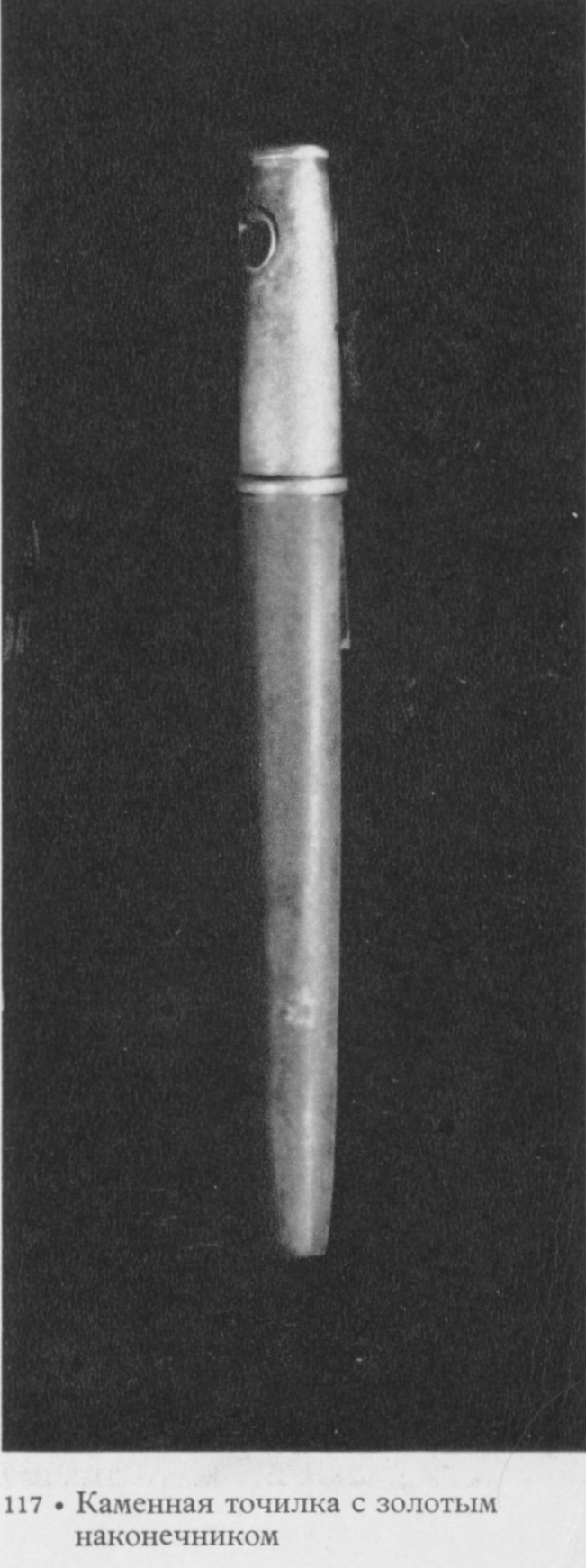
Some artefacts from Chertomlyk - numbered 89-120 especially interesting the the whetstone with a golden handle, most likely suspended from the 'arming' belt (where the sword or swords and combination quiver-bow case known as gorytos were also hung).
Scholar Esther Jacobson writes (p. 246):'' there is  a general understanding that the narrative [...] may refer to the Trojan War, in which participated a variety of non-Greek peoples, or to a battle between the Greeks and the Persians, or even between Greeks and Amazons. It is also possible that the narrative is intended to represent a generic battle, between Greeks and non-Greeks'' (E. Jacobson, The Art of the Scythians, New York 1995)

This dramatic figure, situated of the very end of the scabbard, consists of a wounded warrior falling of the galloping horse still grabbing at the reins, and  it clearly shows some tack: the bridle, reins, bit, breastplate and saddle.
I did not copy the crested helmet below the horse's head. The horse's mane is  shorn, with several strains of longer hair near the pommel of his saddle in a typical Eurasian fashion, while his tail is not tied nor braided in more of the steppe fashion, perhaps reflecting the Greek artist's concept.
Article by prof. A.N. Shcheglov about this barrow and its treasures.
 Review of a book -''The Gold and Power - Scythian weaponry and Greek Myths.''
Enjoy
ps
I should bring more of these ancient images in the future.

Wednesday, December 18, 2013

Nomad sketch and some articles from Academia.edu

Salve,
I did a ball pen sketch of a nomad, generic ancient Scythian/Saka perhaps, last weekend.
I took a quick photo of this sketch with my Canon Power Shot  and then it occurred to me to work it over with GIMP
Hence the results:


The new articles I do recommend from academia.edu
Florin Curta, The image and archaeology of the Pechengs
Mario Fales, Everyday Life and Food Practices in Assyrian Military Encampments
Michel Kazanski, Les Alains et les Sarmates en Occident romain a l'epoque des Grandes Migrations: Donnes archeollgiques.
Petr Žákovský, Dussacks with broad blades and a probable method of their manufacturing
...