Showing posts with label cirit. Show all posts

Wednesday, January 29, 2025

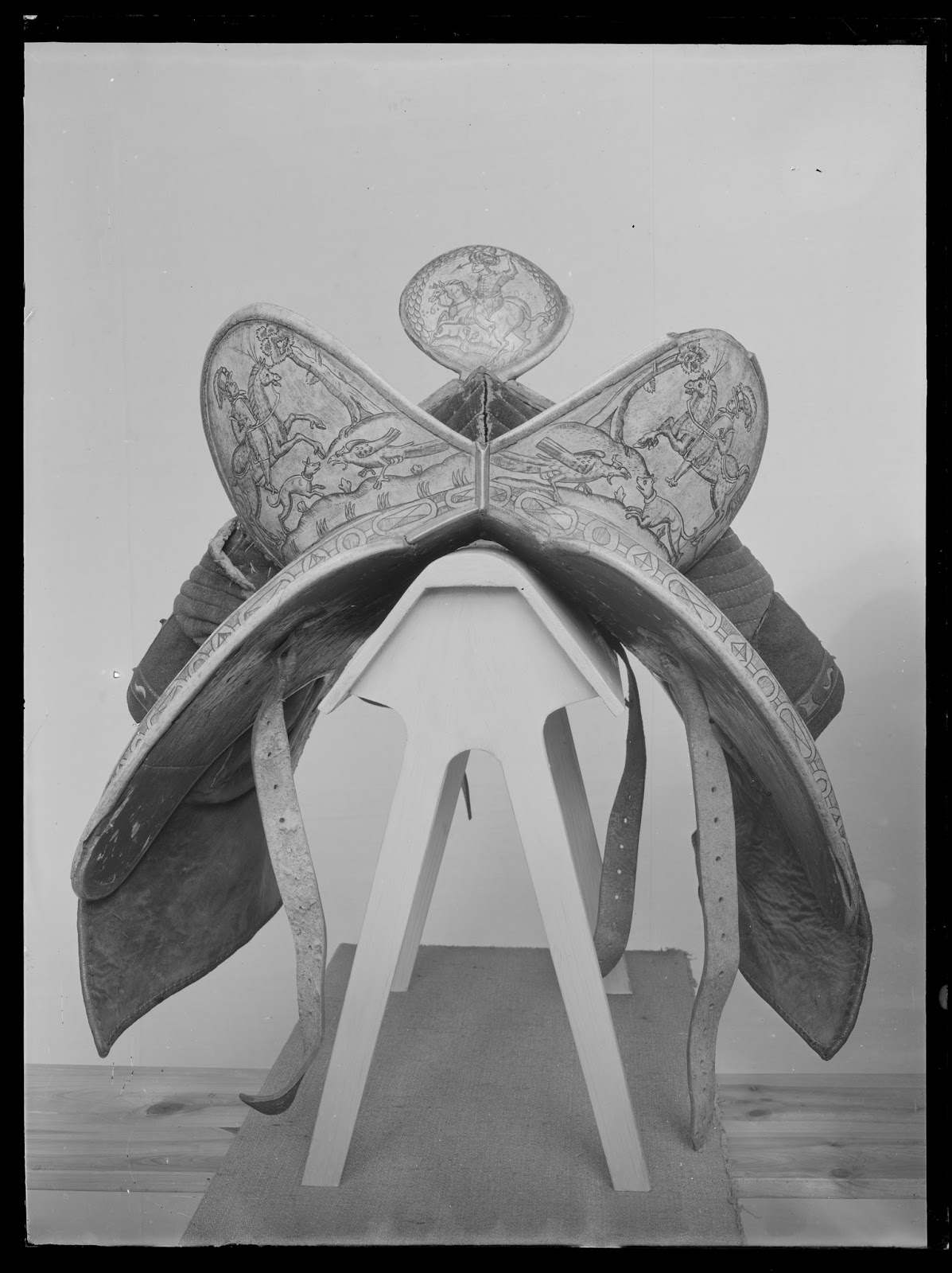
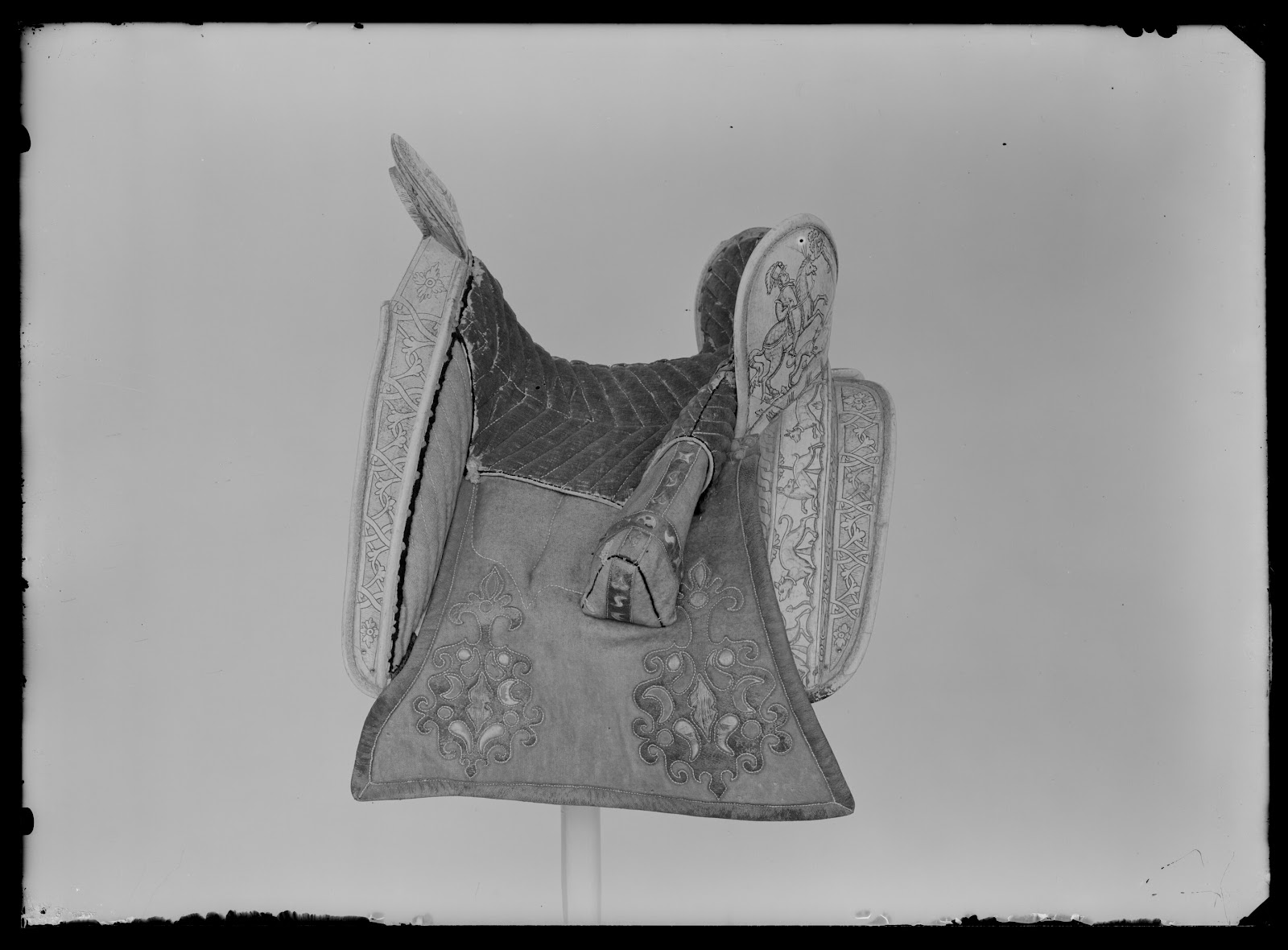
Polish saddle from Livrustkannaren circa AD 1605

 Salvete Omnes,

another unusual XVII century Polish saddle, this time from Livrustkammaren Museum in Stockholm, Sweden.


Sadel med fram och bakbommar av ben med rikliga graveringar föreställande bl a riddare, hundar och andra djur. Hög, rundad sadelknapp, på utsidan försedd med staden Danzigs vapen, på insidan årtalet "1605", det sistnämnda möjligen senare ingraverat.
Sits av grönt kläde med gula tvärgående sömmar. Kåpor, stödbommar samt frambommens insida av rött kläde. Skinnapplikationer på kåporna i form av turkiskt bladmönster. Foder och kantskoning av läder. Kåpornas form något nedhängande samt bredare nertill.
Bakbom med två högt uppstående rundade sittblad. På sittbladens baksida riddare till häst med en hund och fågel i förgrunden. Längs med bakbommens sidor jagande hundar, hjortar och harar. Frambommens båda sidor med två moderiktigt klädda herrar i fokus. Insidan av sadelknappen dekorerad med orientalisk krigare till häst beväpnad med javelin.
Stomme på undersidan beklädd med näver. Två remmar med sölja för fäste av förbygel. Fyra sadelgjordsstroppar. Rester av läderögla framför frambommen.
Uppges i Livrustkammarens inventarium 1748 ha tillhört Karl X Gustav.
[Google translate -Saddle with front and back bars made of bone with rich engravings depicting knights, dogs and other animals. High, rounded saddle horn plate, on the outside with the coat of arms of the city of Danzig, on the inside the year "1605", the latter possibly engraved later.
Seat of green cloth with yellow transverse seams. Covers, support bars and the inside of the front bar made of red cloth. Leather applications on the covers in the form of a Turkish leaf pattern. Lining and edge banding of leather. The shape of the covers is slightly drooping and wider at the bottom.
Back bar with two high rounded seat leaves. On the back of the seat leaves a knight on horseback with a dog and bird in the foreground. Along the sides of the back bar hunting dogs, deer and hares. Both sides of the front bar with two fashionably dressed gentlemen in focus. The inside of the saddle button decorated with an oriental warrior on horseback armed with a javelin.
Frame on the underside covered with birch bark. Two straps with buckle for attachment of stirrup. Four girth straps. Remains of leather loop in front of the front bar.
Stated in the Livrustkammaren inventory of 1748 to have belonged to Charles X Gustav.]


inside the horn plate there is a coat of arms ofg the Royal City of Gdansk


hunter with dogs 


a nice portrayal of an Ottoman horseman with a javelin - cirit

great shot of the undeside of the saddle - the tree is birchbark-lined

the seat is cushioned 


..


this saddle represents the very eclectic world of the Old Poland saddle making, especially  the northern provinces of the Kingdom. 

enjoy


Valete

Wednesday, July 19, 2023

De Warnery on Ottoman Turkish Spahis

 Salvete Omnes,


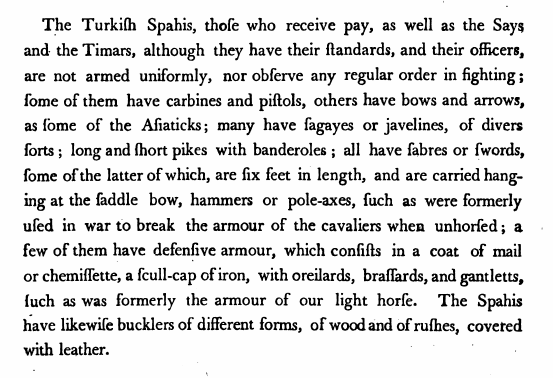
long time ago I brought here the book by a Prussian & Polish cavalry general Charles de Warnery - Remarks on Cavalry

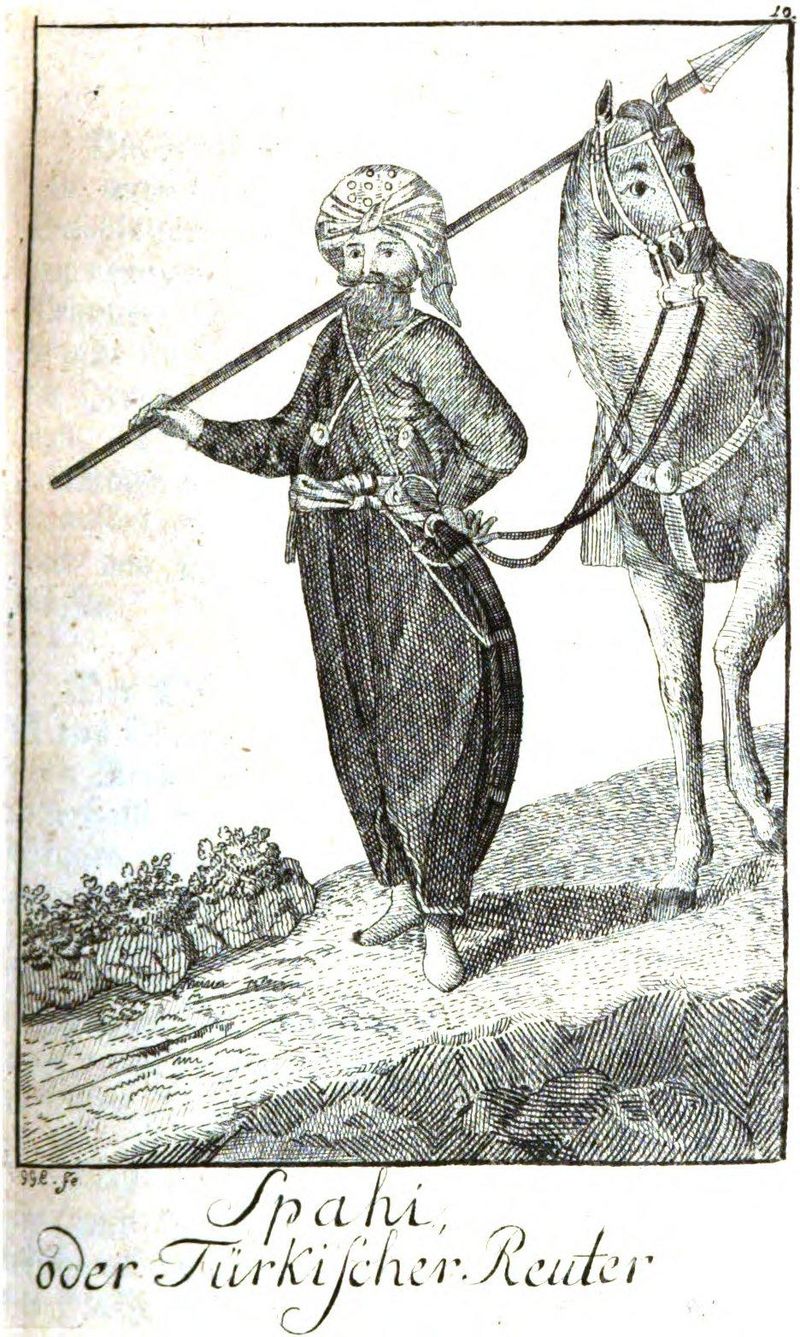
Today, I would like to bring to your attention the short description of the Ottoman Turkish spahis/sipahi as seen by general de Warnery. 


and some other late XVIII century images of the Ottoman Spahis


enjoy

Valete

Tuesday, April 18, 2023

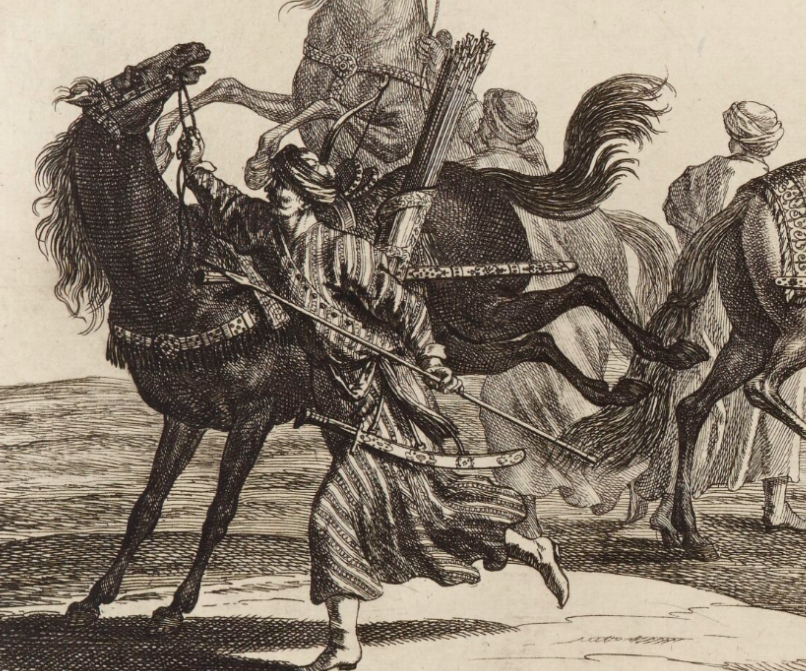
Ottoman aspect of Certamen Equestre - a detail

 Salvete Omnes,

more than 9 years ago i posted the saddle detail from the Certamen Equestre  Ottoman Turkish section- of Gallica French national Library provenance.
in this plate there is an interesting detail , in my opinion, worth looking at -

note the sumptuous saddle coverings and shabraques, dydwyks and bejeweled harnes and kalkan shield, tuck sword etc 


Namely, this part -

In my opinion it looks very much like a type of a Ottoman Trukish cirit or short dzida like in this detail from Querfurt's painting

Valete

Sunday, June 5, 2022

Cirit - Jereed

 Salvete Omnes,

let us gallop with a javelin in hand - Turkish-Persian style.

 First, a note on Cirit aka Jereed from XIX century -
'Jereed is a short lance, having a blunted head, when used in sport, but sharpened for warlike purpose; it is one of the most favorite amusements, both in Persia and Turkey. A good description of exercise will be found in Mr Morrier's 'Ayesha.''

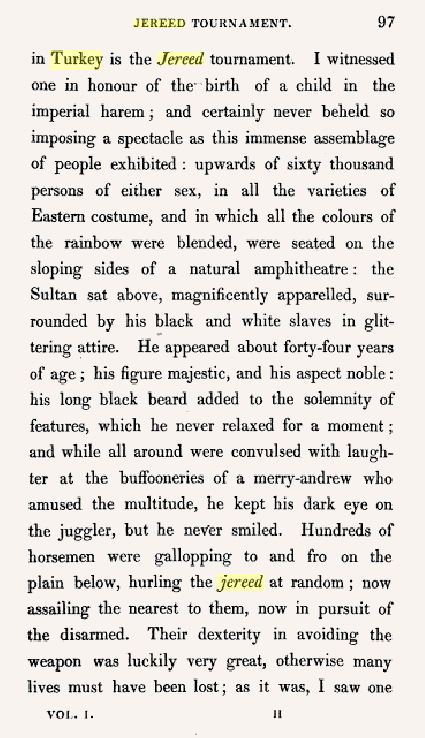
Next, from a traveling-spying book by  a British journalist/useful observer - Richard Robert Madden

Travels in Turkey , Egypt, Nubia and Palestine: 1824, 1825,1826, and 1827.    - this is his depiction: 


and to illustrate this 1820s description a painting by Luigi Acquarone after Antoine Ignace Melling -


Valete

Sunday, May 29, 2022

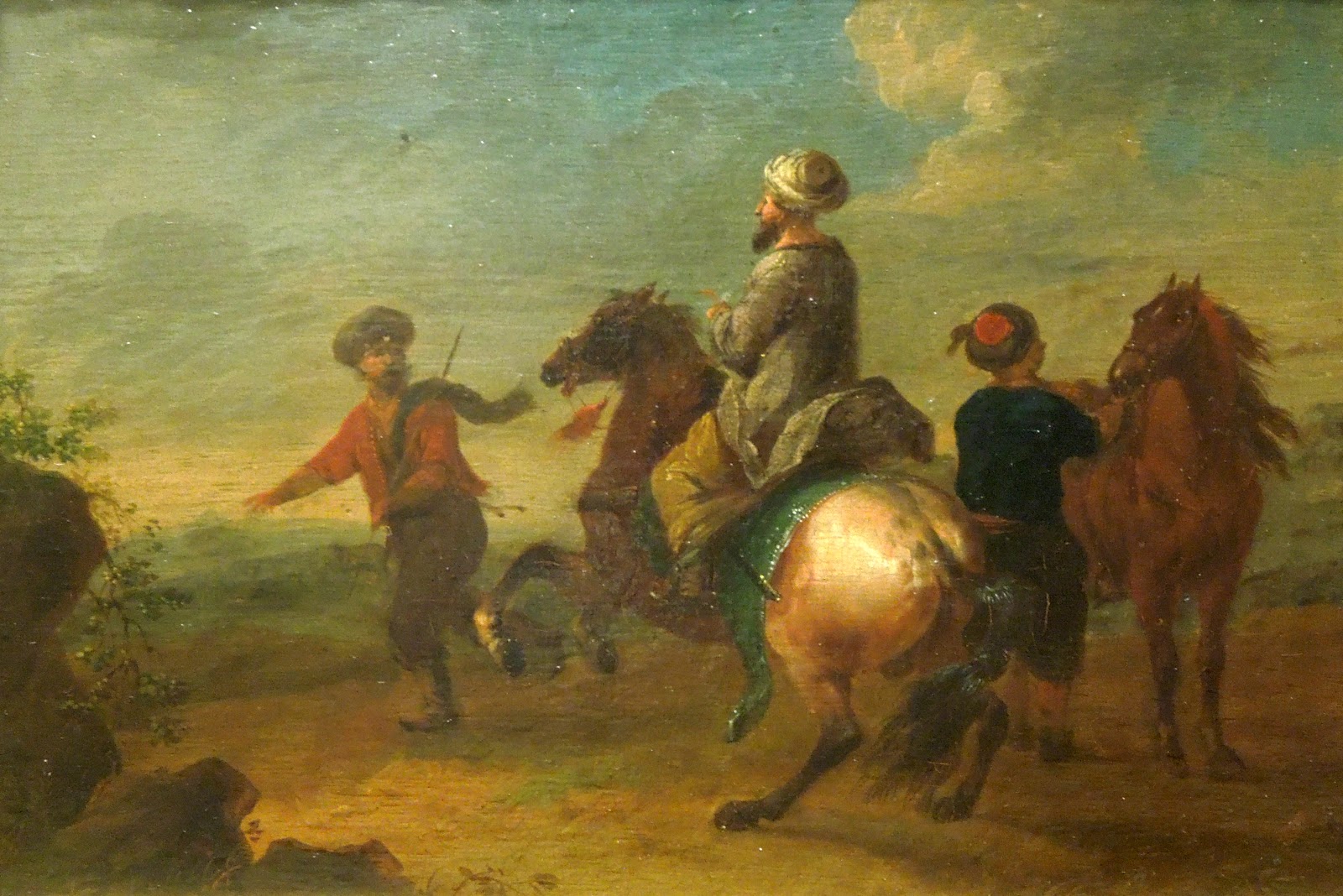
Ottoman horsemen by August Querfurt

 Salvete Omnes,


let us gallop to the atelier of a XVIII century Viennese painter August Querfurt - and his portrayal of Ottoman horsemen - from the collections of National Museum in Wroclaw.


and some battles between the Imperial horsemen and Ottoman riders


here a horseman in the foreground has a javelin - cirit/jereed type


Valete

Wednesday, September 12, 2018

Vienna 1683-2018


Salvete Omnes,
yesterday I did some reminiscing about the tragedy of 9-11 and the war that has been following  the attack ever since and that this war may last forever.

    Since the early morning, but 335 years ago, the Polish, Imperial and German states troops or the allied Christian army had been battling their way down to the plain where capital of Hapsburg empire was surrounded and had been besieged by the multiethnic Ottoman army under grand vizier Kara Mustafa.

     Islamic and Christian soldiers fought one another since the early morning, at first the infantries battling one another, but carried by their bravery and good soldiering slowly the Christian soldiers pushed their Muslim adversaries towards the Ottoman camps and thus opened way for the possibility of cavalry to charge.

It was already the afternoon and perhaps the final assault would have taken the next day,  since Jan III Sobieski had envisioned the final assault against the Ottoman lines, with the Polish cavalry leading the way, especially Polish lance-bearing cavalry, i.e. , the winged hussars armed with kopia ( perhaps 4.5-6meters long, hollowed and painted lance with equally swallow tail long pennon ).
Thus King Jan III was waiting for the moment when field was cleared for the lancer banners to probe the terrain and to attempt the charge. Sometime between 1600 and 1700 hours Jan III ordered one of his army winged hussar companies - prince Aleksander Sobieski - commanded by Zbigniew Zbierzchowski to charge the multitudes in front of the king-led right Polish Crown wing of the Christian army, this being the left wing of the Polish forces.

It was clear that Jan III wanted to know if such mounted  charge was feasible.

The 110-120 lancers and horses-strong company of heroes, in two kopia-bristling rows with red and white pennons flying, charged towards the direction of the commander-in-chief of the Ottoman army huge tent looming in the distance with many thousands of sipahi and otehr cavalrymen of the Ottoman main lines; in front of the charging winged hussars went, on his own volition, the court treasurer Andrzej Modrzewski armed and armored as a pancerni cavalryman.
Pan Modrzewski, galloping well in front of the charging banner, reached the Ottoman screening horsemen and soon was engaged by some brave Ottoman horsemen,  in short time he killed one or two with dzida and wounded some but nunc Hercules contra plures and he had been disabled with some well aimed cirit javelin and dzida blows and  died before the charging winged hussars were able to even reach join him in this uneven fight (his body was carried back to the Polish lines with his head intact as the cantering whinged hussars prevented the Ottoman cavalrymen from carrying away Modrzewski's head); having suffered  their first casualty the winged hussar banner went cantering forward and struck the Ottoman lines at a full gallop like a lightning, but was surrounded on its wings and eventually came to a standstill amidst the Ottoman units. Yet  with utmost difficulty they were able to disengage from their  Muslim foe and with some serious losses (12 companions and perhaps 25-30 retainers were killed ) the winged hussar banner was able to return  to the king proving the charge was possible.

During this charge on the left wing of the Polish Crown army, on the right wing of the Crown forces  another charge was made by a tactical cavalry  unit known as szwadron ( Castellan of Krakow Andrzej Potocki winged hussar banner with two pancerni banners- starost of Halicz Stanislaw Potocki and starost of Rzeczyca Jozef Sluszko - on its wings) led the starost of Halicz Stanislaw Potocki, this unit charged  on the right wing of the Polish army, soon seconded by the second szwadron under voivode of Krakow Szczesny Potocki (his own winged hussar banner and his own pancerni banner and another pancerni banner- Boguslaw Potocki's one). The charging cavalry suffered more losses in total than the lonely royal Sobieski banner and proved that the terrain was quite difficult on this wing of the Polish army.
Finally satisfied as to the possibility of all-out cavalry charge the commander-in-chief of the Christian allied armies and king of Polish-Lithuanian Commonwealth ordered all winged hussar and pancerni companies grouped into szwadron tactical units to charge the Muslim lines. The many thousands of riders of the allied cavalry companies followed in tow.
The rest is history...
Hail to the Victors!
Vae Victis!


..


Valete

Friday, October 21, 2011

Cirit - ancient Turkish game


Salve,
I 'facebook'a bit and via Facebook I met a Polish competitor and reenactor, Bartosz Ligocki, who participated in this event Al Faris in Jordan. Bartosz send me a link to a blog by another of his horsearchery club mates, Mateusz. Mateusz, accomplished horseman and horsearcher, is working in Turkey training stunt-men for a future historical, Ottoman Turkey, film productions. 


In one of his posts, Mateusz writes about the Ottoman and present Turkey equestrian sport known as ''cirit'' and that prior to going to Turkey they, the Horse Archery Club, reconstructed the Ottoman 'cirit' javelins based on the examples found in Polish museum collections, and upon their trials concluded that these slender weapons had been only for parade and not for battle. However, upon seeing the Turkish stable boys performing cirit competitions, Mateusz now thinks that this was quite formidable weapon, capable of piercing 2mm steel plate from a distance of 15 meter, while from a distance of 30 meters Turkish horsemen were able to hit a ball of paper without a problem (Mateusz concludes that the effective  range  was 60 meters). Nota bene Matuesz writes that present day Turks ride stallions, some mix of Arabian or almost purebred Arabian horses,  when playing cirit.

A XIX century description of a cirit game (using English term djerid) played observed being played by the Pasha of Jerusalem and his staff by English officer Lt. W. F. Lynch : "A single horseman would leave his ranks, cross the intervening space, and ride leisurely along in front of the opposite line, when, selecting his opponent, he quickly threw his djerid, or short, blunted, wooden spear, directly at him. The latter, generally dodging the weapon, immediately started in hot pursuit of his antagonist, who, now unarmed, spurred his horse towards his friends, and, to avoid the threatened blow, threw himself nearly from the stead, hanging by one leg .... If the assailed were struck with the first cast, one of his party pursued the assailant; and if successful in striking him, it became his turn to flee from an adversary."


Here you have a photo by Keon-Sik Heo ( World Martial Arts Union - Seoul, Korea - Yong In University) of Bartosz performing feats of horsearchery at Al Faris.


....
At the head of this post I attached a work in progress of an Ottoman XVI perhaps early XVII century cavalryman with a 'cirit' javelin (GIMP and MyPaint only )
...
Images of cirit players and horses from present Turkey via google images
..
Anatolian Horsemanship Committee page has some info, including a page on Anatolian horse sports and an article and diagram of Turkish horse tack etc..
..
 enjoy - :)