Showing posts with label China. Show all posts

Wednesday, February 18, 2026

Fire Horse Year & Tea Horse Road

 Salvete Omnes,


Chinese zodiac - Fukuoka, Japan


the Lunar year of Fire Horse started on February 19th.  May this new year bring peace and prosperity to all.


Today's post will be about tea, mules and horses.

The Chamadao or Chamagudao or the Ancient Tea Horse Road was the trade route between  Tang China and Tibet and Bengal. 


Along with silk and porcelain the teas of China became quite early essential  commodities for the external markets and coveted Chinese imports. 


For more than a thousand year Chinese caravans of tea-horse (mule) muleteers and porters carried packaged tea from Chengdu in Sichuan & Kunming in Yunnan,  from Pu'er & Dali regions of tea growing and production to the Tibetans of  Lhasa and other centers of power, to the Nepalis further west and to the Bengali yet further to  the southwest, all  across the Himalayan mountains and plateaus. 


Since horses did not breed well in the main Han China provinces, then the Chinese export of tea & silk etc led to the exchange of  those much coveted Tibetan-bred horses  for tea etc. 

Tibetan pony


The Song Dynasty, very poor in good horses for their cavalry due to their wars with the  Jin Dyansty and Mongols, is known for importing the Naqu/Hequ horses from Tibetan breeders.


Hequ horse of Tibet

Hequ horse

Hequ horse


.


Teas from the Chinese cultivation areas was harvested by hand, dried, fermented and shaped into bricks and cakes, the final products wrapped in bamboo leaves & husk or tree bark for travel. For six months the tea caravans would trek the road until reaching their desired market destinations. 


The Chinese tea drinking spread to India, Mongolia, Central Asia and Japan, and much later to Muscovy and Europe. 

Valete

Thursday, February 13, 2025

Quian Xuan - late Song and Yuan painter

 Salvete Omnes,

a noble horse archer 

Quian Xuan (1235-1305) - was a painter and calligrapher during the Song and Yuan dynasties of China. He grew up during the conquest of Chinese states by Chingiss Khan and later creation of the Yuan, Mongol, Dynasty.  He is known by his intricate paintings of birds, landscapes, and mixing of the late Song style and ancient Tang one.   


Liao Dynasty period painting of the famous consort


Consort Yang mounting a horse while emperor is watching. - Smithsonian has a page devoted to this artwork.

Tang emperor and his eunuchs retainers


consort being helped to mount the horse . Note the dragon on the saddle's skirt


Yang Guifei was considered one of the Four Beauties of China, and subject of many paintings and artworks in the Chinese and Japanese arts. eg this Wiki Commons page.
During the An Lushan rebellion when imperial forces were all but defeated, the Tang guard soldiers surrounding the emperor forced him to order his favorite consort to commit suicide. She died in July 756 Ad, but went on to live as the object of art and poetry and novels in the Asian history etc. 


Valete

Friday, January 17, 2025

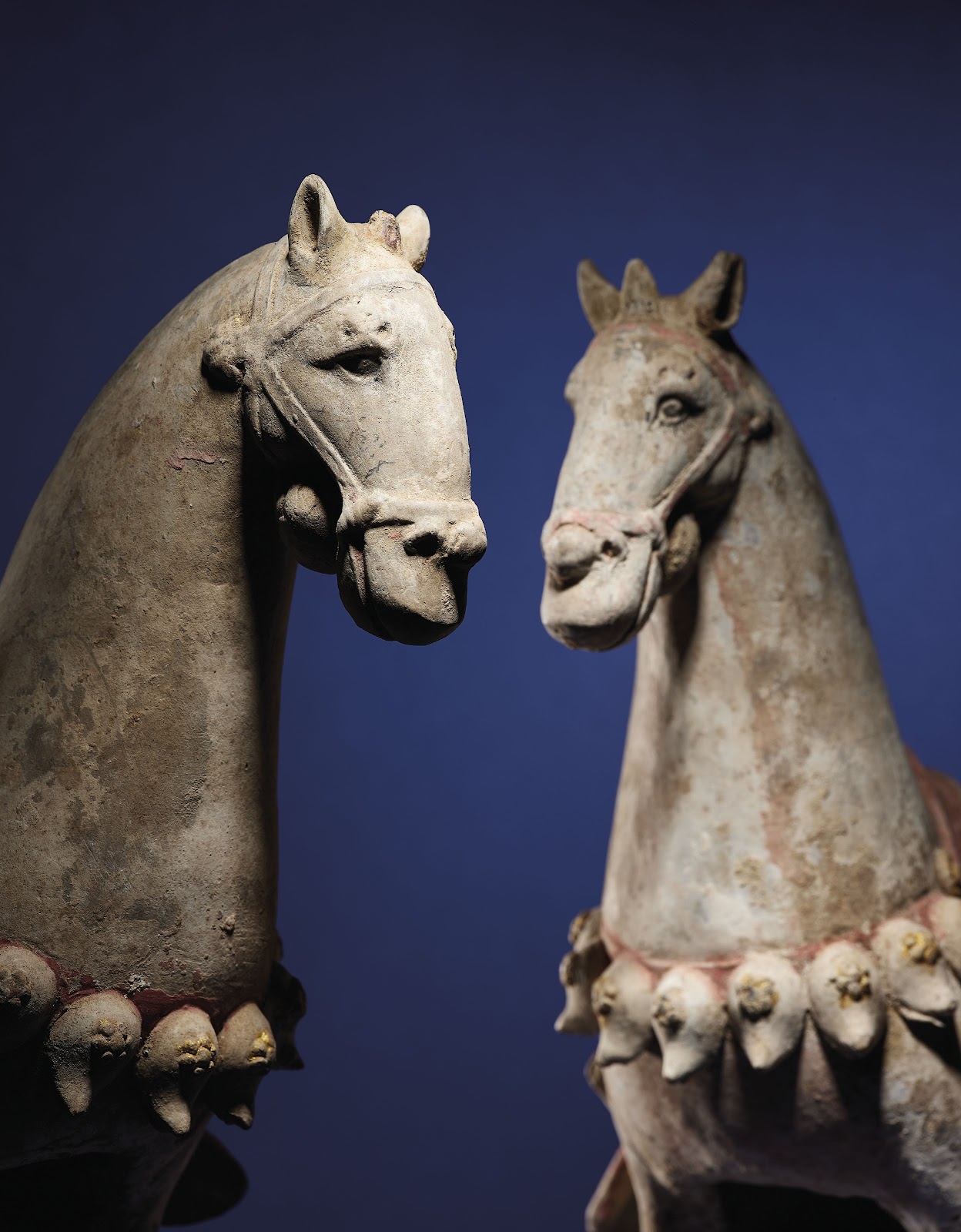
Eastern Wei - caparisoned horses

 Salvete Omnes,


a little visit to early 'Medieval' China - Eastern Wei Empire (AD 534-550) and their warriors and horses.


.

Eastern Wei, albeit short lived, gave us the peculiar sculptures  of fabulously caparisoned and harnessed horses , that where continued during the unifying Sui Dynasty period of the Chinese history, but the Eastern Wei gave way to Northern Qi imperial dynasty (ended in AD 589 by the Sui Empire). 

A Christie's' gallery - larger and full image here. 


A caparisoned horse with a very clearly sculpted saddle and stirrups -


-from this gallery.


Bonhams auction hourse - a Horse Gallery 


In these sculpted horses we can see many elements of the steppe horse harness elements that will endure for more than a thousand years until the modern age.

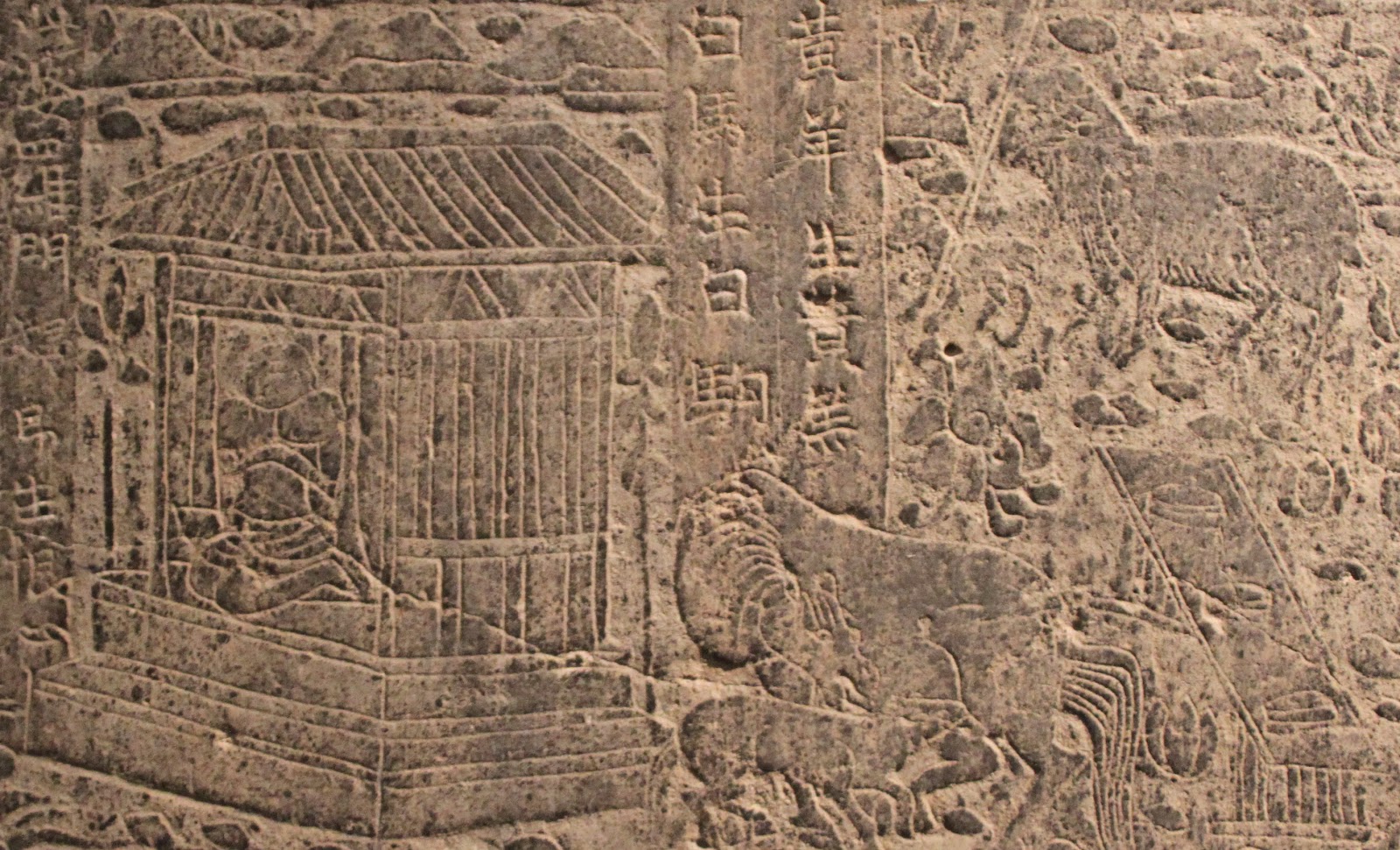
Eastern Wei Stele of 90 Secular Members, 543 AD

a mare with a foal

harnessed horses and carriages

a fine steed in a flying gallop

some personages 


warriors


camel - instrumental in the trade between the Central Asia, Northern Dynasties empires and eastern steppes and Korea.


oxen - 


enjoy

ps 

I will do a post on the Northern Wei and Northern Qi - I hope

Valete
Sunday, March 24, 2024

Manchu Horsemanship Competition for the new emperor Shunzhi


Salvete Omnes, 


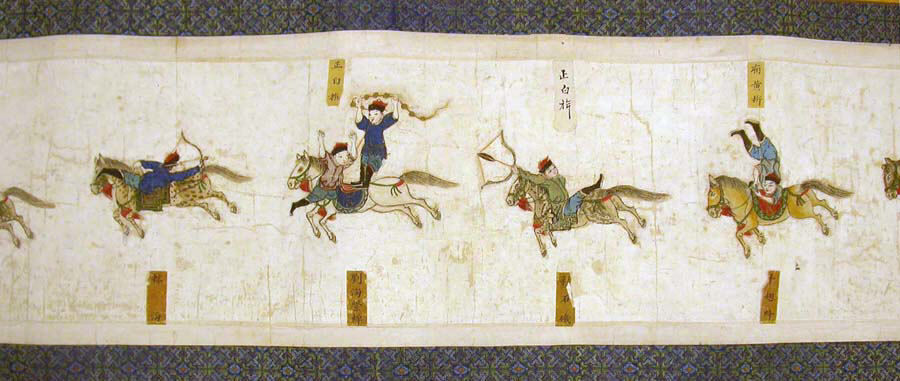
''Horsemanship Competition for the Shunzhi Emperor'' 
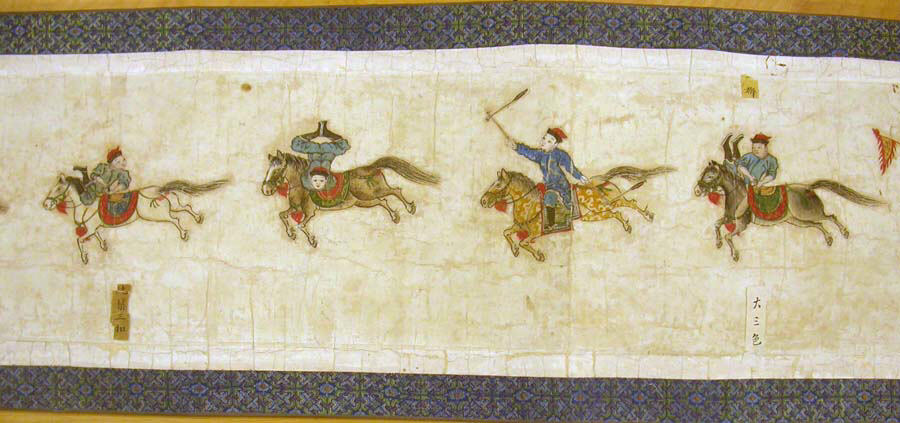


Met Museum has this scroll - hand painted - from the Qing Dynasty period of China.


Painted during reign of the emperor Shunzhi, third of the Qing or the Manchu Jurchen dynasts to rule China, by a court artist Nardubu, circa 1662.
It is very long - Image: 8 in. × 54 ft. 7 in. (20.3 × 1663.7 cm) - and painted with inks & colors/paints on paper.

It represents the horsemanship (dzhigitivka and horse archery) display organized by the emperor's under prince Dorgon (famously successful Manchu commander), in honor of the new emperor on his entry into Beijing (Peking) in October 1644. 
The riders or cavalry men in this competition seem to belong to three, out of eight, Banners of the Qing banner military system. 


The scroll was kept at the Imperial Palace in the capital, but after the whole Opium Wars and rebellions  tragic period in Qing China history, the scroll was sold to the  Westerners and ended up in the Metropolitan Museum Asia Art Collection.
 
enjoy for what it is worth - 

ps

also on Wiki Commons

Valete