|
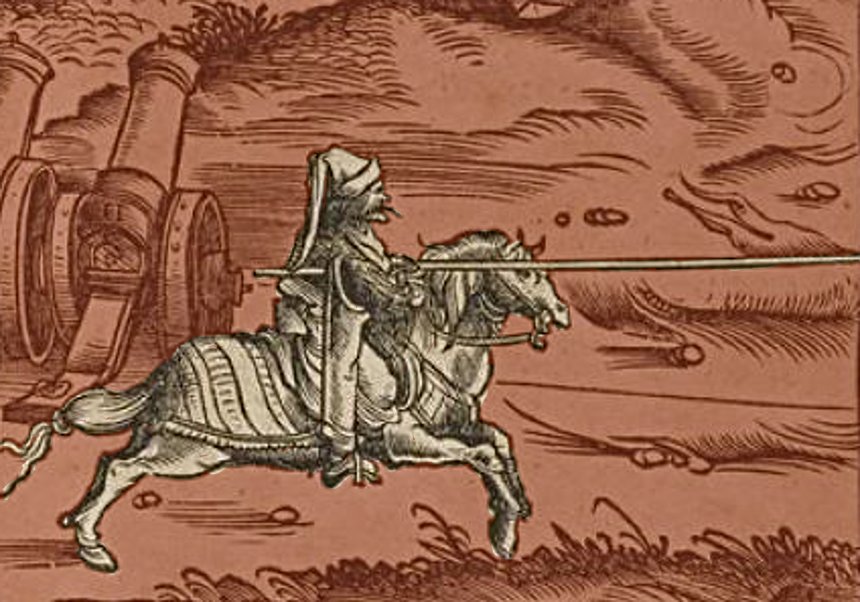
| Adam Czahrowski, Treny i Rzeczy Rozmaite's illumination plus my horse | sketch |
Salve,
we all know about Captain and gentleman John Smith who had been saved by Pocahontas, the Algonquian 'princes' and many years later Disney made a movie about it :).
Well, prior to Jamestown our Captian had same quite extraordinary adventures that merit at least one or more Hollywood films (pretty please).
Born around1580 he was taught arts of the Tudor knight – horse riding, sword fighting, lance fighting and pistol marksmanship – by a Italian-Greek nobleman Theodore Paleologue [or Paleologe], the riding master [ecuyer] to the Earl of Lincoln.
At the age of 23 he was a well rounded master of European martial arts, and found himself fighting as a mercenary for the Hapsburg Emperor against Ottoman Turks and their allies in the Balkans in 1601 or so (well, future Capitan was quite liberal with his places and dates when writing ).
While playing a triple role of an adventurer, Hapsburg mercenary and Christian crusaders, he had three mounted and heroic duels with three different Turkish soldiers (who themselves not necessarily might have been Turkish) during the siege of some strong but unidentified Turkish-Transylvanian held town in the countryside around the capital of Alba Iulia, Transylvania.
These three duels were quite chivalrous but eventually bloody affairs and in many respects do well in recalling previous centuries of chivalry mounted duels, but for one element - the pistols...but let him speak [The True Travels, Adventures, and Observations of Captaine John Smith (1630)]:
*this the original spelling from the 1819 edition of Smith's memoirs.*
That to delight the Ladies, who did long to see some court-like pastime, the Lord Turbashaw did dene any Captaine, that had the command of a Company, who durst combate with him for his head: The matter being discussed, it was accepted, but so many questions grew for the undertaking, it was decided by lots, which fell upon Captaine Smith, before spoken of.
1st duel
Turbashaw with a noise of Howboyes entred the field well mounted and armed; on his shoulders were fixed a paire of great wings, compacted of Eagles feathers within a ridge of silver, richly garnished with gold and precious stones, a Ianizary before him, bearing his Lance, on each side another leading his horse; where long hee stayed not, ere Smith with a noise of Trumpets, only a page bearing his Lance, passing by him with a courteous salute, tooke his ground with such goode successe, that at the sound of the charge, he passed the Turke thorow the sight of his Beaver, face, head and all, that he fell dead to the ground, where alighting and unbracing his Helmet, cut off his head, and the Turkes tooke his body; and so returned without any hurt at all. The head hee presented to the Lord Moses, the Generall, who kindly accepted it, and with joy to the whole armie he was generally welcomed.
This “Turkish' Basha in his winged attire is quite interesting as this account offers us a brief but solid description of a Balkan Turkish 'hussar' noble lancer. Interstingly enough the Turk is wearing an armor and helmet with a buffe – perhaps so called Hungarian
2nd duel
The death of this Captaine so swelled in the heart of one Grualgo, his vowed friend, as rather inraged with madnesse than choller, he directed a particular challenge to the Conquerour, to regaine his friends head, or lose his owne, with his horse and Armour for advantage, which according to his desire was the next day undertaken: as before upon the sound of the Trumpets, their Lances flew in peeces upon a cleare passage, but the Turke was neere unhorsed. Their Pistolls was the next, which marked Smith upon the placard; but the next shot the Turke was so wounded in the left arme, that being not able to rule his horse, and defend himselfe, he was throwne to the ground, and so bruised with the fall, that he lost his head, as his friend before him; with his horse and Armour; but his body and his rich apparcll was sent backe to the Towne.
3rd duel
The challenge presently was accepted by Bonny Mulgro.
The next day both the Champions entring the field as before, each discharging their Pistoll having no Lances, but such martiall weapons as the defendant appointed, no hurt was done; their Battle-axes *was the next, whose piercing bils made sometime the one, sometime the other to have scarce sense to keepe their saddles, specially the Christian received such a blow that he lost his Battleaxe, and failed not much to have fallen after it, whereat the supposing conquering Turk, had a great shout from the Rampiers. The Turk prosecuted his advantage to the uttermost of his power; yet the other, what by the readinesse of his horse, and his judgement and dexterity in such a businesse, beyond all mens expectation, by Gods assistance, not onely avoided the Turkes violence, but having drawne his Faulchion, pierced the Turke so under the Culets thorow backe and body, that although he alighted from his horse, he stood not long ere hee lost his head, as the rest had done.

Alas, the brave Englishman was a bit of a Bayard in his brave duels, and left us with a memorable scenes of dueling and feat of horsemanship in the early XVII century Balkans.
..
*these battleaxes with 'piercing bills' are most likely the 'nadziaks' of the Polish-Lithuanian XVI-XVIII century terminology. Gentleman of my drawing holds such 'nadziak'