Showing posts with label Penjikent. Show all posts

Saturday, May 22, 2021

East Iran in Late Antiquity - oldies but goldies

 Salvete Omnes,


     I have been shifting between subjects in my studies, and recently the ancient and early medieval topic popped out. Namely, I listed to two lectures from 2016 -  hence 'oldies but goldies' - :) 


The Silk Road and the Iranian Political Economy in Late Antiquity - by prof. Richard Payne
and
East Iran in Antiquity: Silk Road and Central Asia outside the Paradigm of Eurasian Trade -  prof. Khodadad 

Rezakhani .


and to go along with the lectures, there are some Sogdian images (including Rustam) or the Sogdians and their famous traders in the Han, Tang Chinese etc art, especially the sculpted figures of the land cruiser of the Eurasian land trade routes - the  camel, the Central Asia context it is the Bactrian camel.
On the Silk Road foundation site   you can read a rather intriguing article by Daniel Potts on the Bactrian Camels and Bactrian-Dromedary Hybrids.


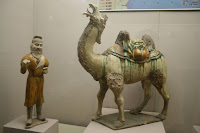


valete

Tuesday, March 21, 2017

Spring & Nowruz


Zaroastrian eternal Bull (the Moon) and eternal Lion (the Sun)
Salve,
Spring has arrived in the Northern Hemisphere - finally  - :)
Marzanna has been drowned - :)


... happy New Year as it is Nowruz time!
Rustam, the hero

The Sogdians of Sogdiana


enjoy
ps
all pictures courtesy WikiCommons

Friday, July 18, 2014

On the Sogdian painting and Sassanian connections

Salve,
 I am always interested in all things pre-Islamic and early Islamic greater Persia, this time I want to share with you a link to an article titled  'Sasanian traditions in Sogdian paintings: hunting and fighting scenes' by Geri Della Rocca de Candal, available for reading or download at academia.edu (or a link via this interesting Facebook page titled Eran ud Turan ). Sogdiana or Transoxiana or Turan  was the land of Silk Road traders, horse breeders, artists and sometime warriors living in the shadow of the great empires of Persia and China and roamed by the Saka and later Turks/Turkuts, until conquered by the Arabs during the VIII century AD (and known since then  as Ma warāʾ al-nahr).  Introduction to the Sogdian art via iranica.com.

Persian and  Sogdian hero Rustam/Rostam (known to us through Shahnameh/Schāhnāme of Ferdowsi - nota bene article on early illustrated version of Shahnameh from 1333AD) in his splendor from a mural at Panjikent (image from Wiki Commons)

Last days of Panjikent - article - and if you curious more about the last ruler of that Sogdian city and his famous palace at Mugh Mount.

From my own stable :)  I drawn this image from a metal plate of Pur-i Vahman, it represents my newest attempt at copying this image. For our interest his stallion's bridle includes the dropped-cavesson (metal noseband) plus bit arrangement, horse's tail tied like a swallow's one,  then a cropped and cranetallated mane, and clearly depicted stirrups in more or less steppe and Korean fashion. Horse tack is still adorned with Persian elements (horse tail and a phalera), reflecting Sassanian and Saka traditions.

Dr  David Nicolle talks about this plate in his other book - Armies of the Islamic Conquest (Osprey Publishing, page 42).