Salve,
Let us turn for a moment to the Napoleonic era and the glorious year 1806 when Napoleonic armies liberated a small portion of Old Polish-Lithuanian Commonwealth, the events leading to creation of Duchy of Warsaw, with the most dashing cavalryman at the helm of the Duchy army- prince Józef Poniatowski.
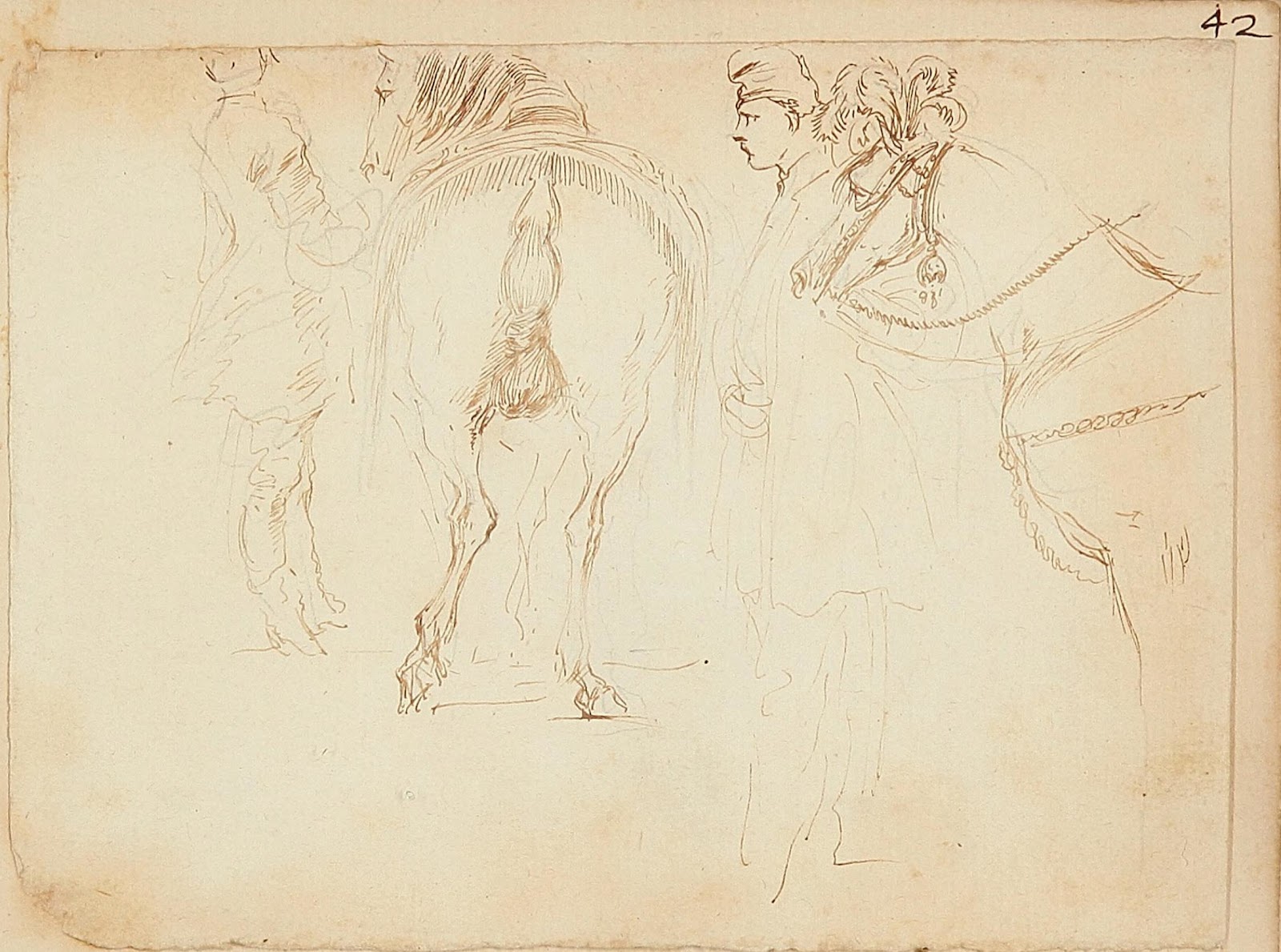
The subject of today's post is a Towarzysz of the Dziewanowski regiment ('pułk') - winter 1807.
There was this cavalry in Prussian army, called 'Towarzysze'' or companions (called Das Korps Towarczys -in the army order Hussarenregiment No.9: a regiment of 10 squadrons and a battalion of 5 squadrons - here in Knotel's reconstruction ), created from petty noblemen (companions) and peasants (retainers) of the newly conquered Polish provinces in 1799-1800, including one squadron of 'Polish Tatars' ( ''Tartaren Schwadron''
), and organized along the lines of then nonexistent Polish National cavalry regiments, with companions armed with lances and retainers with pistols and carbines, or as I found elsewhere the companions carried lances painted in white and the retainers painted in two colors (perhaps more research into the German sources could elucidate on this element of their equipment).
During the war of 1806 when Prussian army was beaten by Napoleon and his commanders, and French armies entered Poland, some of the Towarzysz regiment cavalrymen deserted to the newly organizing Polish cavalry allied with Napoleon - here a discussion in Polish, fantastic forum on the Napoleonic period, about the period 1800-1807 - while the Towarzysz battalion was destroyed at the battle of Bieżun, where uhlans surrendered to the French, in December 1806.
They were grouped under the command of Dominik Dziewanowski and valiantly fought the Prussians and Russian during the Winter and Spring of 1807. Historian and Napoleonic reenactor Andrzej Ziółkowski , who is writing a book on the 6th and 2 more uhlan regiments, kindly shared with me a piece of his writing on these cavalrymen where I read that they had worn Prussian uniforms while back in our Polish Homeland service and had horse hair plumes attached to their headgear- black peakless shako. In spite of the risks involved, wearing the uniform of the former command and present enemy, these uhlans performed fine service during the numerous skirmishes and battles of the reconquest of Gdansk Pomerania from Prussia. These uhlans eventually became the core element of the 6th regiment of uhlans of Duchy of Warsaw, commanded by Colonel Dziewanowski, the best cavalry regiment of the Polish Napoleonic army (Vistula Lancers and Polish Chevaulegers were part of the French Napoleonic army).
Here a text on the early life future German emperor Wilhelm (William I) and his infatuation with the Towarzysz regiment : ''he saw the uhlan regiment
Towarczysz, at that time the only one in Prussia,
and was so charmed with its singular uniform
that he begged his father for one like it. The
King, always ready to encourage his military tastes,
granted his wish, and from that time he alternated
between a uhlan and a hussar.''
Prussian cavalry in 1805, when Poland's Warsaw was but a medium Prussian city
A good introduction to the Prussian cavalry of the era Prussian-Cavalry-Napoleonic-Wars-Men-At-Arms 1
And here, at the Kujawsko-Pomorska Digital Library, a book by Janusz Staszewski on the Pomeranian campaign in 1806-07 , can be downloaded in djvu format.
...
ps
I did not give him the sabretache that they normally carried at the belt while in the Prussian service.
...
Some German info:
Regiment Towarczys Nr. 9, mit Lanzen bewaffnet, 10 Escadrons. Focht 1807 in Preußen und blieb bestehen. Es hatte kein Depot.
Bataillon Towarczys, 5 Escadrons. Focht in Preußen und blieb bestehen, Inspektion der Towarczys: General Lieutenant v. L'Estocq.
1. Das Regiment Towarczys.
Inspektion des General-Lieutenants v. L'Estocq. Garnison: Tulczyn, Drohyczin, Iabludow, Lomza, Ostrow, Bransk, Ostrolenka, Knyszyn, Boczky, Wyztowo. Chef: General-Lieutenant L'Estocq, General-Major v. Kall Commandeur.
2. Das Bataillon Towarczys.
(Hieraus wurde
das jetzige Westpreuß, Ulanen-Regt.
Nr. 1 u.
das Schles. Ulanen-Regt. Nr. 2 formirt.)
Garnison: Augustowa, Raigrod, Suchawolla, Ianow, Lipsk.
Major und Commandeur: Schimmelfennig v. d. Oye.