Showing posts with label Old Polish horsetack. Show all posts

Thursday, January 1, 2026

Year of the Horse 2026

 Salvete Omnes,

so the New Year has arrived - my very first post of this brand new year

It will be the Year of the Horse - in Chinese zodiac calendar. So starting February 17, 2026 it will be the Year of the Fire Horse. 


here I used one of the Polish horses in Polish tack from the Certamen Equestre
The world may gallop a lot this year... 
I hope for the best but get ready for a ride, my friends and fellow Net travelers. 

.


Enjoy

Valete

Tuesday, July 1, 2025

Two Riders - R. Savery - National Galleries of Scotland

 Salvete Omnes,

a new month has started and the Dog Days of the Summer have started as well - so let us start .

National Galleries of Scotland graciously allow us to share their digitized art collections, and one of period gems is this drawing by Roelandt Savery. (crica 1605-10AD)


.


Note that both riders are mounted on stallions and judging from their conformation these warhorses are of 'eastern', lighter, type. 

Are they the Old Polish kozaks cavalry ? Well, difficult to say - Savery had lived in Prague, Kingdom of Bohemia ( Austrian Hapsburg Empire) at least since 1604AD. But also he traveled down south to Croatia (then part of the Hapsburg Kingdom of Hungary) and Croats, Serbs of Krajina and Hungarians (including various ethnic horsemen of that Kingdom) used costumes, armor, weapons and horse tack similar to their Polish counterparts, and the preference to ride stallions and geldings instead of mares. Savery was a master of portraying of these East-Central European warriors, so just let us enjoy the drawing.

enjoy

Valete


Tuesday, January 7, 2025

Stefano Della Bella, Disegni e pensieri originali (schizzi a penna) - Polish horse & horsemen

Salvete Omnes,


a quick but full of wonderful sketches in pen and ink by an Italian maestro of the XVII century.

Polish costume - zupan, delia and kolpak


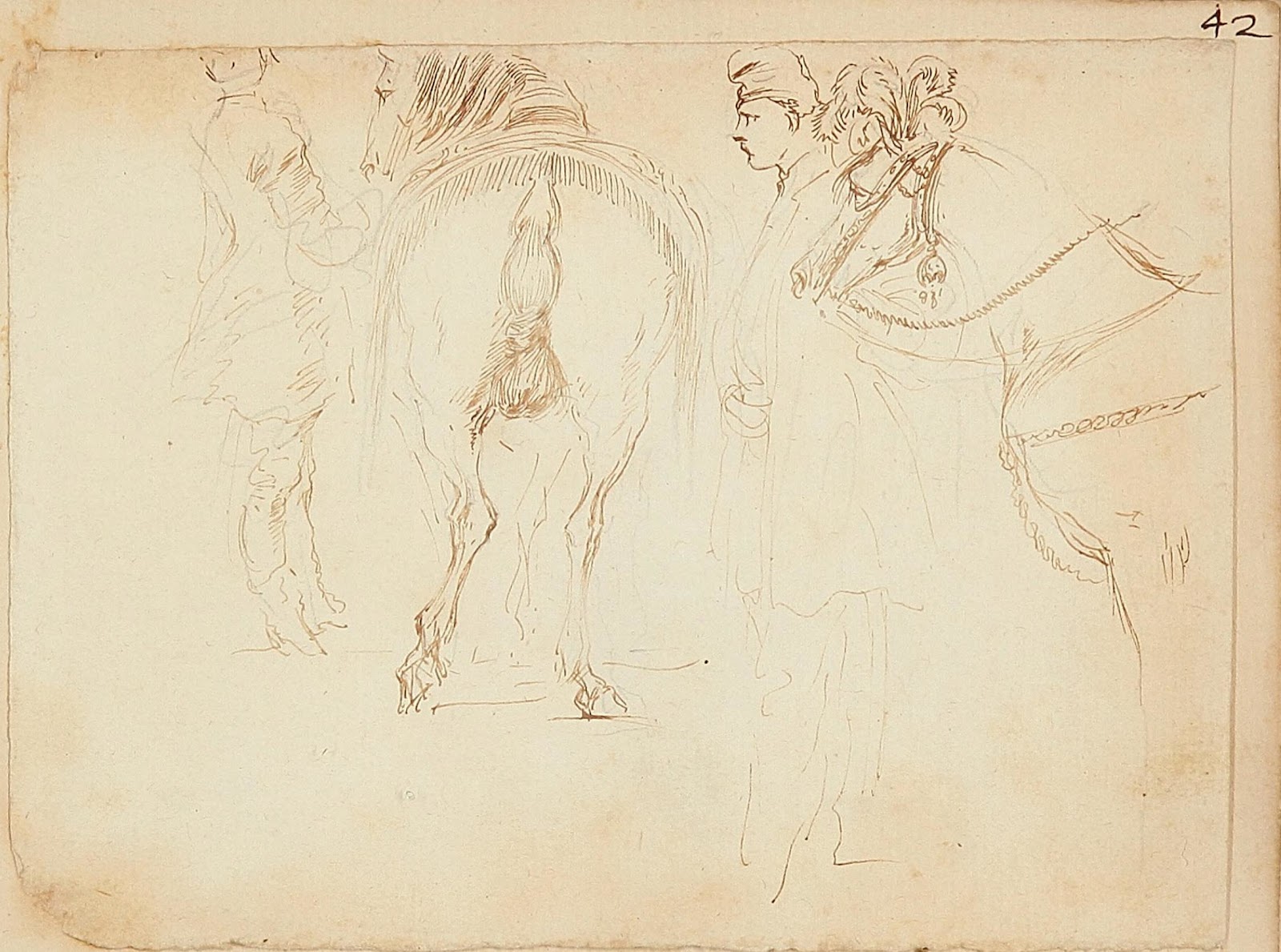
 Stefano Della Bella, Disegni e pensieri originali (schizzi a penna) from Florence, available on Archive .  Sketches were drawn  in Rome during the 1630s, and can be associated with the so called Ossolinski entry into Rome. 

I corralled for you the Polish horse and horsemen, ad a few Ottoman & Safavid Persian portraits drawn by maestro Stefano:


outfitted horse with a jarczak saddle and splendid bridle 


tying of the sash, Polish style, also shaved head with a hair lock, sabretache 


..


enjoy 

Valete

Monday, December 30, 2024

Ballpen drawings & Sketches of Old Polish horsemen and horses

 Salvete Omnes

the very end of the year, it has been not a bad year AD2024 ... but for the wars and mayhem all over the world. 

I have not been posting my own drawings & sketches lately. 


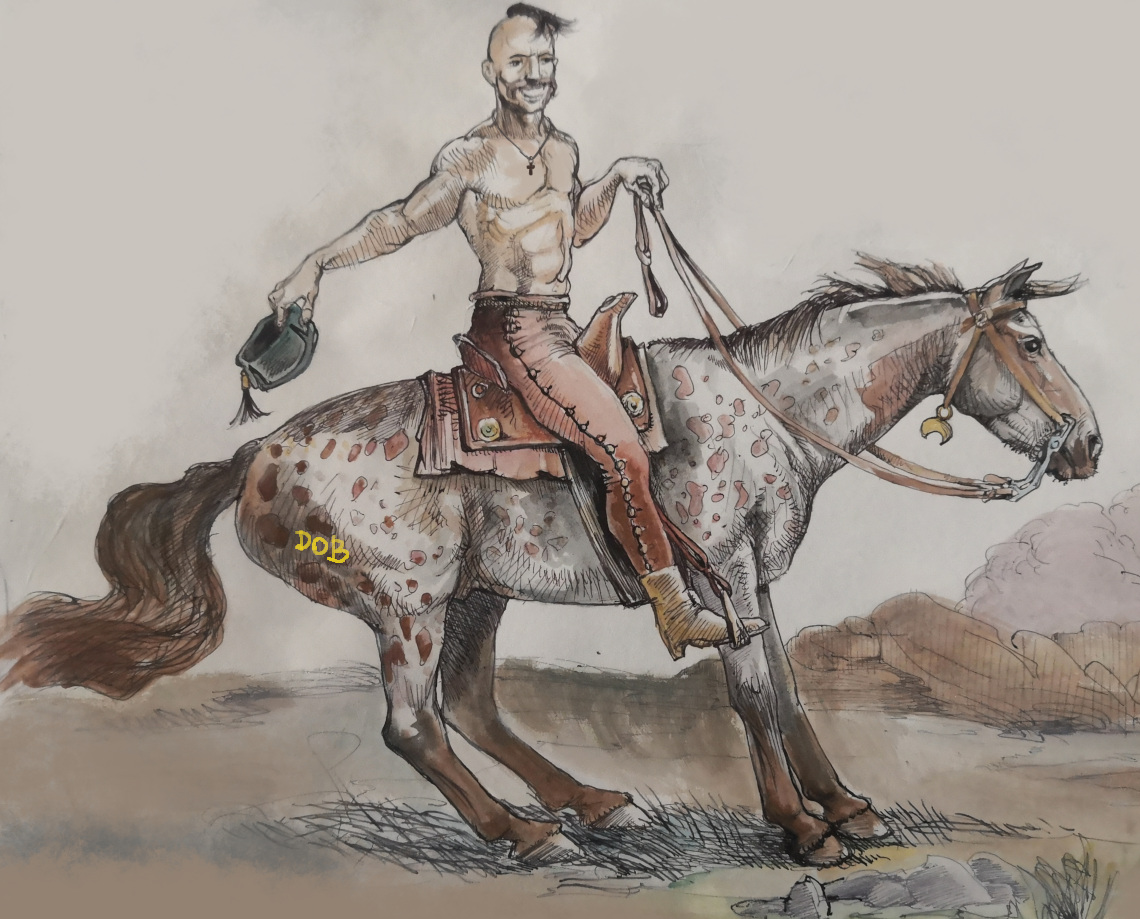
So in the spirit of the New Year's Eve,  San Silvestre, Sylwester or la Noche Vieja coming tomorrow night, I am pleased to share  some of my Old Poland horsemen theme drawings & sketches in ballpen on paper, with some gouache and/or watercolor or gesso (some little resizing etc in GIMP and Krita)


..


.


Enjoy

Salvete

Sunday, June 30, 2024

Johann Georg Pforr - Polish horses

 Salvete Omnes,


J.G. Pforr (1745-98) was active in Western German state of Hesse-Kassel. Being a son of a tenant farmer, he went to work in a mine, injured there he then was hired as a porcelain painter, and from that factory he went on to become a full-time painter. 
Influenced by Philips Wouwermann, Paulus Potter, and  other Dutch painters, he was called a German Wouwermann by his fellow countrymen. Johann Pforr died too early, in his 55 year, and he art remains.

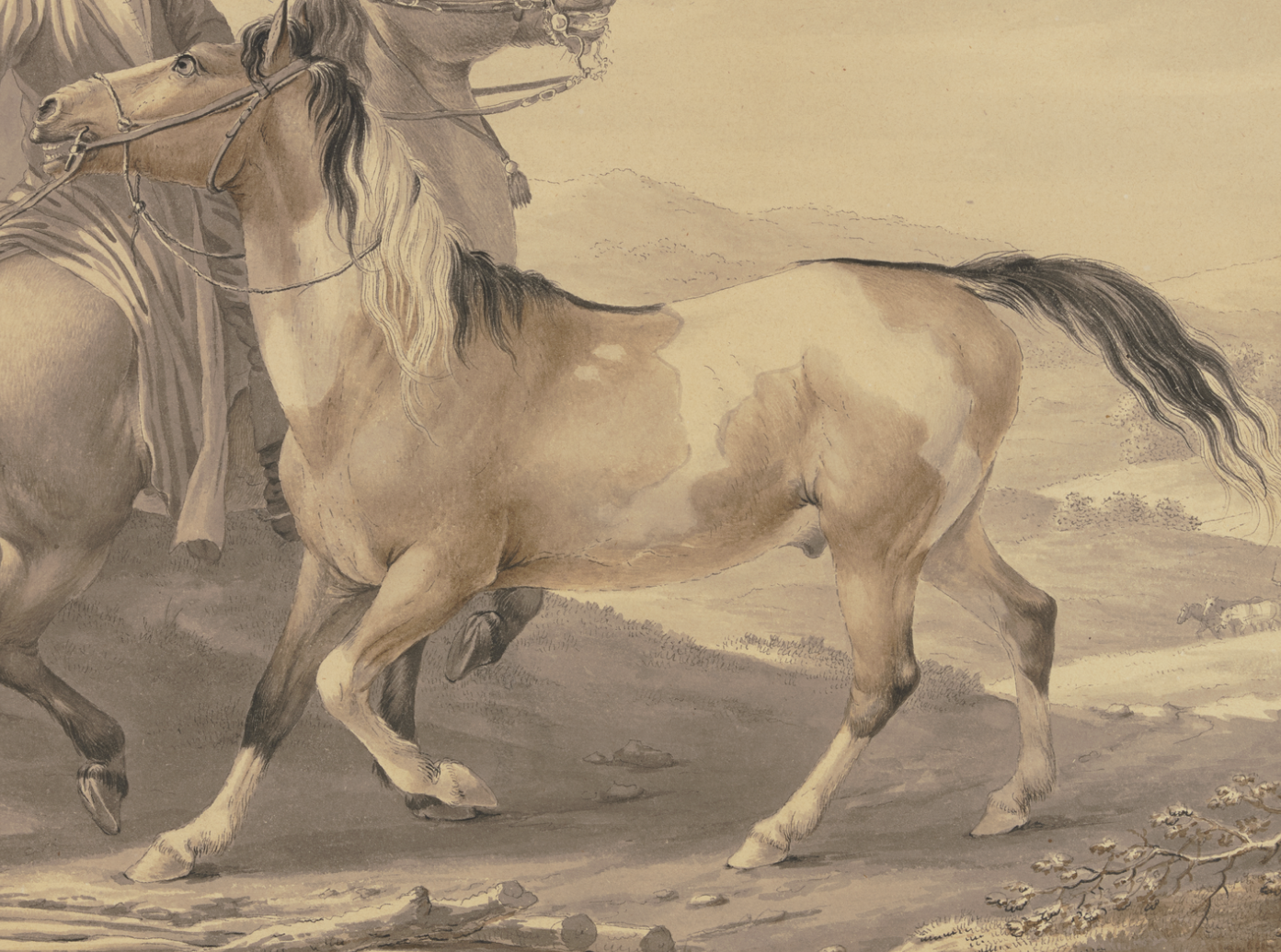
curious bit and kind of interesting headstall & the third rein 


from his 'stable' of horse drawings and paintings comes this piece-  Polish horses of his era. This artwork is held at  Städel Museum in Frankfurt on Main River, western German state of Hesse.

very typical Polish headstall and bridle of the period 


A rider dressed in Polish traditional costume - zupan and kontusz or some other overcoat  and rogatywka/konfederatka czapka or headgear - mounted on a bay? horse holding a paint horse

I wonder if the rider's costume was taken from some Saxon archive, as in Saxony there were Polish-Lithuanian Tatar lancers or uhlan/ulan regiments until 1763. 


enjoy

Valete

Thursday, June 27, 2024

Juliusz Kossak, his stud presentation in print from National Museum in Warsaw

Salvete Omnes,

so the Dog Days of the summer have arrived.   

a little short entry 


I truly enjoy the art painted and drawn by the Polish XIX century painter Juliusz Kossak.

some year ago I posted this color version of Juliusz Kossak's oil painting - Mohort presenting the herd to prince Poniatowski.


Polish National Museum in Warsaw has a print (digitalized)  , showing the whole presentation scene in a  different composition, made circa 1870AD, the painting was owned by Mrs Eugenia Juszkiewiczowa.


enjoy
Valete

Friday, February 16, 2024

Pan hetman Stefan Czarniecki - the glorious commander of Old Poland

 Salvete Omnes,


today, but in 1665AD, Stefan Czarniecki Lodzia coat of arms, field hetman of  the Crown Army of Polish-Lithuanian Commonwealth, passed away. He died at Sokolivika, nowadays Lviv oblast in Ukraine, then a village in Red Ruthenia and Lwow Voivodeship, south-central Crown Poland - Polish-Lithuanian Commonwealth. 

Painted from life portrait of Stefan Czarniecki

XVIII century version - the scene of Czarniecki's passing by Franciszek Szmuglewicz


Born in 1599AD, pan Stefan spent his entire life in the saddle, and later on he was painted on horseback by various artists.
But today we shall commemorate this great warrior and horseman with the paintings showing his last moments with his favorite war steed . his gray mount - as envisioned by Polish early XIX century master January Suchodolski (two versions of the canvass) .


Nota bene Jan Chrysostom Pasek served under Czarniecki during the Deluge and the Polish-Russian war. 

His legacy lives on and even today Polish school children, workers and soldiers when singing the Polish National Anthem, sing about his daring raid on the Als during the Deluge. 

Another Polish painter, Leopold Loeffler, painted  the death bed with a war steed scene -


Also maestro Juliusz Kossak painted this scene, here reproduced in 'Tygodnik Ilustrowany' in 1909.


ps
I like the brushes on another Polish maestro Szymon Kobylinski, and one of these days I shall copy for your viewing pleassure one of his drawings showing Czarniecki and his horse. 

Valete

Saturday, May 27, 2023

Kossak - Mohort presenting the herd to prince Poniatowski

 Salvete Omnes,
a short entry - 
Juliusz Kossak's paintings have graced these blog 'pages' for many years.
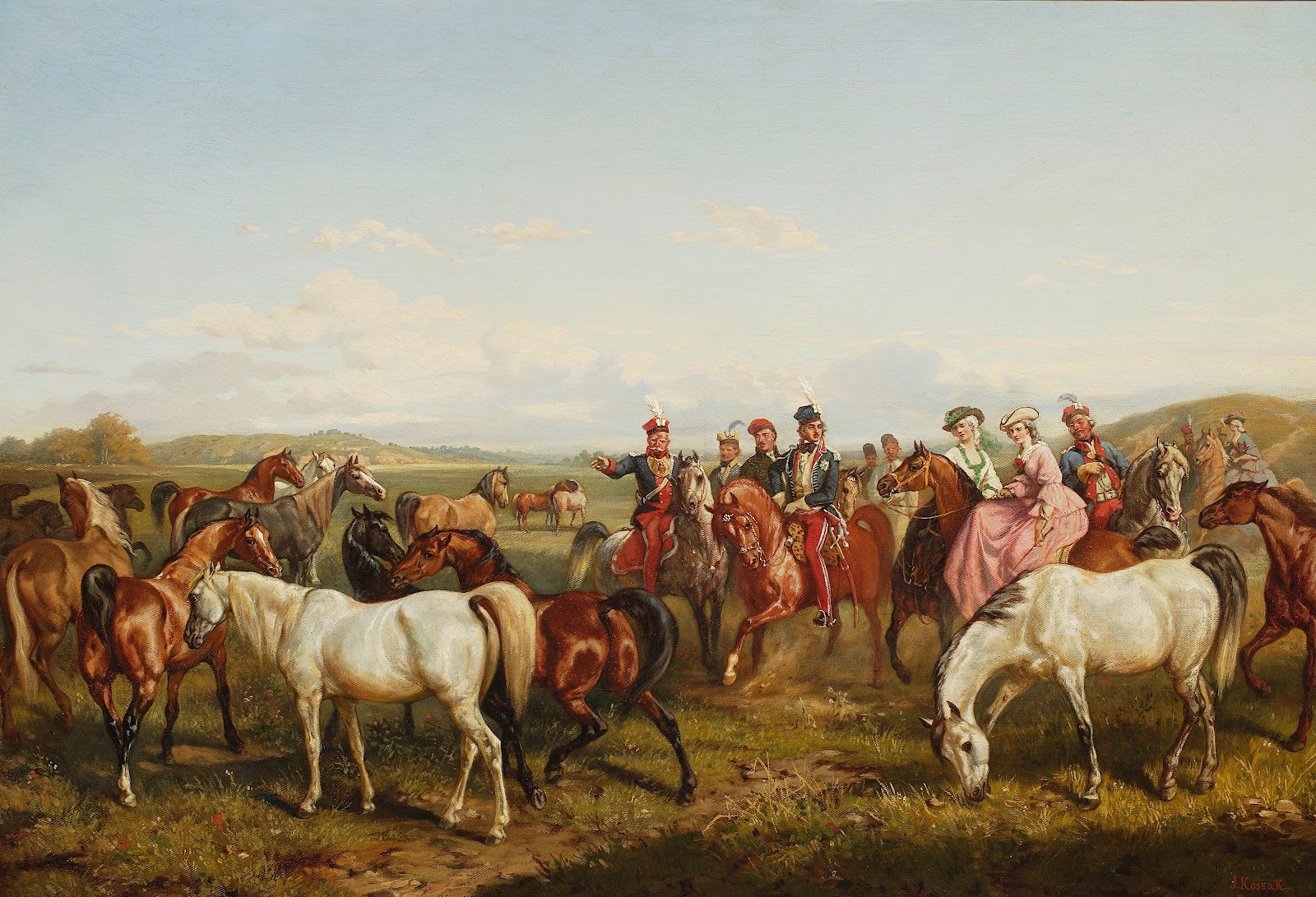
National Museum in Warsaw has a good size copy of his painting on their digital collections webpage- Mohort prezentujący stadninę [Mohort presenting the herd ...to prince Jozef Poniatowski], painted in 1858AD. Unusually this painting is an oil on canvas work, whereas the typical medium used by Juliusz Kossak was watercolor (with some gouache, ink etc) . 
Here, the main protagonist is  a fictitious 'knightly' soldier-cavalryman, the defender of the Borderlands, the hero of Wincenty Poll's epic poem - Mohort. He rides next to a real hero and the last knight of the Old Poland - prince Jozef Poniatowski.
The three main male characters are portrayed in the late XVIII century Polish cavalry uniforms, while the ladies are perhaps dressed in some riding attire of that period? , I am not versed in the female fashions of the ear. 
The site is somewhere in the Old Poland's southern or eastern lands, that make today's central  Ukraine, our Polish lost mythical Kresy or Borderlands. 


The horses painted on this canvas most likely come from numerous sketches and in situ observations maestro  Juliusz Kossak made while visiting Polish studs and herds in those lands. He was friends with many Polish breeders and land owners of the era, painted many portraits of their horses and herds, while the very old Polish lands had been divided between the Russian Empire and Austro-Hungarian one during the three Partitions of Poland (1772-1795);  and in the past these lands were always Polish Crown centers of horse herds and war horse production. We suspect that the so called Old Polish Horse, used by the winged hussars and National Cavalry & Uhlans came from the Ruthenian and Podolian farms.
Perhaps it is worth noting that the majority of these fine Polish stud farms, breeding Polish Arabians as well, were destroyed during the World War I, Bolshevik Revolution  and the independence wars after the dissipation of both empires 1917-20

Valete

Saturday, April 15, 2023

Old Polish horse & tack - Certamen Equestre

 Salvete Omnes,
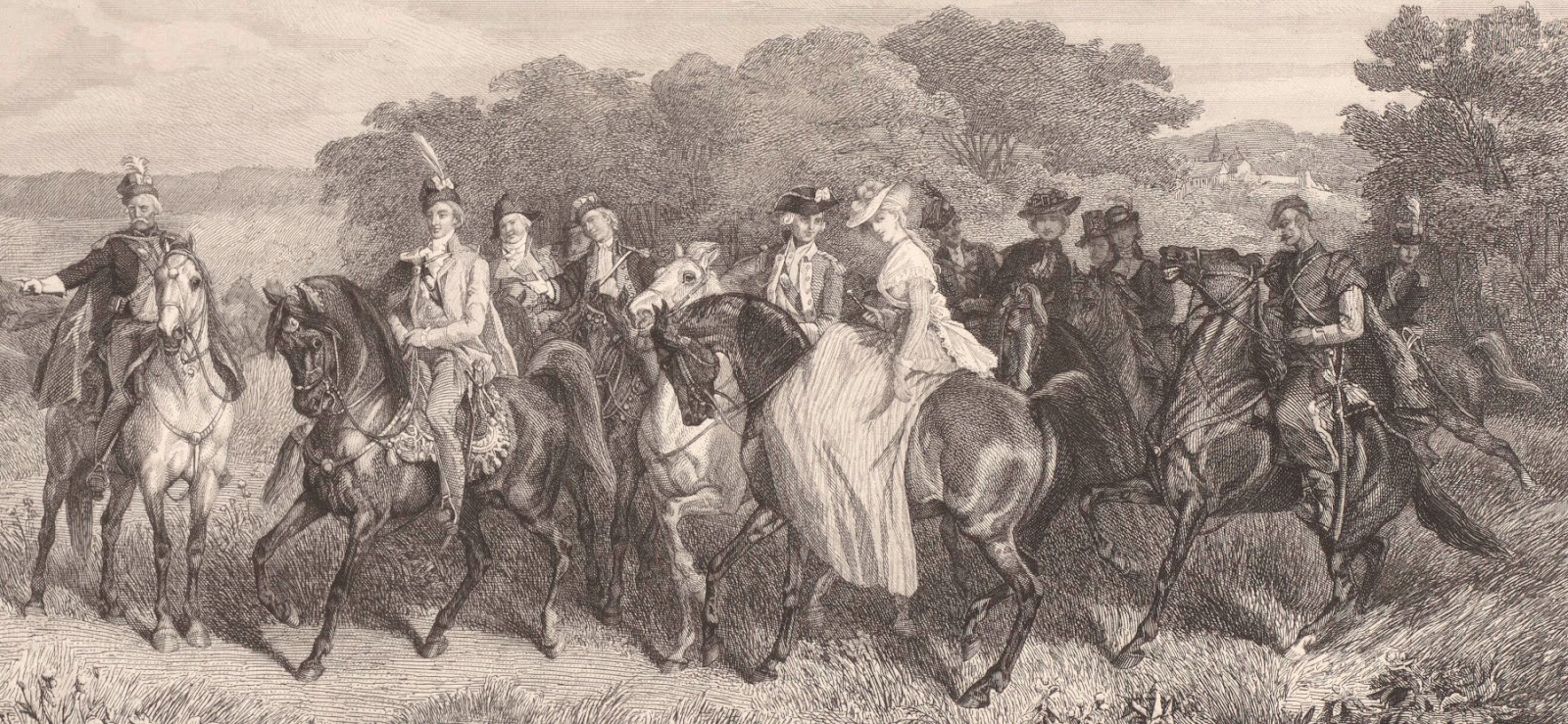


long time ago I posted this description of a Polish horse breed as observed by an English traveler (1737AD) -

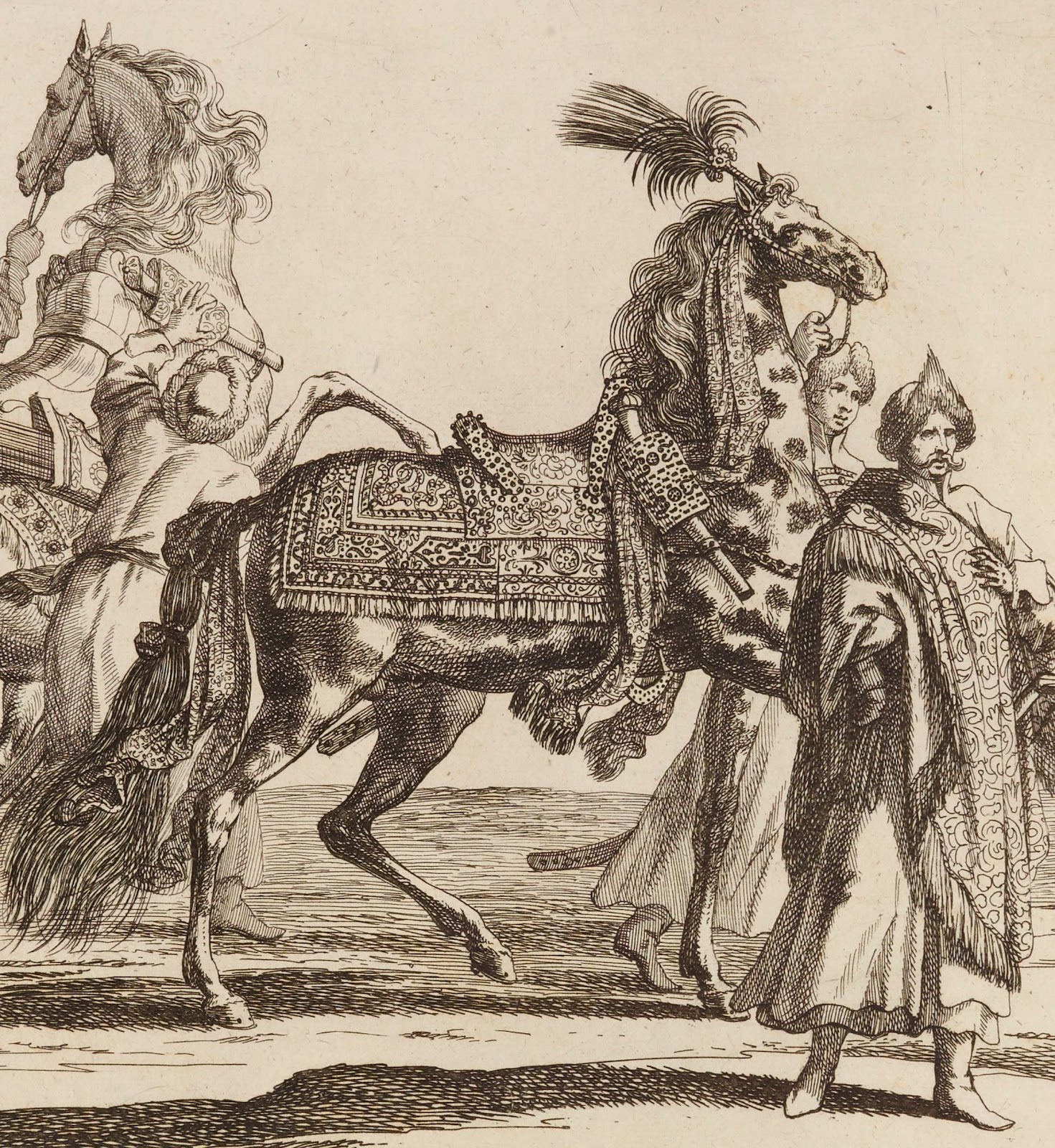
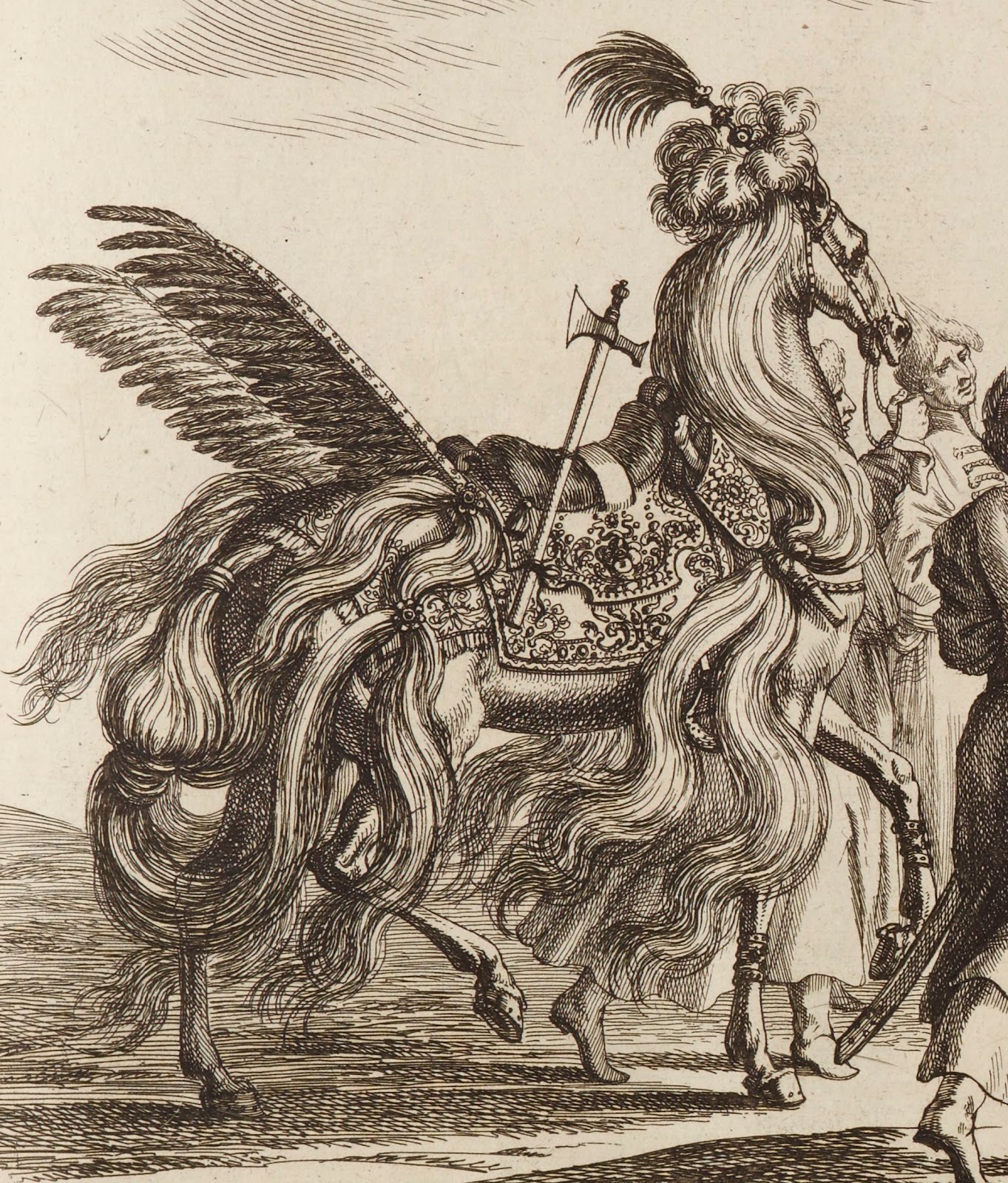
 'These are much like the Danish horse, and are generally about the size of the Spanish Jennet, are of a middle stature, but their limbs are much better knit together, and are of a much stronger make, than the Spanish ones. This horse is in many respects, like our natural English horse, except that their head are somewhat slenderer, like the Irish hobby; but their necks and crests are raised upright, and very strong; their ears are very short and small, and their backs capable of bearing any weight; their chines [shins] are broad, their hoofs are judged to be as good as those of any horse in the world.

.
They are very good for a journey, and will endure long ones, with more ease than any other horse.
' 


So today I am re-posting this short description along with the images of  horses, their tack and riders' costumes from the famous XVII century Certamen Equestre collection which is  a set of prints commemorating the Swedish royal court martial festivities (see my other posts on these prints and their content via Labels) - images edited from Gallica French National library digitized collection.


enjoy

valete