Showing posts with label Circassian-Adyge. Show all posts

Friday, October 20, 2023

Alberto Pasini- Ottoman horses and architecture

 Salvete Omnes,


 weekend almost upon us, may it be peaceful and the ongoing wars around the world will end in some ceasefire &  negotiations before this Christmas.

ad rem, Alberto Pasini, wholly XIX century painter born in Italy 1826 and died there in 1899, started his studies in Parma and proceeded to France where he became a student within the so called Barbizon School (with the Ciceris) in 1852, and then he was admitted to Paris Salon and studied under Théodore Chassériau and his workshop starting in 1854. Later, during the Crimean War, he made his first journey to the Ottoman Empire


Between 1855 and 1876 he made many trips to the Ottoman Empire and further south to Persia and Egypt, and painted many marvelous paintings within the Orientalist tradition of European art. He was to paint more paintings for the fine sultan Abdul Aziz but his Ottoman patron died and thus ended his trips to the Ottoman realm.


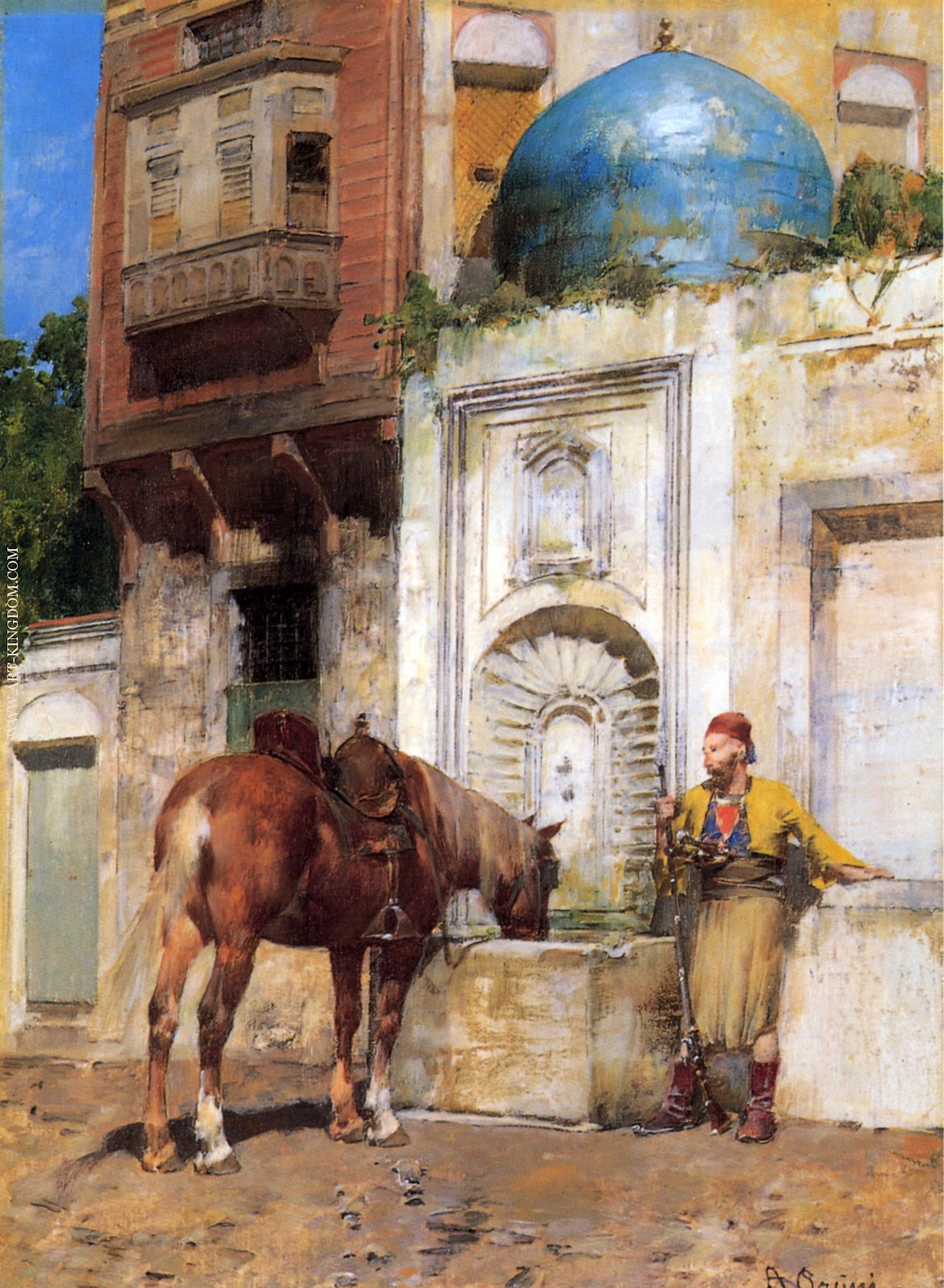
Passini excelled in painting the monumental architecture of the Ottoman and other North African and western Asian  places, with plenty of people and horses going about their business  so to speak.


so for your Friday enjoyment please see some of the fine equestrian details from maestro Pasini's atelier - 

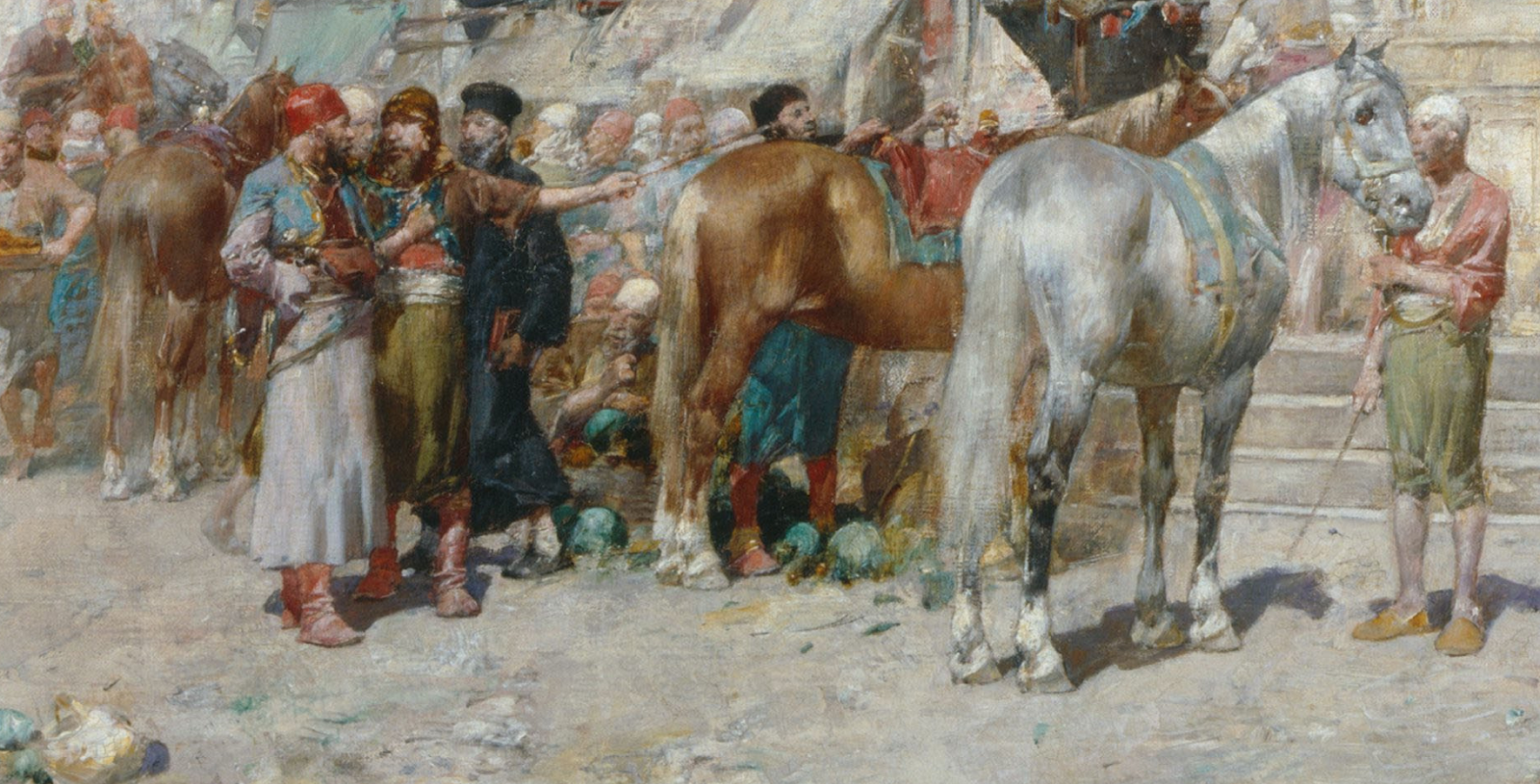
horses in this detail from the Gate to the Bazar


market scene detail with saddled horses


Horse market in Syria, Ottoman Empire


Horse market's details - 


in this detail from the Mosque painting we see some Ottoman Circassian soldiers 


and more Circassian ie Adyge soldiers and their horses and horse tack


some cavalry escort

more cavalry escort

watermelon seller with a saddled gray horse and Albanian soldier?


a cavalry fight scene - reminds me a little of the later paintings by Wojciech Kossak recreating the battle of the Pyramids 


ps 

Rumeli Hisari

Valete

Saturday, December 11, 2021

Franz Roubaud - Caucasus equestrian

Salvete Omnes,


Franz Roubaud - when young a disciple and later member  of Jozef Brandt's circle of painters in Munich, Bavarian Kingdom - was a prolific Russian painter.
Perhaps most famous for his Borodino 1812 Panorama project, he was a prolific equestrian painter, especially painting the Caucasus Mountains region and the ancient peoples who lived and fought and bred horses there.


From Wiki Commons gallery we can get good quality images of maestro Roubaud's canvases depicting the horse people of the most mysterious mountains that divide Asia and Europe in the south.


Valete

Thursday, July 29, 2021

Mamluk - a manuscript & Baptistere de Saint Louis

Salvete Omnes,


so  today let perform a swift jump-in-time to  medieval Africa, more than 500 years ago... with a link to a Mamluk manuscript - Islamic Turkish-Kipchak-Circassian rulers of post-Saladin  Egypt and Syria (1250-1517AD). - a handy 'Art of the Mamluk period' essay on the MET platform .- and the famous Baptistere de Saint Louis from Louvre.

Please note the research I have read uses the word  'Mamluk' - with a capital 'M.' While the later Ottoman period warriors of Egypt and Syria who came to fight under Napoleon, after his  invasion of Egypt, are called Mamelukes (of the Imperial Guard)..


I have been a student of Mamluk history and  research (eg via Mamluk Studies Review etc) related to the slave-soldiers concept and execution in the Islamic world, and their state in Egypt and Syria, so I daresay I am somewhat  familiar with the history, especially military history and some of their 'furusiyya' works, of this sultanate and material culture related to their military and horse culture.


Below there are some military and war horse related works studied and available in English via net libraries:

About 32 years ago a Mamluk-Kipchak work titled Munyatu' l-Ghuzat was translated into English (the Works of Turkish literature ) -

it is a treatise on horseback riding and mounted training for, naturally, the Mamluk 'askari or warrior-soldier.

about 27 years ago preeminent researcher in the military history  dr David Nicolle wrote a very interesting paper: The Realitiy of Mamluk Warfare: Weapons, Armor and Tactics,( Al-Masaq 1994, pp77-100) -  where dr Nicolle discussed a treatise by a writer from the sultanate - Muhammed ben Isa al Hanafi al Aqsara'i (died 1347AD) - titled The Complete Instructions in the Practices of the Military Art.' Dr Nicolle went on writing many articles and books on the subject of medieval Islamic military, including one on the Mamluk 'Askari (from Osprey Publishing, Warrior series, 2014).


In 2001 Isolde Betty Nettles submitted her dissertation on the Mamluk Cavalry practices - (Univ. of Arizona), where the author discussed aspects of the furusiyya and various knightly equestrian traditions.


 and finally the Mamluk  horse manuscript from the British Library


all images come from Wiki Commons  - do take a look at their glassware

Valete

Thursday, November 21, 2019

Pierre Belon. Les observations & Mamelukes, Turks etc

Salvete Omnes,
short entry on this particular XVI century travel - Pierre Belon. Les observations de plusieurs singularitez & choses mémmorables, trouvées en Grèce, Asie, Judée, Égypte, Arabie, aux autres pays étrange.(AD 1588 edition at the French national Library Gallica and English introduction & synopsis with images). English translation (2012) here - but to be purchased not free.

Already an illustrious scientist Pierre Belon, a Frenchman in his country service and protege of the Montmorency family, was sent along with the grand French embassy under Gabriel de Luetz, Baron et Seigneur d'Aramon et de Vallabregues   to the High Porte & the sultan Suleiman (even went to see the campaign against the Saffavids) - here Gabriel d'Aramon portrayed with the Turkish arrows, presumably. Jean Chesneau, who was the secretary to the ambassador, wrote Le Voyage de Monsieur d'Aramon dans le Levant  that we may take a look at  but  at some other time.
 
The scientist voyaged within the Ottoman Empire and upon return in 1549 monsieur Belon may have started composing the aforementioned work for publication, first printing in AD 1553, many later editions. He, being a Roman Catholic, was murdered by some protestant/s in Paris (Bois) in 1564, as France was inherently dangerous place due to the wars  between the Catholics and the protestants.

There are many woodcuts in this work, and two are interesting more than others as they show:
a Circassian  lord on an Arabian horse.


and an Egyptian couple, the faris (knight) with his lance and next to him his wife mounted on a mule, modestly riding side-saddle.


 Arabian nomad? from the Syrian desert, with the bow and arrows.
 

very interesting images worth studying

Valete

Wednesday, September 18, 2013

Circassian horseman

Salve,
while reading a book on cavalry by a famous British cavalryman Louis E. Nolan, I came across this interesting passage on the Circassian horsemen, so let me share it with you:


   General Sir Charles Shaw gave the following most interesting account of the Circassian horsemen
 in a letter published in November, 1853, in the “Morning Chronicle.” -The noble Circassians who have been fighting against Russia, independent of Turkey, have been 
withinthis short time taken into the Turkish service; and it may be interesting to give a description,
by a Prussian officer, of the Circassian cavalry, who are about to take a prominent part in
 the coming conflict. 
He [Prussian] says: 
    The Circassian wears a pointed steel helmet, with a long horsetail pendent from it; a net of 
steel-work hangs down from the lower part of the helmet, protects the front and nape of the neck, 
and is looped together under the chin, underneath a short red vest, cut in the Polish fashion.” [sic!] 
 
   "He is clad in a species of coat-of-mail, consisting of small bright rings of steel intervened; his arms,
from the wrist to the elbow, and his legs, from the foot of the shinbone to the knee, are guarded by thin 
plates of steel; he also wears close pantaloons and laced boots. Two long Turkish pistols, as well as a 
poniard, are stuck into his girdle. He has a leather strap with a noose, like a Mexican lasso, hanging at
his side, which he throws with great dexterity over the head of his enemy; a Turkish sabre and a long 
Turkish musket are slung behind his back, and two cartridge-holders across his breast." 
 
   “The skill with which the Circassians use their weapons is really beyond belief. I have seen them 
repeatedly fire at a piece of card lying on the ground, at full speed, without ever missing.” 
 
   “They will pick up a piece of money from the ground while executing a charge, by bending
 themselves round below the horse's belly, and, after seizing the piece, suddenly throw themselves 
back into the saddle.They form the choicest body of cavalry in the Turkish service, and I have
watched them, when charging,attack their opponents with a sabre in each hand, managing their 
reins with their mouths ; they will spring out of their saddles, take aim and fire from behind 
their horses, then jump into their saddles again, wheel round, and reload their guns as they
retreat in full career. They are perfect madmen in the attack, and few troops would withstand
the utter recklessness of danger they evince.”  
 
 
 “This account of the Circassian cavalry by the Prussian officer may appear incredible to our Life
 Guards, Blues, and Heavies...”


 Above art  by Polish painter Aleksander Orłowski  and a student of Józef Brandt, Franz Roubaud.

Some more images from XIX century: