Showing posts with label Silesia. Show all posts

Tuesday, April 8, 2025

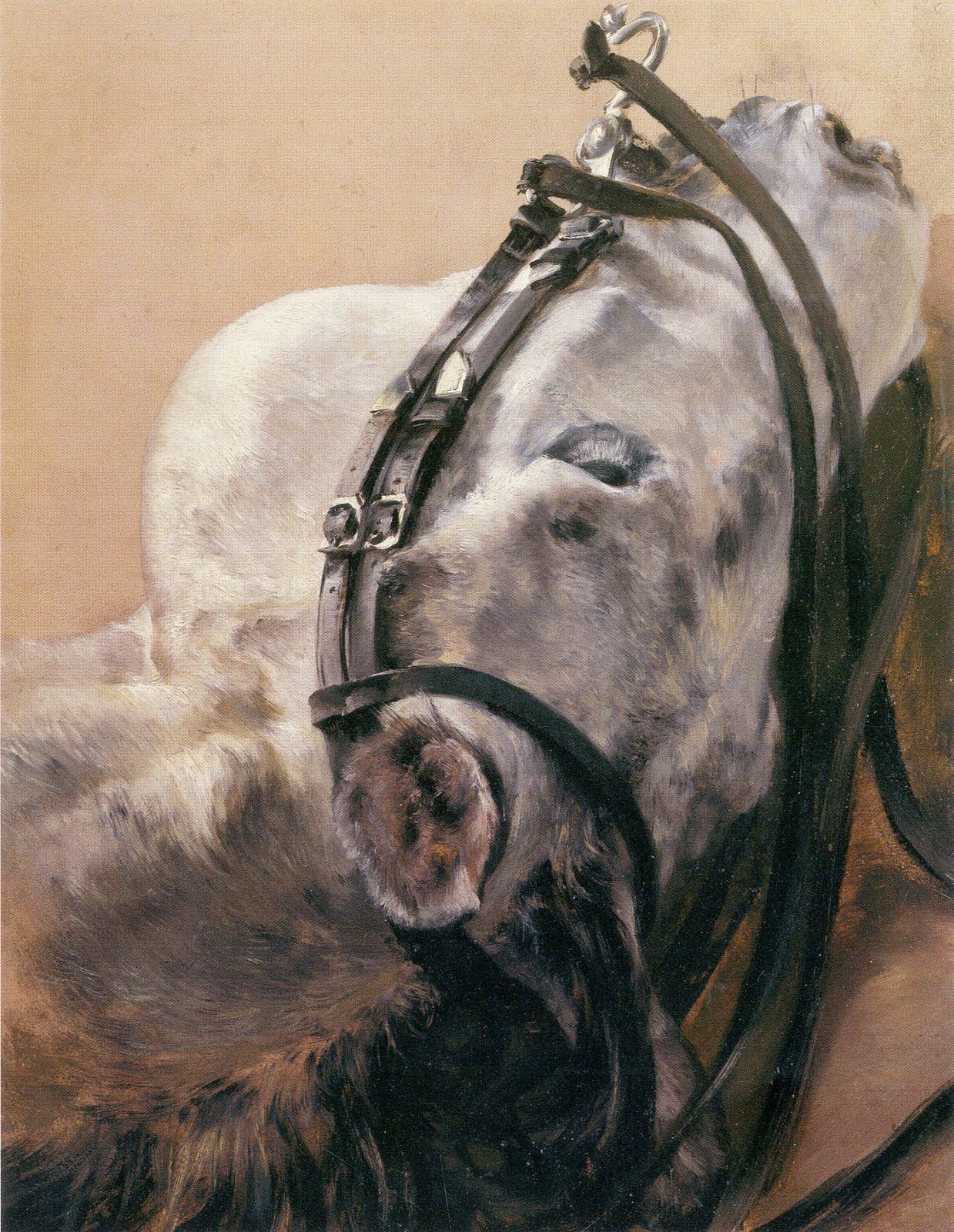
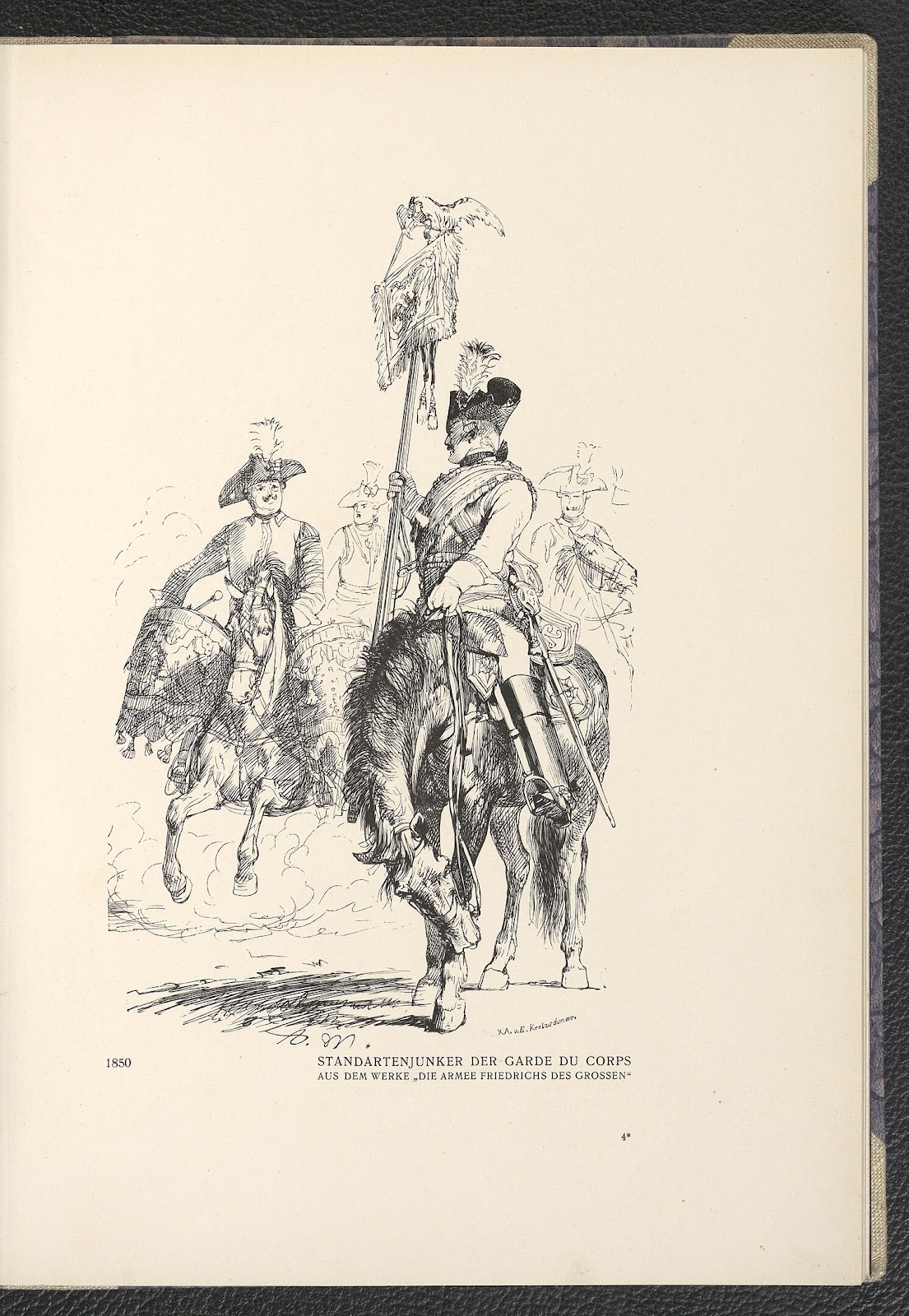
Adolph Menzel - horses and soldiers etc

 Salvete Omnes,


a quick illustrative post - on the equestrian etc themes within Adolph Menzel's works.


Adolph (1815-1905), knighted in 1898 as von Menzel, was a native to Prussian Silesia (born in Wroclaw, old seat of the Lower Silesia), and throughout the XIX century became the preeminent German and Prussian painter of the era in the German states and since 1871 the German Empire. 


Herr Adolph was skilled master in oils, gouache, drawing, printing, 


etchings and woodcuts.


enjoy

Valete

Wednesday, February 5, 2025

Pomeranian-Kashubian Yorck defeats Macdonald's cavalry - 1814

 Salvete Omnes,


several days ago there was 211th anniversary of the battle at La Chausse - Feb, 3rd 1814.
This battle took place during the 1814 defense of France conducted by Napoleon's Grande Armee corps and divisions commanded by his marshals.


In this instance Marshal Macdonald's forces, the XI Corps and II Cavalry Corps, were defending the Rhine River  line from Coblenz on the Rhine.  The French were facing huge numbers of Prussian - Army of Silesia-  and Austrian armies - Army of Bohemia - augmented by the Russian regiments and squadrons. 


General Yorck, a scion of the Pomeranian Kashubian lower nobility family of Jarka-Gostowski, commanded the Prussian 1st Corps f the Silesian Army.

Yorck as a fieldmarshal of Prussian army

the conditions for war during that winter were difficult, especially for the cavalry, with plenty of snow and cold, wind and poor & foggy visibility. 

French cavalry units at the village of la Chaussee were commanded by Dommanget (hussars, chasseur a cheval and lanciers cavalry)  and Marin Thiry  (2 cuirassier regiments), and their potions were constrained by the terrain. Also the French cavalry had poor morale and low spirit, 


while the Prussian horse, including militia horse regiment, was full of military vigor, animus and ardor. They were also disciplined and well trained as horsemen and as miltiary units. 

immobile French heavy cavalry receiving  the charging Prussians 


After the battle Yorck wrote to marshal Schwarzenberg  that the French sufffered loss of: seven guns, six caissons, one standard, several hundred men prisoners. Prussian suffered 150 causalities.  According to researchers at least 100 French were killed. 


I came across this website - where the author, Andrew Field,  goes into the details concerning this cavalry battle, with a splendid use of primary sources and military studies. 


This is the orde de bataille (Order of Battle) acording to Andrew Field's research. 


It was a minor victory of the Prussian cavalry over the French one.
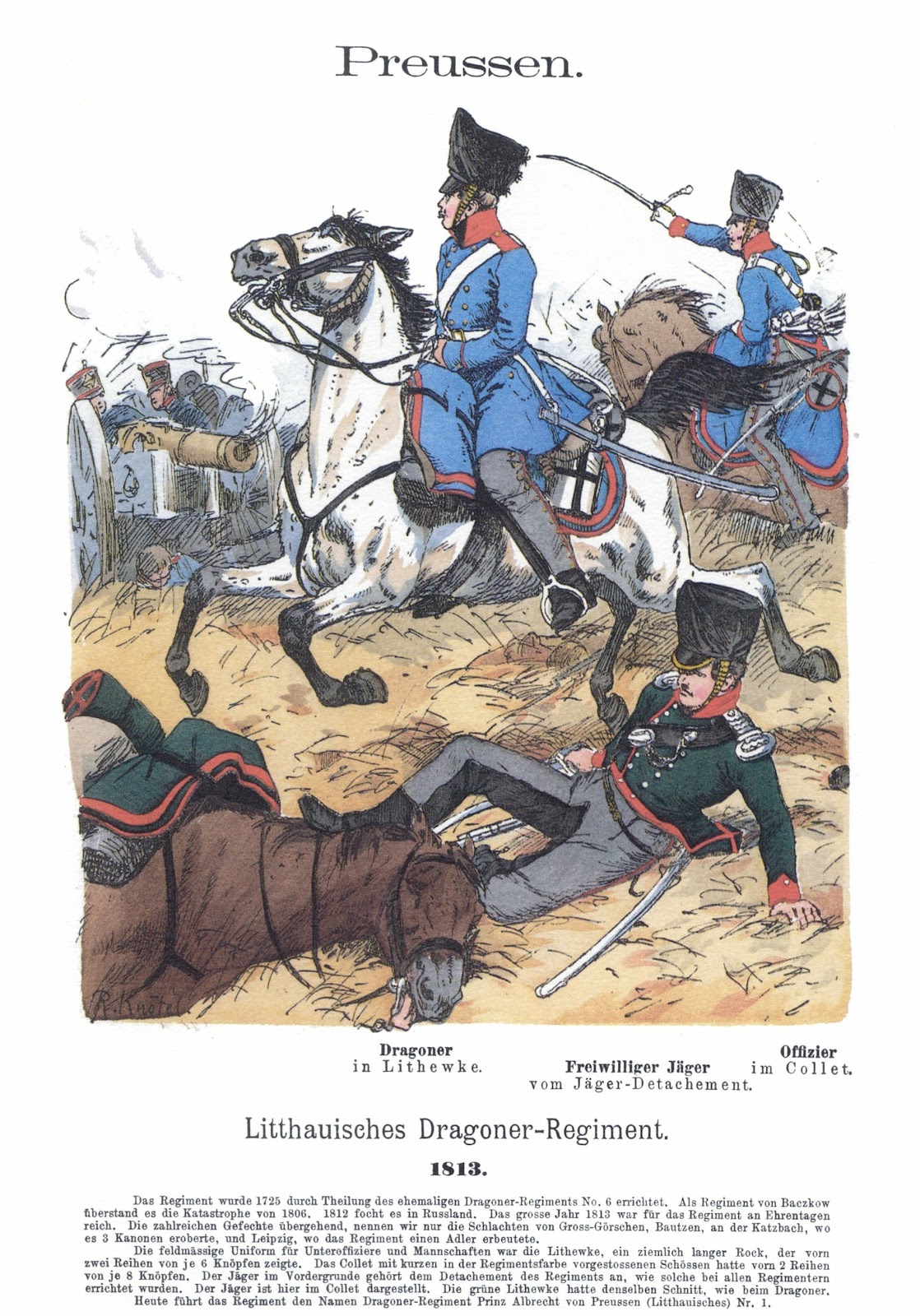
All ink and watercolor plates by Richard Knotel. 

Valete

Monday, May 10, 2021

New medieval painting from Dariusz Bufnal's atelier

 Salvete Omnes,

I have been a friend of one hell of a painter (and musician) from Poland - messer Dariusz Bufnal from Wrocław, Poland - Facebook page here.

I have Dariusz' permission to show on my blog one of his latest brushwork, in his maker's intent and execution  sort of a  window into the XV century borderlands of Silesia, Lusatia, Bohemia and Saxony. Where Polish (Silesian Poles), Czech, Sorbian, German, and Pomeranian nobility and noble clans intermarried and mixed in the plethora marriage and political alliances, adopting language and coats of arms.
The castle-tower and medieval manor of Witkow, Lubusz land and today in part a Polish voivodeship(most lays in the Federal Republic of Germany) belongs to that medieval borderland tradition.
In this painting, one of three painted for the current owners of the castle-tower,  provides a depiction of the Central European  knights from the late XIV and early XV centuries.


   here, on canvas,  we have two brothers von Warnsdorf, Frantzko and Nickel, and their retinue in process of leaving their castle to take part in the Great War 1409-11 ( the Teutonic Order, Sigismund of Luxembourg and their  knightly guests with retinues  against the  Jagiellonian realm - kingdom of Poland and grand duchy of Lithuania) . They have the same coat of arms  - Leliwa - as Polish Kingdom and Silesian duchies clans. In the history of the castle you can read why von Warnsdorfs had Leliwa coat of arms.


The painting was executed in oils on canvas.
Dariusz Bufnal pinxit and all copyrights et al.
ps

maestro Dariusz also painted plates for Trzy Swiaty Sredniowiecza, a study-book on the medieval castles and fortresses from Lower Silesia, written by Grzegorz Kiarszys - Dariusz' Art Station link to some of those plates.

Valete

Tuesday, September 3, 2019

September 1939-2019

Salvete Omnes,
80 years ago the World War started on Sept.1, 1939. Hitler's Germany, Slovakia, and the Free City of Danzig armed forces attacked Polish Respublica (Rzeczpospolita).

In many ways this road to war was a tragic miscalculation on the part of the leadership of the Polish Second Republic. It was during the course of this horrible war,  1939-45, that the occupiers i.e. Germany and Soviet Union, caused the complete destruction of the old Polish nation (compromised of Poles proper, Polish Jews and Polish Germans and Polish Ruthenians and Tatars) and the post-war period saw the emergence of the new Poland under the Soviet yoke etc.


It was the most tragic miscalculation because (to name the few):
- the erstwhile allies - France, England and Romania - either stood by and thus were released from their obligation on Sept. 8th - Romania; or simply made pompous war declaration on Sept 3rd - United Kingdom and France - and then proceeded to do nothing hence the queer name: a 'drole de guerre.'

- Polish central command  had no actual plan in case of the German invasion past some generalities like the rapidly developed screen of individual Polish army groups all along the frontier with Germany and Slovakia and then upon German pressure withdrawal to some unnamed area towards the east to draw the German Wehrmacht into Poland, all based on the assumption that the Western allies would invade Germany and the German war machine would collapse between Polish anvil and French-British hammer.

- Polish central command did not foresee and did not prepare for the new modern war carried out by the Germans in terms of the three-pronged army group attacks  converging on Warsaw, with the extensive use of combined arms: air force, rapid moving panzer groups and mechanized infantry, hence the name of the German tactics the Blitzkrieg.

- Polish central command did not foresee that the modern warfare required modern means of military communications, i.e., radios, and instead relied to their detriment on telephone lines and couriers. It quickly resulted in the almost complete isolation of many divisions and brigades, and the most appalling lack of military communication between the central command and the army groups in the field within  the very first week of the war, and growing worse with each day.
-during the 1930w Polish military, political and economic leadership did not foresee the need to modernize the armed forces for the upcoming conflicts, relying on the traditional marching infantry divisions and cavalry brigades (with large baggage trains), being rather hostile to the air force (like Pilsudski) and tank augmentation (cavalry commanders etc). They actually thought the the German war machine was exaggerated and even upon Germany taking over of the Czech (Skoda factories etc) military industrial complex with their tanks and artillery, they did not saw reasons to worry, in light of the alliance with the British-French mighty armies.

-Polish central command and diplomatic leadership (minister Beck etc) did not foresee the alliance between the Hitler's Germany and Stalin's Soviet Union. Soviet Invasion of Sept. 17th was the straw that broke the Poland's back for good. It resulted in the 4th partition of Poland between Hitler and Stalin.
and there are other miscalculations too numerous to name -
Poland went from saving Europe from the Communism in 1920 to a national catastrophe or even sepuku in 1939.
***

but since I write about the horse and cavalry, so there is something I would like to add about the Polish cavalry AD 1939 and the fight for Silesia -
 
Namely, the Krakow Army under general  Antoni Szylling had one  cavalry brigade aptly named the Krakow Cavalry Brigade or KCB (created in 1937) and this cavalry command  was ordered to screen and defend a section of the border area  that included northern Silesia to the town of Czestochowa (so called White Silesia), with the Silesia region being the pivotal industrial area in Poland, but also full of fortifications and strong points, with a large Polish Germans population but also populated by the most patriotic and energetic Silesians (they carried three uprisings against the post-Versailles Germany 1919-21).
The 10th Cavalry Brigade (without horse cavalry, but mechanized with light tanks and tankettes etc) was made part of Krakow Army but it was not part of the fighting in Silesia, but in the south, in Tatra and Beskid [Carpathian] Mountains front facing the attack from Slovakia on the left flank of Krakow Army.
Each infantry division in Polish armed forces also had a squadron of the so called division cavalry
 [fine diagrams here]. In addition to the regular army there were local Silesian militia units and scouts, some more official as units of   'Ochotnicza Powstancza Samoobrona' (Volunteer Insurrection Self-defense battalion)  that augmented the army and were very motivated and patriotic.

KCB commanded by general Zygmunt Piasecki consisted of:  

-3rd Silesian Uhlan Regiment
-8th prince Poniatowski Uhlan Regiment
-5th Chasseur a cheval
-5th Horse Artillery Battalion
-5th Pioneer Squadron
-a communication squadron in Krakow.

[ detailed reconstruction of a Polish cavalry regiment - in Polish ]
The early morning of Sept 1st, 1939 saw  the Silesian front of Krakow Army attacked by almost 8 German infantry divisions and two panzer division plus numerous air force, Polish units were also attacked from within by the German  terrorists and special operations units wearing the civilian clothes.

During the first hours, starting at 0500 hours, of the German invasion, the defending Krakow Cavalry Brigade came to see the German onslaught in terms of the artillery and aerial bombing of the town of Kalety, and after some three hours the KCB forward elements withdrew towards Wozniki, blowing the bridge on the Mala Panwia River. All  along the KCB front there was heavy fighting, and upon some hard resistance Polish infantry units were withdrawing east from their positions.
Germans entering Silesian towns carried first murders and atrocities on the civilian population and prisoners of war.
Thus already, around the noon hours on Sept 1st, there was a growing gap between the right flank of the KCB and 7th Infantry Division (7DP on the map above). Favorable wooded terrain, in terms of defense, had not been prepared by the Polish defenders, and the German onslaught continued until about 1700hours the German 2nd Light Infantry Division attacked the main units of the KCW but their attack was repulsed. The front, 5km long between Ligoty Woznickie to Wozniki,  held steady by the evening Sept 1.
 Around 0530 hours Sept 2nd, and behind the cover of dense fog, the entire German XV Army Corps attacked the KCW front. Tanks and armored carriers attacked Polish cavalry that had only light anti-tank artillery and machine guns, with the horse artillery providing some punch. Around 0800hours fighting on foot the squadrons of Silesian and Poniatowski uhlans attacked, with drawn bayonets, the German infantry that upon some hand to hand fighting withdrew west past the Ligota-Wozniki highway. Then, around 0900hours, the uhlans were attacked by tanks and general Piasecki ordered withdrawal of all units toward Zawiercie. Around noon the KCW was again attacked by the German 2nd light infantry division in the woods to the southeast of Kozieglowy and was holding their positions with utmost difficulty.
In the end the cavalry was unable to hold the Wozniki-Kozieglowy section and the German panzer units penetrated further east, endangering the Silesian front and units in there. German 2nd division crossed the Warta River in Lgota-Nadwarcie, and thus a corridor of 30km was created between the Polish units. About 2000hours  general Piasecki was ordered by the Krakow Army command to prevent the Germans from crossing Warta and taking Zawiercie but the Germans already had crossed and that part became null.
Around 2100hours general Szylling ordered general Piasecki to take positions around Zarki- Pradla, and the entire KCB moved towards that position ( during the night of  2-3rd Sept 1939.
 This withdrawal, a tactical maneuver, moving the entire cavalry brigade from the right flank of the Krakow Army to its rear (eventually onto Szczekociny and further east) effectively ended the KCB participation in the defense of Silesia.

While they were engaged during the entire 2nd day of war their commander saw the growing calamity of the border battle in their area of operations. Both right and left flank of Krakow Army were compromised by the evening of Sept 2nd. And there was no reserve to counter those flank attacks.

It was earlier on Sept 2nd, around 1430 hours that general Szylling reported to the central command in Warsaw i.e., marshal Smigly and chief-of-staff general Stachiewicz, that the 'situation of his army demands that [Krakow Army] abandons Silesia and congregates closer to Krakow.'
The central command was dismayed and at about 1500 hours the commander-in-chief marshal Smigly agreed  that the entire Krakow Army was to abandon their defenses and to withdraw towards Krakow, but he wanted to defenses continued and withdrawal delayed until Sept 3rd . Fast moving situation on the flanks of Krakow Army - eg by 1800hours German tanks were in Oswiecim (where the Germans would build the infamous Auschwitz contraction camp for the Polish prisoners in 1940) and Pszczyna battle was a calamity - hastened the commander-in-chief resolve and by 1830hours same day marshal Smigly ordered and general Stachiewicz relied this final order to general Szylling that the his army was to withdraw towards Krakow and beyond (Dunajec-Nida Rivers, and Tarnow) immediately. Krakow Army went on their withdrawal until defeated farther east near Tomaszow Lubelski, well after the Soviet Invasion.
Some military historians say that this fateful decision made less than 48 hours into the war in fact caused Poland to lose this war. 


Thus Silesia was abandoned by the regular army by the veneing of Sept 2nd, and by the last regular troops by noon Sept 3rd, 1939.
It was left to the determined and most patriotic units of the Volunteer Battalions and scouts, and civilian insurgents (hard folk like the famus Silesian miners and iron-workers) to defend their Silesia against the Nazi hordes.
Katowice and other towns were defended by the heroic but helpless,  ragtag self-defense units, some civilians and scouts troops, until by the night of Sept 4th the regular German army extinguished all resistance in Silesia, committing numerous atrocities and crimes in this conquest.
vae victis
Valete

Sunday, September 8, 2013

Project White Eagle

Salve,
some time ago in June I mentioned this anniversary - 718 years since white eagle (aquila)  was officially adopted as Poland's national emblem.
Eagle has been the symbol of  states and tribes and clans since time immemorial, Greeks, Romans, and Scythians, just  to name the few. In ancient Greece and  republican Rome  eagle was the companion of Zeus and Jupiter, carrying their thunderbolts, one of the symbols of the Roman Republic. With these divine thunderbolts in his claws eagle also became  the symbol of Imperial Rome, and the symbol of Rome's legions. Imperial Byzantium had a two-headed eagle as its symbol (according to Konopczyński it derives its symbolic two heads from Roman god Janus), while Charlemagne had his palace in Aachen adorned with a large image of the royal raptor. It would eventually  became the symbol the the Holy Roman Empire. (in 1410)
During the high Middle Ages the lands of central and south central  Europe, from Modena, Karniola, and Serbia in the south , through Tyrol, Bohemia, Moravia, Holly Roman Empire and lands of Polish principalities eagle would become the principal image in their coats of arms., while in the north and west image of the lion would dominate.
In Polish history - the Piast state - the first image of an eagle come from a denarius minted by our first king Bolesław  the Brave, while the first mention to the eagle may come from Gallus Anonimus, the author of his 'Gesta principum Polonorum,' who  wrote in the early XII century that Polish troops carried victorious signs.  Wincety Kadłubek, another chronicler and author of the first use of a 'res publica' term for  Poland, wrote that in 1182 our duke Kazimierz II's troops carried ''the signs of a victorious eagle, symbol of royal majesty,'' in the battle against the Kievan Rus troops at the battle of Brest in 1182., so during the Period of Fragmentation various Piast dukes and princes adopted eagle as their heraldic symbol,  first in Silesia, then in Lesser Poland and Greater Poland, later in Kujawy and Mazowsze.
First it was duke of Wrocław Henryk IV Probus who already possessing  the heraldic symbol of black Silesian eagle,, added white eagle, but without a crown, as his second heraldic symbol  in 1290, when he took the throne of Krakow and Lesser Poland.  A month later he had the same eagle, but with a crown on its head, on his seal.
Upon Henryk IV's death, his successor,duke of Greater Poland and Gdańsk Pomerania , Przemysł II took, as per his agreement with Henryk IV,  the throne of Kraków and with it the heraldic symbol of the royal seat - White Eagle. It has been determined that the eagle was white, with a gold ribbon across his wings and chest in the fashion of the Silesian eagle, and its heraldic shield/field  was red/crimson.

I started this project - drawing king Przemysl II in his most royal appearance, most likely mounted, on a fully caparisoned horse.

sketches:

 .

sources
.. from National Archives at Kraków :
Duke Henryk IV Probus - with Silesian eagle on his shield - a drawing from his tomb

.. Henryk IV  Probus from his sepulchre - coats of arms on Poland and Silesia

..  Henryk IV Probus  as shown in the mauscript Mannese Codex - great source for the period costume, weapons, heraldry and horse tack - here the caparisoned horse

.. another Silesian Piast prince Henryk V of Legnica


..Bolko I of Świdnica-Zębice - particularly splendid effigy of this Piast prince

..
King Przemysł II as drawn by Jan Matejko
.. king Przemysł II's royal seal - Premisl II Dei Gratia Regis Poloniae Domini Pomeraniae

.. Szczerbiec

.. the inscription on this Przemysław's seal says: Redidit ipse potens vitricia signa Polonis (God Almighty returned Polish victorious signs, ie, the eagle)

..

to be continued
* into to Polish heraldry on Wikipedia 

Ps
also, Sept 8  is an anniversary of the Orsza victory(Orsha battle) fought between the Lithuanian-Polish forces under knez Ostrogski (Kanstancin Astrožski ) and the Grand Duchy of Muscovy army under Chelyadnin and Knez Bulgakov-Golica in 1514.  The battle is famously depicted in the Orsza painting (National Museum in Warszawa), one of the most important iconographic sources to the period; please note that early Polish hussars (based on the Serbian and generally speaking Balkan mercenaries) are depicted in the painting.
A song celebrating this victory in Belarusian - (and lyrics)
another song (in Belarusian)

Friday, October 5, 2012

Polish-Lithuanian Commonwealth riders in de Bruyn's album - part III

Salve,
almost 15 years ago Richard Brzezinski published his two, now legendary, Osprey Publishing volumes dedicated to the armies of the Polish-Lithuanian Commonwealth. Volume two included an  overview of the so called Foreign Autorament where Western or German-dressed units were grouped. De Bruyn's engravings belong to Bathory's reign and foreign autorament of the Commonwealth army was reformed under king Władyslaw IV, but German-style cavalry was already  present during our Hungarian king reign.
Here it is worth noting that during Bathory's reign Ducal Prussia was firmly within the Polish control and being an integral part of the Commonwealth provided troops and volunteers for the Commonwealth cavalry and infantry units, along with Duchy of Pomerania and Silesia etc. By the way one of the most famous Renaissance Polish commanders, cavalry foray master, known as Terror Tartarorum Bernard Pretwicz came to Polish Kingdom from Sliesia.
  Royal City of Gdańsk and Royal Prussia, and Upper Silesia also provided German-looking units for the Polish Crown while Livonia, Kurland and northern parts of Grand Duchy of Lithuania also provided German amred and often dressed units.

Here are de Bruyn's German horsemen - and it  seems to me that he was much more familiar with the subject.   Note muzzles and heavy bits, double reins, docked tails and heavier horses than previous two parts' plates.

..

..

..

..

..

..

..

..

..

..

Michal 'Kadrinazi' blogs often about the reiter and dragoon units in the Commonwealth armies, sharing his research about these often forgotten units of Old Poland.