Showing posts with label ancient horse breeds. Show all posts

Monday, January 31, 2022

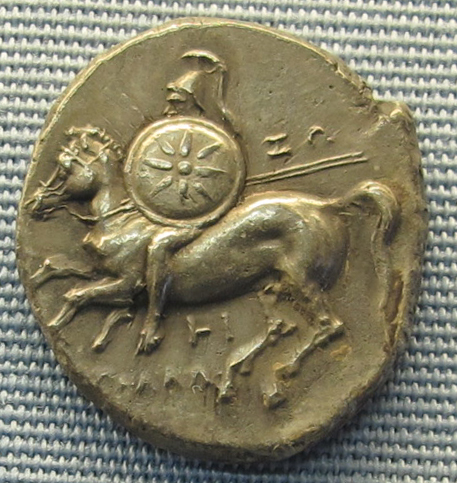
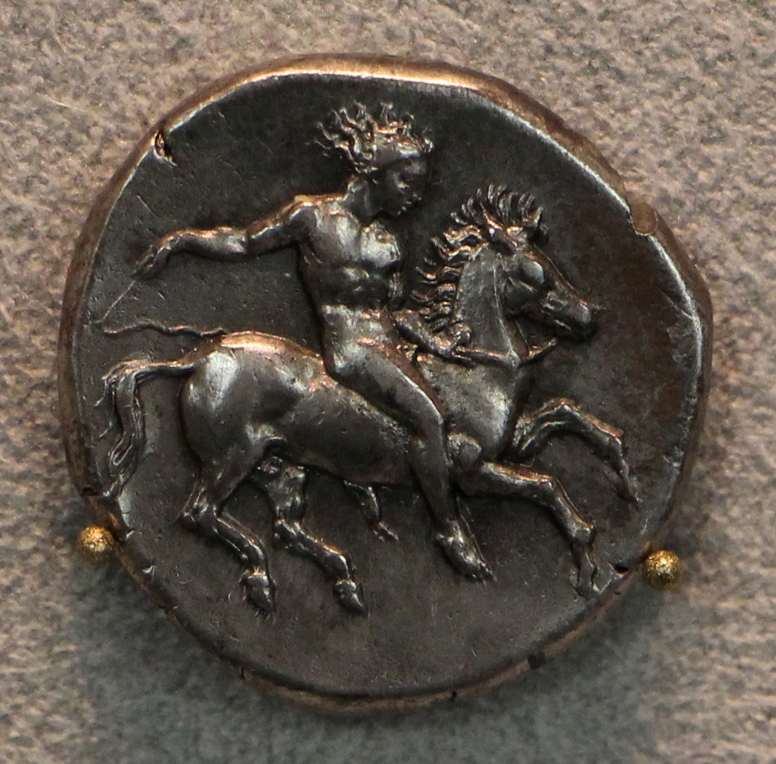
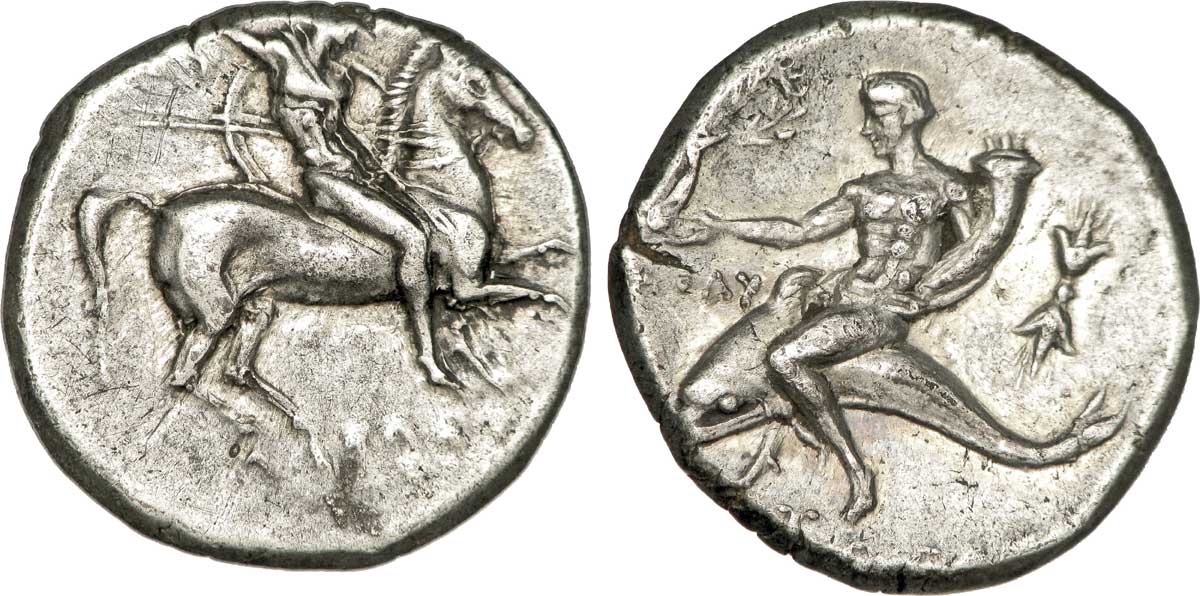
Ancient Taras horses and riders - coins


 Salvete Omnes,


ancient polis of Tarento - Greek colony known as Taras, and after the Roman conquest known in Latin  as Tarentum - was founded by the Spartans in what Greeks called Magna Graecia, or the Italian peninsula and islands adjacent to it. The city grew to become a huge (300,000 inhabitants) polis, and its mints produced some of the more appealing coinage when come to the coin equestrian (and dolphin) imagery of the ancient world.
 The city and land of Apulia in general was somewhat a center of the equestrian culture, and it is said that under Archytas, who was a mathematician and political leader, reached its apex as per hegemony over Magna Graecia. Unfortunately the coming of Rome, the unsuccessful alliances, first with Pyrrus king of Epirus(the Pyrric War and the sack of Taras) 


and 60 year later with Hannibal (209BC destruction ) during the 2nd Punic War 


spelled their  eclipse from a power a cultural center to a Roman provincial municipium.

Osprey Miltiary Publishing has a book on the so called Tarentine horsemen of Magna Graecia, and perhaps one day I will address the horse aspects of that book.

From Wiki Common come these photos of some of their coins - 

military


 and more civilian


enjoy

Valete

Wednesday, February 20, 2013

Numidian/Libyan horse - ancient writers and equine art


Salve,
  let us stay with the coins of the Classical Antiquity and turn to the subject of the Numidian/Libyan horse in the Greek and Roman world for this horse was one of the most famous horse of the Graeco-Roman world .

 Libyan horse from a Carthaginian coin:

Various Numidian rulers included horses on their coins


Diodorus Siculus, in his Bibliotheca Historica, book XVII (from penelope.uchicago.edu or LacusCurtius), wrote about Alexander, the hero-king of Macedon and soon Persia:
''Having settled the affairs of Egypt, Alexander went off to the Temple of Ammon, where he wished to consult the oracle of the god. When he had advanced half way along the coast, he was met by envoys from the people of Cyrenê who brought him a crown and magnificent figures, among which were three hundred [war] chargers and five handsome four-horse chariots. He received the envoys cordially and made a treaty of friendship and alliance with them''


William Ridgeway wrote, quoting various ancient writers, in his book on The origin and  influence of the Thoroughbred horse", page 253 :
''The islanders from Thera, who planted Cyrene, were not 
slow in fulfilling the prophecy of Medea that " instead of short- 
finned dolphins they should take to themselves fleet mares, and 
reins instead of oars should they ply, and speed the whirlwind- 
footed car," for Cyrene soon became famous as "the city of 
fair steeds and goodly chariots." Pindar glorified her king, 
Arcesilas, for his victories in the chariot-race, and later her 
native poet, Callimachus, sang of his " home famed for her 
steeds 


Numidians on the Trajan Column:

..
Horse from a Roman Mosaic (present Tunisia)

..
Strabo, in ''Geography'' book XVII, wrote on Numidian/Libyan Horse and the various tribes that rode or used horses in Numidia/Lubia (From LacusCurtius):
     ''Although the most of the country inhabited by the Maurusians is so fertile, yet even to this time most of the people persist in living a nomadic life. But nevertheless they beautify their appearance by braiding their hair, growing beards, wearing golden ornaments, and also by cleaning their teeth and paring their nails. And only rarely can you see them touch one another in walking, for fear that the adornment of their hair may not remain intact. Their horsemen any mostly with a javelin, using bridles made of rush, and riding bareback; but they also carry daggers. The foot-soldiers hold before them as shields the skins of elephants, and clothe themselves with the skins of lions, leopards, and bears, and sleep in them. I might almost say that these people, and the Masaesylians, who live next after them, and the Libyans in general, dress alike and are similar in all other respects, using horses that are small but swift, and so ready to obey that they are governed with a small rod. The horses wear collars made of wood [tree wool, perhaps cotton] or of hair, to which the rein is fastened, though some follow even without being led, like dogs. These people have small shields made of raw-hide, small spears with broad heads, wear ungirded tunics with wide borders, and, as I have said, use skins as mantles and shields. The Pharusians and Nigretes who live above these people near the western Aethiopians also use bows, like the Aethiopians; and they also use scythe-bearing chariots. The Pharusians mingle only rarely even with the Maurusians when passing through the desert since they carry skins of water fastened beneath the bellies of their horses...'
 Horses and riders from Roman mosaic from Libya
 .


                                                           *

Roman writer of III century A.D. From Carthago, Nemesianus (again from LacusCurtius ), wrote a poem on hunting (Cynegetica) where he described, amongst others, the Numidian/Libyan horses :
''..you may select the courser sent by Mauretania (if he be a stout descendant of good stock), or the horse which the dusky Mazax tribesman[Numidian] has reared in desert fields and taught to undergo ceaseless toil. No need to repine at their ugly head and ill-shapen belly, or at their lack of bridles, or because both breeds have the temper of freedom, or because the neck lashes the sloping shoulders with its mane. For he is an easy horse to guide, plies obediently under the control of a limber switch: its strokes are the orders for speed, its strokes are as bridles too. Nay, once launched across the spacious levels of the plain, with blood stirred, the steeds win fresh strength in the race, leaving by degrees their eager comrades behind. Even so, on the outburst of the winds across the blue waters of Nereus, when Thracian Boreas has uprisen o'er his cavern and with shrill howling dismayed the dreary waves, all the blasts on the troubled deep give way to him: himself aglow mid foaming din, above the billows he o'ertops them in mastery manifest upon the sea: the whole band of the Nereids is mazed in wonderment as he passes over their watery domains.

Nemesianus gives quite detailed description of the preparation of a hunting horse, with some remarks on their long lasting vigour and longevity if properly cared for :
''These horses are slow to attain confidence in prolonged running; also, theirs is youthful vigour even in age that has served its time. For no quality which has bloomed full at its due period suffers collapse in spirit ere physical powers fail. In the fresh spring-time, then, feed the coursers on soft mash, and, lancing a vein, watch old-standing ailments flow out with the ooze of the tainted blood. Soon strength returns joyously to their gallant hearts, moulding the sleek limbs with strength diffused: soon a better blood runs warm in their veins, and they wish for long stretches of road, and to make the broad plain vanish in their career. Next, when summer has hardened the ripening stalks and, scorching the juicy blades, has dried all the moisture for harvest and joined corn-ears [caveat! -not American Maize] to stems, then be sure to furnish barley and light chaff: moreover, there must be care to winnow the produce free from dust, and to run the hands over the horses' muscles, so that the courser may enjoy being patted and relax his body in pleasure and quickly pass the nourishing juices throughout his frame.''

*
another Roman writer Claudius Aelianus aka Aelian wrote, in Natura Animalium, about the Numidian/Libyan Horse :
''De equo Libyco Libyas talia narrare audio: Eos quidem equorum velocissimos esse, nullo vero laboris sensu affici; graciles quoque nec corpulentos, et idoneos ad sustinendam negligentiam dominorum; qui nullam curam iis adhibent, neque eos, postquam labore fatigati fuerint, strigile perfricant, nec eis volutabra conficiunt, nec ungulas purgant, nec jubam pectunt, nec capronas implicant, neque fessos lavant; sed simulatque constitutum iter confecerint, ex equis desilientes eosdem ad pastiones dimittunt. Ipsi Libyes etiam graciles sunt, et squalore sordidi hujuscemodi equis etiam vehuntur. Medi autem luxuriae dediti sunt, atque ejuscemodi illorum equi; quos magnitudine, specie corporis, et ornatu, ac exteriore cultu atque deliciis una cum dominis delectari diceres; sentire videntur magnitudinem et pulchritudinem suam itemque se magnifice esse exornatos.'' (translated from Greek to Latin  on LacusCurtius).


*
Finally, the Numidan prince is the subject of the famous Bande Dessinée (French-Belgian comics) series titled 'Jugurtha,' with awesome horse drawings by two great, but unfortunately deceased, artists Moebius and  Franz Drappier


*
ps most images are from wikipedia 


Thursday, February 7, 2013

Ancient horse from coins

Salve,
today is Tłusty czwartek (Fat Thursday) and our Polish folklore associates this day with eating pączki  and other delicious sweets; so enjoy them wherever you can find a Polish bakery :)

Good traditions aside,  I have been browsing the web looking for the ancient coins and other Hellenic and Roman art images showing Dioskouroi riding horses and holding palm branches, and I cam across some very interesting coins from the ancient Greeks sphere of influence, i..e., Mediterranean Basin. Why are they interesting? Well, because they show different types of horses.

Please note that I do not own any of these images nor have any right to them - they came from this website Ancient Coin search Info
I am showing them to simply share these interesting depictions of horses of the ancient Hellenic world.
Coins from V to III century B.C. - let's the images speak for themselves . Note that Ann Hyland has written on these horses in her book Equus, The Horse in the Roman World.
..
 circa 260 from Carthage - a Numidian stallion?

..
 Tarentine, Magna Graecia (Italy) - Osprey has a book on the Tarentine horsemen, we need one on the Numidian horsemen

..

..

..
 Macedon - Thessalian, Thracian, perhaps steppe influenced horses, eg king Philip II, father of Alexander, brought from his wars (340s B.C.) against the Thracians and Scythians thousands of horses as war spoils - so tell us the ancient historians, eg Quintus Curtius Ruffus or Arrian etc.


Paeonia (Greece)

..
 Thrace - Thracian horse, note the famous mares of Greek mythology or Rhesus of Thrace horses

..


Thessaly - a Thessalian horse


..

..

..
Caria, Achaemenid satrapy in Asia Minor - Nisean horse

..

Monday, August 8, 2011

Louise Firouz interview via youtube


Salve,
I would like to share with you  this video of the interview with one of the most important horsewomen of XX century - American-Iranian Louise Firouz, unfortunately deceased since 2008, well, here there is the wikipedia entry

In this interview she discussed her  Turkoman horses , while she was known the most for the rediscovery of the Caspian horse, the most likely ancestor of the Arabian horse (DNA studies by Dr. Gus Cochran of the Kentucky University prove the link). Another video here
“The discovery of the Caspian, a breed of great antiquity, was a matter of the greatest scientific and historical importance in equine studies,” said Elwyn Hartley Edwards in her 1994 edition of The Encyclopedia of the Horse.

I have Ms. Firouz fine article on the Caspian Horse to which I may return one day in my meandering through the Persian history...

Monday, September 27, 2010

Xenophon of horseridding - paces


Continuing from Chapter X:

CHAPTER XI.

Of teaching a horse his paces. How to make him assume showy attitudes.

1. But if a person wishes to possess a horse that is fit for processions, and of lofty and magnificent bearing, such qualities are not to be found in every horse, for he must be one that is of a noble spirit and strong frame.

2. But what some suppose, that a horse which has suppleness of leg will also be able to rear his body high, is not the case; the truth rather is, that it must be a horse which has flexible, short, and strong loins (we do not mean the part by the tail, but that which is between the ribs and the haunches, at the belly), for such a horse will be able to extend his hinder legs far forward under him. 3. If a rider, then, when the horse has his hind legs thus under him, should pull him up with the bridle, he rests his hinder parts on his heels, and rears up the fore part of his body, so that his belly is seen by those in front of him. But when he does this, it is proper to give him the bridle, that he may assume of his own accord the attitudes most graceful in a horse, and appear to the spectators to do so.

4. There are people who teach horses thus to rise, some by striking them on the fetlocks with a stick, some by directing a man, who runs at the side for that purpose, to hit them on the upper part of the legs.

5.We however consider it the best mode of instruction, as we are perpetually saying, that when ever a horse acts agreeably to the wishes of his rider, it should follow that he receive some indulgence from him.

6. For what a horse does under compulsion, as Simon also observes, he does without understanding, and with no more grace than a dancer would display if a person should whip and spur him during his performance; since both horse and man, when suffering such treatment, would exhibit more ungraceful than graceful gestures. But the rider ought to teach a horse by signs to assume of his own accord all his most beautiful and showy attitudes.

7. If, then, when he is exercised, he be ridden till he is quite in a perspiration, and the rider, as soon as he raises himself gracefully, dismounts and unbridles him, he may feel assured that the horse will always be ready to rear himself of his own accord.

8. It is upon horses of this kind that gods and heroes are painted riding, and men who are able to manage them skilfully are regarded as deserving of admiration.

9.So extremely beautiful, and admirable, and noble a sight is a horse that bears himself superbly, that he fixes the gaze of all who see him, both young and old; no one, indeed, leaves him, or is tired of contemplating him, as long as he continues to display his magnificent attitudes.

10. If it should ever happen to the possessor of such a horse to be a phylarch or hipparch, he ought not to make it his study that he alone may enjoy distinction, but rather that all the cavalry under his command may be deserving of admiration,

11. Should such a horse precede the rest, [as people esteem such horses most,] one that, as he advances, rears himself very high and very frequently, it is plain that the other horses would follow him at a slow pace ; but what striking attraction could there be in such a spectacle ?

12. If, however, while you animate your steed, you lead neither with too great quickness nor with too great slowness, but just as horses appear most lively and formidable, and best adapted for exertion, if, I say, you precede the other horses in this manner, the march of the whole troop will be uniform, and even the very neighing and snorting of the horses will be n concert, so that not only the commander himself, but the whole troop, will present an admirable spectacle.

13. If a person be fortunate in purchasing horses, and bring them up to be able to endure fatigue, and train them properly, not only in exercises for war, but in manoeuvres for parade, and in service in the field, what can prevent him, unless some god be adverse to his endeavours, from rendering his horses of far greater value than they were when he took them under his care, or from having not only estimable horses, but being himself greatly admired for his skill in the art of horsemanship.
Sunday, May 16, 2010

Turkish horses of Cilicia Pedias (Cukurova Plain)

hello,
In the Polish and Muscovy XVI-XVII century sources the so called Turkish horses  were listed as the most splendid and notable steeds fit for the kings, magnates and noble ''rycerstwo'' (knights, chivalry, noblemen).

Being curious about the Ottoman Turkish horse origin, some time ago when I was at the McGill University Library special book collection, where one cannot use any writing tools but for their own short pencils,  I found a very interesting book.

Let's talk about the book first. At the library  I perused - in two days 1-2 hours each - this absolutely splendid and awfully overpriced book in two volumes (one text  and one fine photographs of some horse-related Islamic  artifacts) titled 'Furusiyya' - http://openlibrary.org/books/OL17608339M/Furusiyya
There I found many articles written by noted scholars on the subject of the horsemanship and horse ridding related to the present Islamic land, no matter how deeply into the pre-Islamic history, e.g. Seleucid heavy cavalry.

One of the articles written by J.M. Rogers titled 'Ottoman Furusiyya' (pages 176-183 in the vol.1) deals with XV-XVIII (15-18th) century Ottoman Turkish horses and horsemanship.
Thus I copied some information on the Turkish horses from his article:
   Rogers states that the proper Turkish horses were bred in Cukurova Plain (southern fringes of the Taurus Mountains in the South-eastern Turkey or better put on the wikipedia   http://en.wikipedia.org/wiki/%C3%87ukurova ) first, and later on the rest of Anatolia became the breeding ground, while Epirus and Thesally, historic ancient Greece horse breeding grounds, continued to serve as such for the Ottomans overlords.  I can add my own thought here that this area was part of the medieval Armenian Kingdom of Cilicia, divided into ''Cilician Trachea'' and ''Cilicia Pedias.'' Cilicia Pedias became the Ottoman tributary during  XV century  perhaps as a result of wars between the Ottomans and the Mamluk Egypt, and thus Cilicia would continue in a semi-autonomous existence until her annexation by the Turks circa 1515, thus it would  seem reasonable to think that Cilician Armenians were the actual breeders of the so called 'Turkish horse.'  In my opinion (absent from the said article by Rogers) this horse breeding area and its people also  seem  to fit  nicely with  the ancient horse-breading traditions of the Armenians under the Achaemenid Persian kings and before [Urartu], and their horses are shown on the Apadana Staircase in Persepolis, Iran (via Livius  livius.org apadana armenian delegates   ). It also seems to me that great ancient traditions of the Iranian and Turkish peoples with Greek (Byzantine ) input produced this treat stead of the XV-XVII centuries.

Continuing with Rogers' article - other breeds: Arabian, Tatar and Hungarian were less numerous, but by 1650AD excessive demand for Turkish horses virtually exhausted the Anatolian breeding grounds and this led to actual replacement of the Turkish horse by the horses from the north of the Danube Basin (for the Ottoman military).
Rogers cites Busbecq ('Turkish Letters of Ogier P. de Busbecq,' 1554-62 AD)) and Marsigli ('Strato militare dell'Imporio Ottomano' Hague Amsterdam 1732 AD) as his best sources. Marsigli in his famous book stated that Turkomanian horses were very valued in the Ottoman Empire, and that the best war horses came from Hungarian, Transylvania, Polish and Moldavian stocks. Horses from Dobruja (   wikipedia.org Dobruja   )  were esteemed as parade horses (due to their size, for they were tall). According to conclusions drawn by Rogers from his sources the Arabian horses were not used for war, as they could not withstand cold and damp conditions of Turkish northern campaigns, and also were difficult on the battlefield  because were extremely afraid of the gunfire.
 I could add that we known from the records that during the Vienna Campaign of 1683 AD victorious Polish commanders and noble cavalry 'towarzysze' (companions) captured some very fine Arabian horses [including mares] from the taken Turkish camp after the famous battle. Perhaps those were parade  favourites of the horse-loving Turkish commanders and warriors etc (similar to the way many men nowadays own luxury cars without really driving them daily).

Rogers also writes that Turkish horses were shod  with shoes that were continuous and solid (so no stumbling and damage to the frog etc). According to his sources Turkish horses were used up to 28-30 years of age, fed on hay and barley, while their straw bed was made from dried horse manure (similar to the Persian Turkoman traditions).

The rest of the article dealt mostly with the  different Ottoman warrior and soldier types eg voynuks , akinjis, sipahi etc,  the cavalry of the standing armies of the Ottoman state - Kapikulu  Corps (eg sipahi in reconstruction ) - and its  cavalry branch, subject that I will indulge more in the future. Also I will introduce the writings of a Polish and Ukrainian writer and ' un caballeros supremo' Michal Czaykowski (Sadyk Pasha aka  Mehmet Sadık Paşa   books.google.com Czaykowski biografia )  who while being a Turkish cavalry commander in the mid-XIX century wrote about the pitiful state of the regular Turkish cavalry of the late Ottoman period, but was extolling Balkan horses and Circassian and Turkoman horses...
pa ka

ps
aha, I am working on this sketch of a saddled XVII century horse, it is not finished yet  ... GIMP and MyPaint :)

Tuesday, August 25, 2009

New painting programs etc


Salve,
for those who use computers to paint and either do not want or cannot afford Photoshop or Correl Painter programs I have some really great news - a very useful and absolutely free painting and drawing program that works in Windows XP and Ubuntu 9.04 (I recently migrated to Linux - see ya windows) known as Mypaint - http://mypaint.intilinux.com
.... and a fine extension to GIMP that makes that program more like painter's digital media we do need - Gimp Paint Studio http://www.jesusda.com/blog/index.php?id=314
http://webupd8.blogspot.com/2009/05/gim-paint-studio-gimp-optimized-for.html
it's creator's blog - http://ramonmirandavisualart.blogspot.com/

This is the way I like the Internet aka world wide web to function - free access, open source programs, free society, exchange of ideas...

I intent to work on this image of an ancient Iranian horseman and his stallion with those two new programs/enhancements.
until the next time

Friday, June 26, 2009

Progress and corrections on the King of Kings hunting


hello,
summer is about to hit us with some warm weather in NYC, so definitely there will be less work to be done at home :)
Some little corrections (his bow mainly as I was advised on the great forum for ancient world military history enthusiasts and reenactors romanarmy.com http://www.romanarmytalk.com/rat/viewtopic.php?f=25&t=26749
I did on the famous Sassanian King Bahram Gur, and started adding some color.
Plus I started working a little on some older images of the Sassanian knights... so they will make their appearance here sooner than later ;)
pa ka

Friday, October 17, 2008

Salve - Nisean horse of Nisayan Plain


I am about to start my own little page(s) on history and use of horses in war augmented mostly with my own illustrations, hence the title Dario's Caballeros.
                                       ***

My subject will be Polish Winged Hussars (husaria), uhlans, and Polish horses, Ancient Iranians (Medes, Cimerians, Scythians, Saka, Indo-Saka, Sarmatians, Alans, Persians, Kushans) Eurasia steppe warriors, North American Indian horsemen, Islamic warriors, Colonial Latin America, Conquistadores then obviously some on horse tack and war horses.
                                     ***
Let us start with some little info on Nesean/Nisean horse of ancient, pre-Islamic Iran, that stretched well beyond the borders of the present county of Iran
(I wrote that for a romanarmytalk.com discussion):

     Horses of Nisaya -  scholars and specialist on the ancient equids like Littauer and Crouwel in their digs found horses ranging from 100cm at withers to 150cm from the so called Median strata ...
Considering that the best of these horses ate the wonder herb known as alfaalfa/lucerne – this most important horse food that was domesticated by the Iranians during the II millennium BC,  and this alfalfa provided their animals with necessary protein to grow thus these horses could have attained some great muscular and skeletal size (150cm is a very good size for pre-19th century  horse) pastured on the great Median meadows. It appears that in developing a powerful yet nimble horse the Iranians could have solved the the proverbial problem for cavalry until its demise: relationship between size, strength and stamina of the war mounts versus their performance on the battle field and in transition to-from the battlefield.
We do have some clear information on the Achaemenid horses, mostly from sculptures and ancient writings - the most famous imagery comes from the Apadana Staircase at Persepolis Iran - chariot horse  while the Seleucid and the Parthian  horses must be mostly inferred from other sources, as there are hardly any sources left talking or showing them.
Firstly, one could look at the stone relieves from Firuzabad representing the battle of Hormozdagan between Ardashir, future Sassanian king of Persia, and Arabanus the last Parthian monarch – images from this very great site livius.org
[link]

    next the famous Dura Europos graffito - Parthian 'knight' - one day soon I should post my drawing of this knight.


        The closest depiction of ancient Iran horses might be found in the Ms Louise Firouz' article, although it is mostly about the Caspian horse (she so wonderfully brought back from oblivion) in that horse's present condition (well, 1970s), but she provides in her article some data on the Nissean , eg that 'he' was about 65 inches at withers (comparisons done by reference of the Persepolis Apadana). Also she talks about discoveries (late 1960s and early 1970s) of skeletal remains of horses from the pre-Islamic strata in Iran, especially of interest shall be the site at Shahr-e-Kumis where some remains of Parthian horses (including large skull with that 'Nissean[Nisean] nose' aka swelling from occiput through nasal bones) have been found. She cited (1972) works of Anderson, Sandor Bokonyi, M.A. Littauer etc as the best to look up this matter.
Finally, she provided a citation by Timotheus of Ghaza (6century A.D.) who wrote on the Nissean/Nisean horses (Kermanshah region of Iran)– that they were remarkable for their great size and feet that shook the earth.

    Definitely one should look at the Chinese sculptures and paintings, starting with some from the Han Dynasty (eg horses for emperor Wu-Ti) and Later Han. Wei, Sui to the T'ang dynasty, noting here that the best horses of the Chinese – Tien-Ma or 'heavely horses' – came from east Iranian lands.

Also many a good reader could compare and look at the so called Persepolis graffiti – a fine Callieri's article about these images etc - especially at figure 3, 4, 5 and 6
http://www.transoxiana.org/Eran/Articles/callieri.html
They do belong to the Sassanian period of the Iranian history but perhaps they can be taken as some indication of the size of the noble mounts.

Finally one needs to look at the Panjikent frescoes – they are mostly from the 7th -8th century but the horses there belong to the last phase of the east Iranian (Sogdian) pre-Islamic culture – and they do have the conformation of the war horses of the ancient Persians. (drawings to follow one day).
I am going to look up in my copy of Ann Hyland's 'Equus' and her "Horse in the Ancient World' to see if she has anything there etc.

Let's us turn to more ancient writers : Strabo wrote about Nisean horses and their breeding grounds having been in Armenia (he thought that the Nisean plain was in Armenia and not in Media) . He also says that Parthian horses were not like any horses of the Greek world but very similar to the Nisean horse bread by Achaemenid Persians (Strabo 524).

Ancient Oppian writes in his Cynegetica about the Nisean horses, extolling their easy strides, graceful movements, flowing manes (contrary to the ancient and then contemporary Iranian fashions of crenelated manes and tied tails). He also talks about golden manes - that might imply some influence of the glittering heavenly horses -Tien Ma - from Ferghana - today known as the Akhal-Teke or Turkoman golden horse(please note that obviously the Turkomans were not first to breed these horses that bear their name, these horses as a breed predate the Turks in that area of Eurasian steppe by at least 5-7 centuries and were first bread by the eastern Iranians or the inhabitants of the Ferghana Valley - divided between modern Uzbekistan, Kirghistan and Tajikistan ).

Modern scholar Azzaroli states, in his book,  that in a private communication with Sandor Bokonyi he learned that Bokonyi had 'observed horses remains strong build, standing up to 16hands in the sites from north-western Iran belonging to the Achaemenid period'.

Also, the northern cousins of the Persians - the Scythians, Saka, and Sarmatians, Alans etc -  there are the Pazyryk horses and others of the South-Western Siberia Saka, these horse finds show consistent pattern of tall (15-16h) noble horses and smaller 'common' horses (12-13hands). Dahae or Parni aka Parthians came from the Central Asian steppes already equipped with very fine war horses of certain known qualities etc, suitable for mounted lancer warfare (Mielczarek).
Also might be worth pondering the issue of Parthian exchanges (both peaceful and bellicose) with their cousins from northern India, Pakistan and Bactria(Afghanistan) that might have added more horse breeds/strains to the actual development of the ' Parthian' strain of Nisean horse between 3rd and 1st centuries BC. Ceck the discussion about ancient Indian armies here

                                                         ***

Bt the way, I am reading this very interesting book by one of the most prominent 'equine historians' from XIX century - writing about the horses in the pedigree o the English Thoroughbred -William Ridgeway ' The Origin and Influence of the Thoroughbred Horse (Cambridge University Press 1905)' (please note that some of the information written in this book is already outdated because of modern research and archaeological discoveries etc)
[link]
 On p. 194 he writes "... the Parthian horses, which were both grey and also commonly dun, were descended from the Nisean breed, and resembled it in appearance, we may conclude that the Persian horses of the fifth century B.C. were dun, white or grey. But we have just seen that dun and white especially characterized the horses of Upper Europe and Upper Asia in classical and Medieval times. From this it would appear that the Nisean horses bred in Armenia were of the Upper Asiatic, i.e. Turcoman stock"......


More to follow soon but you could see some of my artwork and 'fotos/photos' at wikimedia
Ciao
ps
perhaps worth pondering is the Assyrian horse, especially VII century BC images, since the bulk of the Neo-Assyrian war horses seems to have come from the Iranian/Median tributaries/spoils and Urartu (Armenian) tributes/war spoils. And those pesky Assyrian sculptors and painters were very precise in their work.