Showing posts with label Napoleon. Show all posts

Wednesday, November 18, 2026

Patrice Courcelle - interview on Yt

Salvete Omnes,


short entry - a video link and some fantastic Napoleonic armies and horses art 

French artist Patrice Courcelle was interviewed over Yt - this is the link. The French is dubbed (2025).


Maestro Patrice has been illustrating and reconstructing the Napoleonic period for many decades, but he also painted other periods of the French history.


I do enjoy his pencils and brushes, I think I first saw his work in this publication (Jack Gibrat started the plates and Patrice Courcelle finished them).  


below Courcelle's example of  work in progress 


-

-

-

all art is Patrice Courcelle copyright. 

  enjoy

Valete

Sunday, January 21, 2024

Napoleon during 1812 Russia campaign in Albrecht Adam's brushes

 Salvete Omnes,

taking of Smolensk 1812


we, the Napoleonic Age aficionados,  are still reeling from the 'fracaso' or failure of the latest Hollywood take on the great European aka Napoleon by a British director R. Scott.


So today some images of mounted Napoleon by maestro Albrecht Adam, who himself, when very young, was 'an honorable visual corespondent' during the epic 1812 campaign in Russia.  

detail from a larger painting
burning Moscow in 1812


detail from the Berezyna/Berezina crossing


nota bene gorgeously painted horse 


Valete

Sunday, December 18, 2022

Stanislaw Bagienski - Polish painter at Polona etc

 Salvete Omnes,

Jozef Dwernicki - the November Uprising 1830-31


a short entry - uff, I watched with lots of gusto the final of the Quatar 2022 World Cup : what a football/soccer game between Argentina and France. Vivat Argentina, new world champion.


ad rem,

Stanislaw Bagienski(1876-1948) a native-born 'Varsovian*,' was a Polish painter active between the end of the XIX century and 1948 (thus he lived through the Great War - which was terrible within the Polish lands, the wars of Restitution of Poland, and finally the tragedy of World War II and coming of the Soviets and their henchmen into Poland. Another Polish artist born in the year of Little Big Horn. 


At first Bagienski studied under his father Feliks (Felix), continuing his art studies at the Wojciech Gerson drawing atelier/school at Warsaw (then Russian Poland), then circa 1900-1901 he went to Munich and Paris to further his studies in their respective fine arts academies until 1903. Upon returning to Poland he started fully his art career, from full canvas paintings to illustrations for various periodicals of the period (leading Polish periodicals like Tygodnik Ilustrowny, Biesiada Literacka, and Swiat).

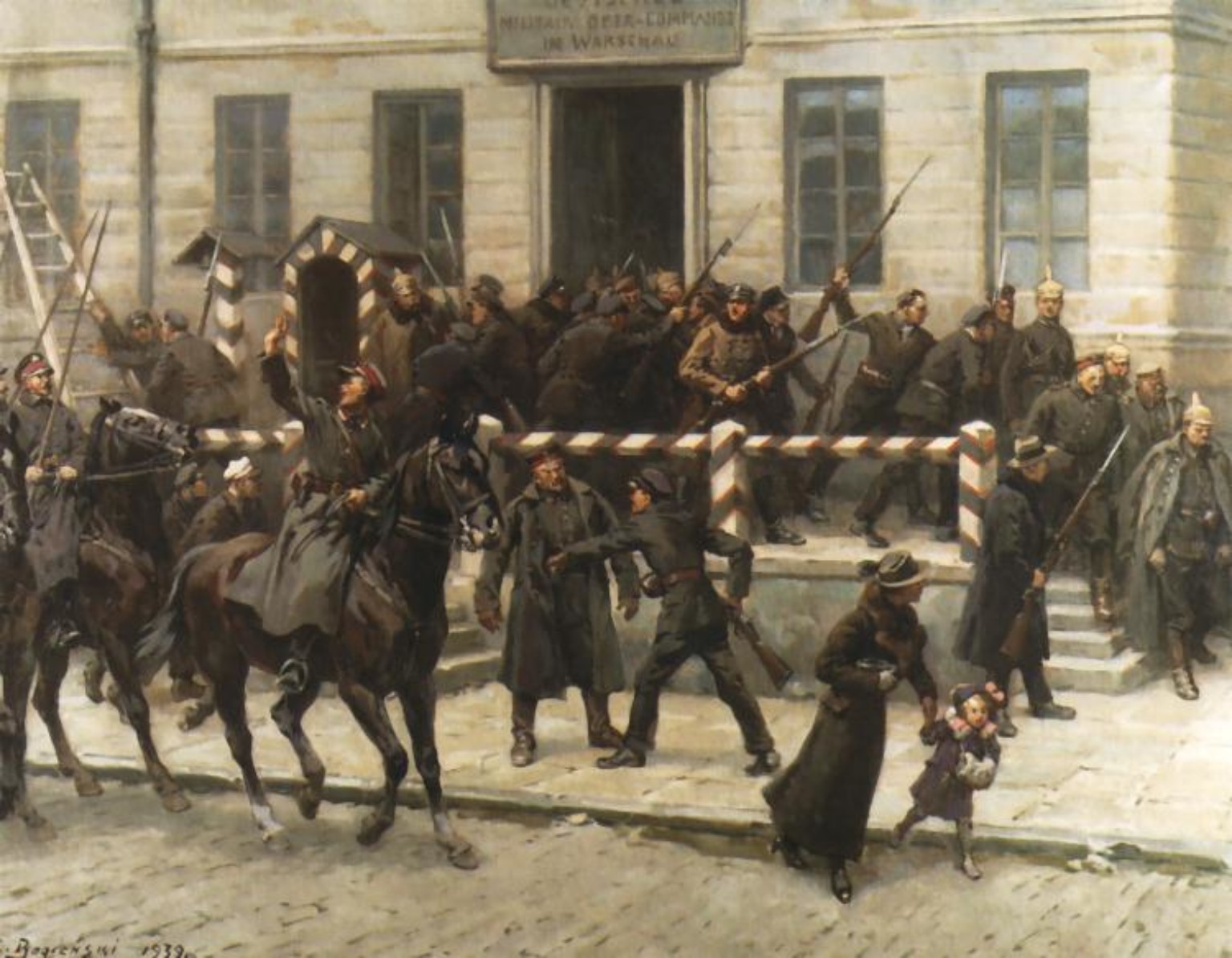
disarming of the German soldiers in Warsaw in November 1918


Circa 1922 he joined the 'Pro Arte' artist group or movement in Warsaw and perhaps stayed with them until it was no more, or circa 1932.


In 1927 Bagienski, then established artist, joined the faculty, as a professor, the very Warsaw Academy of Fine Arts. 


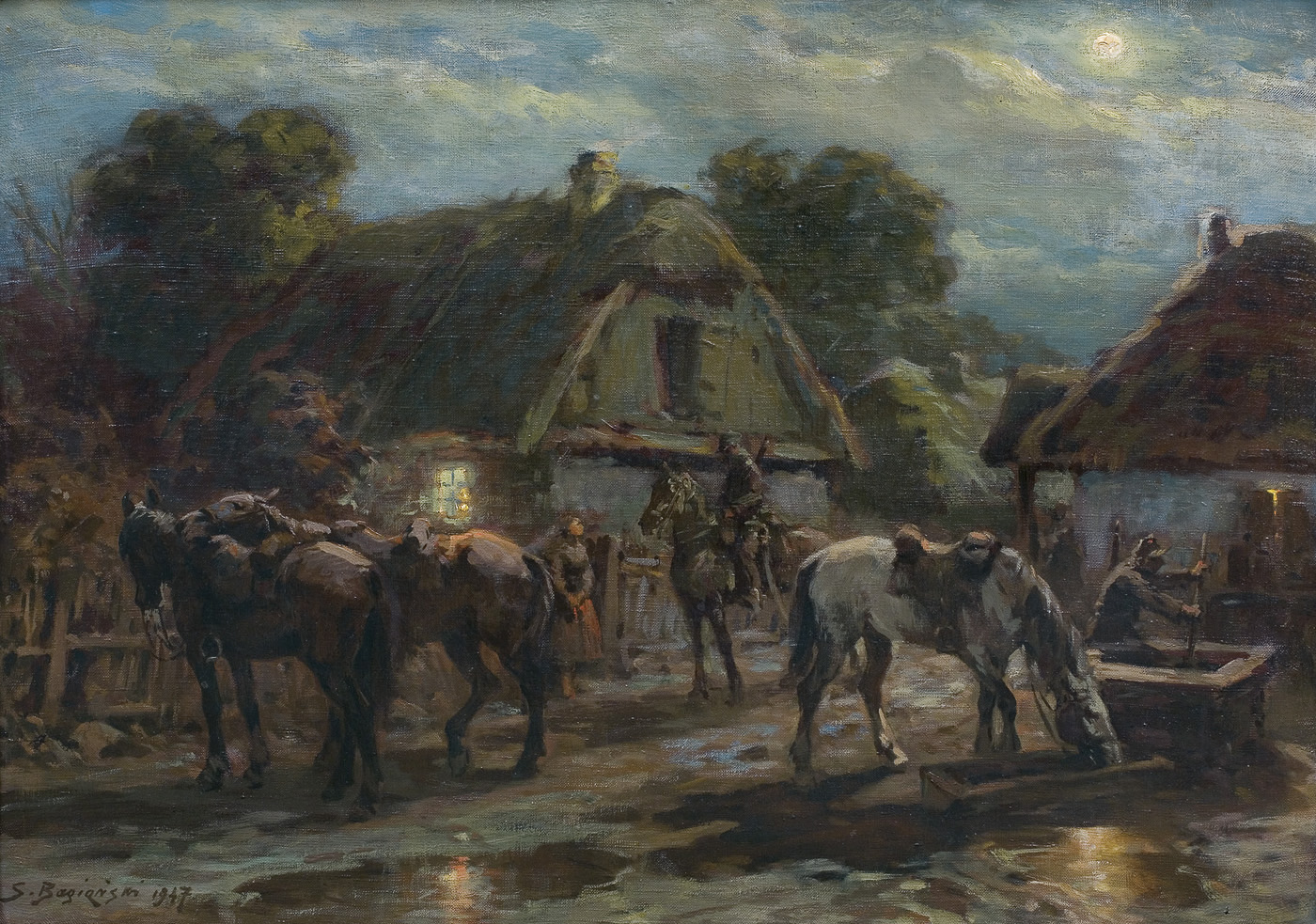
Maestro Bagienski painted scenes from Polish history, including plenty of military-related topics, cavalrymen, famous commanders and common soldiers, from the Old Poland stories, through Napoleonic Wars through Polish uprising to more contemporaneous events of the Great War and Polish wars of Independence 1918-21, and post-1918 Polish soldiers and their horses. Also his topics included book illustrations and genre scenes..


As you can see clearly maestro Stanislaw   painted plenty of horses and this is why I decided to include him in this gallery of painters and equestrian artists on my blog.

Images of his works in sepia from Polona Polish National Library -


Valete
*
Varsovian - native to Warsaw, capital of Poland.

Saturday, April 30, 2022

Kossak & Zamoyski - Napoleon

 Salvete Omnes,

I have read some of Adam Zamoyski's works, and recently I reread his book book - Napoleon. The Man Behind the Myth. - from 2018AD.

here you can listen to the author,  himself the scion of Poland's famous Zamoyski clan, Jelita coat of arms,  presenting his book. Another audio by the author himself. 
The debate between two historians, Adam Zamoyski vs Andrew Roberts , on Napoleon (2014). 
and perhaps a proper illustration to this post - a painting by Wojciech Kossak 


Valete


ps

Stop war in Ukraine! 

Friday, November 29, 2019

Jan Nepomucen Bobrowicz - napoleoniki w wigilie Somosierry

Salvete Omnes,
 
[in Polish]
zbliża się rocznica Somosierry i 'surfując' zbiory  Biblioteki Narodowej Polona (Federacja Bibliotek Cyfrowych)  natrafiłem na luksusową publikację, którą firmował  weteran Powstania Listopadowego Jan Nepomucen Bobrowicz, emigrant pracujący nad wydawanymi  dziełami polskimi we wciąż przyjaznej Polakom i Polsce, choć ledwie niezależnej od Prus, Saksonii.
Bobrowicz pracował dla wydawnictwa Breitkopf & Haertel z Lipska (wciąż istniejące), i tamże w 1838 roku wydano po polsku pracę  poniższą:
Napoleon Bonaparte czyli Obrazy bitew i czynów wojennych bohatera : 90 rycin na stali podług malowideł w Muzeum Wersalskiem i innych pomników z dodatkiem historycznych objaśnień podług pp. Bourienne [et al.]
..

Prawie kompletne dzieło jest dostępne w Bibliotece Narodowej -a poniżej zamieszczam niektóre z rycin (oprócz 2 reszta z polskimi motywami):


Pan Bobrowicz, żołnierz artylerii konnej Powstania Listopadowego i odznaczony krzyzem Orderu Virtuti Militari, był słynnym muzykiem gitarowy, a jako wydawca zasłynął wydaniem 10-tomowego Herbarza Kacpra Niesieckiego, dzieła monumentalnego.

Valete

Monday, June 15, 2015

Two horsemen of David

Salve,
Jacques-Louis David is a famous painter of the late XVIII and beginning of  XIX centuries, master of portraits, historical paintings,  and mythological scenes.
In my corralling of horse images from the annales of history and art, two works of monsieur David come to shine.
Chronologically, the portrait of our Polish aristocrat Stanisław Kostka Potocki and then the more famous one, being the image of a man who shaped the modern Europe, l'empereur of the French,  Napoleon Bonaparte.

The equestrian portrait of Potocki, Pilawa coat of arms,  was sketched and started in Rome, where our Stanislaw was living at the time (1779-80) and fished in Paris, at David's atelier. It represents, according to Luc de Nanteuil[1] - author of an album on David, a history portrait. This work is 'simultaneously realistic and heroic,' and David having studied the Antiquity and Masters comes with an idea of painting the nature anew- that is 'clean colors, sharp outlines and noble composition' - 'nature idealized.'
The rider is wearing an 'informal dress, looking proud, gay[joyful] and exhilarated,'  displaying complete authority and prowess of an accomplished horseman. He is seating in atypical 'French' saddle of the period but very expensive example, proper for a young aristocrat. His legs are extended completely with his stirrups' leathers long while the reins of the curb bit are relaxed. Together an perfect rider - ecuyer complete.  
 I am curious about the horse. It is a muscular stallion, multicolored coat, his colors are of a fashion preferred by the Polish nobility at the time. Perhaps it is a horse from his own stud, perhaps a Polish horse?

Napoleon -  this equestrian portrait is very different from from the Potocki. Painted in 1800-01 (one of five, this one is the Chateau de Malmaison one), after the famous Marengo campaign, it is an apotheosis of new Hannibal and Charlemagne, who while crossing the Alps amid raging storm is about to descend on the Northern Italy and conquer it for France and himself.  In fact First Consul crossed the Alps on a mule, the most surefooted mountain traveler, in a calm, mountain weather, but he made a demand on David to paint him  'calm, mounted on a fiery steed" (Calme sur un cheval fougueux ).

There is a mixture of realism and theatrical fantasy, eg the uniform is the one Napoloen wore at Marengo,  obtained by the painter from Napleon's valet de chambre. The rider is very different from our Potocki, completely indifferent to his rearing mount,  he is a master and hero, his eyes are meant to 'blaze  like bolts of lightning that pierce through the storm and subdue the ,maelstrom'.  
The horse is a paint, and one of many horses Napoloen possessed and rode. we see very little of the saddle, just a saddle skirt, but most of the tack is there, the crouper and breast plate, wide cinch, small chabraque, French military  bridle of the period with double reins (for curb bit and snaffle), we see no third rein or halter. The horse has long mane and tail, beautifully rendered by the master painter.  Napoleon was an artillery man and never a dashing horseman like some of his soldiers, but in this painting he is master, but in an Antiquity style, very mythical and unconvincing.


The rider's position is more akin to the antiquity method employed while riding without stirrups,  most  famously shown by the sculptures of Parthenon or the relieves of the Alexander sarcophagus than to the typical technique employed by the riders and cavalrymen of the period, linking our heroic First Consul with the ancient heroes and their immortal fame. Hence, all 'Hollywood', propaganda with a dash of reality :)


Enjoy
[1] Luc de Nanteuil, David, New York, 1990