Showing posts with label Kuban Cossacks. Show all posts

Sunday, February 13, 2022

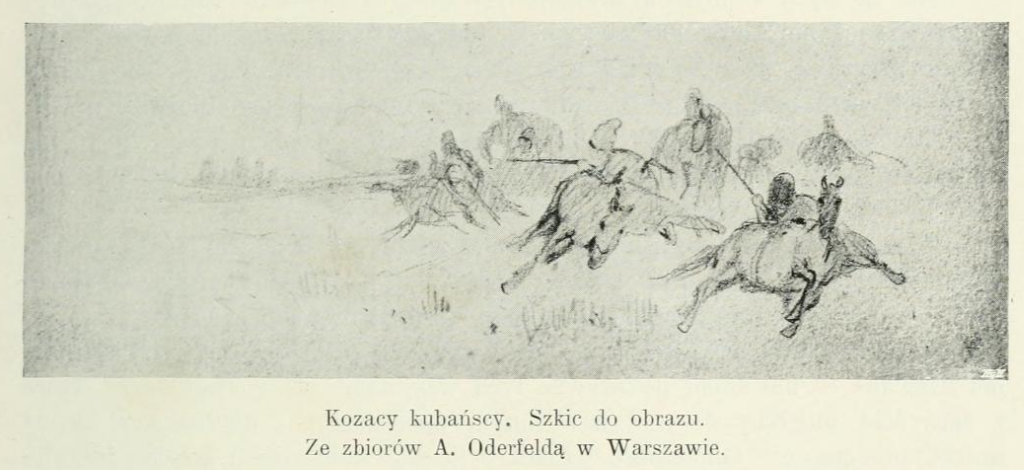
Maksymilian Gierymski - some sketches

 Salvete Omnes,


there was this uprising in Polish Russia back in 1863 - and the hopeless struggle known as January Uprising drew 200,000 young men to the guerilla-like armies of the Polish insurgents. One of these soldiers was a very young student Maksymilian Gierymski from Warsaw, the capital of Russian Poland (Congress Kingdom). 


Young Giermyski, born in 1846 AD, participated in the guerilla warfare against the Russian Imperial army, and this more than a year long field service must have been imprinted in his mind's eye, and thus influenced his art too - as evidenced by his sketches and paintings. Maestro Gierymski did not live long and tragically succumbed to tuberculosis in 1874AD, his untimely death cut down his developing artistic career .  But that is every Earthling's destiny - to live and to  die one day for certain. C'est la vie.

Here are some of his sketches  - horses, Russian Cossacks, uhlans and Polish guerillas. 


In the future I will share some more of Max Giermyski's works - eg as related to Mazepa, both the Byron's poem and historic Mazepa in the certain Polish 17th century memoir.

Valete

Saturday, December 11, 2021

Franz Roubaud - Caucasus equestrian

Salvete Omnes,


Franz Roubaud - when young a disciple and later member  of Jozef Brandt's circle of painters in Munich, Bavarian Kingdom - was a prolific Russian painter.
Perhaps most famous for his Borodino 1812 Panorama project, he was a prolific equestrian painter, especially painting the Caucasus Mountains region and the ancient peoples who lived and fought and bred horses there.


From Wiki Commons gallery we can get good quality images of maestro Roubaud's canvases depicting the horse people of the most mysterious mountains that divide Asia and Europe in the south.


Valete

Monday, June 3, 2019

Sarmatian stela from Temryuk Museum

Salvete Omnes.
a short entry - in a summer style one may say - the Archaeology News Network I read today that Salzburg Museum, Austria, will return to Russia 'a trove of ancient[...] artefacts plundered during the World War II.'
The ancient treasures were taken from the Temryuk Archeological Museum during the German occupation of the Taman Peninsula 1942-43AD. Perhaps some Austrian German officer, being part of the Third Reich conquering armies (Austria being the most Nazi of all the German lands during the Hitler's rule), 'conquered' these artefacts from the archaeological museum.
It took oh, 70 odd years to finally return these treasures to Russian Federation.
I am not sure if you remember but the Nazi Germans performed systematic, with the strictest scientific approach one may say, looting of cultural objects from private collections and museums in German-occupied Poland during 1939-45.
One of the artefact shows a horseman, and I think this a Sarmatian of the Bosporan Kingdom.

In many respects it is similar to the funerary stelae (Ic BC -Ic AD) from Panticapaeum in Crimea, that are on display in the Odessa Museum, Ukraine.


The country- Taman Peninsula and Kuban steppe to the south - over there in Russia has been the Tatar and Cossack country - it should come as no surprise that the original Cossacks were Tatars in the Genoese service during the colonial Genoese empire of the north Pontic shores  the XIV-XV centuries.
 
Wiki commons contains a large number of photos from the 'ethno-turist' center 'Ataman' that is 'recreating' a Don/Kuban Cossack  stanitsa (village). The place appear to be located in   Taman.  In some of the pictures there are modern Cossacks doing dzhigitovka.


Valete