Showing posts with label Eurasian steppe. Show all posts

Saturday, September 5, 2026

Nomad 'Olympics' in Kyryzystan, buzkashi-kokpar

 Salvete Omnes,


the Eurasian Nomads are having their own games,  their Olympics right now in Bishek and Issyk-Kul (Astana Times report), Kyrgyzstan. 


One of my favorite nomadic sports to watch  is buzkashi (kokpar, kok-boru, Ulak-Tartysh) or 'goat wrestling.'  There is even an American kokpar team participating - cowboys. 

.


.


.


Valete

Sunday, March 24, 2024

Manchu Horsemanship Competition for the new emperor Shunzhi


Salvete Omnes, 


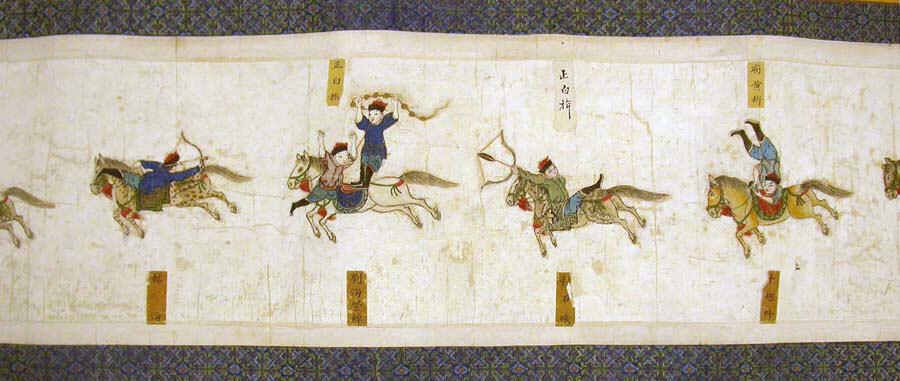
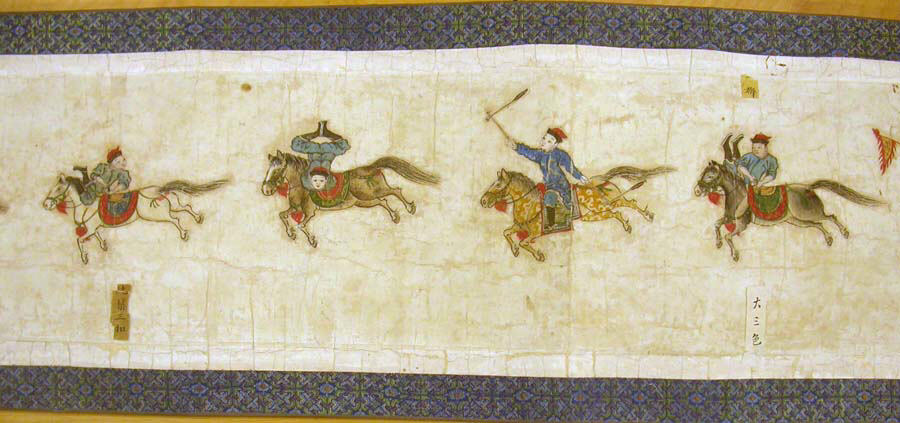
''Horsemanship Competition for the Shunzhi Emperor'' 


Met Museum has this scroll - hand painted - from the Qing Dynasty period of China.


Painted during reign of the emperor Shunzhi, third of the Qing or the Manchu Jurchen dynasts to rule China, by a court artist Nardubu, circa 1662.
It is very long - Image: 8 in. × 54 ft. 7 in. (20.3 × 1663.7 cm) - and painted with inks & colors/paints on paper.

It represents the horsemanship (dzhigitivka and horse archery) display organized by the emperor's under prince Dorgon (famously successful Manchu commander), in honor of the new emperor on his entry into Beijing (Peking) in October 1644. 
The riders or cavalry men in this competition seem to belong to three, out of eight, Banners of the Qing banner military system. 


The scroll was kept at the Imperial Palace in the capital, but after the whole Opium Wars and rebellions  tragic period in Qing China history, the scroll was sold to the  Westerners and ended up in the Metropolitan Museum Asia Art Collection.
 
enjoy for what it is worth - 

ps

also on Wiki Commons

Valete

Sunday, November 7, 2021

Origin and spread of horse domestication - latest DNA research

 Salvete Omnes,


and just a quick link - to the October 2021 Nature Magazine article titled:

 The origins and spread of domestic horses from the Western Eurasian steppes -

 from the article's abstract: 

Domestication of horses fundamentally transformed long-range mobility and warfare. However, modern domesticated breeds do not descend from the earliest domestic horse lineage associated with archaeological evidence of bridling, milking and corralling at Botai, Central Asia around 3500 BC.

Other longstanding candidate regions for horse domestication, such as Iberia and Anatolia6, have also recently been challenged. Thus, the genetic, geographic and temporal origins of modern domestic horses have remained unknown. Here we pinpoint the Western Eurasian steppes, especially the lower Volga-Don region, as the homeland of modern domestic horses.

Furthermore, we map the population changes accompanying domestication from 273 ancient horse genomes. This reveals that modern domestic horses ultimately replaced almost all other local populations as they expanded including Sintashta spoke-wheeled chariots. We find that equestrianism involved strong selection for critical locomotor and behavioural adaptations at the GSDMC and ZFPM genes. Our results reject the commonly held association between horseback riding and the massive expansion of Yamnaya steppe pastoralists into Europe around 3000 BC.driving the spread of Indo-European languages.

This contrasts with the scenario in Asia where Indo-Iranian languages, chariots and horses spread together, following the early second millennium BC Sintashta culture.


Valete

Wednesday, March 10, 2021

People of the Horse

 Salvete Omnes,


yes,  we Eurasians are the original people of the horse - from domestication of the equus caballus to inventing of  the chariot, horseback riding and fighint from horseback by turning horses into magnificent war steeds.

so today I will just share  two links coming from this Y-tube channel - Study of Antiquity and Middle Ages - where guests and their host talk about the ancient Indo-Europeans, the people of the horse of the ancient world.

First, ancient Indo-Europeans and their DNA - talk with Razib Khan.


Second, the Indo-Europeans in the Mediterranean world - talk with dr Fred Woudhuizen. - nota bene his excellent works are available on dr. Woudhuizen's academia page.

and I can still recommend prof. David Anthony (here his lecture from 2013) and his book The Horse, the Wheel, and Language. And the academia site  of his wife's, Dorcas Brown, works related to the Indo-European origin, horse domestication  and ancient equestrian research.
and on Archive.org you can find prof. Marija Gimbutas excellent works.

ride away..


Valete
Wednesday, April 24, 2019

just sketching

Salvete Omnes.
just sketching and mostly reworking my older sketches - in progress


Spring is here and more sunshine


nota bene check out this fantastic project - Digital Central Asian Archaeology (DCAA) -
yesterday I downloaded some works by Pugachenova on Khalchayan[in Russian].

Here you can read a very interesting article by my friend Patryk on the diadem from the Khalchayan battle scene.

Valete