Salvete Omnes,

The very end of November brings back the story of the November Uprising of 1831, when during the night of 29th to 30th of November, a 80-plus company of cadets and second lieutenants marched out of their barracks in Warsaw and aided by their civilian co-conspirators attacked the Belvedere Palace( the seat of the king's representative) and the Arsenal of Warsaw. In process they murdered 6 Polish army generals (out of the 30-plus of the whole number of the Polish army generals at this time). Numerous pubs and alcohol magazine had been broken in and the inhabitants of the Old Town Warsaw got drunk and for the next two days there was mayhem in the city center. Instead of putting the rebellious cadets and young officers on trial the ruling Polish elites could not decide on any concrete course of action, and faced with the Russian armies marching onto Warsaw in the winter of 1831 had to fight the war against their king (well, the parliament, in the act of mass formation psychosis, deposed the king, cutting off any road to 'salvation') and his armies, which had to end in failure due to the lack of any international support and especially due to the Russian supremacy in the field and in logistics (eg the problem of horses for cavalry and artillery for the Polish army). Thus ended the Army of the Kingdom of Poland established by the Congress of Vienna in 1815, and since 1832 the kingdom existed in the name only, without any special Polish army, laws nor Polish symbols until 1916, with the Russian direct rule and with the Russian army and police forces policing the territory.
Congress Poland or de jure Kingdom of Poland was a state established on the ruins of the Duchy of Warsaw (minus the Greater Poland, Kujawy, Torun, and Free City of Gdansk/Danizg that were re-attached to Prussia, and Free City of Krakow as a separate Polish entity) joined with the Russian Empire by the person of the king (personal union), first it was tsar Alexander I who was crowned the king of Poland in 1815 (nota bene, he discovered that the Prussian monarchy destroyed by melting historic Polish royal crowns and regalia in 1818-11) and then his brother tsar Nicholas II, crowned the king of Polish Kingdom in 1829. Grand Duke Constantine was king's representative and the commander-in-chief of the kingdom's army residing at the Belvedere Palace in Warsaw.
Kingdom had its own army - colonel Bronislaw Gembarzewski wrote and illustrated a very nice monograph on the kingdom's army in 1900s-20s.
The army consisted of the regular regiment and guard regiments, which included:

one guard regiment of the chasseurs a cheval (strzelcy konni) (renamed to 5th reg of the chasseurs a cheval in January 1831)


one battery of horse artillery.


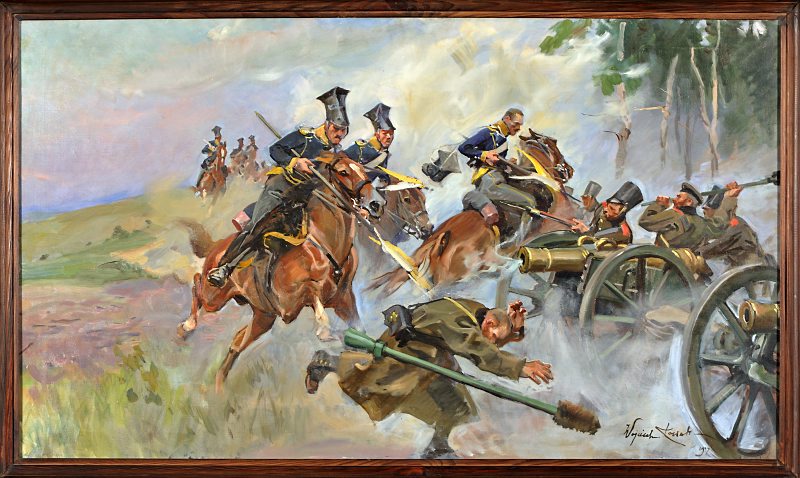
the Cavalry of the line or Cavalry Corps of Polish Kingdom, commanded by general Aleksander Rozniecki, consisted of:

the chasseur a cheval division - four regiment of chasseurs named: 1st, 2nd, 3rd, 4th .
 |
| from the left - 1,st, 2nd, 3rd, 4th regiment |
 |
| 3rd chasseur - stable uniform |

 |
| 1st reg. chasseurs in their field uniform |
 |
| 3rd chasseur regiment -field uniform |
 |
| 4th chasseur - horse trumpeter |

the Uhlan/lancer division's regiments were named:


1st uhlan,

2nd uhlan,

3rd uhlan,

4th uhlan.


.
 |
| 2n uhlan regiment - lancer in his stable uniform |
Each cavalry division was divided into 2 brigade, each brigade consisted of one uhlan regiment and one chasseur a cheval regiment.
Each cavalry regiment was divided into two divizions, each divizion consisted of 2 full squadrons. A full squadron had 160 soldiers, 13 NCOs and 8 officers. Each squadron was divided into two half-squadrons, and each half-squadron was divided into 4 platoons, in turn platoons were divided into thirds, each third was divided into 3 'rotas.' The 1st and 4th platoon had the best men, then the 3rd could pick from the remainder of all men and the 2nd had to take whoever was left. There platoons were commanded by the platoon commanders and 3 officers 'ou-or-rota', who sort of were to oversee but did not interfere. Squadron formed in two lines, the first line had the best men and best looking horses. For the marching order, the squadron marched in threes (or like the Russians in 6-men abreast ).
The uhlans/lancers were armed with lances and sabres, each squadron had 1 carbine-armed platoon, or equally possible was the arrangement where there were 4 carbine-armed rotas in each platoon of the squadron. The flanking carabine-armed uhlans were supposed to form in two skirmish lines and even to dismount and defend the squadron, when necessary. They were trained to do these tactics with the use of trumpeters and their signals.
The chasseur a cheval (szaserzy) regiments, beloved of grand duke Constantine, were armed with a sabre, a cavalry carbine, and a pair of pistols. although they were taught infantry drills and fire drills of the infantry, they were horse-fighting 'dragoons,' using essentially the same tactics as the lancers.
Additionally , every regiment had one more reserve squadron of 100 men. NCOs and officers, where recruits were trained and schooled. (Tokarz, Armia Krolestwa Polskiego 1815-30).
In total 6788 officer, NCOs and soldiers and horses as of the late 1830.
This was the most beautiful, led by the most experienced officer and best trained army in the Polish history since the Jan III Sobieski's reign(1674-1699).
 |
| Eagle on the uhlan 'czapka' according to Bronislaw Gembarzewski's research |
Valete