Showing posts with label XIV century saddle. Show all posts

Wednesday, December 24, 2025

Merry Christmas on Christmas Eve

 Salvete Omnes,

so it is Christmas Eve (Wigilia in Polish, La Nochebuena in Spanish) - 

a page from Breviary of Salisbury

..

Merry Christmas to you and your loved ones, dear fellow net travelers. 

.

I would like to point your attention to the much damaged frescoes by one maestro  Jenez (Johannes) Aquila - XIV century painter in the Arpad Kingdom of Hungary. 

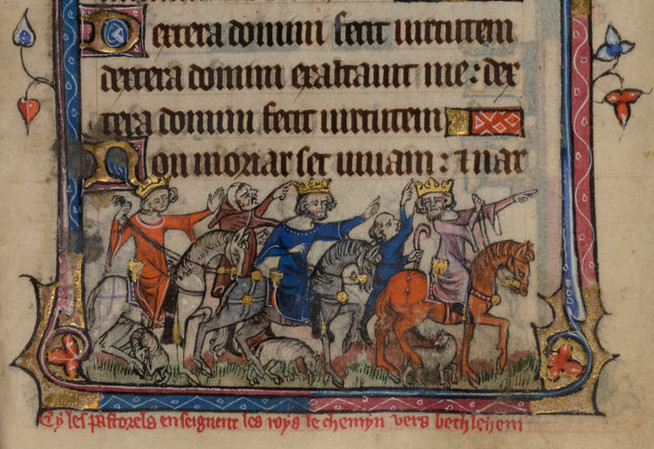
The Holy Trinity and Saint Stephen church in Velemer, Hungary, has some surviving frescoes showing, presumably, the Magi approaching and adoring the Baby Jesus. 


.

.


.all images are from Wiki Commons


.

[Polish] Wesolych Swiat Bozego Narodzenia - wesolosci i humoru, pieknej a smacznej kolacji Wigilijnej

..

Feliz Navidad...

..

May your horse, dogs and other domestic animals stay healthy and safe.

Again, Merry Christmas - may peace prevail everywhere and the current wars cease immediately.  

Valete

Thursday, March 7, 2024

Taymouth Hours - British Museum

 Salvete Omnes,

Guy of Warwick


Illuminated beauties from AD 1320s Book of Hours  known as Taymouth Hours of British Library. In the link you can view the scanned pages in their full glory on the BL search page (with more detailed description).


Nota bene, the first four illuminations are on  the theme of Guy of Warwick  - Anglo-Norman romance of Giu de Warewic (one of the medieval Matter of England heroes )


and other illuminations

Amoras and his wife

Amoras & Virgin Mary


Virgin Mary saving a woman fallen from a horse from a devil


enjoy 

Valete

Thursday, August 5, 2021

Jean Pucelle, horse & rider - BNF Gallica manuscripts

 Salvete Omnes,

August is always a difficult month to begin, Dog days on one hand and the remembrance of the tragedy of Warsaw and her Uprising of 1944, especially mentioned on my blog the massacre and genocide of Wola district inhabitants by the Germans. 

But also  this doggy August  brings the memory of our king Sigismund II August, son of Sigismund I and Bona Sforza. Queen Bona gave birth to our future king Sigismund II August on August 1, 1520. He was a good king, he was. Yet he was unable to collect the money his mother had lent the House of Hapsburg. But he made possible the creation of the Polish-Lithuanian Commonwealth.

So going a bit medieval today, I will first comment that perusing old archives, digital archives included, is like going hunting, and from time to time sweet prizes are to be had.

By pure coincidence I came across the medieval illumination  works cumulatively known as BNF 10483-84 and attributed to a Parisian 14th century  Gothic painter Jean Pucelle, although there were other painters (3 or four) or miniaturists who worked on this two volume Breviaire de Belleville. Interestingly  this breviary was named after  this famous Breton she-wolf Jeanne de Belleville. And until the French Revolution the volumes were held in a Dominican abbey at Poissy, Ille-de-Fance.

     I corralled some of the wonderful illuminations from both volumes, there are  Biblical in literary  context(eg two miniatures of Absalom or David and Goliath) and very XIV century medieval French in material context, for our purposes bits, cinches, saddles, cloth, stirrups, weapons etc :


Enjoy

Valete


Tuesday, May 21, 2019

Lorenzo Veneziano - horses and knights

Salvete Omnes,
Spring is around us, and where is the global warming or climate change? It has been cold and cold.
anyway, to warm up the historical equestrianism a bit - maestro Lorenzo Veneziano and the horses and  horsemen in his art :
first this little picture, the triptych from 1370sAD - Museo Tyssen-Bornemisza in Madrid, Spain -on the right side of the triptych there is a horseman with his grey steed, but owing to the small size of the picture I cannot see much there

the second image, a predella, from the Staatliche Museum in Berlin shows  Conversion of Saint Paul, is more populated, with 7 horses and riders, and due to the proper size for more investigative approach  appears quite rich in detail.


the center figure - of Saint Paul the Apostle - the knight soon to become saint Paul carries a great sword, and a combination of cuir-bouilli (hardened leather) armor that for the last quarter of the XIV c. appear to have been purposefully antiquated as already the Italian armor industries were the most advanced in Christian Europe.

 the red leather saddle is interesting,as with its low pommel and cantle appears to portray a riding knightly saddle (note the saddle skirts and cinch - it is a leather one?), but the gray  horse (shod with horse shoes), with its tied tail and short mane and tied up forelock, perhaps is supposed to represent  a dextrarius and not a palfrey. Horse tack is rich in beautiful vermillion red, the bridle has a curb-bit with a single set of reins.
the figures on the left
we see two figures on the left, one sorrel horse with a long- shanked curb-bit hanging from its bridle and dark blue tack,  behind him(presumably the armed men rode male horses) a gray horse with red tack - both horses appear collected.

 the horses on  the right - the brown horse with another set of rich red horse tack, also a curb-bit and studded crouper and breastplate. The saddle with long skirts appears to have been portrayed with larger pommel and cantle than that of Saint Paul. There are three more horses, seen in less detail - gray, bay, and dark brown,


 So in this little predella we get a glimpse of the rich equestrian  life of the northern, Venetian?,  Italian nobility.
Valete

Sunday, April 28, 2019

Simone Martini et tents etc

Salvete Omnes,
I would like to bring your attention to several works of the XIV century Sienese painter Simone Martini , disciple of the famous Giotto. In his brushwork we see medeival Italian horses, horse tack and event tents used by the medieval armies.

 
 first, the fresco of Guidoriccio da Fogliano, the Sienese condotiero (mercenary) commander, at the siege of Montemassi at the Palacio Publico in Sienna.
He is riding a tall grey dextrarius that is shod and  caparisoned.

We do not see much of the condottiere's armor but for his neck, arms and legs that are protected by the mail, and the legs are reinforced by some early plate armor. Riding in the military fashion, double reins in left hand, he holds the botton, the symbol of his authority as the commander (and conqueror of Montermassi).


 very interesting portrayal of the pavilon tents of the nobility and commanding officers and also tents for the troops (included grass or perhaps straw covered tents) and it is my guess that the green structures are stables for their horses.

Another work, a panel painting, that is interesting is the  Blessed Agostino Novello Altarpiece
 where in this tempera panel we see a fallen horse

 and the details of the saddle (painted leather skirts) and stirrup  with the stirrup leathers.


Valete

Sunday, May 20, 2018

Arne Koets on Knightly Lancer saddles


Salvete Omnes,

Just a short entry - thanks Marcin Ruda of Ruda Saddlery of Poland-

well known ecuyer Arne Koets did a short video presentation of two medieval  lancer saddles, one from the XIII-XIV centuries (or even as early as XII century)  and the second more developed lancer saddle from the XV century,  saddles were made by Andre Görlach (XII-XIVc) and Joram van Essen (XVc) of Germany.

Arne takes time to explain the saddle construction and its impact on riding and lance fighting - so enjoy and learn.


Enjoy