Showing posts with label morisco bit. Show all posts

Tuesday, August 11, 2026

Cheiron - lecture on Medieval curb bits and hinged bits

 Salvete Omnes

MET German curb bit


Cheiron Journal has many podcasts on their Yt channel, and today I would like to point your horses to this presentation on the Medieval Curb and Hinged Bits..


The lecturer also uses my  own art from 2012 (eg used here  - a spade bit diagram with explanation


.some Medieval bits


John Clark's article on the archeology of Medieval bits in England.

Valete

Saturday, August 17, 2024

Bericht und Ordnung der Gebiss a. 1578 - manuscript

 Salvete Omnes,


at the Austrian National Library they have this manuscript - by our prolific ecuyer Georg Engelhard Lohneysen.
Dated 1578AD it is beautifully written and illustrated - the men leading their mounts - done in gouache


.


.

Hungarian, Ottoman or Polish noble

.

mule or large donkey with a docked tail


the printed version of 1588  is condensed as per images  but equally pleasing in its beauty, but without the plates with horses and mule being led. I do not read old German so to me these plates are it has to be - on Fb there is a group talking and writing about these old German equestrian manuscripts.


enjoy
Valete

Thursday, July 25, 2024

Fiaschi - maneggi, posata & repolone via Tomassini

 Salvete Omnes,


a little entry from the archive of the history of horsemanship and some modern research into the history of equitation


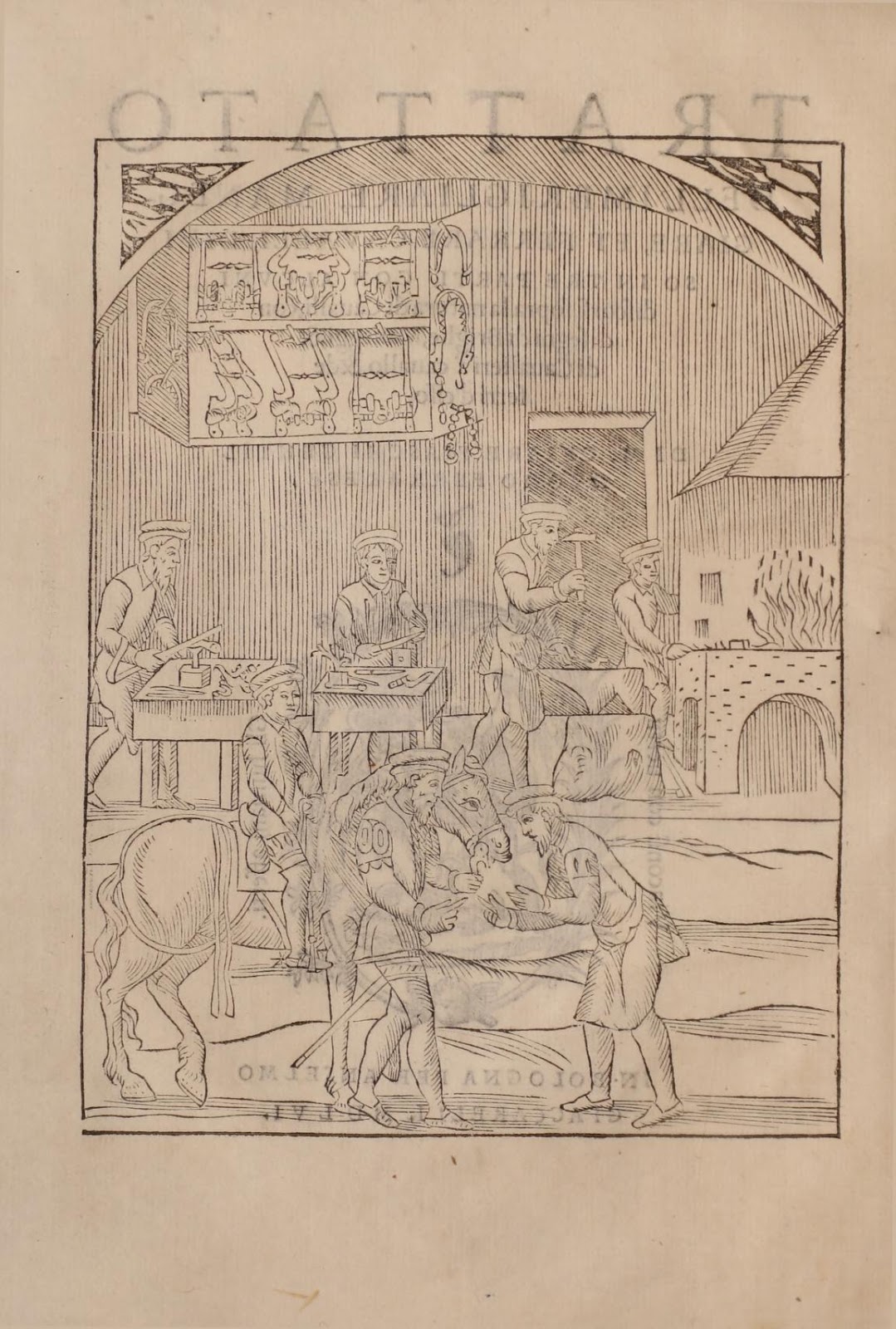
Archive World Library contains thousands of old books - eg Trattato dellimbrigliare, maneggiare, et ferrare cavalli: diviso in tre parti, con alcuni discorsi sopra la natura di cavalli, con disegni di briglie, maneggi, & di cavalieri a cavallo, & de ferri d'esso.
which is a very nice copy of the famous equitation treatise by Cesare Fiaschi, a gentleman of Ferrara, Italy (a town where the famous Palio took place), born in 1523 when d'Este princes ruled Ferrara and fought their enemies with fire and artillery mostly,  and where he died after 1570AD, when the arts of horsemanship and their studies took over Italian peninsula and eventually the aristocratic Europe.


Some time in the first half of the XVI century  the  Este's Ferrara saw opening of a riding academy.


Perhaps there messer Cesare Fiaschi became a riding master or ecuyer  of the academy in Ferrara, and 5 years after famous Frederico Grisone's treatise on horsemanship, Cesare published his famous work on horse training in 1556AD.


Modern Italian ecuyer, researcher  author, and RAI journalist, Giovani Batista Tomassini has been researching the art of horsemanship, including the life and works of signore Fiaschi. - note I posted about Giovanni Batista Tomassini's articles and research in the past. 
This is messer Tomassini's work on Fiaschi's life - new and proven information - it is a veritable trove of information about Cesare, his family history, and his trials and tribulations, including a trial for heresy in 1560s.

But I would like to turn your attention to another two articles on Fiaschi and and works by signore Tomassini - Maneggi and Jumps - part 1 & part 2

here I will 'quote' one of the most interesting passages from the part 1 - 
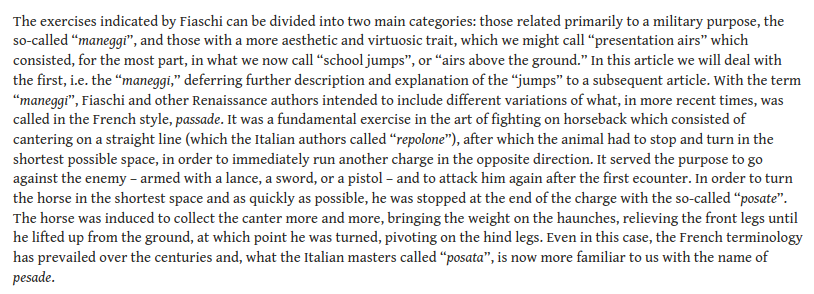
worksofchivalry.com site or from Academia


The second part discusses not only Fiaschi, but also Claudio Corte and Grisone, all most famous and influential ecuyers of the era.


and some of the morsico bits form signore Friaschi


Valete


Wednesday, July 24, 2024

J.G Pforr - Tunisian (Barb) horses

 Salvete Omnes,


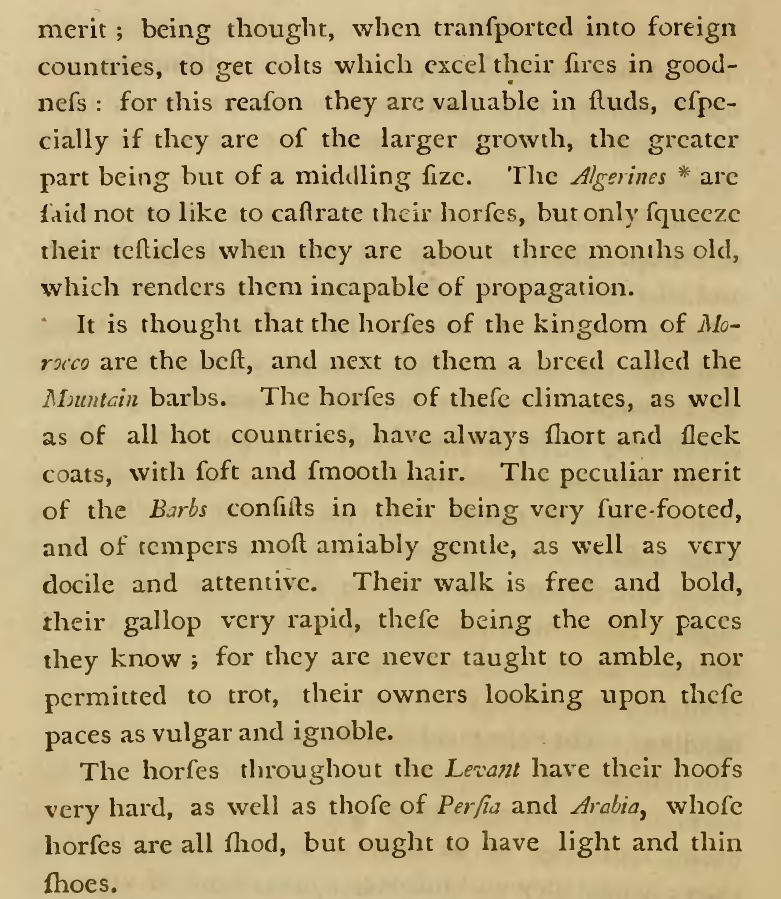
and the time has come to look at Johann Georg Pforr's horses of North Africa aka the Barb horses.


The Sportsman's Dictionary said:

in addition to the Barb description, there is this falcon described

.

Barb horses  described by Berenger 


.


.


.

this horse has the famous Morisco curb-bit in his mouth 

we can see the ring bit of this horse Morisco curb-bit, and a moon shaped halzbant

enjoy

Valete

Friday, June 12, 2020

Jean de Feschal - late medieval treatise

Salvete Omnes,
back form the break of sorts - the USA in upheaval and things are very emotional, violence and rioting out there - all this qualifies for a Chinese saying -
Ad rem, a short entry- :)
while 'talking' about the medieval and early modern hinged-bits on one of the Facebook groups I was pointed to a manuscript by a French lare Medieval or early modern hippologist chevalier Jean (Jehan) de Feschal,  - Traité d'Hippiatrique .
 ''De nombreuses inscriptions dans une écriture cursive du XVIe siècle (peut-être plusieurs mains) sont présentes dans le manuscrit.''
so, the author of Gallica information on this manuscript seems to ponder the difficulty with precisely pinpointing the year this family manuscript was produced, and indicates that the writing style belongs to the XVI century style and there are various hands present, thus might have been more writers to this folio.
It is accessible for viewing and/or download on Gallica - French National Libary.

it may be interesting to search and find out which Jehan de Freschal  it might have been - as there were at least two Jean de Feschal(separated by more than 2-4 or more  generations?) two of this family: I found
1. Jean, seigneur de Ture et de Bourgon,
2. Jean du Feschal, seigneur de Marbouë & du Gripon, capitaine du château de Caen.
and the coat of arms shown in the manuscript shows that this family branch was entitled to use the coat of arms of the Montecler one on their escutcheon-  more about this Le Mains family of de Feschal  see here
The manuscript has more than 160 pen and ink and watercolor images of various bits.
Among them this interesting  bit for la gineta/jineta.(view 70 on Gallica)

Valete

Wednesday, May 20, 2020

Ring bits from The Loriner & Juan Segundo

Salvete Omnes,
short post on the morisco bit series.
While perusing my book Bits and Bridles by dr G.A. Malm, I came accross a reference to the XIX century book titled The Loriner : opinions and observations on bridle-bits and the suitable bitting of horses, with illustrations by Benjamin Latchford- (1871). Mr Latchford makes reference to a book by a Spanish writer and specialist don Juna Segundo.
On the world library site The Archive you can actually study and enjoy this work, it is freely available.
Don Juan Segundo book on horse riding and bits  also available freely there.

So, among many varieties of bits and stirrups there are two ring bits, or the Spanish name goes: the Morisco bit.

The Turkish ring bit

Mameluke rRing bit
 

Salvete

Thursday, May 7, 2020

Dorohostajski - munsztuk (hiszpanski) II

Salvete Omnes,
[in Polish]
imć pan Krzysztof Dorohostajski, rycerz waleczny, towarzysz husarski, min dowódca prawego skrzydła w zwycięskiej wojsk polsko-litewskich bitwie pod Kokenhausen 23 czerwca 1601, uczestnik szturmu na mury Smoleńska  13 czerwca 1611, w swym dziele o koniach czyli Hippice opisuje munsztuk 'hiszpański' który jest podobny adziamskiego (od Adziamu czyli Persji). Munsztuk ma zakrzywiona, krótką czankę, którą autor nazywa ussarską (tak jak w przednio opisanym munsztuku).
 
Opis autora:
'Munsztuk zupełny hiszpański, na kształt adziamskiego, z gęsią szyją sowitą, z łańcuszkiem cały, z kolcami miasto igrzyska poprzecznemi, z czanką krótką, zakrzywioną ussarską, z sowitem uchem szrubowanem.
Tego munsztuka, dla kształtu, do stroju adziamskiego używają, względem krotochwil raczej, aniżeli z potrzeby, bo może być do wargi końskiej i bez nagłówka przypięty; pożyteczny jednak jest do jazdy w mieście, koniom albo raczej parepom wolnym, dobrej i postanowionej gęby, załamuje, i czyni smaczne dzierżenie, nóg podnoszenie i ozdobnego chodzenia nakłada.''

..
 Valete

Saturday, September 15, 2018

Morisco Bits North Africa - MET

Salvete Omnes,
North African morisco bits from the MET:
Tuareg


 Maghreban


Valete!

Morisco bit from Ottoman Empire - MET

Salvete Omnes,
 more ring bits today - Ottoman Empire morisco bit - MET collection


Valete!

Morisco alias ring bit from New Spain - MET

Salvete Omnes,
riding aids from history:
a morisco bit aka ring bit from New Spain (today Mexico and southwestern US) XVIII century - Metropolitan Museum of Arts collection.


Valete

Sunday, September 4, 2016

Morisco style Curb-bit from Dorohostajski

Salve,
on the Polish digital library site Polona there is a 1620 version of Krzysztof Dorohostajski Leliwa coat of arms book titled 'Hippica to iest o koniach xięgi' (Hippica or books on horses)
Hippika title page engraved by Makowski

with etchings done by a Polish master engraver Tomasz Makowski (circa 1575-1630AD), also a very skilled cartographer as we will see below, including this beautiful rendering of a Morisco bit
Morisco bit

Master Tomasz worked for the Grand Duchy of Lithuania  prince Mikołaj(Nicolas) Krzysztof Radziwiłł nicknamed Sierotka (the Little Orphan) Trąby coat of arms, author, pilgrim (went to the Holy Land, and to Egypt- where he got mummies, and wrote a book about this experience here 1607 translation from Latin to Polish by a Jesuit father Andrzej Wargocki, 1925 edition by a linguist, librarian and historian of literature Jan Czubek ), warrior, statesman and also the builder of many manors, churches, and among them the famous castle at Nieśwież/Nesvizh
prince Mikolaj painted circa 1590

Makowski etching of prince Mikolaj

Nieswiez engraved by Makowski
and among many projects engraved a map of the Grand Duchy of Lithuania..
with these interesting details showing Polish-Lithuanian soldiers advancing against some mounted foes, most likely the Crimean and/or other Pontic steppes Tatars
The engraved map was 'stolen' by the Dutch printmakers and published without attribution to master Tomasz  in their world atlases etc (eg here ) - no American FBI and no copyrights then _:)
enjoy