Showing posts with label Dziady. Show all posts

Wednesday, November 1, 2023

All Saints Day - ancient holiday of ancestors & lights for Poles

 Salvete Omnes,

Landau altarpiece by Durer 


today all Poles around the world celebrate the day of ancestors or our own version of All Saints Day, deriving in part form our ancient pagan Dziady feast . In Poland and in the lands formerly being Polish there are famous cemeteries - Powazki in Warszawa/Warsaw, Rakowicki w Krakow/Cracow, Łyczakowski in Lviva/Lwow (now Ukraine), Rossa in Vinlus/Wilno (now Lithuanian), a smaller ones like the one in Dyneburg/Davgaupils, Latvia (from where some of my ancestors come) etc. 
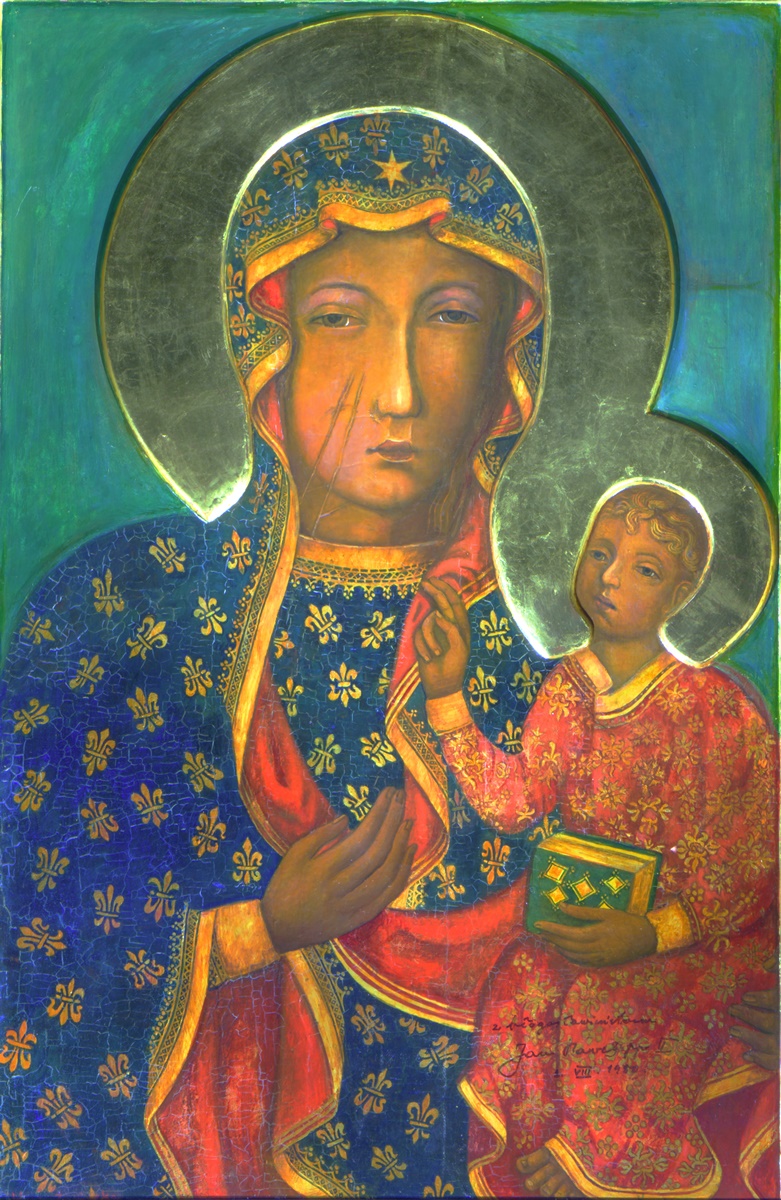


In America we even have our own version of the Holy Jasna Gora Monastery Czestochowa Shrine with...  a very special Polish-American cemetery , where many important Polish-Americans are buried (near Doylestown, Pa).


Including these monuments to Ignacy Paderewski, the father of Polish post 1918 independence and many others

genius of piano and Polish raison d'etre 

World War Two ace 

Polish-American painter Adam Styka 

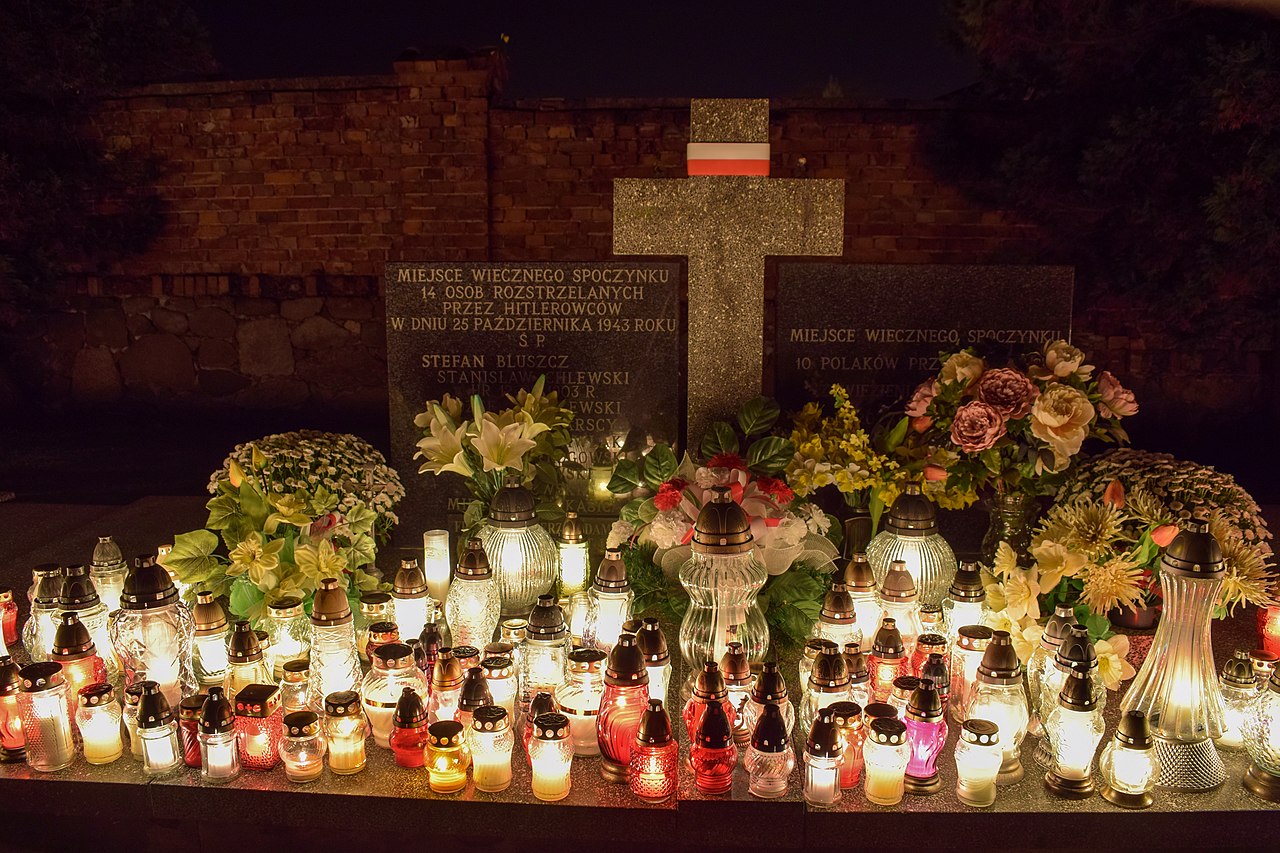
tonight the cemetery will be alive with lights of the candles and reflections of flowery arrangements and wreaths  etc.

pre-World War II celebrations by Narcyz Witczak-Witaczynski, nota bene murdered at Katyn in 1940


Like this one from Poland proper


Polish goverment, the current one pretending being conservative and traditional, prohibited celebration of All Saints Days during the C19 first 'season ... to their eternal shame.  
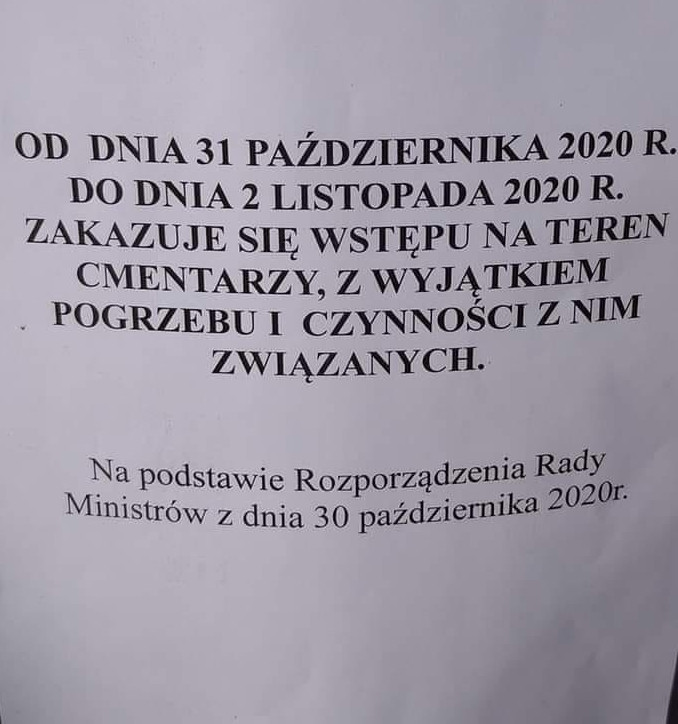
infamous 'regulation' in violation of law and custom & tradition 

There will be celebration at the Polish military cemetery at Monte Casino, Italy, and Grainville-Langannerie Polish war cemetery , Polish Air Force Memorial in London, Polish cemetery at Polonzekoy in Istanbul, Turkye, Polish Cemetery in Tehran, Iran, Tobruk etc.  Even Katyn War cemetery will be alight, in spite of terrible relations between Poland and Rus. Federation. And many other cemeteries containing remains of us, Poles, like the most tragic Auschwitz Concentration Camp Museum site, the largest mass grave of Polish citizens in the world.
Too bad the poor Polish people tortured, abused and genocided  by UPA in Ukraine circa the period of 1944-45 will have no graves, no markers nor candles to illuminate their eternal resting places, as Ukraine prohibits finding their murdered and abused remains. Shame..
ps

I hope for peace and tranquility in the world, from Ukraine to the Holy Land, et al., as wars seem to be all over and growing..

again, Happy All Saints Day

valete

Tuesday, November 7, 2017

Dziady yet again - gothic story from Paprocki

Salvete omnes,
Dziady or Slavic Halloween feast [and All Saints Day too]  has passed already.
But in this gloomy November weather gothic stories may be more appropriate then other times...
So from time to time I read this very special Polish armorial harkening back from our own Polish  Golden (XVI) century, namely Bartosz Paprocki's Herby Rycerstwa Polskiego.(Wiki) . It is a lovely book and quite fine example of heraldic literature, not to mention a very interesting study of the Polish XVI century prose, grammar and orthography. 

Inside, among so many stories and tales pan Paprocki tells us readers,  there is a story most appropriate for the 'dziady' feast, I think.

The story perhaps took place sometime during the  Crown of the Kingdom of Poland wars with the Turks and Tatars (1485-1503) when three Jagiellon kings (Kazimierz IV, Jan Olbracht and Aleksander) carried expansion policies into  Moldavia and southern Pontic Steppes colliding with the Ottoman Turkey, Crimean Khanate and Duchy  of  Muscovy plans and policies.
So perhaps we have here the events circa May 1498- November 1498, during the several deadly incursions, deep into Polish state, carried by the Ottoman Turks and their Tatar and Circassian and Turkmen vassals (nota bene perhaps some of the Turkmen horses were captured and added their blood to the Polish horse bloodlines).
These incursions were very large and inflicted huge material loses on the kingdom, while the invaders, going after slaves and plunder, murdered children and elderly indiscriminately, took many thousands of young women and young men (perhaps up to 30-40 thousands or more)  of southern Polish Crown lands into captivity (jasyr - yasyr) to be sold down south in Crimean slaving markets and Constantinople imperial slave markets (slave trade was run exclusively by the Ottoman Jewish slave traders -  Andrzej Dziubiński, Na szlakach Orientu. Handel między Polską a Imperium Osmańskim w XVI-XVIII wieku. Wrocław 1998. s. 210 ) more in these article a & b .


We are given but a glimpse into some unknown battle, very fragmentary one, and it is difficult to decipher what exact battle our illustrious author wrote about.
Syrokomla coat of arms
Paprocki wrote [and I translated):
Żołędziowie[1] [from] near Halicz in Red Ruthenia, were excellent men and of a house(family) well-multiplied; when the Turks were near Lwów (Lviv), [then] their ancestor (unnamed Żołądź),  having  learned that they had killed his brother, rapidly rode into the pagans' [lines], crossed arms with one of them, bravely unhorsing him with his lance, [and then] attacked another [Turk] with his sword, but suddenly a second Turk rode up to him from the rear and when Żołędź was raising his sword to strike the former, the latter ardently attacked him from behind and with his sabre decapitated him*. [ Thus decapitated Żołądź] rode without his head for about a half of furlong and [during this last ride] he three times waved his sword and finally fell off [his] horse.
The third brother, who was in the third polk[2] once given notice about his brother's death, having had with himself Zawisza of Sas clan  and they were a hundred horse[3] strong in this poczet (unit)[4], assaulted those Turks who had penetrated into the Christians'[lines], defeated them completely and [subsequently] adding more troops to his poczet he harassed  the Turks so since that time they [Turks] had not ridden with the Tatars into Poland anymore.

In Polish (original and the XIX century edition):

Sas I coat of arms
And so we have a headless horseman waving his sword fighting the 'infidel' (or a pagan) of pan Paprocki's times.

enjoy
*alternatively  : [and then] attacked another [Turk] with his sword, but suddenly this Turk rode up from behind(turned his horse so he placed himself behind the attacking Pole) and attacked [Żołądź] from the rear and when Żołędź was raising his sword to [strike], this Turk ardently assaulted him and with a saber he cut [decapitating Żołądź]. (but I prefer the first version)
[1] Syrokomla coat of arms
[2]  Old Polish military organizational unit
[3] third polk
[4] poczet - here a military unit, perhaps company?
ps'
 thanks to dr Sikora for his help in reading the Old Polish.

Wednesday, October 31, 2012

Dziady or Slavic Halloween


Salve,
my Slavic ancestors, when still pagan (Poland was officially converted in 966AD), celebrated their dead by holding a special feast twice a year (spring and autumn) known as ''Dziady'' or Grandfathers. The fall feast was held at the end of October and beginning of November.


Bonfires were lit to show the sprits of the dead the way to their living relatives' dwellings.

Prayers were held and foodstuffs were prepared especially kasha, honey and eggs to celebrate the strips of ancestors and relatives, both to secured their favours and to ease their existence in the Underworld.

Wooden masks known as karaboszki (singular - karaboszka) were carved to symbolize the spirits of the dead.

Wandering beggars were thought to have been the special nexus between the world of the living and the dead, and during the ritual of ''Dziady'' these beggars were fed and in return they would recollect and tell of past experiences of the deceased relatives.

I should mention that the spirits of the dead who passed naturally were celebrated in the way I described above, but all those who died violent death were buried approximately where they fell and their burials were feared and anyone passing those had to leave a green branch on the burial, eventually the gathered wood was burned during Dziady, as these poor souls were suspected of mischief and those special fires on their burials were thought to stop these wretches from coming to the world of living and causing harm.


With the coming of Christianity these rituals survived in the folk customs and rituals, and they are celebrated in Poland as Zaduszki ( day after All Saints Day), by bringing flowers, often some food and by burning znicze.

Our great Romantic poet Adam Mickiewicz described Dziady in his epic poem "Dziady."

Above, the Headless Horseman Polish-style, in my old sketch :)


ps
 I took the photos shown here from the Wikipedia article, slightly converted via GIMP