Showing posts with label dzida. Show all posts

Sunday, February 11, 2024

A shield, lion pelt, & crane wings of ambassador's valet

 Salvete omnes,

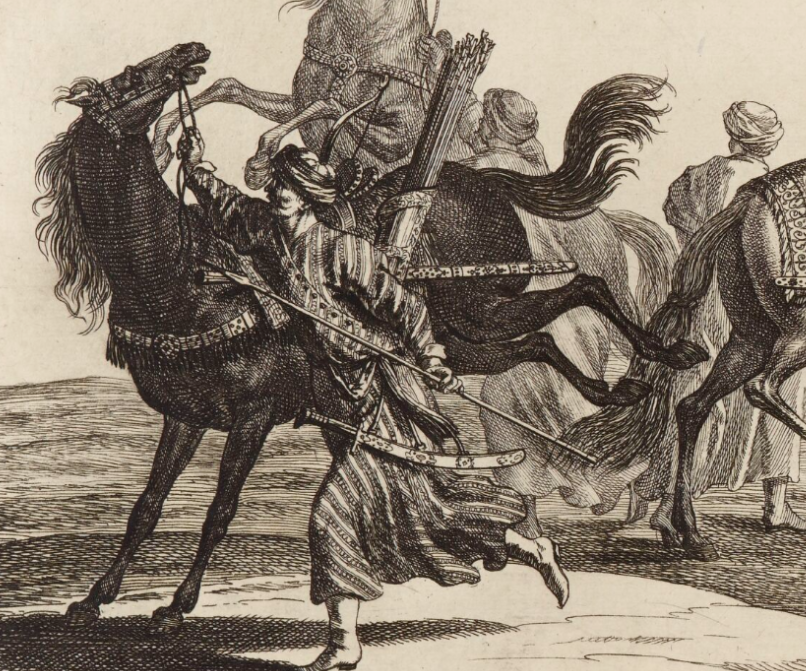
today I prepared a sort of info-graphic, where we can learn and understand a little more about one of the riders in Stefano della Bella's print - Entry of Jerzy Ossolinski into Rome, AD 1633.


Perhaps in the future more this sort images will appear on my blog - what do you think, dear Net travelers? 

enjoy

Valete

Tuesday, April 18, 2023

Ottoman aspect of Certamen Equestre - a detail

 Salvete Omnes,

more than 9 years ago i posted the saddle detail from the Certamen Equestre  Ottoman Turkish section- of Gallica French national Library provenance.
in this plate there is an interesting detail , in my opinion, worth looking at -

note the sumptuous saddle coverings and shabraques, dydwyks and bejeweled harnes and kalkan shield, tuck sword etc 


Namely, this part -

In my opinion it looks very much like a type of a Ottoman Trukish cirit or short dzida like in this detail from Querfurt's painting

Valete

Wednesday, June 9, 2021

Uhlans and lance circa 1760 -Anne Brown Military Collection

 Salvete Omnes,

a quick post - the Anne S.K. Brown Military Collection (Brown Digital Repository. Brown University Library) contains a vast number of military-related images from various periods.
In this 13 print collection by Johann Georg Hertel and Carl August Grossman we can 'corral' 5 prints that may show the Polish cavalrymen (Lithuanian Tatars et al) in the service of the -Polish-Saxon kings up until 1763 (when Augustus III died and uhlan regiments were recalled). The date - 1765 - is approximately one year after for these cavalry units to have been returned to Polish-Lithuanian Commonwealth, where they were re-incorporated into the army.
these three are the most telling as to a hypothesis that they show Polish uhlans from the Saxon royal army:


So in these three prints we can see kurtka, kontusz, katanka, szarawary, dzida (lance),and old Polish customs of head shaving and bowing as a sign of respect - kronoskaf side dedicated to the 7 Years War has two of these lance-bearing regiments described and reconstructed via illustrations - here and here.  


Nota bene according to the  sources the first time these Polish-Lithuanian Tatar lance cavalry banner were called uhlan cavalry occured in 1735. Upon capitulation of the Saxon army at Pirna in 1754 our king had three uhlan regiments - Rudnicki (fully Czymbaj Murza Rudnicki), Renard (who replaced Bronikowski) and Wilczewski - in Polish Crown territory.  In 1756 two regiments - Rudnicki and Renard - marched to join the Saxon corps in the Hapsburg Austrian army (they participated in the famous raid on Berlin under general Hadik) , while Wilczewski's regiment stayed in Poland. During the war additional uhlan regiment was created and by the winter 1762 there were four  royal uhlan regiments - the commander of one, count Renard, returned with the Saxon royal troops to Saxony, and those four uhlan regiments were led by four commanders - Jozef Bielak, Mustafa Korycki, Jozef Chojecki and Ahmed Skirmott.*
Thus in the early Spring of 1763 the story of Polish-Lithuanian uhlans on the Saxon royal kings service ended, and they rejoined the Polish-Lithuanian armies.

valete

*article by Grzegorz Szymborski, Jak Tatarzy ulanow stworzyli-historia polskiej fromacji wojskowej - many thanks Grzegorz.
Borawski Piotr, Tatarzy w dawnej Rzeczpospolitej, Warszawa 1986

Borawski&Dubinski, Tatarzy polscy. Dzieje , obrzedy, legendy, Warszawa 1986

 Ciesielski Tomasz, Armia koronna w czasach Augusta III, Warszawa 2009

Kryczynski Stanislaw, Tatarzy Litewscy, Rocznik Tatarski, vol.III, 1938

Trabski Maciej, Pulki przedniej strazy wojska koronnego w latach 1768-94.  Chorzow 2012


Wednesday, September 12, 2018

Vienna 1683-2018


Salvete Omnes,
yesterday I did some reminiscing about the tragedy of 9-11 and the war that has been following  the attack ever since and that this war may last forever.

    Since the early morning, but 335 years ago, the Polish, Imperial and German states troops or the allied Christian army had been battling their way down to the plain where capital of Hapsburg empire was surrounded and had been besieged by the multiethnic Ottoman army under grand vizier Kara Mustafa.

     Islamic and Christian soldiers fought one another since the early morning, at first the infantries battling one another, but carried by their bravery and good soldiering slowly the Christian soldiers pushed their Muslim adversaries towards the Ottoman camps and thus opened way for the possibility of cavalry to charge.

It was already the afternoon and perhaps the final assault would have taken the next day,  since Jan III Sobieski had envisioned the final assault against the Ottoman lines, with the Polish cavalry leading the way, especially Polish lance-bearing cavalry, i.e. , the winged hussars armed with kopia ( perhaps 4.5-6meters long, hollowed and painted lance with equally swallow tail long pennon ).
Thus King Jan III was waiting for the moment when field was cleared for the lancer banners to probe the terrain and to attempt the charge. Sometime between 1600 and 1700 hours Jan III ordered one of his army winged hussar companies - prince Aleksander Sobieski - commanded by Zbigniew Zbierzchowski to charge the multitudes in front of the king-led right Polish Crown wing of the Christian army, this being the left wing of the Polish forces.

It was clear that Jan III wanted to know if such mounted  charge was feasible.

The 110-120 lancers and horses-strong company of heroes, in two kopia-bristling rows with red and white pennons flying, charged towards the direction of the commander-in-chief of the Ottoman army huge tent looming in the distance with many thousands of sipahi and otehr cavalrymen of the Ottoman main lines; in front of the charging winged hussars went, on his own volition, the court treasurer Andrzej Modrzewski armed and armored as a pancerni cavalryman.
Pan Modrzewski, galloping well in front of the charging banner, reached the Ottoman screening horsemen and soon was engaged by some brave Ottoman horsemen,  in short time he killed one or two with dzida and wounded some but nunc Hercules contra plures and he had been disabled with some well aimed cirit javelin and dzida blows and  died before the charging winged hussars were able to even reach join him in this uneven fight (his body was carried back to the Polish lines with his head intact as the cantering whinged hussars prevented the Ottoman cavalrymen from carrying away Modrzewski's head); having suffered  their first casualty the winged hussar banner went cantering forward and struck the Ottoman lines at a full gallop like a lightning, but was surrounded on its wings and eventually came to a standstill amidst the Ottoman units. Yet  with utmost difficulty they were able to disengage from their  Muslim foe and with some serious losses (12 companions and perhaps 25-30 retainers were killed ) the winged hussar banner was able to return  to the king proving the charge was possible.

During this charge on the left wing of the Polish Crown army, on the right wing of the Crown forces  another charge was made by a tactical cavalry  unit known as szwadron ( Castellan of Krakow Andrzej Potocki winged hussar banner with two pancerni banners- starost of Halicz Stanislaw Potocki and starost of Rzeczyca Jozef Sluszko - on its wings) led the starost of Halicz Stanislaw Potocki, this unit charged  on the right wing of the Polish army, soon seconded by the second szwadron under voivode of Krakow Szczesny Potocki (his own winged hussar banner and his own pancerni banner and another pancerni banner- Boguslaw Potocki's one). The charging cavalry suffered more losses in total than the lonely royal Sobieski banner and proved that the terrain was quite difficult on this wing of the Polish army.
Finally satisfied as to the possibility of all-out cavalry charge the commander-in-chief of the Christian allied armies and king of Polish-Lithuanian Commonwealth ordered all winged hussar and pancerni companies grouped into szwadron tactical units to charge the Muslim lines. The many thousands of riders of the allied cavalry companies followed in tow.
The rest is history...
Hail to the Victors!
Vae Victis!


..


Valete

Sunday, January 9, 2011

Chocim 1621 and Turkish 'copia'*

Salve,

a couple days ago my  dear friend and 'early hussars' scholar Samuel made a comment about the lances with 'galka' (knob. Apple, 'pomme') so in response to his comment I am showing a fragment of 1657-9 painting done for Swedish ambassador Claes Ralamb by hmm..., there is no agreement amongst the authorities as to the authorship, perhaps by a Polish dragoman and convert to Islam who was associated with Ralamb and perhaps procured or even drew the famous Ralamb Costume Book, while the ambassador was in Istanbul on a mission for his king Charles X Gustav of Sweden. The collections consist of 20 paintings now in Sweden.
These are spahis/sipahi of the Sultan bodyguard unit.   I had the entire Ralamb book on my computer but sadly I lost it when my Windows XP had got infected (and I use only Linux and Mac now).
And here a sample of a bit earlier, 50 yers,  Turkish lancer with knobed(with 'galka')  'copia'  drawn and etched by German artist Zimmerman circa 1605 - courtesy of Samuel.


 Pan Jakub Sobieski, who was one of the commissaries sent by the Polish Seym (Diet) to observe and assist the  Polish commanders during the Polish-Turkish struggle at Chocim (Khotyn), left a description of the Turkish cavalry as he saw them at the beginning of the battle. - battle described in English here radoslawsikora.republika.pl/materialy/Chocim1621/Chocim1621.pdf
Amongst others he stated:

[Ottoman] cavalry gave wonderful show with their fine clothing and beauty of their argamaks (war stallions  - I am writing a little entry on this ancient  horse, perhaps during this coming week), and with banners or pennons with glittering  knobs. Their steeds, brought from much pleasant climate and used by the long trip they had made, were much less brave and sound than we expected.
Asiatic non-warlike host, made but numbers; with long beards and not because of their war deed they demanded attention, and they were terrifying because of their screams and not due to their bravery; they were ready to run,  unable to withstand camplife, used to riches but not the war itself, they did not carry much promise for war....
Turkish European armies justly could call themselves the defence and adornment of this campaign. Veterans trained in the Hungarian wars, and their bodies, spirit and even clothing were unlike the other Turks, they retained the traces of old Christian settlers [Balkan?]. Lancers [with 'copia/kopia'] stood in their first ranks, and we saw typical weapons that Turks commonly use: bow, curved sabres, curved iron hooks[sic!], 'rohatyna' spears [shorter lances or 'dzida' 1,7-3 meters long] and more often the short iron spears [jarid or djarid – Turkish javelin], which they assault enemy with by throwing...


Polish word 'oszczep' denotes a type of a shorter lighter spear-like weapon with a small leaf- or lance-shaped head. Oszczep was used usually by throwing or casting it against the enemy or prey (hunting), hence I think it is translatable into English as 'Javelin', which is a light spear used for throwing, either on foot or form horseback, eg ancient 'palta' was carried in pair, one was used as javelin and second as a thrusting light spear from horseback, such use we see by the ancient Iranian cavalry and later by the Greeks and Macedonians etc.
In Polish we also have a name for a very short javelin of a Turkish kind described above – 'dzirit' which is a borrowing form the Turkish language.

* I used Latin word 'copia' for lance, in a meaning used by the Polish writers in XV-XVII centuries.

Wednesday, February 10, 2010

Ułani - introduction

a Halan, Uhlan, der Ulan, Ułan, Улан - an introduction


Today there was one snowy day on the East Coast of the US of A. Good day to do some painting and reading, I suppose.

     I always wonder how our ancestors could cope with  the freezing winter months, when they liked to wage war and invade their neighbors like the winter 1664 campaign against the Grand Duchy of Muscovy aka Russia.  It was during this unfriendly season that they started serious military operation over the frozen swamps, lakes, and rivers across the large areas of the Northeastern Europe. Polish-Swedish Wars and Polish-Muscovy  (nota bene Poland stopped using Muscovy and adopted new name  'Russia' around 1772 or so) Wars of the XVI-XVIII ( 16-18th) centuries were conducted during all seasons, including the coldest months. I guess they, the people of the Northeastern Europe, were the exception to the rule in the European warfare of the early modern and modern eras. Only Polish-Lithuanian  and Mongolian-Tatar armies were able to defeat and capture Moscow and do that to the Russian in their wintry country while the Western European armies of Napoleon and  later the German armies of the notorious  psycho and murder of millions Hitler could not withstand the cold and snow, eventually perishing under the snow, sleet and ice.

Eh, so many horses died in those wars, and the Napoleonic defeat in 1812 had direct bearing on the collapse of the so called Old Polish Horse as viable breed/type. But it also spelled the beginning of the Polish Arabian breeding, so successful in the late XIX and XX (20th ) centuries.

And this leads me to this subject – 'Ułani' or English Uhlans (actually older form was 'Halani') - the Polish lance-armed, wearing a 'czapka' ('chapska' square-topped hat of the Great Steppe origin) and 'kurtka' (a double-breasted Polish cavalry jacket), cavalry. They appeared in Western military history during the War of Polish Succession (1733=38) http://en.wikipedia.org/wiki/War_of_the_Polish_Succession in the army of the Saxon and Polish King. It took almost a 70 odd years for these uhlans to become famous due to their service with the Napoleonic armies. I will write about that some other time...
So I wanted to start this theme, and I will be returning to it every so often, because I found some early images of the Polish Uhlans from the XVIII ( 18th ) century.
Two horsemen in full uniforms, showing all the distinctive characteristics of the early Uhlan uniforms. From Charles de Warnery's book on the light horsemen writtine in late XVIII century.

   For a moment let us return to the origin of the name - uhlan. I will skip for now all the Mongolian-Turkish origin of the word Ułan or oghlan, for sake of brevity and just turn to the origin of the cavalry formation name.

Polish name "Ułan" for these fine horse soldiers comes from the Polish-Lithuanian Tatar noble family surname 'Ułan,' and it was made especially famous and thus survived into the posterity because of one cavalry regiment commander named 'Aleksander Ułan' who was commanding the Polish cavalry 'pułk' - sort of a  regiment - in the Polish-Saxon king's service (during the Saxony-Polish-Lithuanian Commonwealth Union 1733-64) and this regiment was known via his surname as 'dzieci Ułanowe' (Ułan's children) and as such name was Germanized into 'der Uhlan'.

Nota bene there were several 'pulks' in the king's service but they all took this new name for light lance armed cavalry after Aleksander Ułan had died. They returned to Poland from Saxony in 1764, because our king Augustus had died, and they carried the name 'Ułan' in the Polish-Lithuanian army, during the Bar Confederation days and later after the Partitions
So after the Partitions of Poland (1772, 1793, 1795) some of the Polish cavalry regiments were forcibly incorporated into the practitioners' armies (Russia, Prussia and Austria), but only the Napoleonic wars made them Europe-famous and most desired in all European armies and beyond...


I must add that the first Ułan regiments were of the Polish (Lithuanian ) Tatars origin, who at first made the uniform to their liking and used their favorite weapon – a light lance (dzida or rohatyna) with a pennon, along with a sabre, pistol while the officers even carried bows as sign of prestige and rank.

In some not so distant future these Tatars and their history will be told here in some detail, or so I hope.
Pa ka
ps
 the picture that I use for my 'avatar' is of such pre-1795 Polish-Lithuanian uhlan officer - done some years ago.