Showing posts with label Crusades. Show all posts

Wednesday, January 21, 2026

Crusader states XIII century history by Helena Schrader

 Salvete Omnes,


As Syria is back in the news this year - the Syrian defense forces, augmented by former ISIS fighters and pro-Turkey militias, from the official Syrian goverment in Damascus are fighting the Kurds in Kobane and north-east Syria, while the Druze minority  enjoys their Israeli protection in the south.

 
From time to time I check the website of the formidable researcher, historian and storyteller Dr Helena P. Schrader. 


This month dr Schrader already posted two interesting articles on the crusades, dealing with the 


Mongols and Mamluks: The Changing Face of the Middle East. - the XIII century conflict between these two great powers, leading to the Syrian wars between the rulers of Mamluks sultanate and the western Mongolian armies, whereas the Mamluk sultans went on to obliterate  the remainder of the Crusader kingdom and knightly strongholds in the Holy Land - like Latakia,  Crac de Chevaliers and Montfort. Cyprus is part of the Crusader myriad but the mainland is in trouble.

fall of Trpioli Ad 1289

Freer Gallery - a glass beaker Mamluk period


The Loss of Latin Syria

detail from a basin with Christian and Islamic symbols, Freer Gallery

the story of internal rot of the Crusader statesmen and Italian trading states (Pisa; Venice was in conflict with Genoa),  that led to development of  multiple conflicting interests and infighting, in face of growing overwhelming powers of the Mamluk state.  If finally leads to the tragic siege of Acre - the infamous execution of the Templar marshal by the Mamluk sultan Al-Ashraf Khalil in 1291. Followed by the evacuation of Tyre, capture of Sidon, loss of Beirut, and final evacuation of Tortosa and Athlit. End of Latin Syria. 

The Mamluk sultanate carried a rather successful eradication of the Crusader material culture and high arts, as almost nothing have survived from the 200 years of Latin rule in Syria, but for some ruins and architectural elements.  


The Latin Crusader kingdom survived in Cyprus, where port of Famagusta  became the Frankish commerce center in the East... Cilician Armenia survived as a vassal of the Mamluk sultanate, and then was annexed by the Ottomans, when they conquered the Mamluks. The various Christians of the Holy Land had to return to their pre-Crusading Age status and situation within the Muslim world. 


enjoy

Valete

Friday, November 10, 2023

Varna 1444 - one fatal charge of a royal banner

 Salvete Omnes,


today we are to commemorate the tragic battle of Varna, in Bulgaria (Academia article about Bulgarians during the crusade 1443-44).
On this day in November 1444 our crusading Polish and Hungarian king, Wladyslaw III (1424-44) of the Jagiellon dynasty, fought the pitched battle against the Ottoman army under sultan Murad II. 


The king's forces, not very large and numbering circa 15,000 fighting men,  had many good commanders among the leadership, including the principal war chief of the Hungarian realms Janos (John) Hunyadi of Transylvania.


King's banner - part of one of the two large banderias of the army center - included two son of our famous knight Zawisza Czarny Sulima coat of arms.


During the final course of battle king's bodyguard 400-500 strong lancer detachment attacked the 5000 (?)  janisary infantry square, within which sultan Murad was sheltering and commanding his army from. It was a daring feat, a gamble and furious attempt to finish the foe at its most central element, the command post.
The action of the Jagiellon  royal detachment was not  unlike many military actions in history, let me show three of them - first, going deep into the ancient world we see the pretender Cyrus the Younger, of the Achaemenid dynasty, who in 401BC  at Cunaxa led his  bodyguard armored  horse detachment against his brother's, Artaxerxes,  5-6,000 strong center. He got within the striking distance to his brother-king, even wounded the king of kings but was killed before he could slay his older brother. 
In 1621, during the Ottoman siege of Khotyn's entrenched Polish-Lithuanian army, the 4 banners of Polish winged hussars charged 10,000-strong Ottoman assault divisions, and  after a  furious struggle and mayhem  these 600 lancers confused, terrified and broke the attackers' will to proceed and saved the day, while killing countless Ottoman cavalrymen and infantrymen. 
In 1656 Polish-Lithuanian several winged hussar banners(perhaps as many as 500  men and horses under Polubinski)  charged the entire Swedish-Brandenburg-Prussian army(at least 20,000 men, horses and artillery) during the 3rd day of the battle of Warsaw.  They penetrated Swedish cavalry lines and disrupted the Swedish array, but in the end, without proper support their amazing charge was fruitless and ended in defeat.


King Wladyslaw's charge at the janissaries square behind a palisade eventually ended in defeat, and the fate of the king remains somewhat a mystery, from dying right there before the sultan on the field to escaping  to distant Madeira, Portugal and living his life out there.


The Varna defeat was huge, but the savage  fighting bloodied the victors too, and Janos Hunyadi, who escaped from the debacle, went on fighting the Ottomans in the Balkans for years to come.

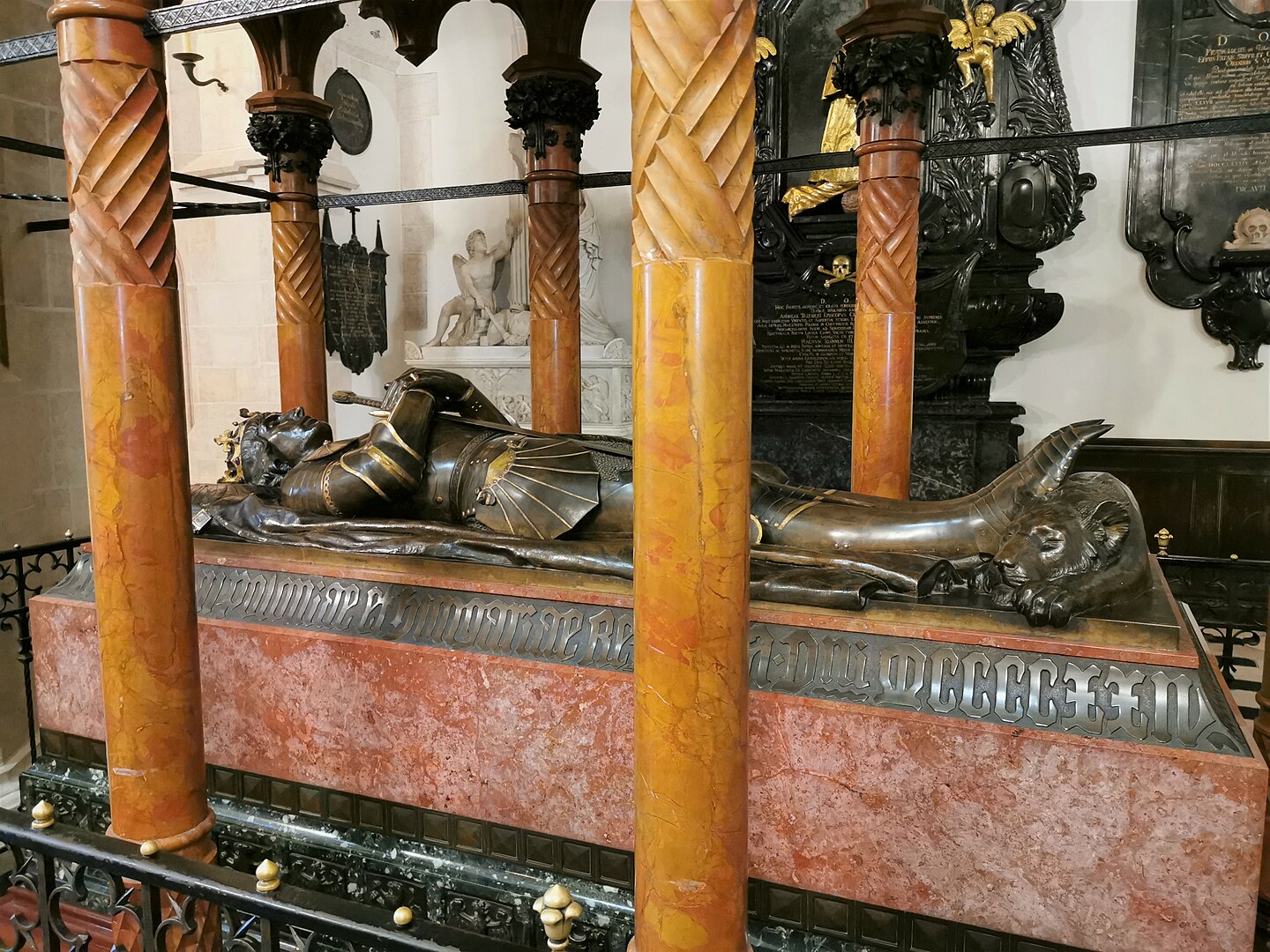
the ceremonial tomb of Wladyslaw III, with no body inside the sarcophagus,  at the Krakow Wawel Cathedral 


Pacem aeternam

Valete

Friday, June 7, 2019

Polish Eagles & hussar lancers - XVI century Wappenbuch

Salvete Omnes,


just a short entry on this day  but 920 years ago or on  June 7, 1099AD the Crusaders under their respective leaders reached the walls of the city of Jerusalem and the famous siege begun.
 There is a book on academia - The Social Structure of the First Crusade by Conor Kostick who is a scholar studying this period- where the various social aspects of the crusades are studied and dissected.
Deus lo vult!
                                                            ***

Ad rem, wiki commons has many images of the Grand Duchy of Lithuania coat of arms known as Pogoń in Polish, Pahonia in Belarus, and  Vytis in modern Lithuanian, -  a charging knight with a sword brought up to strike on a galloping (white usually) horse.
During the time these drawings were created the Polish Kingdom and Grand Duchy were united under one king, of Jagiellon dynasty.

For the purposed of this post among the hundreds of Pogon in the collection there are several images of interest.
They all come from the first half of the XVI century, they are showing  White Eagle and Pogon together.
They are interesting in that they also show early winged hussars, somewhat idealized and/or simplified.


 there is also a third image, of Pogon alone and without the customary shield

Valete!


Saturday, July 28, 2018

Canicular days continued


Melisande Psalter

Salvete Omnes,
it is the hot days of the year, lovely blues skies and harvest time traditionally in the Northern Hemisphere.
milking a cow


medieval life
medieval water mill and fishing - nota bene an article on Roman stone watermill

Author Helen Schrader wrote another excellent article on her blog - on the the particularly of the rural Frankish settlement in the Crusader states, according to the newest research and archaeology - mostly via Ronnie Ellenblum's research  - also about the  prevalence of Christian settlements and population in the Holy Land during the medieval period.
Here, an article on building a church in Latin Kingdom of Jerusalem.
Article on the Norman settlement in the Latin Kingdom of Jerusalem before 1133AD.
Simon Dorso has this article on sugar growing and in general on various aspects of the life of the rural settlers of Latin East.

council of Acra


Council of Jerusalem


My friend Krzysztof Laszkiewicz had the official presentation of his new book at the Manufaktura in Lodz.
They blew up my small drawing of King Jagiello and his courtiers onto the wall, as you can see in this picture
Krzysztof & wife Katarzyna at Manufaktura, Lodz

Arne Koets, Peter Spatling et al. did an experiment - shooting crossbow bolts at a reconstructed chain-of-mail shirt with a reconstructed medieval 200lbs crossbow - watch the video and marvel at the protective qualities of the medieval chain-of-mail.

Valete!

Monday, July 6, 2015

Battle of Hattin 1187 reenactment

Salve,
I am a big fan of the Crusades, and have been reading and researching about that period of Medieval history.
Last July 4 was also yet another anniversary of the battle of Hattin AD 1187 -  it was the most tragic disaster for the Crusader states of the Holy Land et al.

 Modern view of the battlefield.
Dr Helena Shrader who has written many books on this period, wrote a blog entry on this battle that I quite like. Also  you can read her short stories about the most important companion of the medieval knight, his dextrarius or destrier stallion - the horse in question is Centurion, the mount of the famous knight of the Kingdom of Jerusalem, Balian of Ibelin.

Ad rem, Salah Ad-Din Yusuf ibn Ayyub, known as Saladin (Saudi Aramco has a long article on this ruler) and  the most famous Kurdish Muslim  warrior  of the Middle Ages, entrapped and then crushed the thirsty and demoralized army of the King of Jerusalem and his barons. After the battle 230 knights of the Templar and Hospitaller Orders were murdered by the scholars from the Saladin's entourage.
 'De re Militari' site has this article that includes four accounts of the disaster, from Christian and Muslim sides, including one by William of Tyre.

This year the battle was reenacted in Galilee, Israel, in its original surrounding. This article has some interesting photos from this daring reenactment
enjoy

Wednesday, January 14, 2015

Crusaders' horse - Outremer

Salve,
back to horses and away from the madness of our world...

...perhaps the time is ripe to take a look at the Crusades and Outremer (Crusader states in the Levant/Near East ), and by Jove, I will try to do some this year (fingers crossed :) ).

Basically, I have been skipping the Middle Ages (and by that therm I mean the European history between the Muslim conquests of 630sAD and discovery of the Americas), but for several on the Medieval warhorses, saddles etc.

Thanks God, we can use images from the period - great depositories at  Wiki Commons and other fine 'open' websites offer us plenty of opportunities -
so in this spirit several images from the Siculo-Norman cultural area, i.e., the Kingdom of Sicily ruled already then by the Holy Roman Emperor Henry VI  and drawn by Petrus de Ebulo (Pietro or Peter of Eboli) around 1196 AD. The work comes from a manuscript ''Liber ad honorem Augusti'' (held presently in Bern, Switzerland) but published and available here with Italian commentary.
Roger II of Sicily 


The conqueror of the Siculo-Normans - emperor Henry VI

Constance of Sicily, clearly riding a palfrey while seating a side-saddle.

Note that all riders use a form of curb-bit and riding holding reins in one hand.. queen's horse tack is especially rich and beautiful, while her horse seems to be a dapple-grey one.

Dr. David Nicolle and his prodigious amount of work will probably figure strongly in this thread - his two-volume set ''Arms and Armour of the Crusading Era 1050-1350'' is a must here.

enjoy
ps
It is a great pity to us readers that the American historical fiction writers always and constantly write about the English Medieval history & characters, when there is this great and unploughed field of the continental Medieval history, while,mind you, most of the Americans are either German, French or Spanish in their descent. Seems like the British royals conquered the US popular culture without firing a single shot (after having lost the two wars 200 years ago - 1776-83, and the War of 1812). Cecelia Holland is a notable exception with her many novels, eg the novel 'Antichrist' telling the story of Frederick II, son of said emperor Henry VI, most successful crusade since the creation of Outremer.