Showing posts with label Hungary. Show all posts

Thursday, March 23, 2023

Polish-Hungarian Friendship day

 Salvete Omnes,

today Poland and Hungary celebrate the  official  Hungarian-Polish Friendship Day (since 2007 in both nations)


Polish 'tribe' and the Magyar one have been friends for more than a thousand years, exchanging kings and queens, princes and princesses, giving aid and helping hand, and refuge to the exiled ones.


Old Poles took or interpreted costumes, weapons, and horse tack from the Hungarians. The most famous Polish cavalry - winged hussars - have Hungarian origin and provenance (Serbian links notwithstanding) .


This long history produced a saying in both countries, both mirror one another  -

Polish-
Polak, Węgier - dwa bratanki,

i do szabli, i do szklanki, 

oba zuchy, oba żwawi,

 niech im Pan Bóg błogosławi.

***
Hungarian  - 

Lengyel, magyar - két jó barát,

 Együtt harcol s issza borát, 

Vitéz s bátor mindkettője, 

Áldás szálljon mindkettőre.

 ***

 the English translation, of my own,  could be as follows:

Pole and Magyar, two sworn brothers

for a sabre and for a cup

Both are valiant, both are lively

May the Lord's blessing be upon them

***


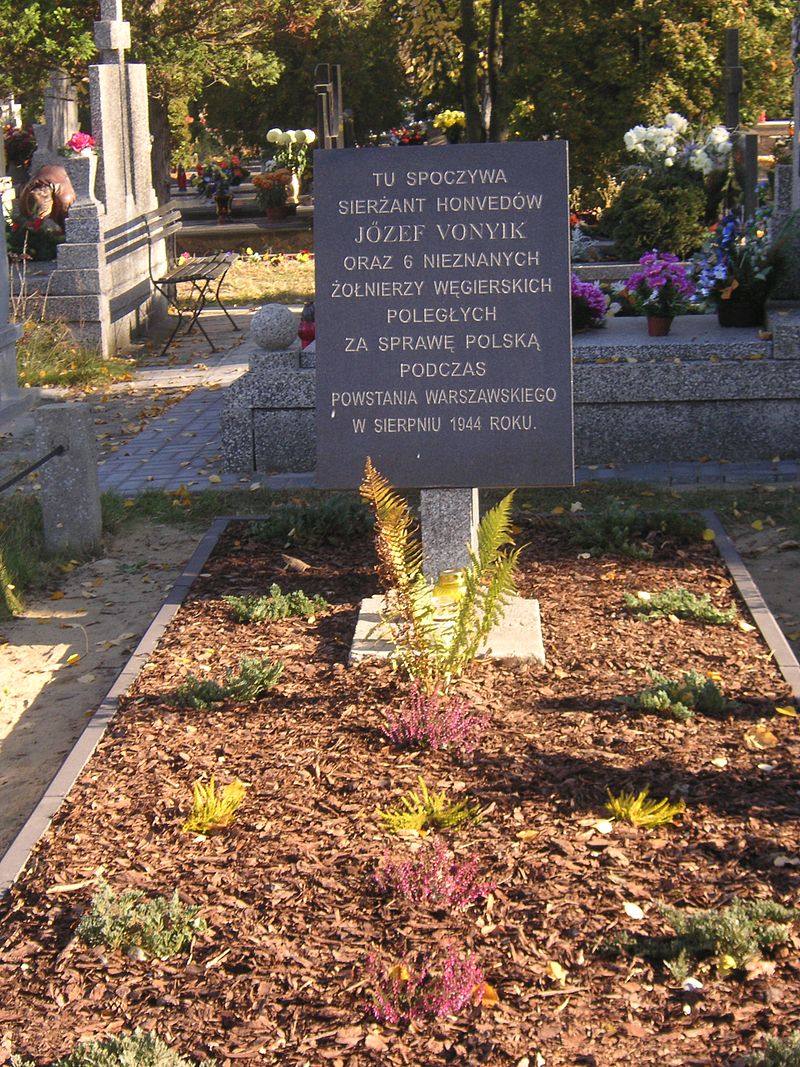
In Polish tradition graves and tombstones play great cultural role and significance. Monument to Hungarian soldiers who died fighting the Germans and their allies (various Nazi units of the ex-Soviet citizens) during the Warsaw Uprising 1944


I wish another 1000 years of friendship to both ... 

ps

there is a mural in Budapest - two oaks of friendship 


Valete

Sunday, May 10, 2020

Hungarian Plain - puszta, horses and grey cattle - Karoly Lotz

Salvete Omnes,

a short entry but before I go to the topic a little remainder and comment.
Namely,  this week there passed the 75 anniversary of the end of World War II (for the Soviets and post-Soviet states it was and is May 9, for the West it was and is May 8, 1945), it culminated with the capture of Berlin and German unconditional surrender. 
 
Poles were part of the conquering Soviet Red Army 'fronts,' and Stalin allowed to raise our Polish flag over the Berlin's vicory column by the Polish army soldiers who took part in the conquest of Berlin.
The Soviet Union flag raising was documented with utomost care and pomp as a part of the Stalin's epic (more than 20 million of the Soviet Union citizens died in that war, while Poland was reduced from 35 million citizens in 1939 to little over  the 22 million in 1946)- some victory they could say, couldn't they?...

It was a great victory for the Soviet Union and USA, while Poland was left by the allies on the other side of the Iron Curtain, and then the citizen were outright robbed of their wealth, all in broad daylight and with the West blessing) in post-1989 'transformation.'
I am fond of Her Majesty the Queen Elizabeth II - after all she is a horse aficionado and  eg she still rode her horses before this corona calamity - and Friday she addressed her subjects to celebrate and commemorate the 75th anniversary, and to pay tribute to her father and her people.
Too bad Polish soldiers (after all Poland was attacked on Sept.1 1939 by  the Germany's Wehrmacht and on Sept 17, 1939 by Stalin's Red Army, and never capitulated, unlike France, or the Benelux countries) were not allowed to march in the Victory celebration in London back in 1946, it was politically incorrect, Britain already had the good Attlee's Labour government at the helm. 

ad rem,

the Hungarian Plain with its puszta, animals(horses, sheep, dogs, and Hungarian Grey Cattle) and people(especially the Csikos) in the art of Karoly Lotz -


Finally, some XXI century videos on the Hungarian Grey Cattle, puszta (eg Hortobágy National Park )and Csikos  & horses from Hungary.

Valete

Saturday, April 7, 2018

Pressburg - Witold Biernacki

Salvete Omnes,
nota bene there is a book coming soon and with my illustration on its cover - by Polish historian and writer Witold Biernacki titled  Pressburg 1620. Jesienna kampania ksiecia Gabora Bethlena. (PRessburg 1620, The Autumn Campaign of prince Gabor Bethlen -  from Infort Editions publishing house.
          This book, which I haven't read yet, is part of the Pola Bitew (Battlefields) series, and is devoted to the miltiary struggle of the Hungarian prince Gabor Bethlen against the Hapsburg Empire during the initial state of the 30 Years War.
Inside apart from the very interesting narrative of this campaign there are illustrations - 8 in number - by Mr. Gyozo Somogyi, Hungarian master illustrator (I wrote about his work already).
Mr. Somogyi and Zrinyi Publishing House from Budapest, Hungary kindly provided this set of illustrations showing Hungarian soldiers of the 30 Years War.
bookcover as shown on Wanax

Valete!
ps
my other set of illustrations  that were to appear along the new edition of Radek Sikora's Lubieszow 1577  has been missing in action. In fact it is the publisher - Wydawnictwo Erica - who has delayed or abandoned this publication, and it has been almost a year since it was supposed to go into print, which is really a pity since I think I painted a very nice set of illustrations  -  some 27 plates, with coats of arms and other goodies... c'est la vie.

Tuesday, August 9, 2016

Saddle from Wielun XV century

Salve,
yesterday I wrote about  visiting the Slav and Viking Festival in Wolin, Polish Republic. I met there Mieczyslaw Mietko Machowicz from Kalisz, Poland, who leatherwork master and historical leathercraft reconstructor and researcher.
In his tent, along with many different examples of his craft and various leather and hides for sale, he had several interesting examples of horsetack and several saddles.

The saddle that brought my utmost attention is this one, from Wieluń in Poland:

reconstructed XV century saddle

 Article about the exhibit in Wielun, including a short information about this saddle, and many photos from this exhibit.

historic excavated saddle from Wielun
a Polish saddle circa 1467, a detail of a painting from the Holy Trinity/Holy Cross chapels at the Wawel cathedral
The historic saddle reconstructed by Mietko was excavated during the archaeological excavation in Wielun, Poland. According to the maker, the saddle has been used while riding, on the Polish 'konik' and with plenty of comfort and safety.
Below find some photos of this historic reconstruction.

saddle tree, horizontal view

saddle, horizontal view

saddle -front arch(pommel), right side

saddle - front arch (pommel), left side

saddle and saddle tree, horizontal view

saddle, 'underside' with rear arch (cantle) visible- with bars covered, and birch bark layers shown, saddle skirts from underneath

saddle, 'underside' with rear arch (cantle) visible- a closeup

so as you can see the saddle appears to have been a riding saddle, not a lancer war saddle, but it could have been used by the crossbowmen and squires too.
and one of my most favorite saints always on horseback - St. Martin in a painting from late XV century Kingdom of Hungary

ps
when I opened the photos I realized that I had not taken any shots of the saddle tree alone, and no shots of front and rear arches (pommel and cantle).

Monday, January 27, 2014

Miklós Zrínyi/Nikolaus Zrinski - another winged hussar

Salve,
 leaving the present politics behind, let us turn again to the period prints from XVII century.

This print shows  Croato-Hungarian aristocrat, poet and military leader Sir Miklós Zrínyi/Nikolaus Zrinski
 again we have typical hussar equipment, a shishak helmet adorned with feathers in a jewelled feather holder and half-armour with coat-of-mail protecting the hips. Instead of the wild cat pelt our hero covers his armoured torso and arms with mente lined with fur and with a huge fur collar. Typically Hungarian nobility would use a kaftan called dolman under the armour or under the over-garment (like delia, szuba or mente). 

Note the curved sabre with  a thumb ring to put one's thumb finger there, holstered pistol (presumably 2) and a sword under the thigh
 His footwear is typical of the Polish and Hungarian nobility - a mid-length Moroccan leather boots, saddle not visible except for parts of the skirt (perhaps he is using a Ottoman Turkish style saddle), while stirrups and stirrup leathers are prominent. He is riding short,  so whether this was characteristic of the Croatian and Hungarian cavalry or this was his own style of riding might be beyond discovering, while it is a fact that the author of this engraving decided to show this style of riding. and the artist was  quite well  acquainted with the Eastern European military, having lived and worked in the Kingdom of Poland prior to moving back to Germany (Nuremberg).
Horse, a true Baroque animal, is spirited and a bit fearsome, bitted with a long-shanked curb-bit and lead with a single set of reins (while it was popular in our part of Europe aka Eastern Europe to use two sets of reins, or at least a lead rein in addition to curb-bit reins), his chest displaying a very nice metal halzbant adoring the leathers of his breastplate; I wonder if the engraver omitted the the adornment (horse tug or just a metal half-moon ) under the throatlatch, typical of the bridles of the Eastern European military? Horse is covered with a Turkish or Persian style rug-shabraque (could have been of the msot expensive materials, with gold, silver and silk thread), a fashion typical to the Eastern European military.

Again, we are given a sketch of a winged hussar with a shishak helmet, wild pelt on his shoulders, but it is unclear if he holds the lance or his companion rider who is also wielding a sabre.

 Nice drawing of a Turkish bow in a bowcase, arrows in a quiver, and in the background a Turkish horseman executing  so called 'Parthian shot'

 the following citation from 1911 Britannica describes nicely this Kingdom of Hungary aristocrat:
...
ZRINYI, MIKLÓS, Count (1620-1664), Hungarian warrior, statesman and poet, the son of George Zrinyi and Magdalena Széchy, was born at Csákvár. At the court of Péter Pásmány the youth conceived a burning enthusiasm for his native language and literature, although he always placed arms before arts.
From 1635 to 1637 he accompanied Szenkveczy, one of the canons of Esztergom, on a long educative tour through Italy. During the next few years he learnt the art of war in defending the Croatian frontier against the Turks, and approved himself one of the first captains of the age. In 1645 he acted against the Swedes in Moravia, equipping an army corps at his own expense. At Szkalec he scattered a Swedish division and took 2000 prisoners. At Eger he saved the emperor, who had been surprised at night in his camp by Wrangel. Subsequently he routed the army of Rákóczy on the Upper Theiss. For his services the emperor appointed him captain of Croatia. On his return from the war he married the wealthy Eusebia Draskovics.
In 1646 he distinguished himself in the Turkish war. At the coronation of Ferdinand IV he carried the sword of state, and was made ban and captain-general of Croatia. In this double capacity he presided over many Croatian diets, always strenuously defending the political rights of the Croats [ 1046 ] and steadfastly maintaining that as regarded Hungary they were to be looked upon not as partes annexae but as a regnum. During 1652-53 he was continually fighting against the Turks, yet from his castle at Csáktornya he was in constant communication with the learned world; the Dutch scholar, Jacobus Tollius, even visited him, and has left in his Epistolae itinerariae a lively account of his experiences. Tellius was amazed at the linguistic resources of Zrinyi, who spoke German, Croatian, Hungarian, Turkish and Latin with equal facility. Zrinyi's Latin letters (from which we learn that he was married a second time, to Sophia Löbel) are fluent and agreeable, but largely interspersed with Croatian and Magyar expressions.
The last year of his life was also its most glorious one. He set out to destroy the strongly fortified Turkish bridge atEsseg, and thus cut off the retreat of the Turkish army, re-capturing all the strong fortresses on his way. He destroyed the bridge, but the further pursuance of the campaign was frustrated by the refusal of the imperial generals to co-operate. Still the expedition had covered him with glory. All Europe rang with his praises. It was said that only the Zrinyis had the secret of conquering the Turks. The emperor offered him the title of prince. The pope struck a commemorative medal with the effigy of Zrinyi as a field-marshal. The Spanish king sent him the Golden Fleece. The French king created him a peer of France. The Turks, to wipe out the disgrace of the Esseg affair, now laid siege to Uj-Zerin, a fortress which Zrinyi had built, and the imperial troops under Montecuculi [ Raimondo Montecuccoli ] looked on while he hastened to relieve it, refusing all assistance, with the result that the fortress fell. It was also by the advice of Montecuculi that the disgraceful peace of Vásvár was concluded. 
Zrinyi hastened to Vienna to protest against it, but in vain. Zrinyi quitted Vienna in disgust, after assuring the Venetian minister, Sagridino, that he was willing at any moment to assist the Republic against the Turks with 6000 men. He then returned to Csáktornya, and there, on the 18th of November, was killed by a wild boar which he had twice wounded and recklessly pursued to its lair in the forest swamps, armed only with his hunting-knife...*


Named Zrínyi Miklós, a költő hadvezér és politikus Sir Nicolas, this true knight faithful to the cannons of chivalr , also wrote poetry - Britannica says:

His poetical works first appeared at Vienna in 1651, under the title of The Siren of the Adriatic (Hung.); but his principal work, Obsidio Szigetiana, the epopeia of the glorious self-sacrifice of his heroic ancestor of the same name, only appeared in fragments in Magyar literature till Arany took it in hand. It was evidently written under the influence of both Virgil and Tasso, though the author had no time to polish and correct its rough and occasionally somewhat wooden versification. But the fundamental idea — the duty of Hungarian valour to shake off the Turkish yoke, with the help of God — is sublime, and the whole work is intense with martial and religious enthusiasm. It is no unworthy companion of the other epics of the Renaissance period, and had many imitators. Arany first, in 1848, began to recast the Zrinyiad, as he called it, on modern lines, and the work was completed by Antal Vékóny in 1892.


Portraits of Sir Nicolas, showing the national costume of the Hungarian and Croatian nobility of the period, very similar to the Polish one. In the first portrait he is wearing a 'dolman'  with a 'mente'? lined with fur.
 In this portrait he wears his crimson kaftan or dolman (over a shirt), and over the dolman he wears a mente. Flanged mace or buzogány in his right hand is the symbol of his command and military prowess.

Enjoy
*
Until this day, legend maintains that he was killed at the order of the Habsburg Court. No conclusive evidence has ever been found to support this claim; however, it remains true that the Habsburgs lost their mightiest adversary with his death (from Wikipedia).
                                                            ***
Zvonimir Grbasic, Croatian artist and military historian (in English speaking workd known for two books on cavalry - here and here) drew a very fine reconstruction of ban Nicolas Zrinski on horseback some years ago.
I received artist's permission to use his reconstruction on my blog, so it is my pleasure to display it here, in its beauty :
 By the way Zvonimir is about to bring more books to us, the reader and admirers of his art and research, so I am looking forward to see more of his books on Amazon.
Thank you Zvonimir!

ps
 some military aspects & assessment of the warfare on the Hapsburg-Turkish border on this page 
ps'
Miles Cameron's 'Red Knight', just received a new and fantastic webpage 'facelift,' as the second volume in the series is about to be released, so do visit it to see yourself and definitely read the first volume when you can - medieval and magical world - with dragons, chivalry, demons, knights and strong damsels -  Traitor son Cycle

Saturday, January 18, 2014

Count Adam Batthyany - winged hussar extraordinarie

Salve,
Wikimedia Commons has this fantastic print from the studio of  Jakob von Sandrart who was one of the best engravers in Nuremberg.
The print is dated to 1664 and shows count Adam Batthyany or Adamus de Betania, Hungarian magnate and one of the chief defenders of Holy Roman Empire's border with the Ottoman Empire during the 1640s and 1650s - of the so called Capitancy of Kaniza.

He was appointed the capital-general in 1640 and his military duties included the security of the entire area south of Lake Balaton.

 This Hapsburg Empire border region, de jure secure under the 20 year extension of the treaty of Zsitvatorok of 1606,  was in constant chaos and threat of small scale raiding by the enterprising commanders leading small Turkish forces while both sides pretended there was peace observed, i.e., no large scale war; hence in this state of no-official-war the Turkish commanders exploited Hapsburg inability to conduct war on two fronts (Thirty Years' War)on their side of the border conducted raids across the border into Royal Hungary for plunder, slaves, cattle and glory.


Count Adam must have achieved his goals with enough success since he was called 'a pillar of Fatherland, ' name coined by his friend and Hungarian poet Miklos Zrinyi (Zrinski). He was to have a very large retinue and being the last Batthyany to hold such vast estates in Royal Hungary, had some 1000 courtiers et al., amongst them he hosted young noblemen from Austria, Transylvania,  Croatia and Poland.
On the subject of Croats he was keen to resettle Croatian mercenaries with their families in Royal Hungary, Croats being experienced warriors and Catholics. He was known for using hussars in his border wars with the Ottomans.
On 15 March 1659 count Batthyány died in Güssing, but it is known that during the battle of Székesfehérvár (1654) when his troops defeated the pasha of Kaniza he had suffered a stroke and yet in 1657 he had been leading the troops, along with  Franz III  Nádasdy , against another Turkish incursion into his Royal Hungary..
But enough about count Adam, let us turn to the engraving itself, done about
 5 years after count Adam's death.

He is shown here as a war leader and winged hussar commander mounted on a spirited stallion, holding a mace as a sign of captaincy, command and war prowess.


He is protected with a splendid,  apparently gilded, half-armour but instead of wearing thigh & hip plate ( Faulds & Cuisses ) protection he has a coat-of-mail under his cuirass, not unlike the winged hussar on the Tablica Gołuchowska and Stockholm Rolka paintings.  Around his shoulders, covering parts of his armour he is wearing a wild cat pelt, lynx or leopard, although perhaps this pelt looks more like a lynx one with a short tail?

A typical hussar shishak helmet covers his head, with a splendid 'egreta' of precious stones and feathers, perhaps a mix of egret featehs with   falcon or hawk feathers.


Under his right thigh there is a broadsword, typical arrangement for these shorter weapons, whereas longer 'estocks' were usually carried on the left side. He is wearing a 'dolman' underneath his armour, or at least should have worn one, as it was Hungarian fashion of almost 2 centuries, and would persist well into XIX century. His boots are typical Hungarian of the period, most likely of Moroccan leather.


We are offered a closer look at count Adam's horse bridle, with a typical curb-bit with long shanks, while our hero is riding with one hand holding the reins in a military style, not unlike the style the California vaqueros were using some 100 years ago. We see just the lower skirts of his saddle, and perhaps it is a Ottoman Turkish-Hungarian blend, with high pommel and wide cantle.

While this imaginary portrait is splendid in itself,  the background images  shows one spectacular scene, namely they show winged hussars attacking their foe.

We have the entire retinue - the noble towarzysz hussar and his retainer. Behind them there is a mounted archer and another winged hussar charging the pillaging Turkish soldiers.

Both soldiers wield lances, but only the retainer has a wing attached to his back, while the towarzysz is wearing armour and is covered with wild cat, leopard (?) , pelt.
 Again, the winged retainer with a wing not unlike the Tatars at the battle of Warszawa 1656, except this Royal Hungarian has a long lance aka kopia (Lat. 'copia')


 The wings are also little similar to the wings from Certmen Equestre and wings drawn by Dollabella in his prints showing entry of Polish ambassador  Jerzy Ossoliński entry into Rome.

ps
 images from Wikimedia Commons