Showing posts with label Roman saddle. Show all posts

Friday, January 20, 2023

How Did Roman Cataphracts Go To War? DOCUMENTARY

 Salvete Omnes,
a short entry

I would like to invite you to watch this production  on the ancient  Roman Cataphract, his horse and  equipment .
From Invicta - How Did Roman Cataphracts Go To War? 

comparable armored riders aka cataphracts (albeit with much different saddles) from across the Eurasian continent of the Chinese Northern dyansties -
the Northern Wei


and Nortehrn Qi 


and the Parthian and  Sassanid Persian Caathracts:


valete!

Wednesday, July 7, 2021

Vergilius Vaticanus

Salve,
The Vatican Apostolic Library has digitalized one of two oldest surviving Late Antique manuscripts - which contains parts of the Virgil's works collection (originally the manuscript might have contained the entire Aeneid, Georgics, and Ecolgues) - nice Wiki page in French. Publius Vergilius Maro(70BC-19BC)- Roman poet writing in the Homeric epic traditions - if you have studied Latin or planing to study it, then  Vergilius' works may be part of the study and enjoyment of the Latin literature.

I have corralled some horses and riders from the manuscript - end of IV century AD Romans and their mythical history.


the entrance to the Elysian Fields


Roman imperial imagery - Trojans and king Latinus on the throne


the other Roman manuscript held at the Vatican Library is the so called Vergilius Romanu - here a scholarly article on this late Roman manuscript.  
Nota bene, two  libre books, from my most favorite museum - MET, The Age of Spirituality - a catalogue of exhibit held at the MET in 1977-78 season; and the collection of articles of The Age of Spirituality, A Symposium. So if you wondering about the Late Rome and her art etc , then these works provide  rather easy access to 'pre-end of history' scholarship and commentary. 

valete

Wednesday, February 12, 2020

The Horsemen of Hadrian's Wall - turma in action

Salvate Omnes,
 
a quick and joyful sharing  - this time to a BBC documentary titled The Horsemen of Hadrian's Wall  - part of the Digging for Britain (Series 6 Episode 4). On the Roman cavalry training and tournaments known as hippika gymnasia, like the famous Cantabrian circle, cuneus etc .

Narrated by professor Alice Roberts, who has been co-presenter within the series,  this episode is especially interesting since many reenactors took part in it from across UK and continental Europe - eg Yves Ruttiman (Yves is a fantastic Roman cavalry reenactor) or Timothy Dawson (among others Tim owns  the great side  devoted to the Roman Eastern Empire or Byzantine history of culture - do peruse it).
 
This presentation is quite spectacular and very informative, so do watch if you can - link .


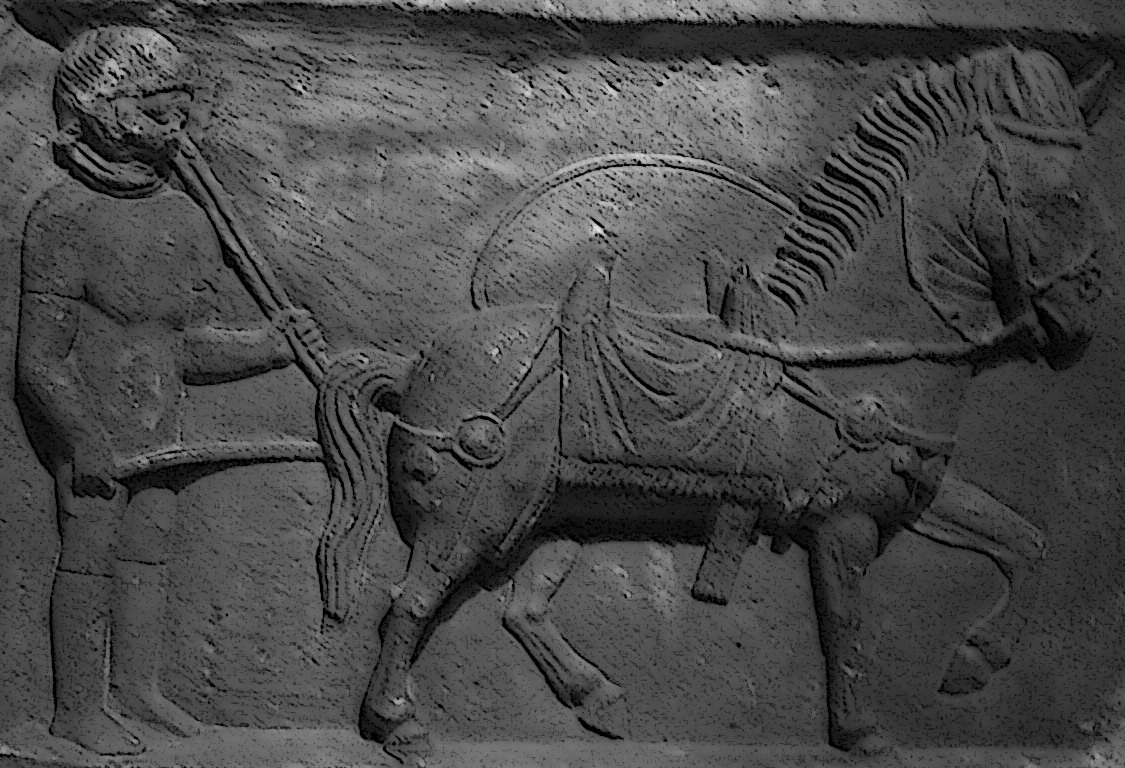
 The film spends some time to study the Hexam Abbey Roman funerary monument of one Flavinus, Roman cavalry standard bearer.


 the revolutions of the 'turma' or the troop  of Roman cavalry reenactors are explained and put in historical perspective in a text and film by dr. Mike Bishop & Dr. Nigel Mills. The video, bits and pieces from the longer BBC video above, nicely complements the main documentary. More information and films here.

Valete
in case we forget, Britain is still home to Comitatus, the home of Roman cavalry reenactors - peruse their site.

Saturday, January 18, 2020

Interesting exhibit in Chichesteer

Salvete Omnes,
a short entry - a very interesting exhibit to open in the Novium Musem, Chichester, UK on January 25, 2020.
12 years ago they discovered the remains of a man called the North Bersted Man, thought to have been a warrior and a horseman, with some very unusual or even astonishing and spectacular helmet adornments etc. The archaeologists think that he was a refugee from the continental Gaul where Julius Caesar and his legions were perpetrating conquest and genocide on the Celtic inhabitants of the present France and Belgium.
there is this article devoted to the visualization that includes some interesting, puzzling  and primary sources information.

the poster for the exhibit showing the North Bersted Man on horseback - I wonder why he is left-handed?
copyright (c) the Novum Museum


 We can see from the article and visualization contain some interesting elements , but what I find puzzling is the lack of the horned saddle; also the lack of the cinch and rather strange strap that goes down from the horse shoulder phalerae under the horse chest. The very tiny in circumference reins are also puzzling.
Finally, the raider's seat, with the legs being so high, as if using the so called chair seat and that particular faulty 'seat' seems to me to be contrary to the fabulous, and well-sourced, equestrian skills of the continental Celts of Gallia(Gaul) and northern Iberian peninsula during the classical Antiquity.
valete

Wednesday, May 1, 2019

Roman saddle from Aegyptus frontier

Salvate Omnes,
perusing the Wiki Commons I came across this very interesting artefact from the Oriental Institute Museum, University of Chicago, Chicago, Illinois, USA.
It comes from the Qustul site in southern Egypt and is dated to the last quarter of the IV century AD. This was the frontier of the Roman Aegyptus and Meroe/Kush//Nobadia of the Nile Valley.

also a quiver
 

some further visual aids regarding the Roman Aegyptus and Nubia and the Nile


The ancient Egyptian sanctuary of Isis and Roman stronghold of the island of Philae, situated within the rapids of the Nile known as the 1st Cataract (also the other famous fortresses of Elefantina and Talmis), on the Roman southern frontier and where traditional ancient Egypt frontier was set between Egypt and Nubia, where the early I century Ad Roman fortress at Primis (Qasr Ibrim) lay within the land of  Dodekaschoenos  that traditionally was the buffer zone between the Ptolemaic Egypt, later  Roman Aegypt and Meroe/Nubia/Nobadia and raided by the Blemmye( the Eastern desert nomads and skilled raiders - ancient Arab desert dwellers - riding as far north as the famous Wadi Hammamat spice and silk trade and gold mining route between the Nile and the Red Sea ports). South of the Roman frontier on the Nile sat Faras (ancient Pachoras) that was the capital of the ancient Kingdom of Meroe (famous for the war  its queen Amanirenas waged against the Augustus praefect of Egypt Gaius Petronius), and after 350AD was the capital of the Christian kingdom of Nobadia/Noubadia, and later of the medieval Christian Makuria( it was a Christian state  until it had fallen victim to the Islamic conquest in the XIV century AD).
The area was the subject of military expeditions during the later Empire, including one by Diocletian. During the later Roman rule in Egypt the region became Christian and resisted Saracen invasions for many centuries to come.
Presently Faras is under the water of the Aswan Dam and it was many archaeologist teams from Europe and the US who helped to save many of the objects from the water-induced destruction. Polish archaeologist under prof. Michalowski   helped to save some of the amazing artefacts from Faras - today some of the frescoes and other treasures from the Faras Cathedral can be seen at the Warsaw National Museum special Faras section. I had the pleasure to walk these galleries with the distinguished  members of the Siedlce conference in 2016.
Valete

Saturday, May 5, 2012

Pacem Eaternam, maestro Peter Connolly


Salve,
I learned yesterday that Mr. Peter Connolly, British academician and artist and one of the greatest scholars in the area of Ancient Greece and Rome  reconstructions passed away on May 3, 2012.

His works and especially his reconstructing via illustrations of the Greek and Roman fighting men, daily life, equipment, architecture etc has no parallel in the modern world. For the historians and enthusiasts of the historians of horsemanship it was Mr. Connolly who reconstructed the horned saddle of the Roman cavalry.

Some of his images available on the Net here
There are some of his books in my own library:
* (1979), Pompeii
 * (1991), The Roman Fort, Oxford Univ. Press
* (1993), Greek Legends: The Stories, the Evidence

* (1988), Tiberius Claudius Maximus: The Cavalryman, Oxford Univ.Press.
*  (1988), Tiberius Claudius Maximus: The Legionary, Oxford Univ. Press.

* (1998), Greece and Rome at War, Greenhill Books and Stackpole books
* with  H.Dodge (1998), The Ancient City, Life in Classical Athens & Rome, Oxford Univ. Press
* (1998), The Ancient Greece of Odysseus, Oxford  Univ. Press


...
all  images attached are in copyright and are shown here under fair use to give some, albeit inadequate, impression of Mr. Connolly's talent and expertise.

Sunday, September 11, 2011

Ancient Roman Cavalry Saddle

Salve,
I usually have been staying away from the Romans, doing very few drawings showing their horses and tack.
here I drew a Roman bit used by the Roman cavalry,
So let me take you for a little visit back in time of the Romans and their rigid saddles, just let the images speak for themselves. Please note that it is my belief that the so called horned Roman saddle, whatever its immediate inventor (Celtic or Eurasian steppe warrior), does seem to be a descendant of the ancient Saka/Skuda/Scythian saddles and horse tack 
...

...

..

.... Mr. Peter Connolly and his reconstruction in my 'redrawing'

....
Germany - a saddle reconstruction


Weißenburg ( Bavaria ). Roman Museum: Reconstruction of an ancient Roman cavalry saddle - actually this one has a very interesting and very logical saddle skirt/flap.


....

Another reconstruction with full horse tack from Germany

...
the best English language site devoted to the reconstruction and practice of the Roman cavalry -  comitatus.net/cavalryresearch