Equestrian Polish, Eurasian and the Americas history and horsemanship - from Bronze Age to circa1939AD. Historical equestrian art, my own artwork; reconstructions, and some traditional art media and digital artwork-related topics. All rights reserved unless permitted by 'Dariusz caballeros' aka DarioTW, copyleft or fair use.
Friday, August 27, 2010
Achaemenid Persian (and Median) cavalry in sketches
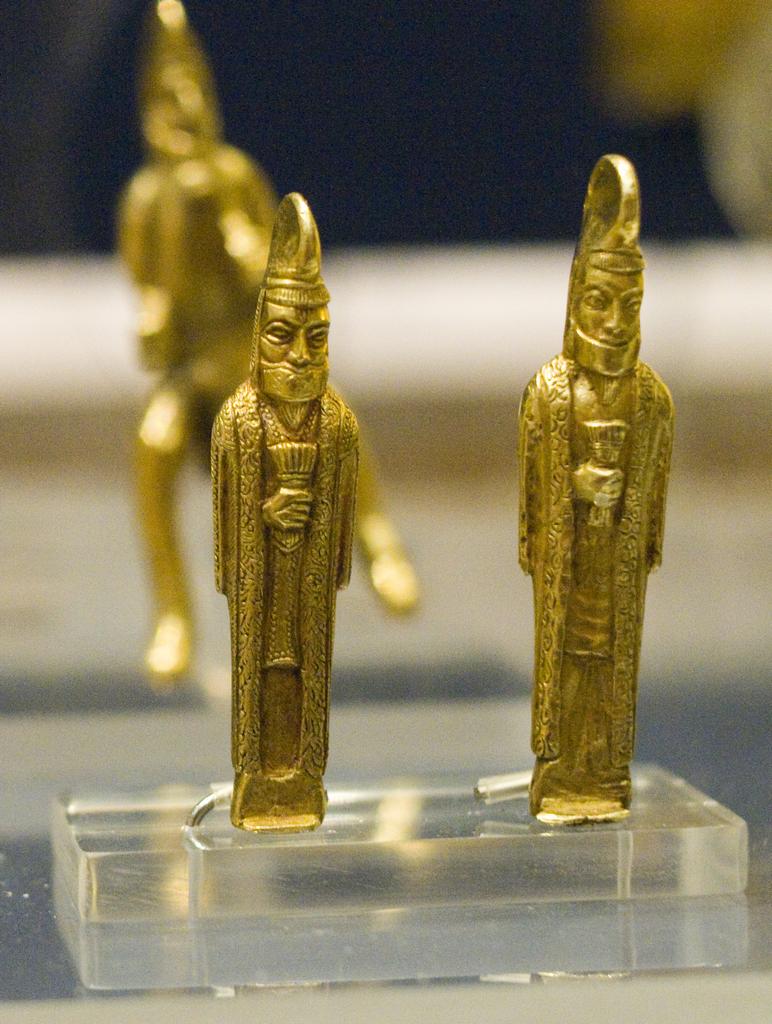
I wold like to show you this composite image of several drawings of mine that are supposed to show the horsemen of the Achaemenid Persian Empire http://www.metmuseum.org/toah/hd/acha/hd_acha.htm . the central figure has a kantush or kantus (Median robe - you can learn more about their clothing form this article http://www.iranica.com/articles/clothing-ii ) like in these figures form the Oxus treasure ( wiki/Oxus_Treasure ) Gold_statuettes_from_the_Oxus_Treasure_by_Nickmard_Khoey.jpg ).
They were done with pen and ink, watercolor and acrylics, and then placed on one digital paper 'sheet' using GIMP.
They are not finished yet, there is lots of work to be done :) .They will become separate images in their own right... in the future :)
and another old drawing in process of digital painting
I have a drawing of a Oxus Treasure armored warrior's reconstruction but we will save for the next time, in September I hope.
Tuesday, August 24, 2010
Xenophon on horse ridding - continuation of Peri Hippikes
Salveos,
today continuing from the Xenophon's book Peri Hippikes
http://dariocaballeros.blogspot.com/2010/08/xenophon-on-colt-young-stallion-male.html
Xenophon states:
12. For, being then about to raise the left foot, he will thus start with that foot; and just at the moment that the rider turns him to the left, he will make the first spring in his gallop; for a horse, when he is turned to the right, naturally leads off with the right foot, and when turned to the left, with the left foot.
16. But at the time that the rider pulls him in, he ought to sway the horse as little as possible with the bit, and to sway himself also as little as possible; for if he sways himself much, he may be well assured that a very small impulse will be sufficient to stretch both him and his horse on the ground.
Friday, August 20, 2010
Xenophon's threatise 'On Horsemanship' continued
Salveos,
today we're going to continue with the most famous equestrian treatise, Xenophon's "On Horsemanship," already started several days ago on my blog : http://dariocaballeros.blogspot.com/2010/08/xenophon-on-colt-young-stallion-male.html
Xenophon on buying a horse and caring for the steed:
Thursday, August 19, 2010
XV century horses and their tack in Cappella dei Magi, Florence
Salvete,
In my previous one entry on the Medieval dextrarius and his lesser friends war-horse-dextrarius-opertus , I attempted to introduce the subject of the so called knightly 'great horse.' I gave links to plenty many illuminations and paintings form High and Late Middle Ages showing those artists impressions of their great horse, palfrey, courses etc.
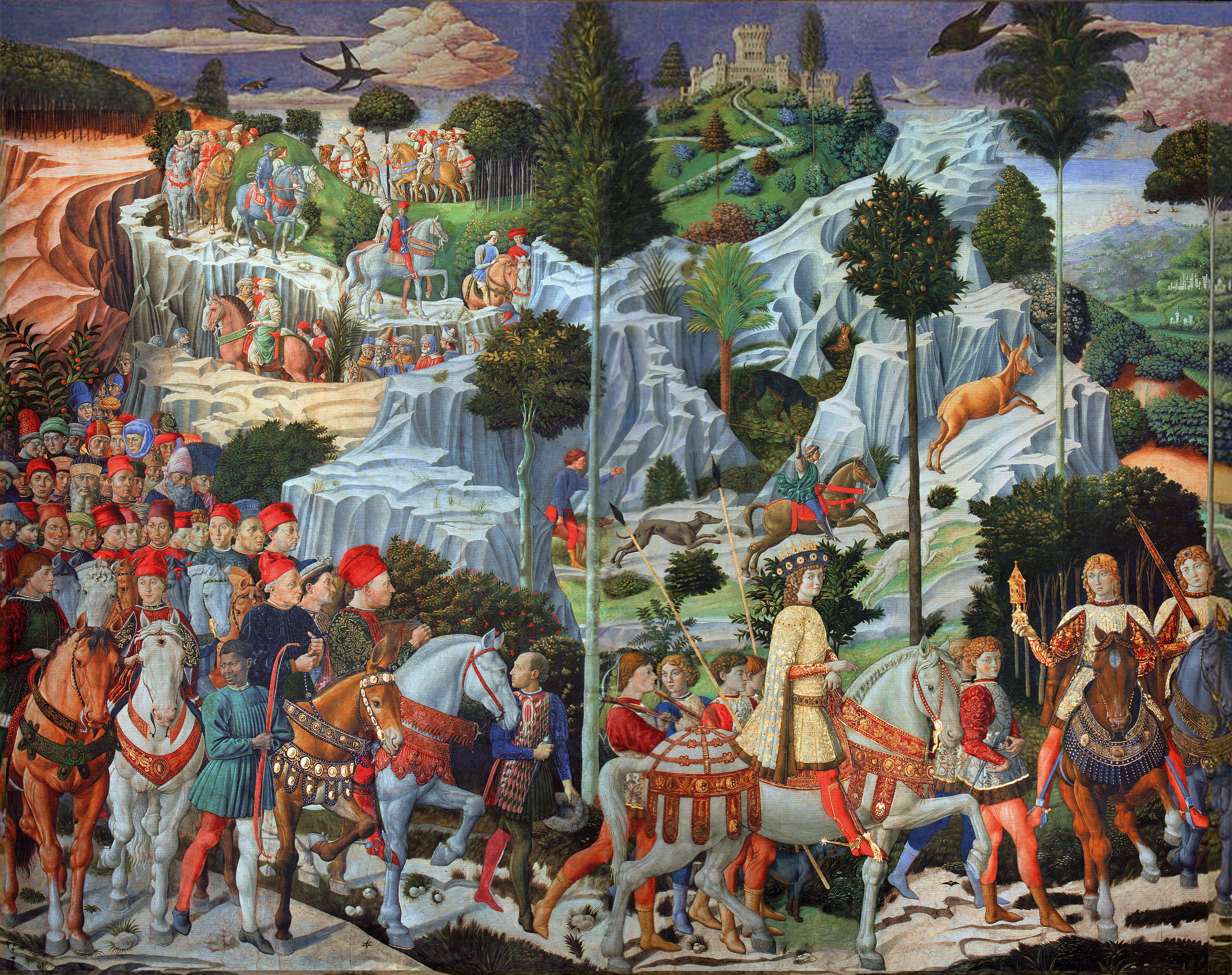
So let us now turn the the one of the most important equestrian artwork of the XV century - the Cappella dei Magi in Florence Itally Magi_Chapel Gozzoli_magi . Painted by Benozzo_Gozzoli one of the most gifted 'equine' Medieval painters (and disciple of the famous Florentine painter of angels, Fra Angelico) for our purposes this series of frescoes is a cornucopia of images of a great horse and his lesser equine friends (because the true theme of the artwork is the glory of the Sforza family with some famous characters of the era Sigismodno Pandolfo Malatesta - below on a bay horse next to Galeazzo Sforza on white one, John VII Palaiologos on a grey horse above and in these sketches by Pisanello Sketches_of_John_VIII_Palaiologos Florence_in_1438 Pisanello ).
Please note that both horses have bridles without a noseband, heavy curb-bit (but with short and curved shanks) and heavy, single reins. Galeazzo Sforza horse has jeweled pendant hanging from his browband.
Here another Sforza rides a roan horse with a Eastern (Turkish or Byzantine) shabraque on his steed croup. The purpose of the shabraque is clear - it is to give support and protection to a wild cat sitting there. I daresay it is a cheetah and not a leopard, as these trained felines had been used exactly for that purpose - showy and fearsome display and for going hunting while riding to the spot behind his master. This tradition of employing 'horsed' cheetah is very ancient, being used by the nomads and rulers of Central Asia, spreading to Tang China in the east of Eurasia and to Islamic lands in the Northern Africa in the West. This collected roan horse and his comfortably mounted rider show high degree of schooling predating by more than a 100 years the world of Grisone and Renaissance manege schools, and they are intentionally performing for a viewer. Again no nose band on the bridle, single heavy reins and a curb-bit with glided round 'cheekpiece'.
Here we have a great view of a croup and crouper position. The tail on this black horse is not docked, perhaps following the advice of Xenophon :
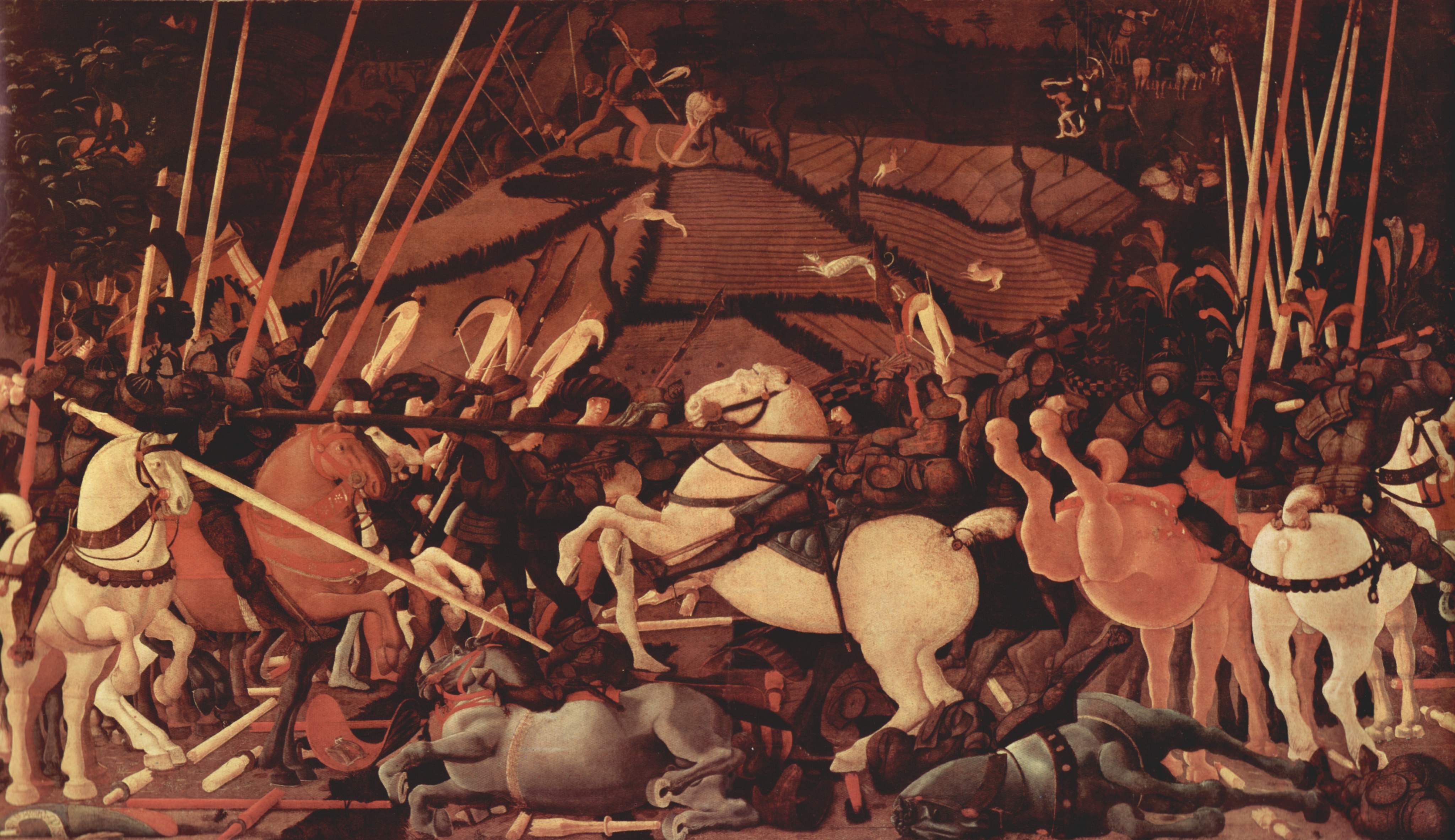
I am going do a separate entry on the horses of Uccello, the painter of Medieval war horse.
Sunday, August 15, 2010
Cavalry and horses of Northern Wei - China nomadic rulers
Salve,
Let us return to China and its nomadic heritage and equine past, to the time of the IV-VI centuries AD.
When in the western Eurasia and around the Mediterranean Sea classical Antiquity was slowly dying under assault of the Germanic barbarians and new religion, and where her direct heirs, Eastern Roman (Byzantine) Empire and Sassanid Persia, were locked in series of never ending wars, in the eastern Eurasia Chinese Han, eg. a Han rider from Cernuschi_Museum , empire Han_Dynasty collapsed amid fighting and corruption, and rivalry amongst the ruling clans. China rulers and conquerors divided the Han empire into Three_Kingdoms , while some parts went back to the nomadic peoples as they were restless and seeking their own empires, and soon, in the VI century AD, almost the entire steppe was to be united under the Turkuts (ancient Turks) gumilevica.kulichki.net beautifully reconstructed in this Russian article http://history.novosibdom.ru/node/31 or on this page ancient Turks articles , future arch-enemy of the Tang Dynasty and Sassanid Iran.
Three Kingdoms eventually collapsed and in the south of China we then have a leading Jin dynasty Jin_Dynasty 280-420 AD, but their rule in the north was challenged by the nomads during the IV century AD. Because in Han's wake the northeastern nomadic peoples of the Eastern steppes were bound to create their own smaller and bigger kingdoms, and one group of proto-Turkic nomads seemed to distinguish itself - Touba Xianbei xianbei . They absorbed exhibit/nwei former masters of the eastern steppe, multiethnic polity of the Xiongnu xiongnu image002 (wonderful reconstructions on this Siberian archaeology page history.novosibdom.ru/?q=node/45 ) that were chief enemies of Chin and Han dynasties empires until Han armies destroyed their might xiongnu.atspace.com xiongnu.atspace.com/art
article Xiongnu mutliethnicity archaeology
xiongnu belt plate
xiongnu silkroadfoundation.org
Toba/Touba Xianbei northern wei essay were most likely Mongolian/Turkic nomads, that came southward from the Manchurian steppe, and upon taking over the Inner Mongolia moved further south, and eventually in concert with Han Chinese elites created their own empire known as Northern Wei (386-534 AD), becoming sinicized towards the end of their rule over the Han populations. Their steppe enemies were Turkic juan_juan , some scholars believe they were know as Avars in western Eurasia. Slav-Avar belt plaques/mounts
more images of steppe art, in this article associated with ancient nomadic Bulgarians bolgnames.com/text/Treasure.html
But Northern Wei was just one of the kingdoms or empires in China of that time Southern and Northern Dynasties, before the first reunification of Han China by the short lived Sui dynasty Sui_Dynasty
In the history of the development of war horse harness this period of the II-VI century AD , within the eastern Eurasia milieu, had been the most fertile ground for revolutionary changes - it was the time of the development of solid 'treed' saddle (with pommel and cantle) from Saka/Sarmatian saddle development eg
, curb-bit, stirrups, horse armor. Naturally some of these inventions were made within the Eastern Eurasia by the various nomads and Han Chinese, and some came from the West, from the Sassanid Iran (Persia) etc.
Some visual sources showing artifacts of Northern Dynasties, mostly ceramics and few paintings :
military man/officer in a nomadic costume (Northern China)
Xinabei belt buckle, with dragon images, this kind of belt buckle has been known to the nomads of the eastern Eurasia since II millennium BC
warrior in armor http://history.cultural-china.com/chinaWH/images/exbig_images/d710523115ea14f25607036d17243364.jpg
mounted musician http://history.cultural-china.com/chinaWH/images/exbig_images/2d0edc1388eb068996a61423fecca491.jpg
nomadic musicians china. Wei musicians on horseback
riders, horses, and camels (Bactrian) of Northern Wei
muscian with nomadic 'horse' drums
nomad on a Bactrian camel
...
archers from frescoes of the Dunhua caves dunhua53
heavy cavalry, Dunhua frescoes dunhua54
rider with a horn
heavy cavalry cataphract
heavy cavalry cataphract II
heavy cavalry cataphract III
the above heavy riders are shown without spears and swords, and without spear holster, that only very few sculptures show (I will show them in a separate entry on this blog I hope)
more ceramics ceramics - fine steeds:
horse I
horse II
here we have fine example of Northern Wei horse armor and saddle
armored horse
Northern Wei tomb guardians silkroad/exhibit/nwei/nwei
Northern Wei neighbors
beautiful painting of two riders from Northern Qi (550 - 577AD) dynasty 'Xianbei' tomb of one Liu Xian, part of a series of funerary painting showing horsemen riding and hunting with dogs riders northern Qi_Dynasty.jpg please note that they are using stirrups
In the western part of the 'Chinese' steppe, in today's Chinese Turkestan, lived Tocharians, Indo-European people of the eastern part of the Silk Road, Tocharian Qizil Cave Donors Their towns and fortresses will become of part of the Tang Empire, and from there Tang China will clash with oncoming Arab conquerors of Central Asia, in the battle on river Talas.
Some literature on war, Iranian influences in China, 'Chinese' nomads, Chinese military during the end of I millennium BC and fist 500 years of I millennium AD time frame etc:
Articles on Iranica about the ancient China-Iran relations.
Excellet book by prof. Nicola di Cosmo, Ancient China and its Enemies .
Many works of porf. Albert Dien - like his very interesting article on the pre-Tang armor in China, while another one - on Chinese, Korean and Japanese horse armor - is also a very interesting one, and here a link to his very interesting book on the life and arts of six dynasties
Chris Peers, and Michael Perry work for Osprey Miltiary Publishing, for this period there is vol I of imperial China series Imperial China
and another Osprey, rather badly needing rewriting,but with beautiful iconography and illustrations by late Angus McBride, Atilla and Nomad Hordes, by dr Nicolle - Attila and hordes .
For reconstructions of the nomadic warriors you can look for "Warriors Of Eurasia, from the VIII century BC to the XVII century ad" by Mikhael V Gorelik, Montvert Publications, 1995.
For the nomadic Bronze and Iron Age art in China nomadic heritage best are the books by art historian Emma Bunker , eg Ancient Bronzes of the Eastern Eurasian Steppes or Nomadic Art of the Eastern Eurasian Steppes
but there is this article written by two art galleries, Janssens and Wace with Emma Bunker help, on the nomadic Bronzes .
Also, a very interesting book by Davis-Kimbal, Bashilov and Yablonsky: Nomads in the Early Iron Age .
***
Finally the Orlat belt plaques - found by Galina Pugachenkova - these are some of the most important images of Central Asia nomadic warriors and warrior lore, perhaps Xiongnu warriors in this article with detailed drawings Mode Orlat and Russian language version by messers Nikonorov and Khudiakov on Academia.
...and so many others, one only needs to starts searching the net and peruse resources and libraries...
In China equine-military history overview treads on my blog, next I think I am going to tackle the Tang China and her marvelous horse.
And here is a very interesting site with reconstructed images of Chinese warriors' arms and armor throughout the history china-ancient-armours
ps
I hope to cover some of the subjects mentioned above in more specific blog entries with my own reconstruction etc.
ps'
little sketch of a Sui or Korean caparisoned horse, drawn without a bridle nor bit - on purpose :)
Saturday, August 14, 2010
Xenophon on colt- young stallion conformation
Salve,
let us return for a moment to that time less than 2,400 years ago, of the IV century BC, when Athenian hippeis, adventurer, philosopher and writer Xenophon (Ξενοφῶν ) wrote his famous On Horsemanship ( Peri hippikés) treatise, and I am going to 'publish' here the most relevant parts of that ancient work since this work seems to sum up the ancient Indo-European (North Iranian, Thracian, Greek, Persian and Median) knowledge on horses in war and parade.
Xenophon (Ksenofont, Ксенофонт,) :
1.In regard to a colt not yet broken, it is plain that we must examine his body ; for of his temper a horse that has never been mounted can give no certain indications.
4. Since we have commenced with this part, we shall ascend from it to the rest of the body. The bones immediately above the hoofs, then, and below the fetlocks, must be neither too upright, like those of a goat (for then, being too unyielding, they shake the rider, and such legs are more subject to inflammation), nor ought those bones to be too sloping; for the fetlocks will in that case be denuded of hair and galled, if the horse be ridden either among clods or over stones.
link to a Spanish language scholarly article (from Gladius magazine) on the Ancient Greek riders and their 'echo' amongst the Iberians http://gladius.revistas.csic.es/index.php/gladius/article/download/29/30
ps
at the top my own little sketch of a warhorse, I hope :) and a photo of a Hellenistic spirited war horse covered with a leopard 'schabraque' (sort of like Alexander the Great before and Hungarian, Polish and Ottoman Turkish riders during the XVI-XVIII centuries)
Friday, August 13, 2010
Horace Hayes on horses
The Polo Pony.—Handiness and speed, with sufficient staying and weight-carrying power, are the two chief requirements of the polo pony. Consequently, he should be light in front, should carry his head and neck well, have sloping shoulders, strong hocks, and his hind legs well under him. The fact of his being rather " goose-rumped " will be no detriment. These views are strengthened by the remarks made on pages 310 and 311 about the conformation of the zebra; for the polo pony, like his striped relative, requires great ability of suddenly stopping, turning round, and galloping off in the opposite direction. This turn has to be done chiefly on the hind legs, which in this case will be more or less bent, and will then have full power to project the pony in the new direction. The best English polo ponies, such as the once matchless Dynamite, are animals which, but for an accident of breeding, would have been high-class hunters or brilliant chasers.
source:
Points of Horse pp392-95
another horse so called Hack pp389
The Hack.—The chief points about the hack are that he should be " light in front," have sloping shoulders, and sound legs and feet, so that he may be sure-footed and able to stand work ; and he should be rather high in front (pp. 177 and 178). The conformation of his head and neck should be such as to allow him to bend readily to the rein. The action of the hack should be somewhat " high" and should be " true," so that, when viewed from behind, the near pair of limbs, in the walk, trot and canter, should move in a line parallel to that of the off pair. Action, good looks, and a showy carriage of the head and tail are essentials in the high-priced hack.
According to hipologist Juan Carlos Altamirano, great historian and specialist on the Pura Rasa Espanola or Spanish Horse, the XVI century nondescript hacks or 'haquas' imported from England, Northern Europe and Poland were foundation horses along with particular Barb, Neapolitan and Andalusian stallions and Marismenas mares when king Felipe II (Philip II) ordered creation of the breeding program at the Yeguada Real in Cordoba, Spain in 1567 AD.
H. Hayes' entire book can be read here, but my text belongs to 1904 edition and the photos of the horses given in the text as well http://books.google.com/books?id=P1sCAAAAYAAJ&printsec=frontcover&source=gbs_atb#v=onepage&q&f=false
ps
at the top some old sketch of mine
Thursday, August 12, 2010
XV century Medieval Saddles from MET

today I would like to share with you some screenshots of a video of the German Gothic Medieval Saddles kept on display at the MET - Metropolitan Museum of Arts in New York. Light is rather dim in there and I did make some video instead of taking the photos this time.
These XV century saddles are beautifully carved in bone (stag). They must remind us about the wonderful pageantry of the Medieval horse worlds. The best book to talk about that may be the famous book '
The waning of the Middle Ages' by Johan Huizinga
http://books.google.com/books?id=Ol2rd6MM474C&printsec=frontcover&dq=waning+of+the+middle+ages&hl=en&ei=wC9kTNbtOsOBlAea94COCw&sa=X&oi=book_result&ct=result&resnum=1&ved=0CCsQ6AEwAA#v=onepage&q&f=false
We can only imagine how splendidly these saddles must have looked when taken on a glorious parade day done somewhere in Nuremberg or some other beautiful Medieval German Imperial city of the period. The tree is lindenwood (which is very soft) covered with thin rawhide, and with a birchbark lining glued onto it, in order to make it waterproof and stronger, then the bone plates were attached/glued. Museum curators linked it to the Prague, Czech, workshop based on some orders from mid XV century from Prague. More MET images and short description are here http://www.metmuseum.org/toah/works-of-art/40.66
Note the stirrup and cinch holes/slots in their relationship to the saddles' center. MET Curator S.V. Grancsay stated that according to this opinion the rider must have been sitting on the cantle when ridding.
More on the bone carving in the Gothic Era http://www.metmuseum.org/toah/hd/goiv/hd_goiv.htm
ps
Interesting article about mounted lance combat, saddles etc http://www.classicalfencing.com/articles/shock.php
Tuesday, August 10, 2010
War horse 'dextrarius opertus'
Salve,
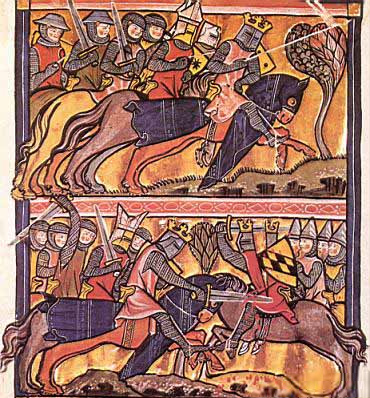
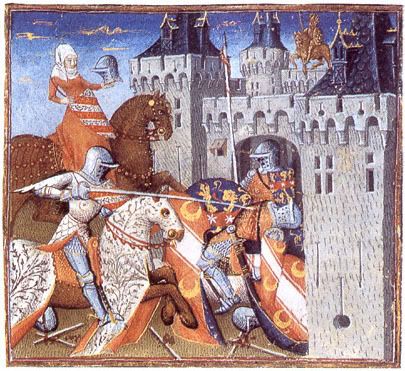
Fascinating subject and wonderful art - great horse and his (as it was a stallion or a gelding) equine friends 1250-1450 AD.
the image (color insert into the same but a black and white one) above of a knight in full 1420-30s suit of armor mounting his fully caparisoned horse, note horse has a chamfron to protect his head, comes from the illuminations and poems book by Medieval writer Catherine de Pisan(Pizan) published in the XV century http://xenophongroup.com/montjoie/pizan.htm http://en.wikipedia.org/wiki/Christine_de_Pizan
Bayeux Tapestry horses http://commons.wikimedia.org/wiki/File:Bayeux_Tapestry_5.jpg
pre-1250 charging knight http://www.corbisimages.com/images/67/9181137F-172A-4F8F-9F12-0B3D6B4B6C9C/IH164168.jpg
some medieval iconography of the Middle Ages golden era - 1250-1450:
http://upload.wikimedia.org/wikipedia/commons/6/6a/Einhard_vita-karoli_13th-cent.jpg
Ucello horses (at Fornovo the Italian heavy horse fought the French almost to a vicotry) http://upload.wikimedia.org/wikipedia/commons/0/08/Paolo_Uccello_023.jpg
Tourney http://x35.xanga.com/f6fa82660753577263791/m52329369.jpg
http://i56.photobucket.com/albums/g161/defrostindoors/history/ladyknghtrdr.jpg
famous painting http://www.corbisimages.com/images/67/7A3557AA-9405-4B67-9870-58839B5EAE97/CS005704.jpg
Paolo_Uccello's Hawkwood http://upload.wikimedia.org/wikipedia/commons/thumb/3/3c/Paolo_Uccello_044.jpg/280px-Paolo_Uccello_044.jpg
another Italian condotiere http://www.lukespence.com/art/102/ch-21-italy-1400-1500/don-horse.jpg
Verrocchio condotiere http://www.paradoxplace.com/Insights/Equestrian/Equestrian_Images/Verrocchio%20Colleoni%20c1483%20BR.jpg
great horses and palfreys of the clergy painted by Jan van Eyck http://www.cavhooah.com/info/wp-content/gallery/early-cavalry/knighted-cavalry-and-noblemen-painting-by-jan-van-eyck-circa-1390-1441.jpg
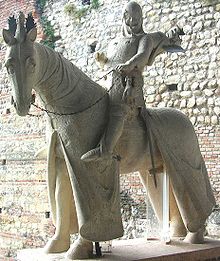
Caparisoned horse with a great helm rider http://geopolicraticus.files.wordpress.com/2010/04/cangrande.jpg
more caparisoned horses http://www.corbisimages.com/images/67/7E4821A0-91CF-46A0-A9FB-A0237F59C61A/IH164100.jpg
http://img199.imageshack.us/img199/1465/knightsaddle1170.jpg
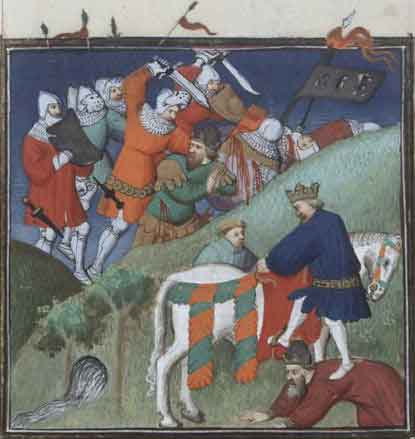
king using his servant to mount his white horse http://www.mlahanas.de/Greeks/Medieval/war/BattleOfManzikert.jpg
here in many others we have the use of double reins http://www.corbisimages.com/images/67/4FF14BF0-465C-4CC1-8308-0955D2646C21/CS004792.jpg
http://www.corbisimages.com/images/67/F00F5D17-2015-4FA3-BD63-7BF973B1D878/IH164002.jpg
battle of Poitiers http://www.man.poznan.pl/~ritter/tmp/psie/Rycina_Poiters.jpg
combat http://visualiseur.bnf.fr/ConsulterElementNum?O=IFN-8100062&E=JPEG&Deb=38&Fin=38&Param=C
one of the most famous illuminations Luttrell Psalter knight and his ladies http://www.boryssnorc.com/oldsite/images/articles/heraldicfrocks/luttrell_psalter.jpg
one of the most elaborated curb-bits with lots of control and damage potential http://www.metmuseum.org/toah/works-of-art/04.3.478a,b
Spanish rowel spur http://www.metmuseum.org/toah/works-of-art/14.25.1737
high saddle, curb and breastplate on a famous Bamberg sculpture http://www.roma-antiqua.de/forum/galerie/data/500/Bamberger_Reiter.jpg
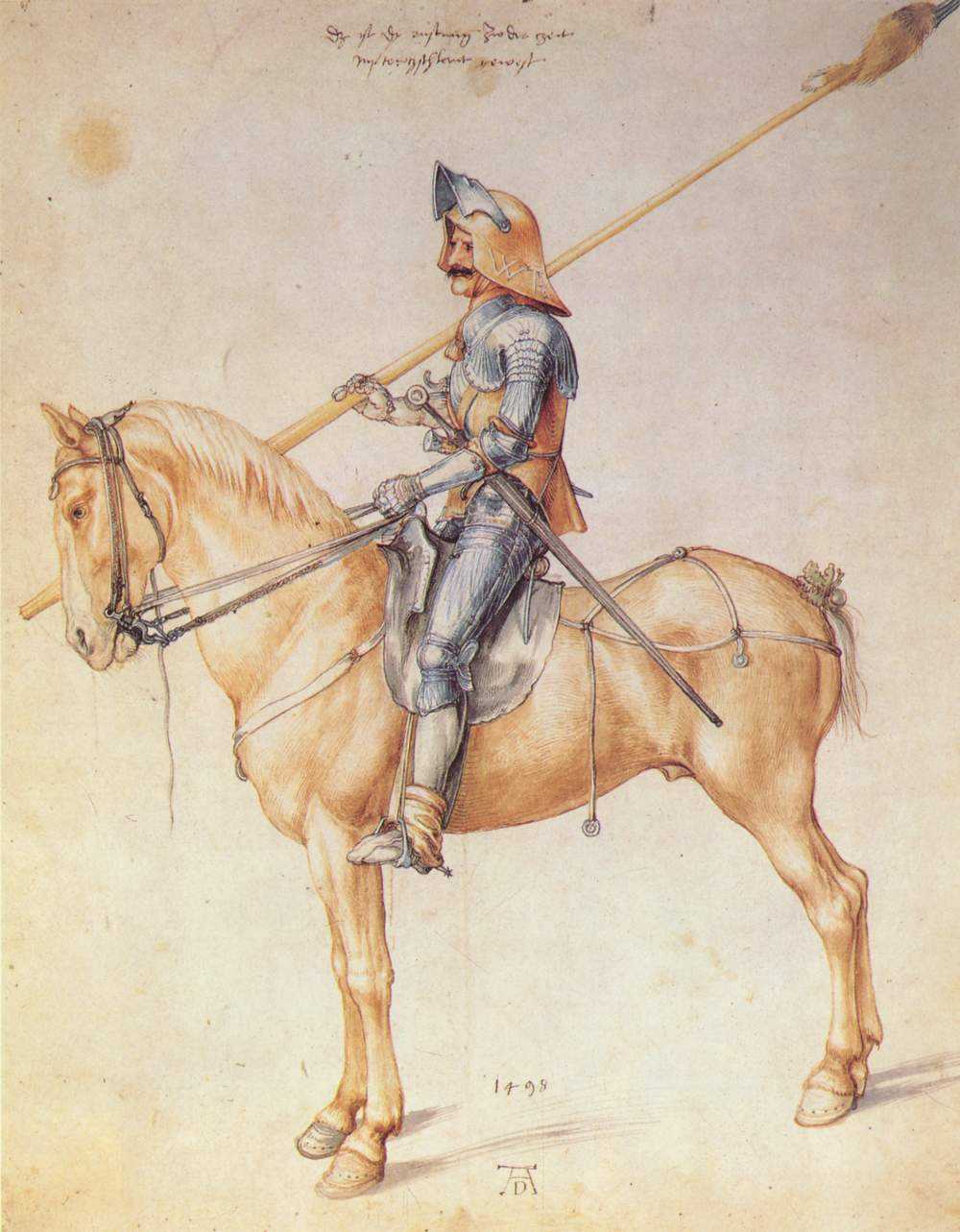
past 1450 -man-at-arms, a beautiful watercolor by Durer http://de.academic.ru/pictures/dewiki/100/duerer_-_studie_reiter_1495.jpg
Let us recall that our own Polish king Wladyslaw II Jagiello rode a roan stallion at the battle of Grunwald (Tannenberg) Ad 1410
One of the most advanced equestrian cultures of the European Middle Ages - Teutonic Knights and their horses in this article by one of the most noted medieval scholars - Sven Ekdahl http://www.deremilitari.org/resources/articles/ekdahl.htm
great page on caparisoned horses or rather the Medieval caparison itself http://www.larsdatter.com/caparisons.htm
palfreys http://www.pizan.lib.ed.ac.uk/miniatures/144a.jpg
allegory or truth - ladies ridding caparisoned warhorses http://molcat1.bl.uk/IllImages/Kslides%5Cbig/K010/K010289.jpg
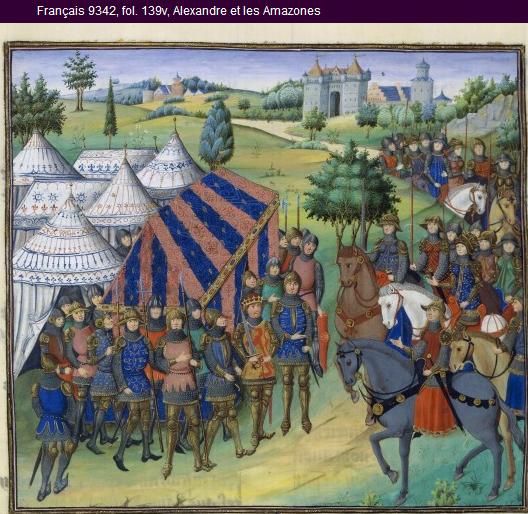
ladies with Alexander http://i26.servimg.com/u/f26/11/53/58/72/a154.jpg
ladies in horse combat http://i26.servimg.com/u/f26/11/53/58/72/a143.jpg
http://mediaephile.com/images/Paris,%20Bibl.%20Mazarine,%20ms.%201559%20,%20f.%20111.jpg
this page has many illuminations of warrior ladies of the Middle Ages http://mediaephile.com/forum/cgi-bin/yabb2/YaBB.pl?num=1213254594
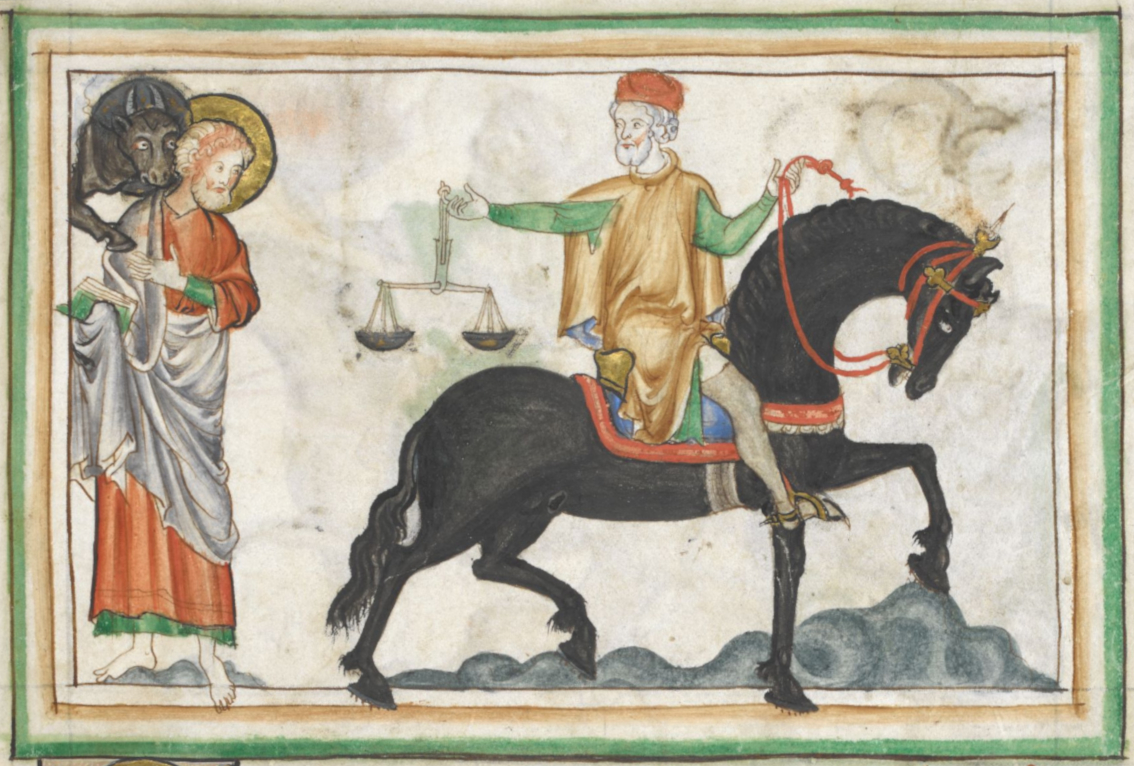
finally nothing beats a pacing horse, for comfort and pleasure of riding it - in this wonderful miniature http://upload.wikimedia.org/wikipedia/commons/b/bb/BritLibAddMS35166ApocalypseUnkFolio3SealBlackHorse.jpg
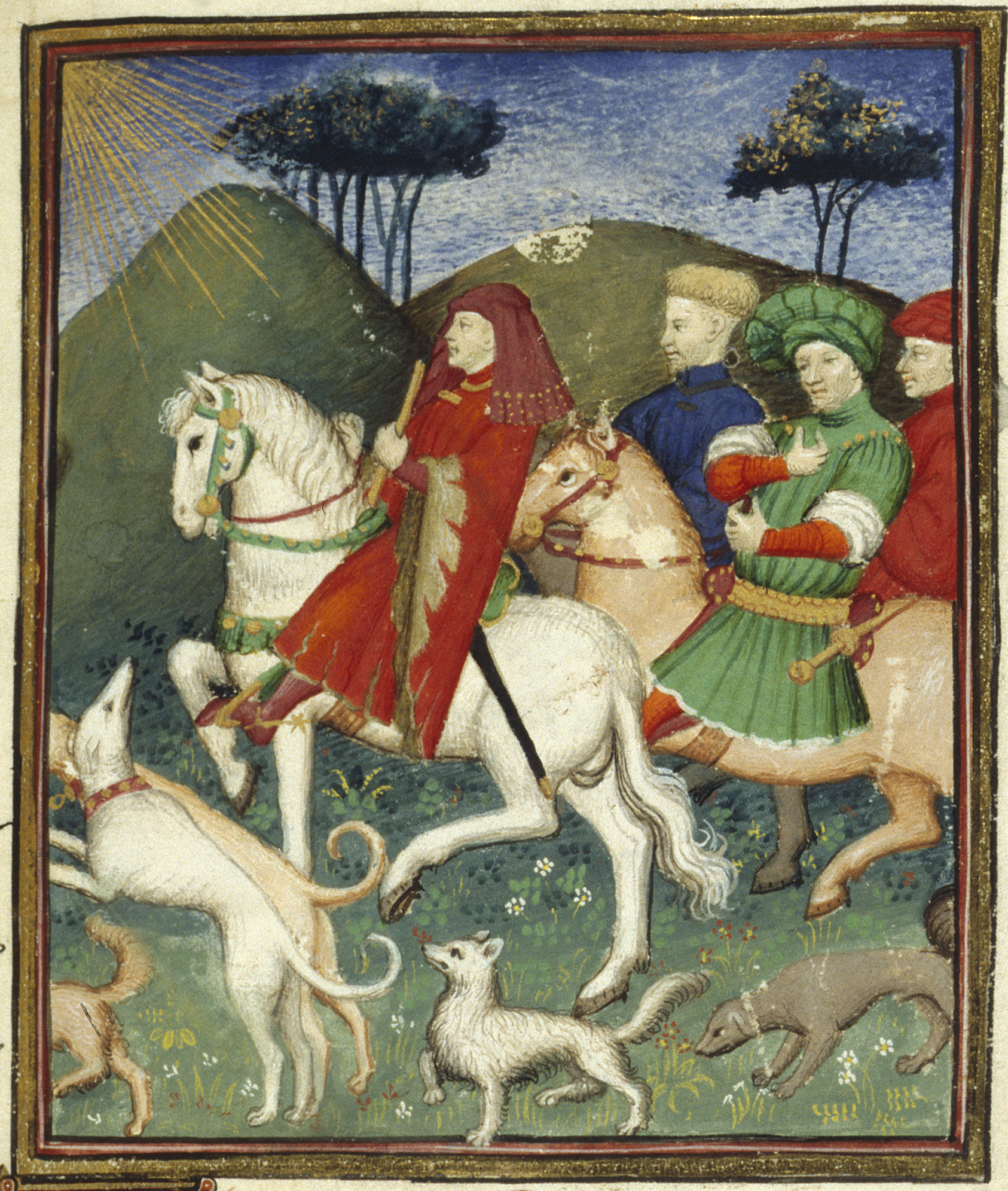
Above late Medieval hunters of the XV century painting - in the foreground a wonderful white stallion being ridden in a complete collection, he could shame many a rider at today's dressage competitions, note all the horses have curb-bits and second rein, and a bridle without nasal/nose band.
Monday, August 9, 2010
Inwentarz - estate inventory - po nieboszczyku JeMPanu Stanisławie Stawskim
Salve,
here is this very interesting estate inventory of movables left by Stanislaw Stawski, cavalryman of the second half of the XVII century Polish-Lithuanian Commonwealth. Published by a web user and practicing historian 'Miuti' here: http://www.historycy.org/index.php?showtopic=11878&view=findpost&p=685546
Original writing was cleaned a bit by dear Miuti and it is very readable for a Polish reader, at the link given above.
For my purposes, horses and horse tack, I will mention several interesting, horse related aspects of this estate inventory :
Written list of things left by the deceased Stanisław Stawski, having served as a companion under the 'pancerni' ( as much as I want to use wikipedia, the entry in wikipedia on this subject is less than satisfactory) banner of Stefan Bidziński (famous Polish horseman, cavalry commander and king Jan III Sobieski's confidant).
Horse tack:
rządzik za który dał nieboszczyk złotych dwieście ze wszystkim porządny,
1. horse harness set (briddle, saddle, brestplate, crupper etc) paid by the deceased on the amount of 200 zloty and in all a fine one.
gończa uzdeczka nowa jedna,
2. one 'hunting' bridle, new
3 kulbaka haftowana z olstrami haftowanymi z wojłokiem adamaszkiem podszytym, z pistoletów parą, bez płata jedna
Kulbaka - Old Polish Eastern-style - war saddle, with pistol holsters embroidered, with a felt saddle banket covered with damask wiki/Damask , also two pistols and this saddle was without a 'skirt,' one
4 drugich kulbak trzy,jedna nieboszczykowska, dwie czeladnych bez wojłoków,
other{lesser quality?] 3 war-saddles, one of the deceased, two of the retainers' without felt [blankets]
namiot turecki zdobyczny porządny,
Turkish tent, captured booty, and in good order
horses:
Koń gniady pocztowy zdechł.
Bay horse, retainer's, died
U chorągwi drugi także zdechł,
when with the banner/company, another of his horses (retainer's) also died
także i z drogi do domu idąc od chorągwii Jurkiewiczy klacz zdechła u chorągwi myszata,
another mare, grulla or mouse dun, died going home form the Jurkiewiczy banner, died .
podjezdka jednego białego dano księdzu od pogrzebu a drugiego wronego co się zwał Bałwanem ukradziono.
One gray/white rouncey [stallion or gelding] was given to the priest who had performed at the funeral, and the second black one known as 'Balwan' (Clown ?) was stolen.
Teraz do domu od chorągwi przyszli ale bardzo chude i znędznione, jeden cisawy od JeM Pana Marcina Stawskiego, drugi wrony, trzeci z tureckiej zdobyczy kary podjezdek.
Now the horses that finally have returned home from the banner/company but they are very thin and in poor condition, first a roan from Marcin Stawski (another companion), second raven black, third black from the Turkish [war] spoils/booty
.......
Source: this registry comes from m the State Archive in Cracow, Wawel Castle division, part of the estate archive of Karol Wacław Larisch (1603) 1768- (1868).
....
battle of Bolkhov 1608 I
salve,
while in Poland, and having taken the opportunity of purchasing Polish books at some much lower prices than in the US, I did buy some and now I have been reading 'Od Starduba do Moskwy', by Andrzej G. Przepiorko, published by inforteditions, a Polish language book on military history during the time period from after the death of the Tzar Dimitri II (known in older Russian historiography as False Dimitri I), Bolotnikov uprising against the Shuisky 'usurpation,' and appearance of False Dimitri II with his Polish military commanders, and the fully blown civil war in Muscovy known as Time of Troubles - Wielka Smuta, Смутное время, that would eventually led to Polish and Swedish wars against the Muscovy etc.
What interests me during the time period of 1607-1608 is the military career of the scion of the old Gediminid (Ruthenized Lithuanian princes) family and Polish military officer Roman Rozynski, and his brilliant military victories against Tzar Shuisky armies.
From my perspective this time period of 1607-1608 is very interesting because of the participation of Polish mercenary cavalry (hussars, petyhorski and cossack banners) in these struggles, emergence of the Lisowski light cavalrymen (famous in the 30 Years War as 'Lisowczyks') and for the Polish and Lithuanian history emergence several low level Polish cavalry officers as military leaders who would distinguish themselves as able commanders of these motley crew armies that carried False Dimitri II to his final capital/camp in Tushino etc.
In this context military leadership of Roman Rozynski is quite remarkable, especially during his quite amazing victory during the two day-long battle of Bolkhov in May 1608 between the forces of legitimate Zar and Zar-pretender, or impostor if you will.
The actual battle took place some 21 km south of Bolkhov, in the vicinity of the rivers Kamenka and Sukha, and author Andrzej Przepiorko concludes that actual battle took place in the swampy valley of Kamenka. The actual commander of the False Dimitri army Roman Rozynski was preparing his battle plans in face of rather overwhelming enemies. God of war Ares was sharpening his tools...


_e_galeazzo_maria_sforza_(dx).jpg)